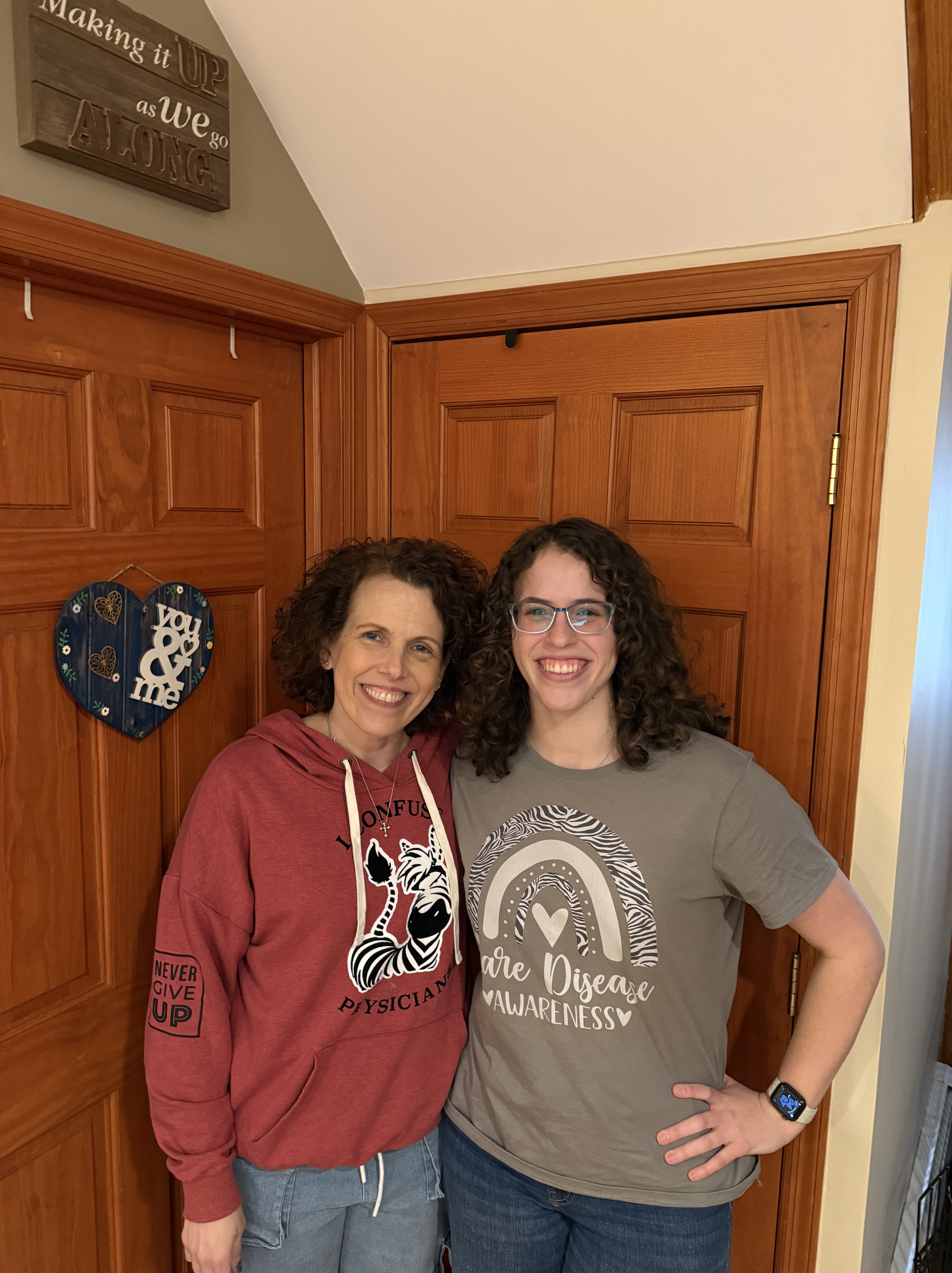
I recently fount this post in my “drafts” from August 2024. I edited only the dates. I have no idea why I never published it. Now, in August of 2026, 3 more Meghan surgeries later (including a double mastectomy) I guess it’s better late than never… Will any of my PTEN moms who are also PTEN patients themselves give a shout out? I’d love to know you.
I spend a whole lot of time in this blog space discussing my girl. Meghan is my amazing, fierce, feisty, never-give-up, never-give-in PTEN kiddo who is so much of my heart, my life, and my every breath. She was born through the craziest birth story and seemed to not feel well literally from day 1. Day 1 was 23 years ago, on August 9, 2003.
She was diagnosed with PTEN Hamartoma Tumor Syndrome in the fall of 2011 after a persistent physical therapist (our forever hero Dr. Jill) led us to a brilliant geneticist. I told him of her struggles during that visit. We talked about her GI issues, the gall bladder that was removed when she was three, the incredibly notable and full of nodules tonsils and adenoids removed soon after, and the AVM (arteriovenous malformation) in her right knee that would not quit despite being treated by the doctor everyone told us was the best. That visit lasted about an hour and during the visit, he asked some questions about my own history as well. I answered everything, desperate to figure out how to help my girl. When he was finished he looked me straight in the eye and said, “I know what she has Mom, and you have it too.”
That’s the only part of the day I can put in quotation marks, but I will NEVER forget that sentence.
What followed was him asking me to trust him. To let him test and get confirmation before he released his suspicions even to me. He told me the internet was not where I wanted to be until we were sure. I never trust anyone. I trusted him.
For 6 anxious weeks, we waited. And, the results were as he had expected. Meghan showed a pathogenic mutation on the PTEN gene, which is a tumor suppressor gene. I was brought in for testing soon after that and since my test was targeted to only confirm that her mutation came from me, the results were faster. Before the end of 2011, my girl and I had both been diagnosed with PTEN Hamartoma Tumor Syndrome or as it is often referred to in its most common manifestation – Cowden Syndrome.

There was not nearly as much information available in 2011 as there is today, and our diagnoses even predated the PTEN Syndrome Foundation. I scoured the internet and dug into Facebook groups. I read and read and read so many things that I barely understood. But, I was in good company. So few medical professionals had even HEARD of this syndrome that they BARELY understood it either.
I connected with some parents/ patients across the globe who became my actual lifeline in those early years. I wanted to hear about others and what their experiences were. I wanted to learn all of it because I was determined to help my girl be the best she could possibly be.
My 30s had been spent seeking a diagnosis for her random and disconnected symptoms. As a mom, my own health concerns got addressed but they were definitely second in my mind and priority to hers. In late 2011, 14 months before my 40th birthday, I was left to process the reality that she had inherited this syndrome FROM me AND that I needed to figure out what this looked like as a parent, AND a patient.
When my diagnosis was confirmed I had little time to think. I was told that the inherent cancer risks that come with this diagnosis begin to peak around 40. I was told that time was of the essence to have Meghan’s thyroid evaluated, and it seemed like everything had to happen, well, yesterday.
It appears this autosomal dominant mutation was “de novo” or new in me, and that I am the first in our family to present with Cowden Syndrome. I had no road map. And I am terrible at directions.

What I did know was that I was reading staggering numbers – putting the lifetime breast cancer risk of PTEN patients at close to 90%. I brought my new diagnosis to my breast surgeon. He was my breast surgeon, not just because he had performed my Mom’s double mastectomy in 1997, but because sometime around 1998 (at the age of 25) he performed my first of 8 surgical breast biopsies I had had through the years. Somewhere around 2007 he suspected something genetic so he sent us for BRCA testing. It was negative. Now, with my confirmed PTEN diagnosis we had something concrete that required some forward motion. Quickly. He sent me for another opinion.
I gathered up all my pathology reports through the years, including the most recent “Atypical Ductal Hyperplasia” and brought it to the cancer center at NYU.
I look back now and am sure it is through God’s grace alone (well, combined with my husband who was often an angel on earth) that I stayed afloat. We had Meghan’s first, and extremely traumatic thyroid biopsy in January of 2012 after an ultrasound found multiple nodules. Thyroid cancer can come really early in PTEN patients, and in the spirit of things that eventually made sense, my thyroid had been partially removed in 1988 with a (now very logical) diagnosis of multinodular goiter. I mention this because, as you’d want to, Felix and I went together with Meghan to that biopsy. We soon learned that was not a luxury we could afford as his job was hourly and without sick time. I soon began traveling to most appointments alone.
As I walked into the cancer center at NYU for the first time a week or so later, I was coming in at the end of a work day. The few sick days that I had needed to be guarded carefully, and with Meghan having had at least 8 surgeries before 2011 and with me having had a few of my own. I was exhausted and overwhelmed when I met the bubbly red-headed no BS Breast surgeon. She did not beat around the bush. She told me she reviewed my history, my family history, my biopsies, and the PTEN results. “When are we scheduling it?” she asked as if she was talking about a haircut. Confused, I asked, “Scheduling what?” “Your prophylactic bilateral mastectomy.”
Um. Um… I so desperately wished I could just check out at that moment, but I was the only one in the room. I had to keep my head on straight.
I tried to challenge her. She was so matter-of-fact. She said, “We are not looking at IF, we are looking at WHEN you will have breast cancer. Let’s get in front of it.”
I remember trying to convince her I could wait until the summer. I remember explaining that it would make sense. I am a school teacher. I will have time to recover.
“March 5th” she was direct and authoritative. I didn’t argue. She sent me to her surgical coordinator and then to the plastic surgeon she did most of her operating room time with.
Mastectomy. Reconstruction? Tissue expanders? Inflations? Additional surgeries? There was no time for this. Meghan was scheduled for her 9th surgery in February. I could not even gather logical questions.
Somehow the plastic surgeon heard me and offered me “immediate reconstruction.” I didn’t even look at a picture. I had no time to consider aesthetics. I needed a return to normal with as much speed as we could muster so that my 8-year-old, who was looking at me as a view to her own future would see minimal chaos surrounding this surgery.
We got through the 4th embolization of my girl’s right knee during the February break as I began to make plans for what would be a 5-week absence from work. I did not have the days to cover that absence and we were looking at a serious financial hit. Plus, the fear of coming off payroll and the anxiety surrounding that was overwhelming to me. In NYC where I live, teachers can donate sick days to other teachers with very specific parameters. First, you need to have 50 or more of your own days. Then, you can donate at a 2-for-1 rate. This means for every 2 days donated, the recipient gets 1.
There aren’t many teachers that even have 50 sick days at any given moment in this largely female field where we are giving birth, and caring for our own tiny humans. But my dear friend Pat, whose generosity still makes me tear up, gave up 50 sick days. She gifted my family 25 days – 5 weeks at full pay, and more than that, the mental peace to recover from this life-changing surgery. She remains one of my angels on earth.

With that handled we pressed forward. And I remember waking up in recovery feeling almost empowered. Like I got to the cancer before it got to me.
I returned home and after a few days of careful babysitting from my own mom, I started processing my new reality. I learned there was a lot I could do with drains at my side, even a parent-teacher conference and closing to refinance my mortgage. But, I sure was glad I couldn’t drive yet, because the post-op appointment blew my mind. While I wish Meghan hadn’t been there for the live show, (she was smart enough to grasp too much of what she had heard,) I was glad I had Felix to keep me together.
The pathology, quite unexpectedly, revealed stage 1 DCIS, or Ductal Carcinoma in Situ. Breast Cancer. I had instinctively not spared my nipples, and in doing so saved myself another surgery. The cancer was far enough away from the chest wall, the margins were clean, and my move to “survivor” was almost too easy. Well, maybe not easy… but you get the idea.
Now all of a sudden everyone was in a frenzy, and when a screen of my uterus revealed a polyp, I found myself at a consultation for a full hysterectomy. I was dizzy but not able to stop this terrible spinning ride. My breast cancer had been estrogen-fed. I was advised to move forward with a complete hysterectomy and no hormone replacement.
On May 16th, just about 10 weeks after my double mastectomy I was welcomed harshly into menopause with a complete hysterectomy. Less than 6 months after a confirmed diagnosis I had undergone another invasive risk-reducing surgery. That polyp they were worried about had been benign, but had I delayed the surgery the plan was for uterine biopsies 4 times a year. That was something I was not signing up for.
And in the midst of all this, they found a ridiculous collection of hamartomas on my spleen. That’s where I drew the line by the way. My spleen, definitely 3 times the size it should be, is still firmly placed in my midsection where it is screened by ultrasound annually. I mean I’ll give it up if I have to, but 2012 had seen enough!
There was no time. There was just no time to breathe.
***
I sit here typing now, in August of 2026. I try my best to summarize the events of the last decade and a half, but I just can’t. Truth be told, we never came up for air.
Surgeries, tests, doctor’s appointments, MRIs, emergency room visits, screening testing, lather, rinse, repeat.
Mix that up with regular life and more than a half dozen very personal deaths, a global pandemic, an obscure foot injury, and surgery to add some hardware to that foot and it’s easy to see why we lost touch with almost everyone in our lives.
I barely turned on the television. I could not identify a musical artist, an actor, or an athlete if they sat down next to me.
All of which makes it really difficult to fit into any conversation. Anywhere. The isolation is remarkable.
***
Meghan challenged me to sit and see if I could write about ME. She asked me to put my thoughts about how being a Cowden’s patient has affected my life. I understand the assignment, and her challenge, the product of years of good therapy, (and maybe some good parenting- LOL) is important and noted.
The truth is it’s all blurry. I don’t see any lines.
They told us when we were first diagnosed not to let the disease define us. I’m convinced it’s not possible.
This diagnosis changes you.
I’ll try to pick it apart more, but for now, my thought is this. As a Cowden’s patient, I would have endured. I would have persevered. I am stubborn.
As Cowden’s patient and the MOM of a Cowden’s patient, I have been blessed with superhuman strength. It has been a gift and a privilege to everyday model for my girl, that it can be done. All of it. It all may seem impossible. It may always be harder than it should be. It may feel flat-out unjust, but it can be awesome. And when you claw your way up to the top of that mountain, and you are muddy, and torn up, and exhausted, you can rest a bit. You can pause to find your footing. And then, you should look around and soak in what you just got done. Never forget to appreciate the successes.
When the parent is also the patient there is a journey like no other.
When you both understand the scope of the positive effects you can have on each other though… that is where things really become remarkable.
And together we continue
#beatingcowdens