PTEN Patient Symposium 2026: A Community Connection

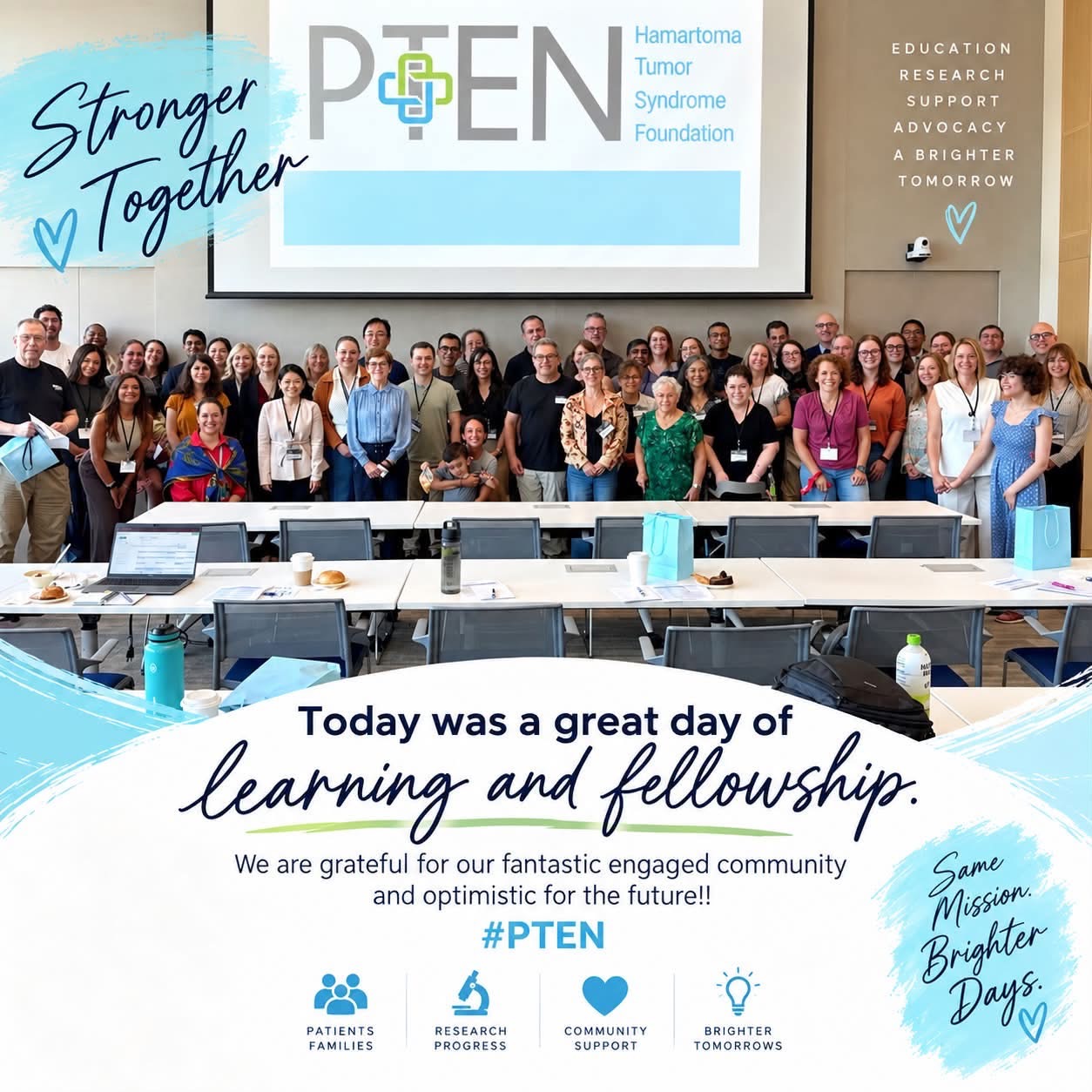
I had the exciting experience of attending the 2026 PTEN Patient Symposium yesterday at CHOP. Sometimes, 15 years after diagnosis, you can get in a rut, thinking you know everything you can know.

Instead I am learning in the rare disease world, longevity of diagnosis can be your enemy, and it can make you complacent or accepting of what already is without seeking more!

The biggest reality check I had yesterday is that NONE OF US knows everything, because what is relevant is changing constantly.

The mind blowing revelation that I was already a college graduate in 1996 when the PTEN gene was connected to Cowden Syndrome gave me a great deal of perspective.

Getting to meet people I only “know” on line was amazing.

I came away with a long ‘to do’ list and a pressing need to recategorize all of our medical files in ways that are easily accessible without relying on a digital chart or a doctor to keep them for me.

I have already found answers to questions in Meghan’s reports from 2004!

Those of you who normally follow because you are kind, and looking to stay connected to us, this is likely to bore you very quickly.

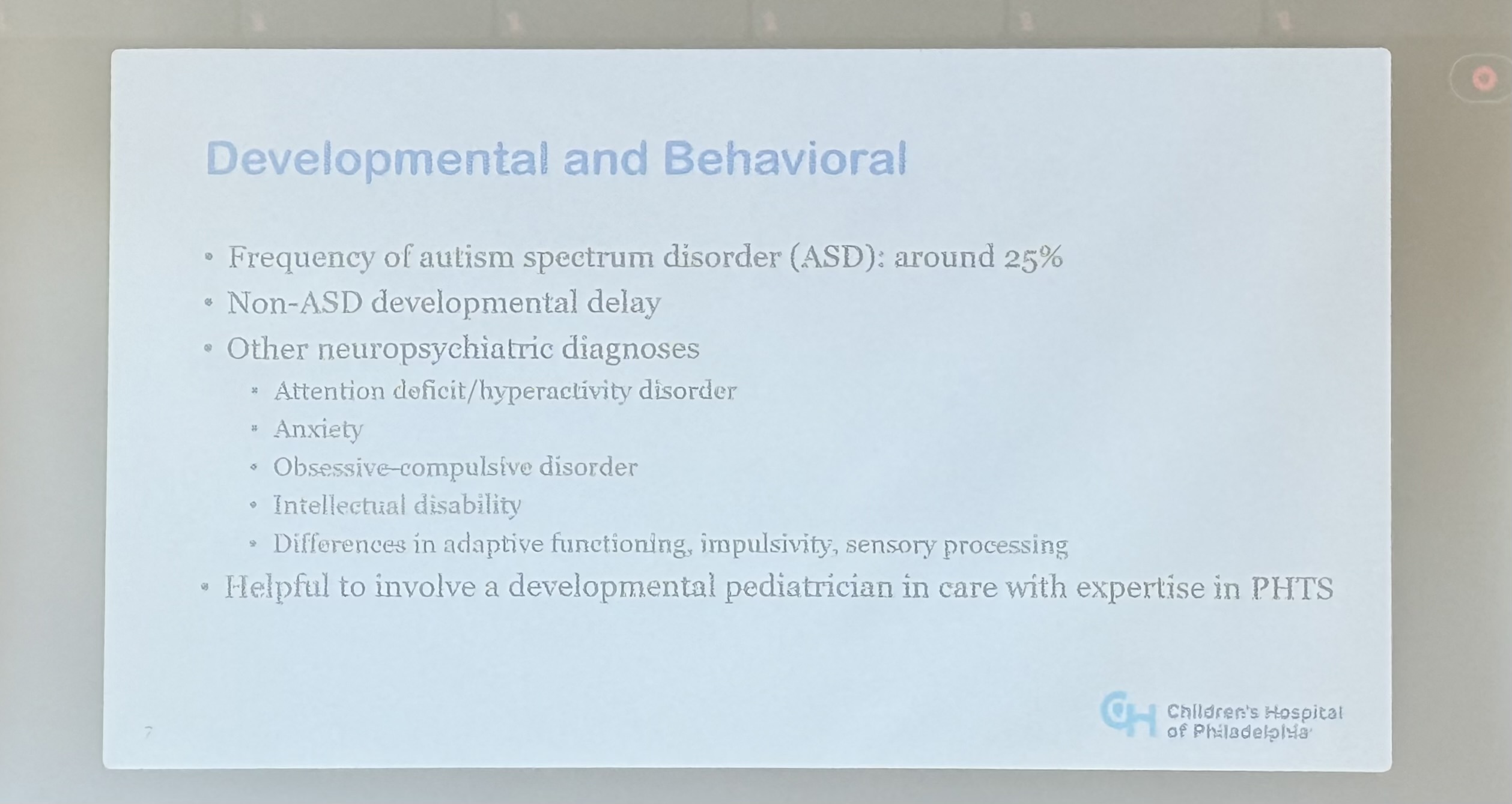
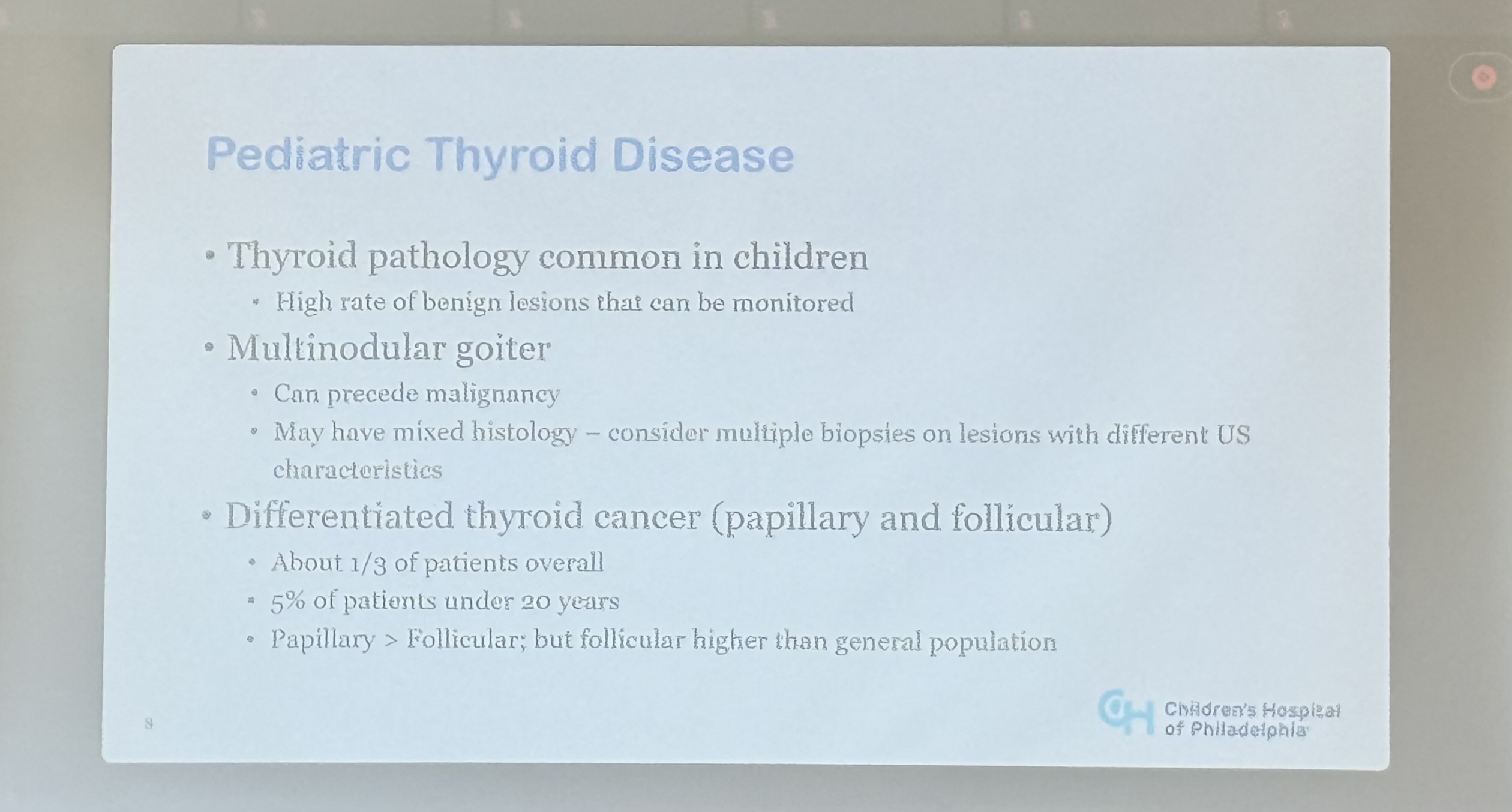
Those of you who are PHTS patients or parents, I hope my rundown of the day helps you! It is definitely slanted towards the things that drew me in for Meghan and I, but I included many screen shots of the slides!

We are indeed “Stronger Together!”
PTEN Patient Symposium

September 4, 2026

CHOP

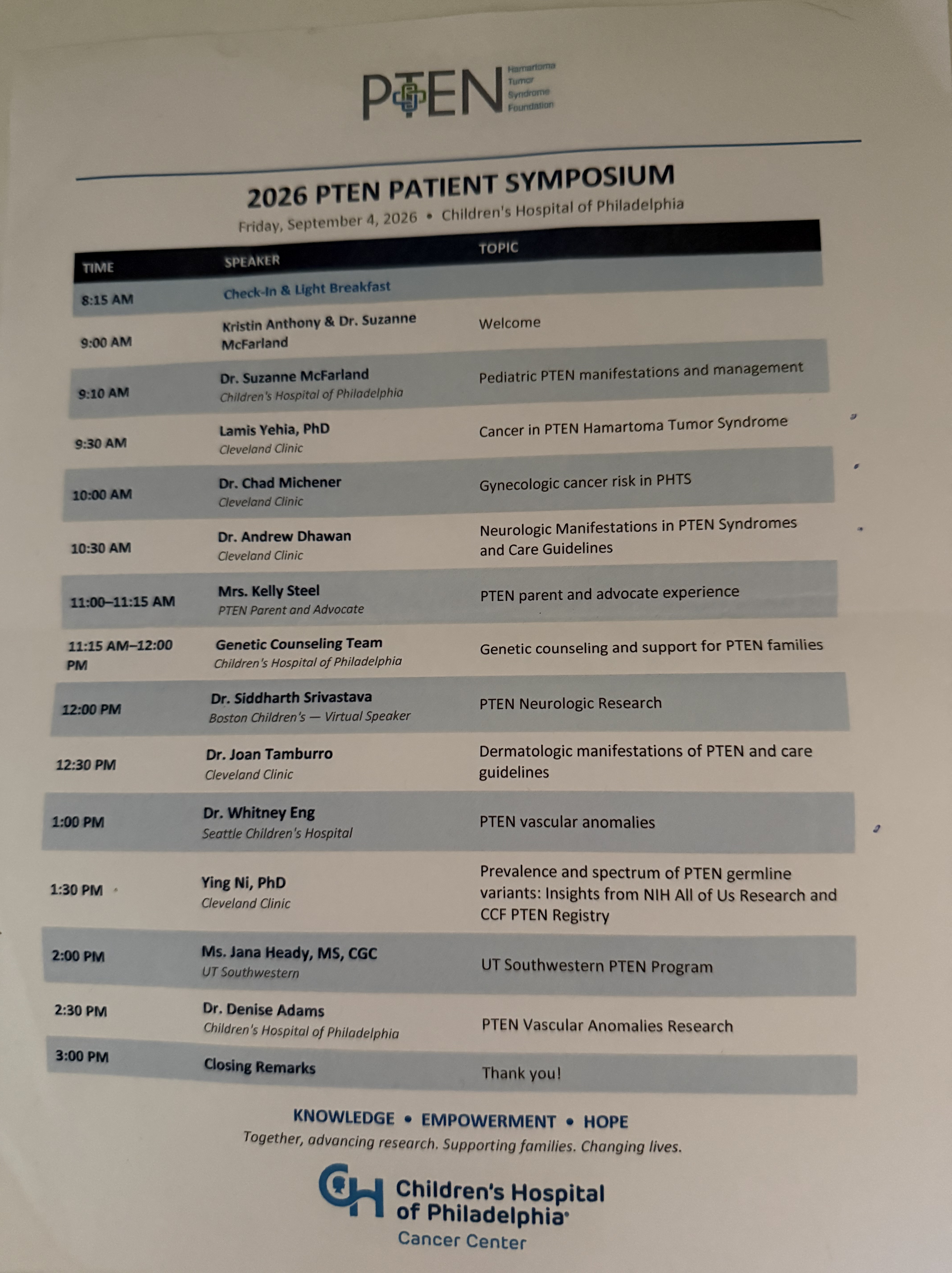
9:00 Kristin Anthony PTEN Foundation
Kristin welcomed us and gave a heartfelt thank you to all attendees. She also told us that the PTEN Foundation will be posting an opportunity for a Scientific Director role. The position will be located in the Southeast and it will help the foundation move forward! Exciting times!!

9:10 Dr. McFarland (CHOP) 

Pediatric PTEN Manifestations and Management
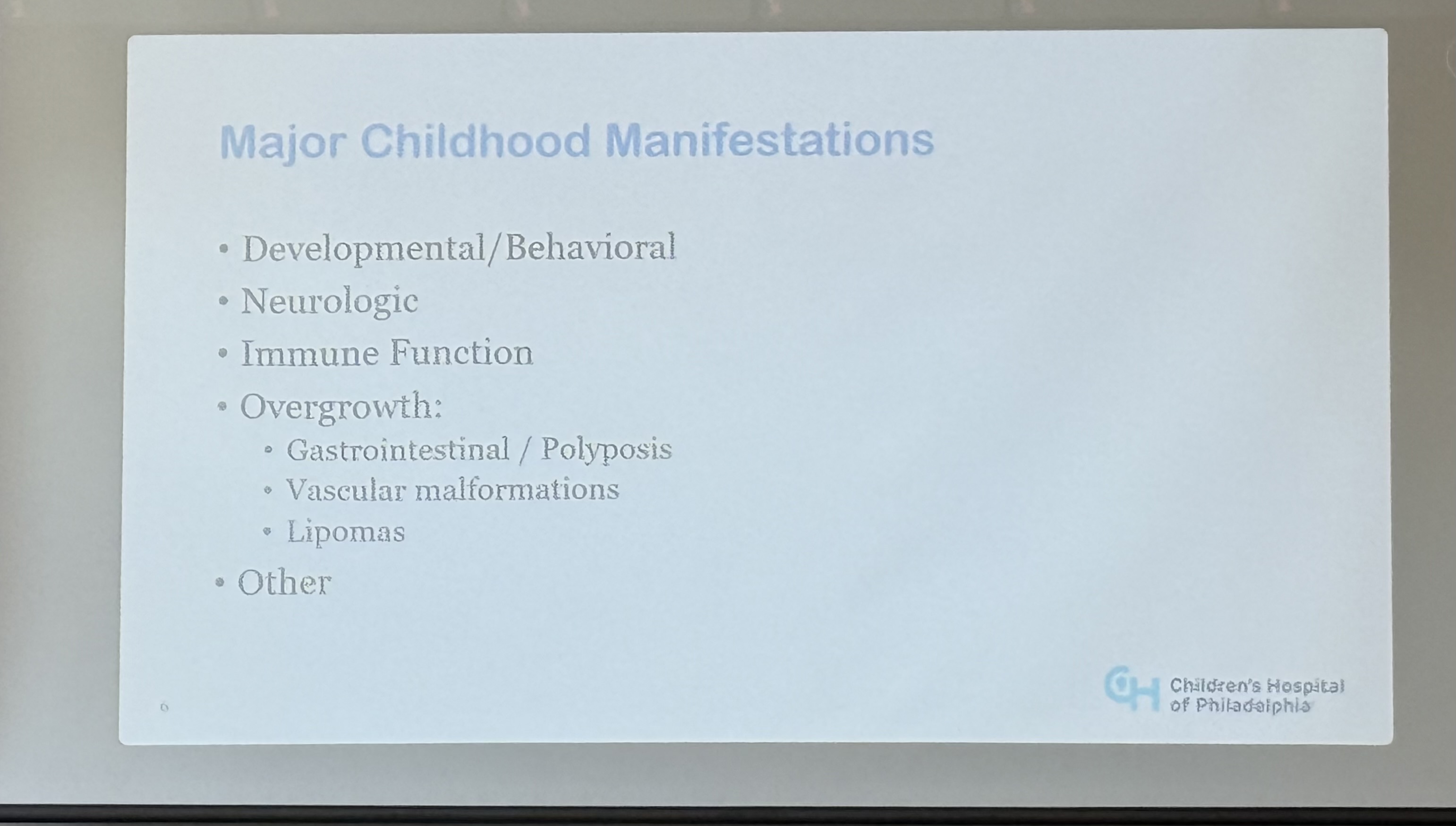
*Almost half of all patients when scanned will have a finding that does not require intervention, but causes unnecessary anxiety. They only scan the brain if a patient is symptomatic.
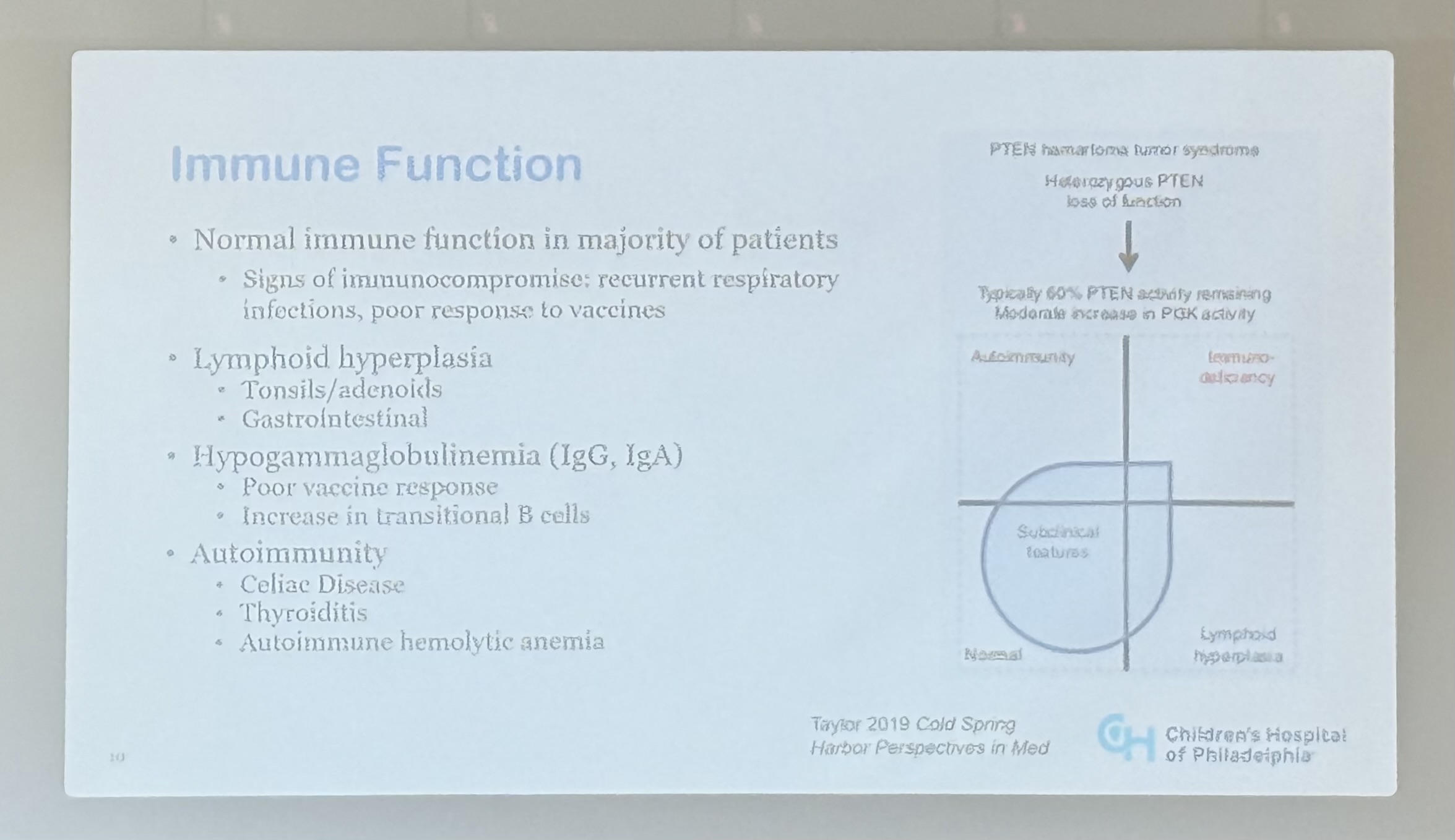
Hypogammaglobulinemia of Infancy was Meghan’s diagnosis at about the age of 2. ( PTEN diagnosis did not come to us until she was 8, so we ware learning many things in hindsight!) In addition to that, her IgG subclasses were often low as a child. Her Pediatrician/ Infectious Disease doctor treated liberally with antibiotics which were often needed to come through “simple” infections. Immunizations were paused and later completed at the age of 16 when immune function was considerably improved. That was an area of disagreement among the MANY specialists we saw. We are in no way opposed to vaccinations!

Meghan’s tonsils and adenoids were removed at 4, after repeated bouts of chronic strep. Although the pathology was “chronic tonsillitis and reactive lymphoid hyperplasia,” a relatively common finding, the doctor told us they were “the most diseased tonsils I’ve ever seen.”

I am told that I suffered from chronic infections as a child and was hospitalized for pneumonia. I was often sick and frequentlyneeded antibiotic treatment as well. As an adult I get sick only 2-3 times a year, but still typically require antibiotics for even “simple” infections.
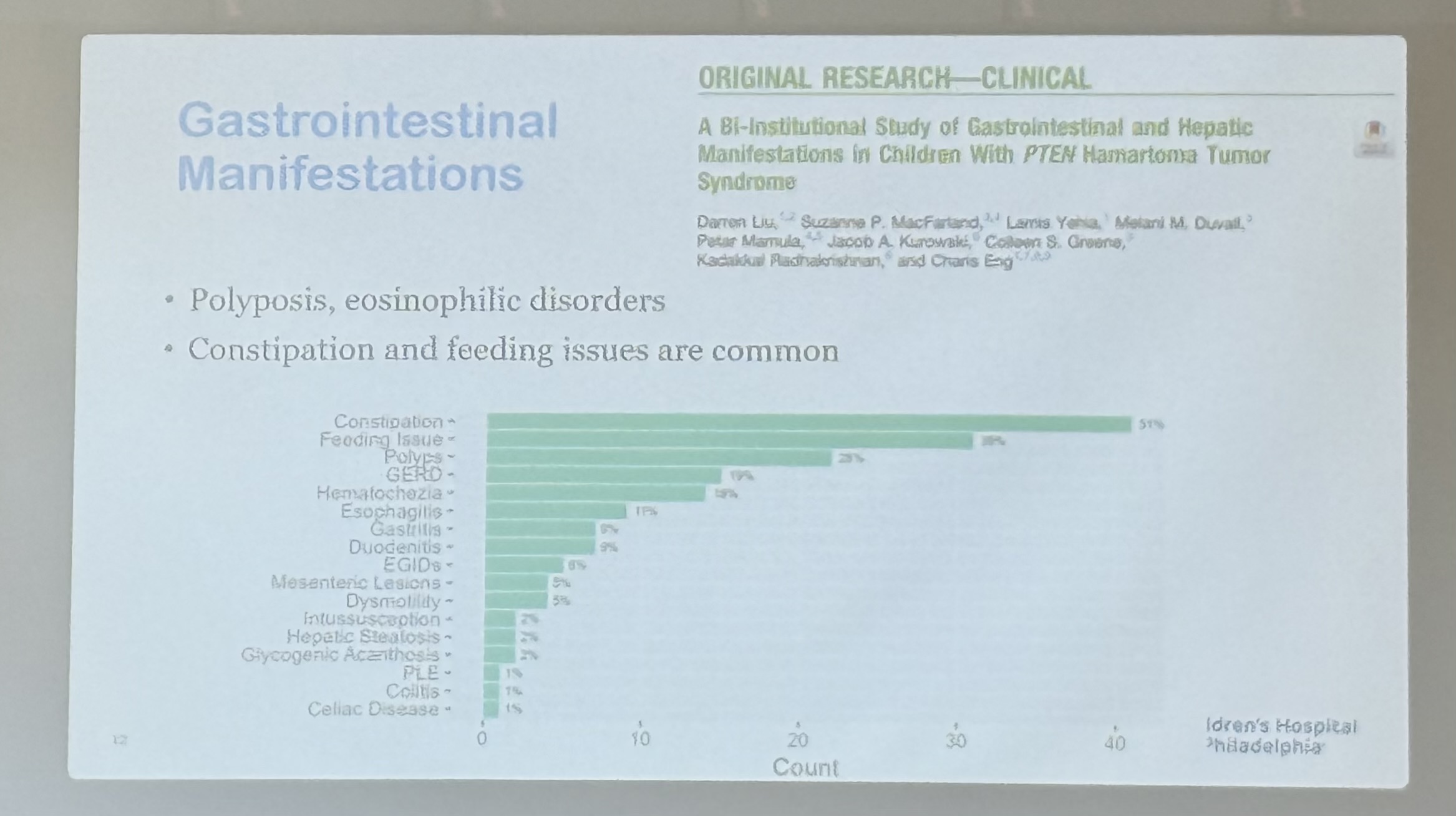
My own GI “issues” consisted of me somewhat regularly vomiting as a child, and finding myself in very embarrassing situations. I realized early to stick to a basic and somewhat bland diet. I avoid high fat foods, as they make me uncomfortable, and treat constipation with additional fiber. Most recent colonoscopy in 2022 was uneventful. I will have my next one in 2027 and remain diligent as “90% of PTEN patients over 35 have GI polyps” and the elevated colon cancer risk is not to be ignored.

Meghan’s GI issues have been present and at the forefront since her birth. She was colicky. She tolerated only a very specific formula, and even that was a struggle. She spent a good deal of childhood on PPIs and various acid reducing medicines. A cursory search of our medical files finds at least 4 endoscopies and one colonoscopy. All were essentially inconclusive and polyps were minimal and benign.

Meghan’s gall bladder was removed in 2007 after a diagnosis of ‘milk of calcium’ and significant pain.

Her diet through the majority of development was gluten, dairy and soy free for GI comfort. Early on corn and egg were also problematic. Allergy testing only showed a mild positive (level 1) for dairy, and GI biopsies at 13 months were negative for celiac. 

Reflux remains an issue to this day, as does constipation. Eating is sometimes a struggle as certain foods/ textures seem to cause esophageal spasms making eating impossible at points even though the desire exists. 

9:30 Lamis Yehia, PhD Cleveland Clinic

Cancer in PTEN Hamartoma Tumor Syndrome

As someone who was born in 1973, hearing that Cowden syndrome was only first labeled in 1986, and that the corresponding PTEN gene mutations linked to Cowden syndrome were not characterized until 1996 can be mind-blowing. I was out of college and working as a substitute teacher in 1996. Literally all of the meaningful work on this syndrome has taken place during my teaching career!
I also noted a quote from this presenter, “There’s nothing (PTEN) cannot do.” Indeed!

A lot of this presentation was technical and statistics that are better seen on the presenter’s slides.
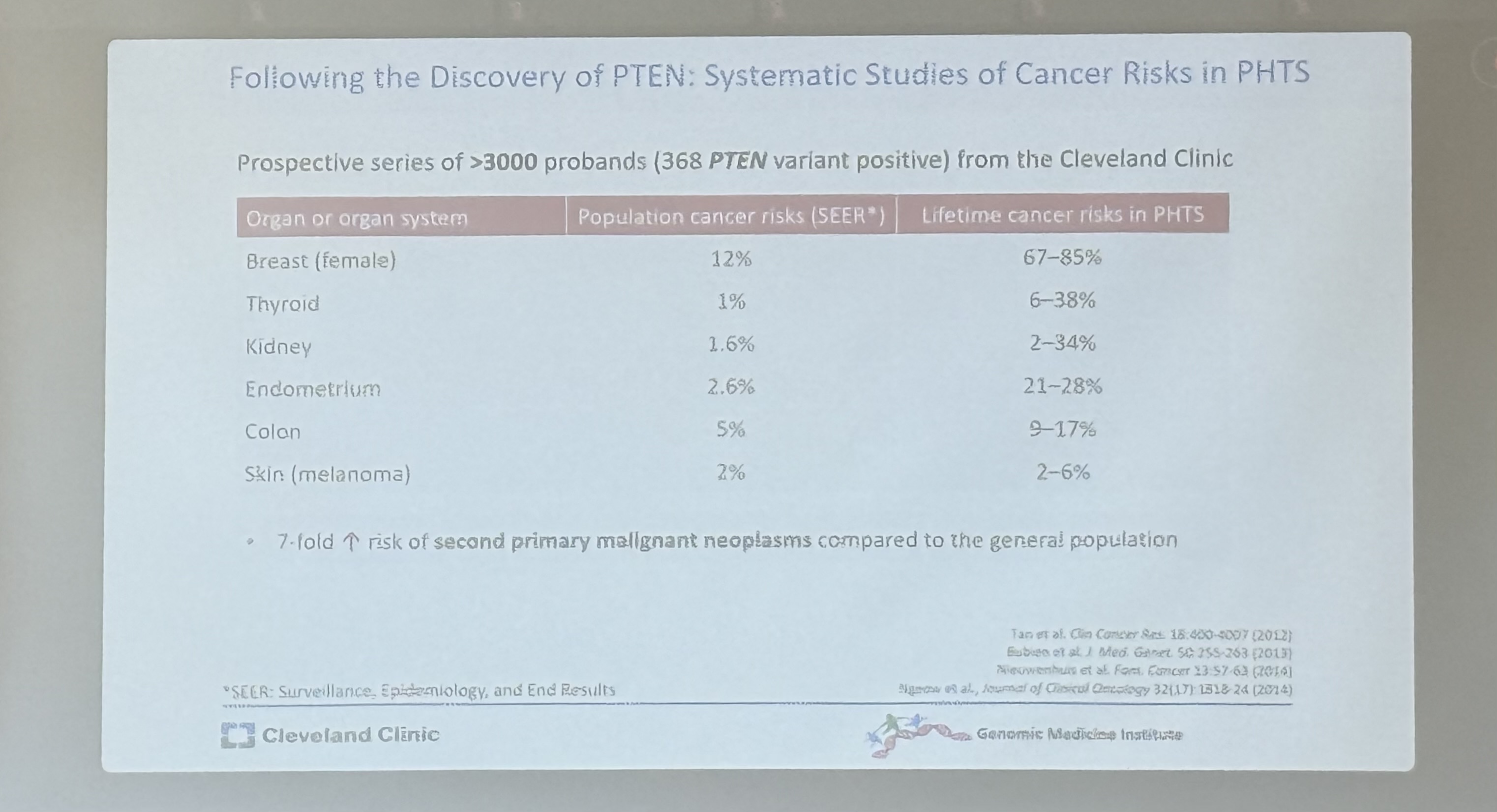
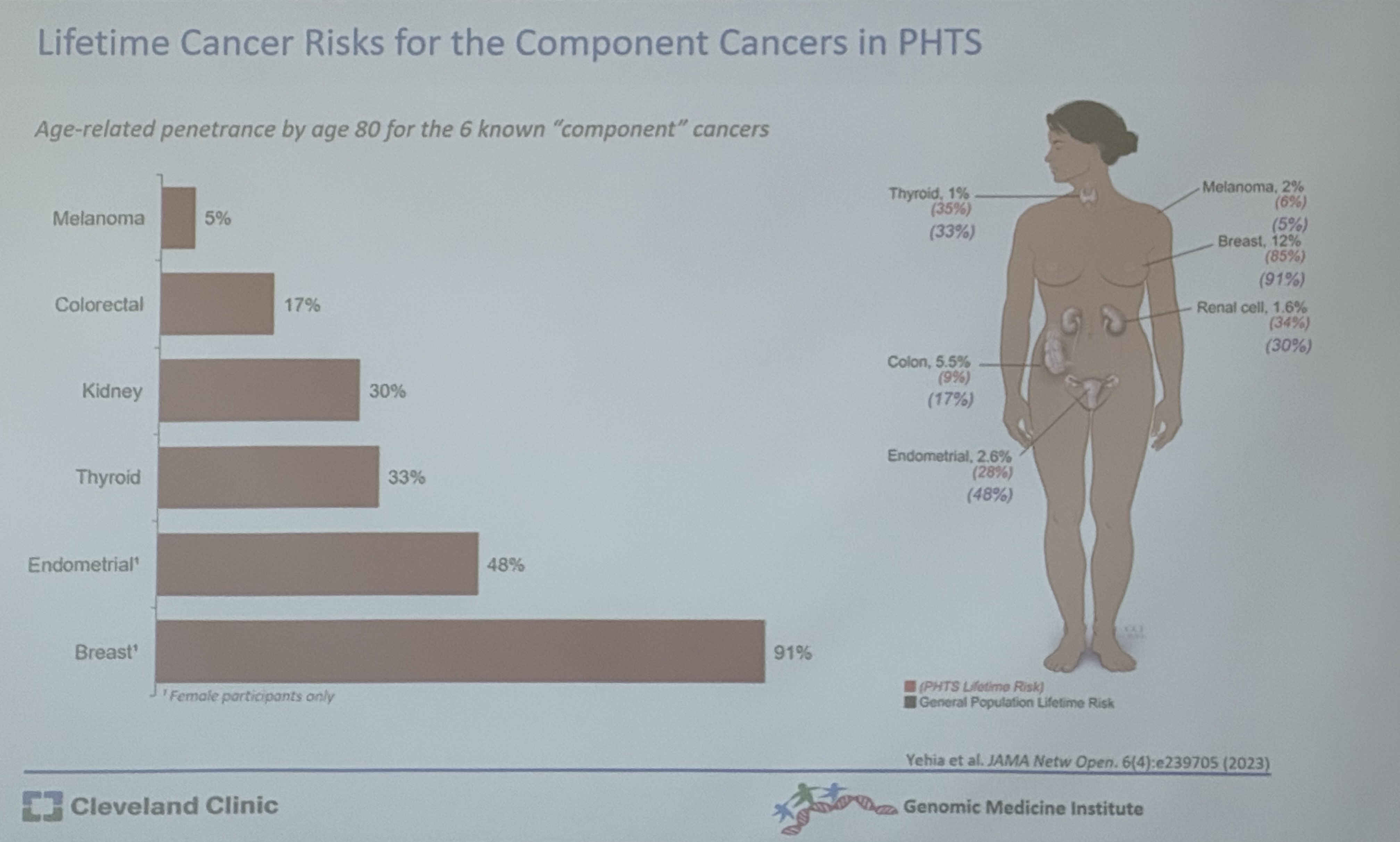
The slide below shows cancer risks for the six ‘component’ cancers in PHTS, both in a graph and by body part. On the human model, the black numbers indicate the general population. The red numbers are from a study published in 2012, and the purple numbers are the updated percentages of those with PHTS. The age related penetrance is 80 years.
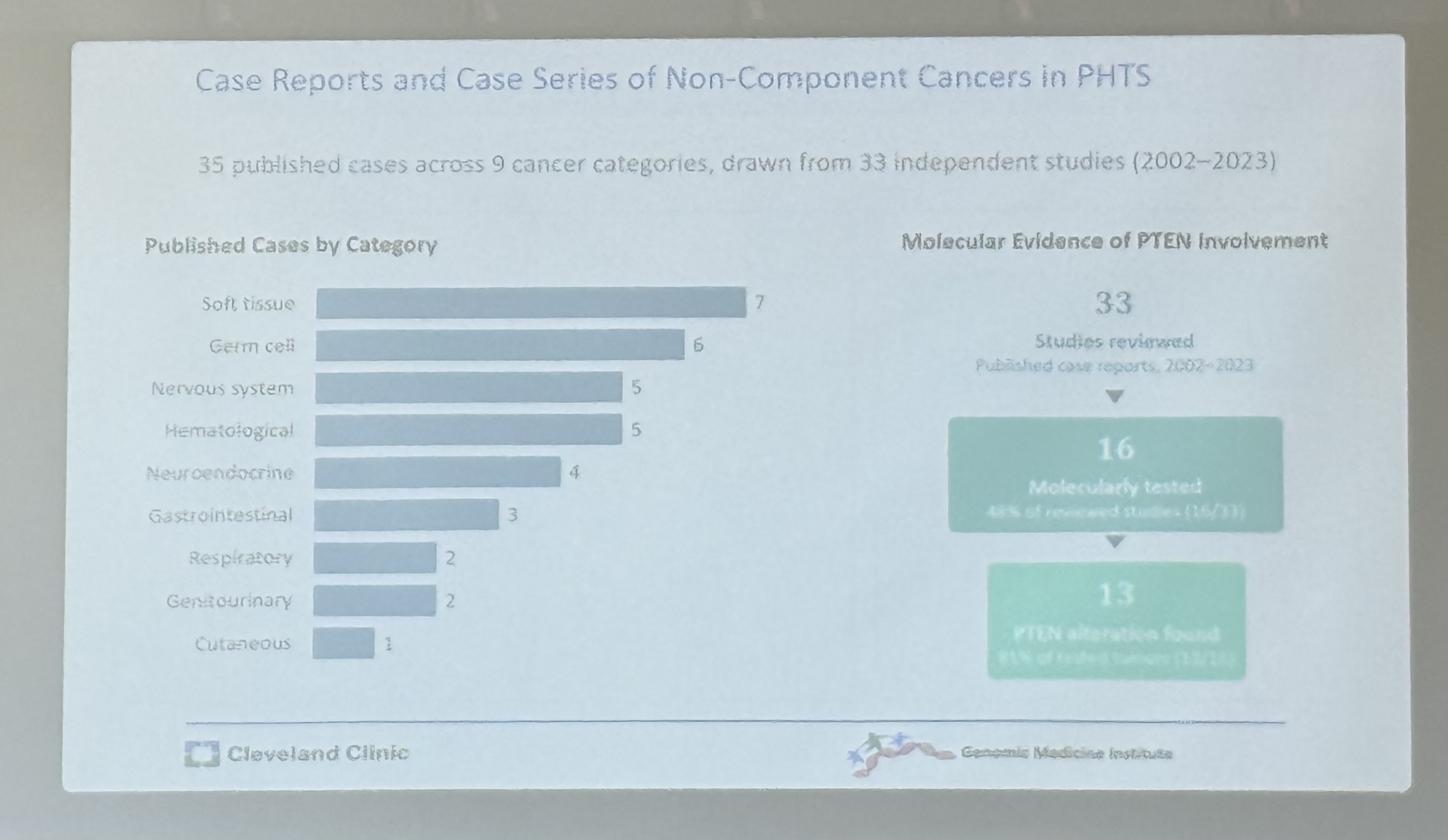
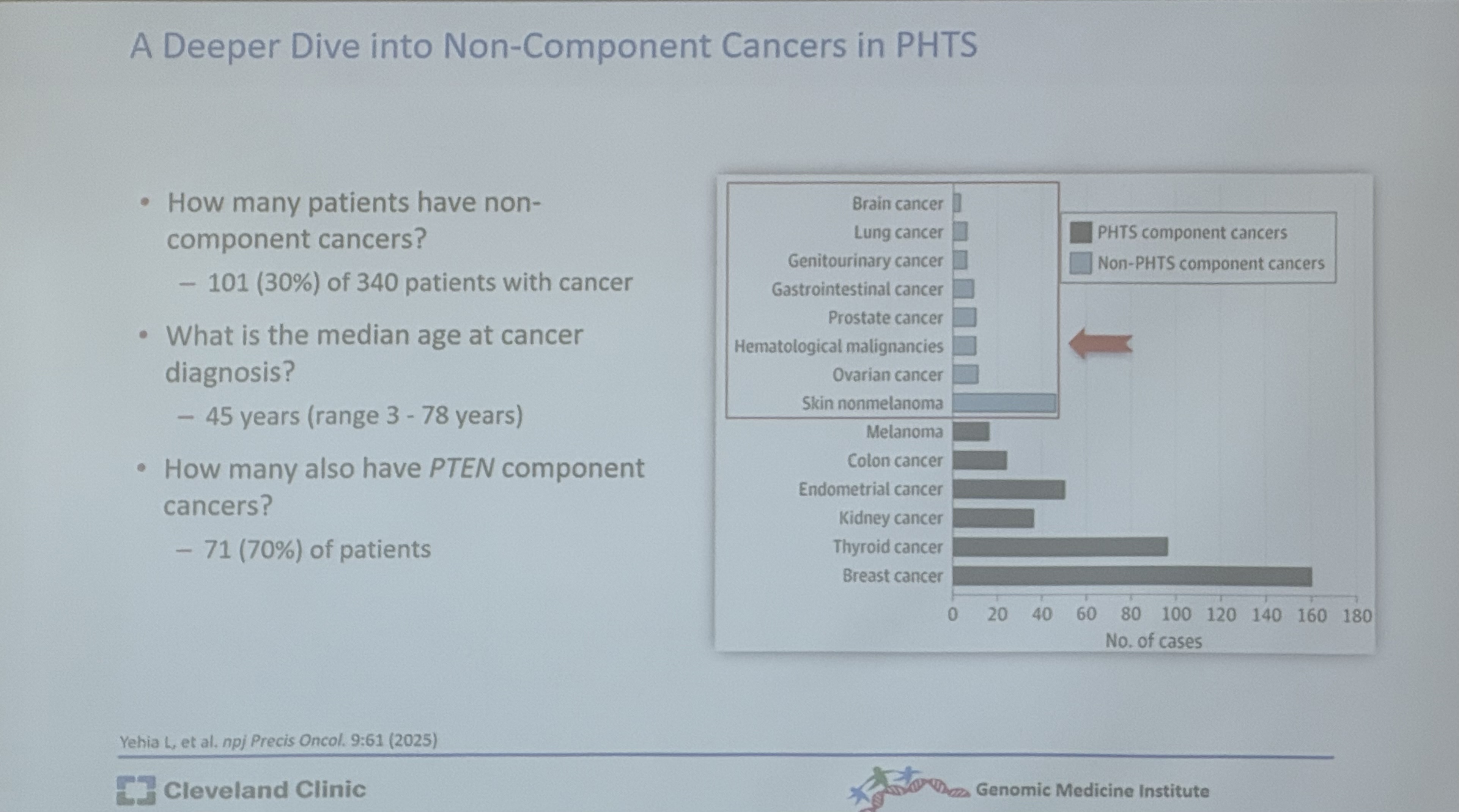
There was discussion on ‘non component’ cancers, and they are listed on the slide below. Attention should be paid to the small sample sizes, a hazard of working in a rare disease population. We were assured they are working on studying modifiers.
10:00 Dr. Chad Michener, Cleveland Clinic

Gynecologic Cancer Risk in PHTS

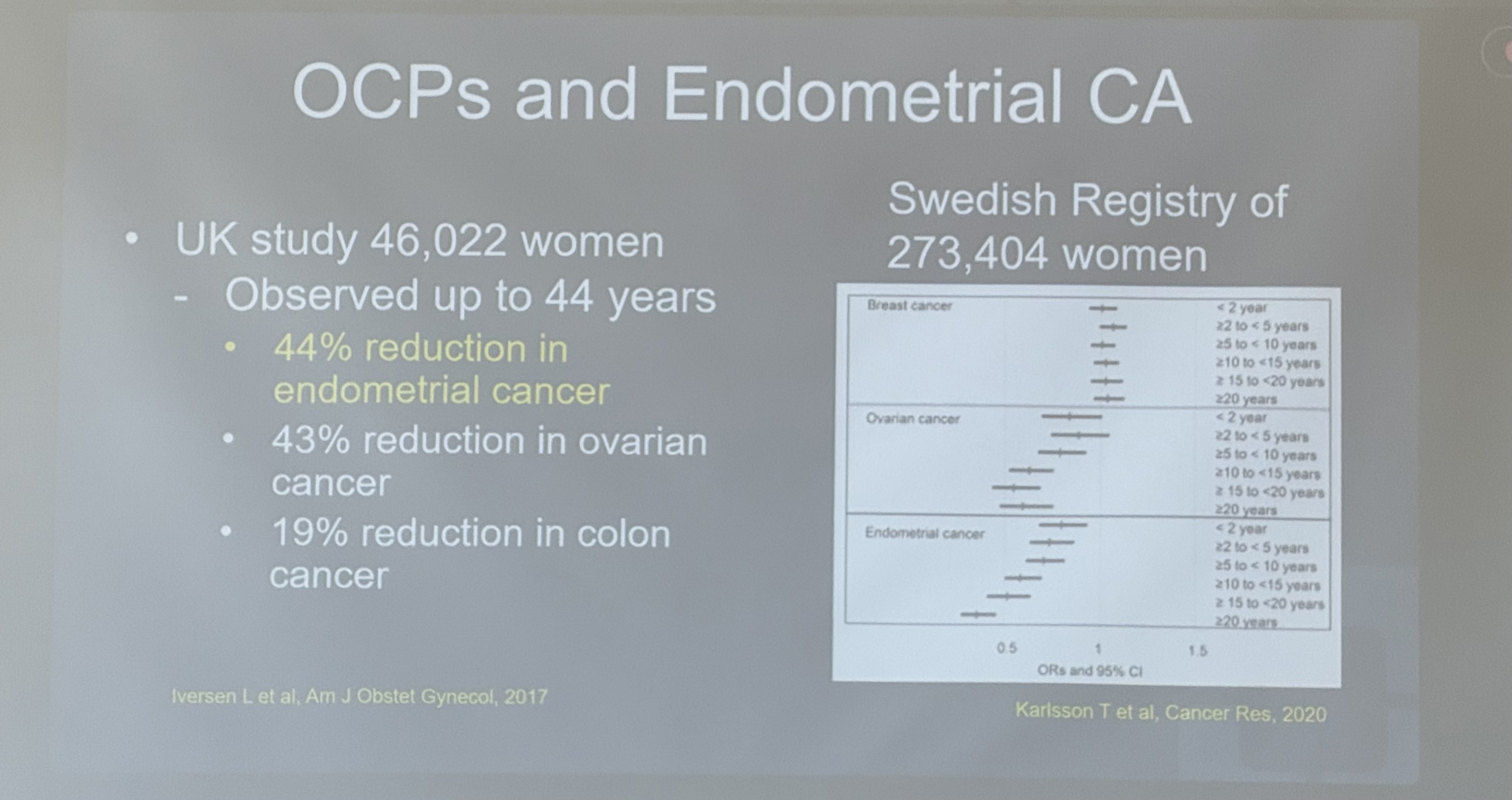
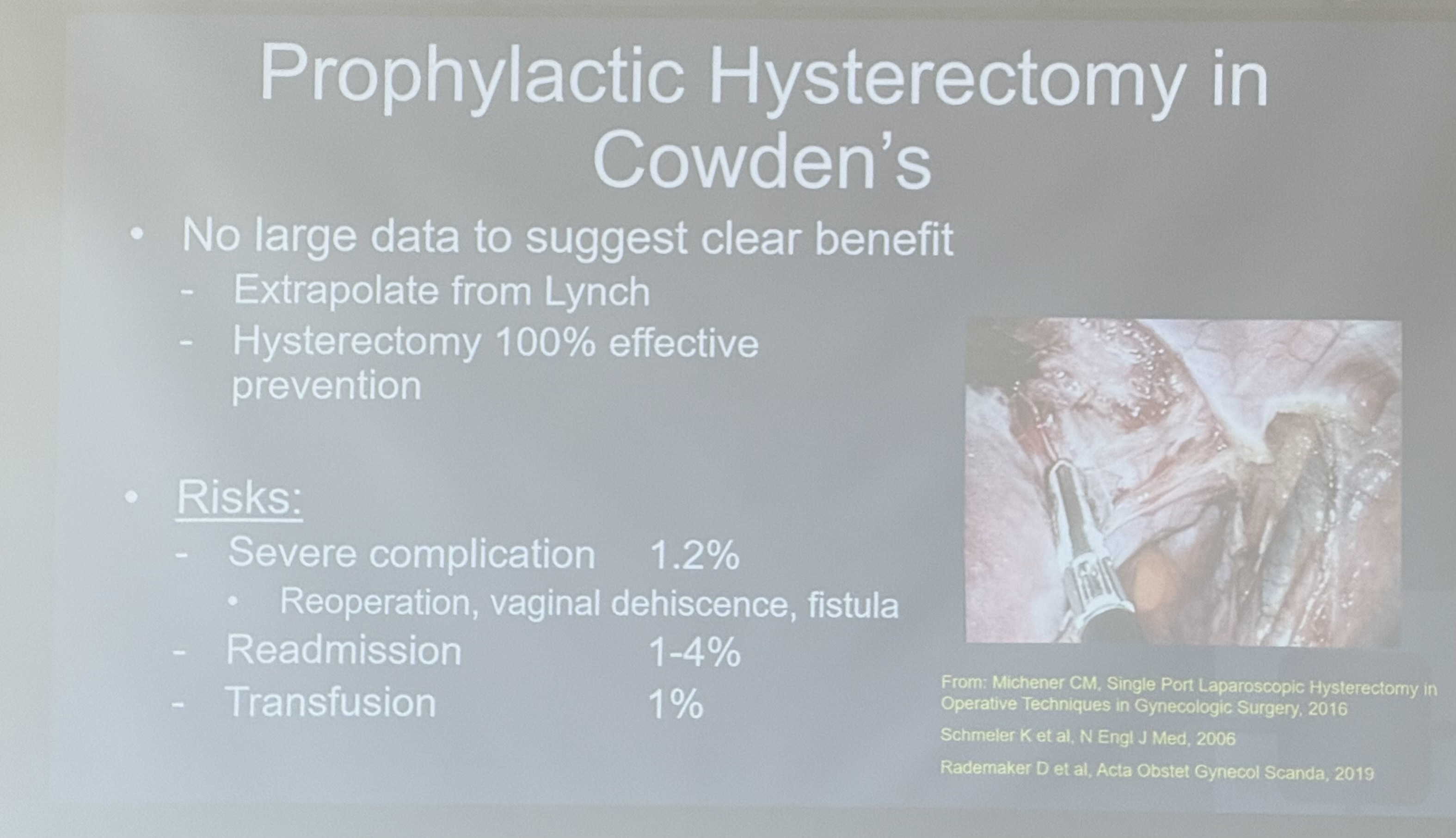
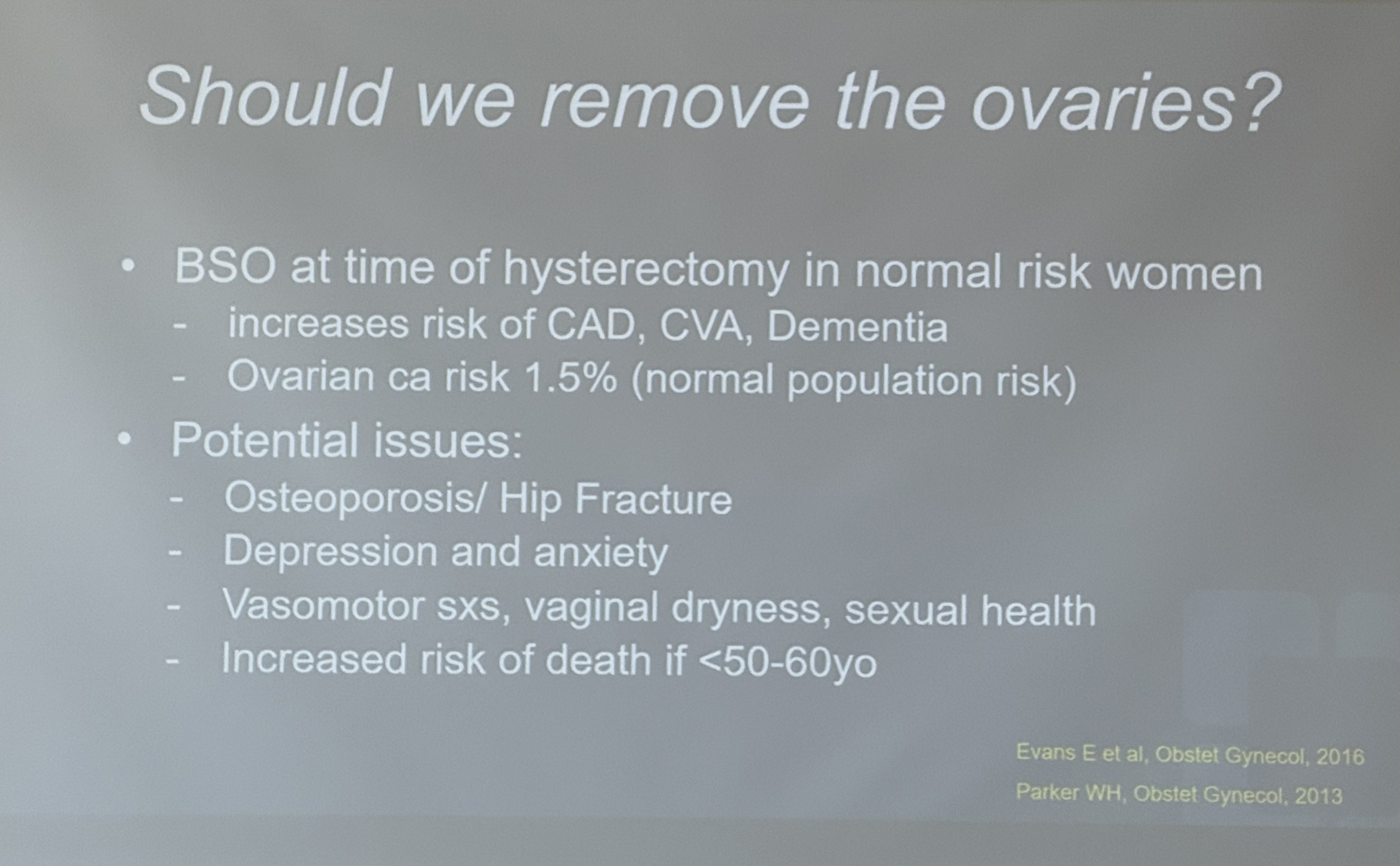
As a breast cancer survivor, a PHTS patient who had a full hysterectomy weeks after my double mastectomy and a mother of a PHTS patient who is post double mastectomy and who has already had more than her share of trouble with her uterus, this one had my attention. Meghan has also been on a continuous (no placebo) birth control pill since 2017. At the time an adolescent gynecologist suggested it after her first biopsy. I know she is not alone with what were utterly miserable, and in my opinion, beyond humane, periods.

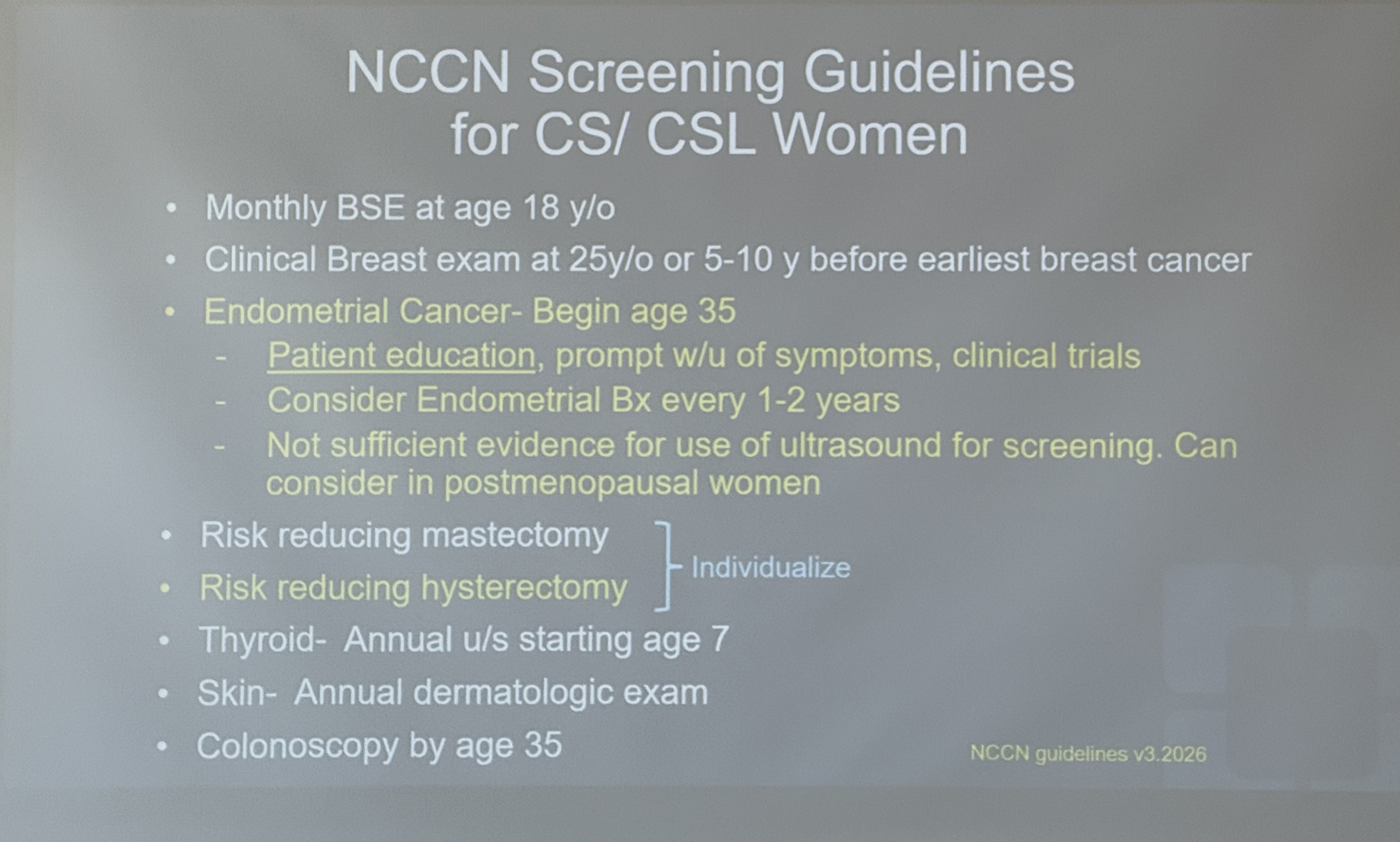
I was reminded of the information on a previous slide, that while the risk of endometrial cancer used to be listed as 28% in the PHTS population, it is now at approximately 48% for those of us with pathogenic PTEN variants.

That was definitely tough to swallow.

I also learned my daughter’s gynecologist is on top of things as there is a low threshold to biopsy when there is suspicion of malignancy. “Just do it.” 

I will insert the slides I clipped below.
10:30 Dr. Andrew Dhawan, Cleveland Clinic
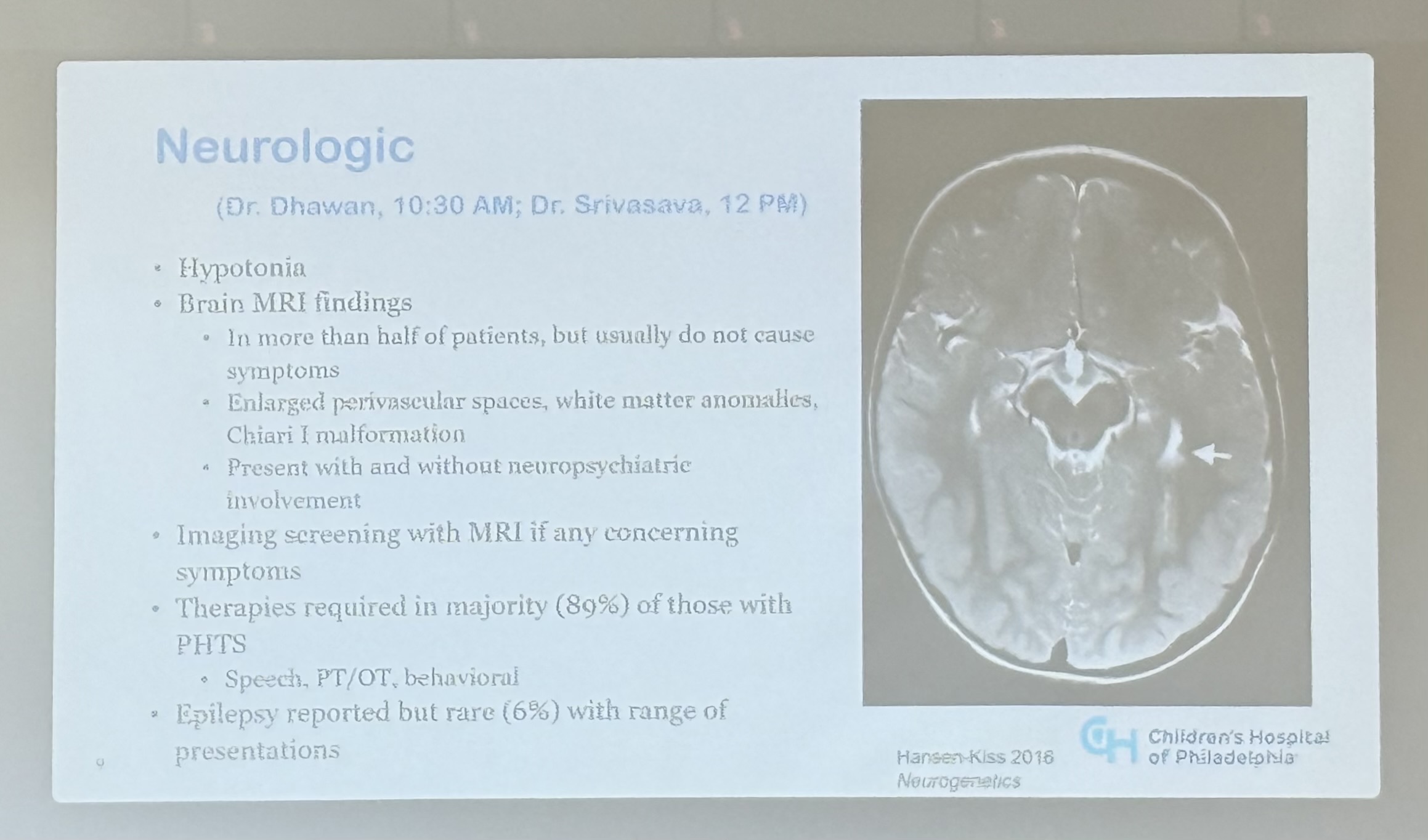
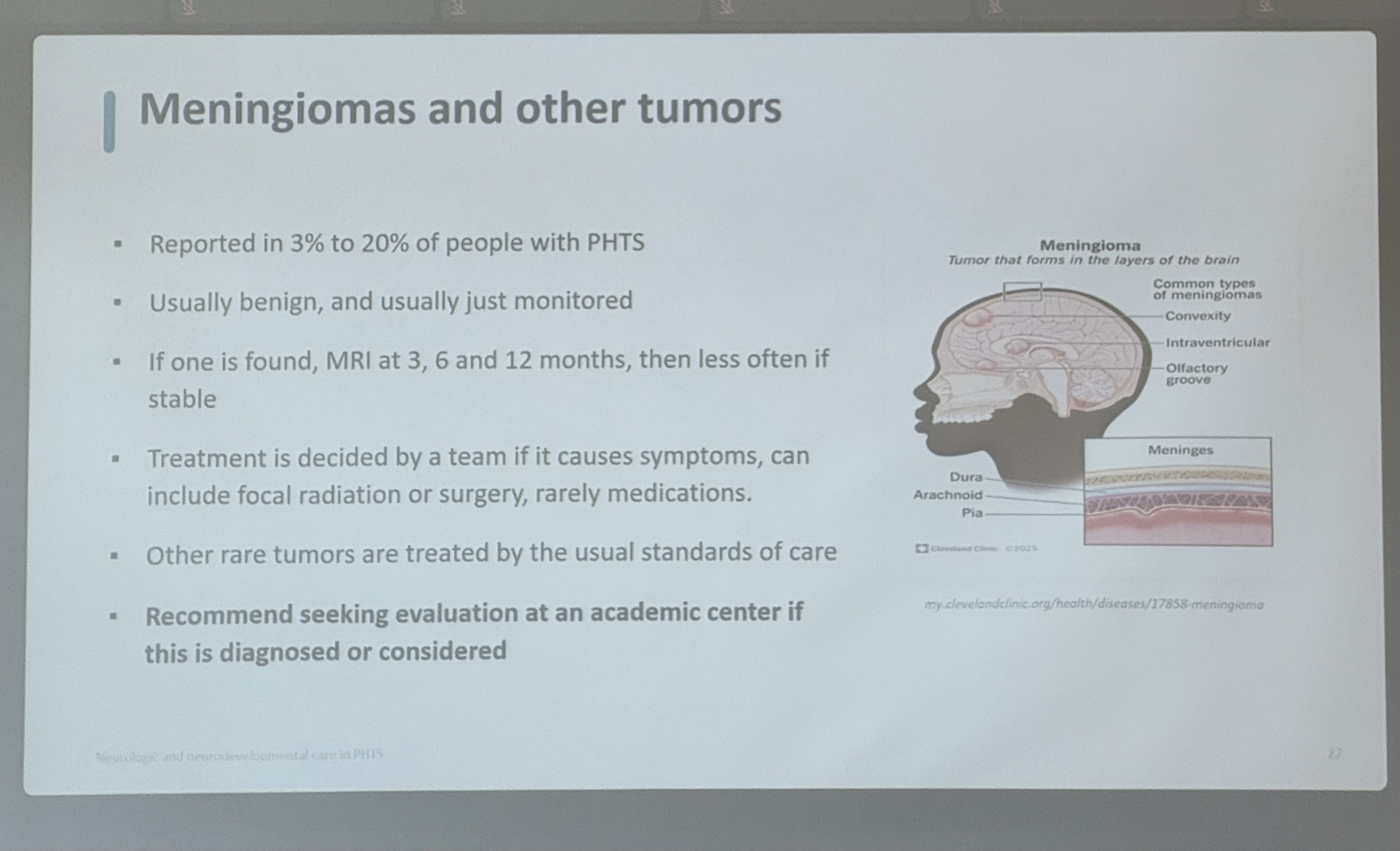
Neurologic Manifestations in PTEN Syndromes and Care Guidelines

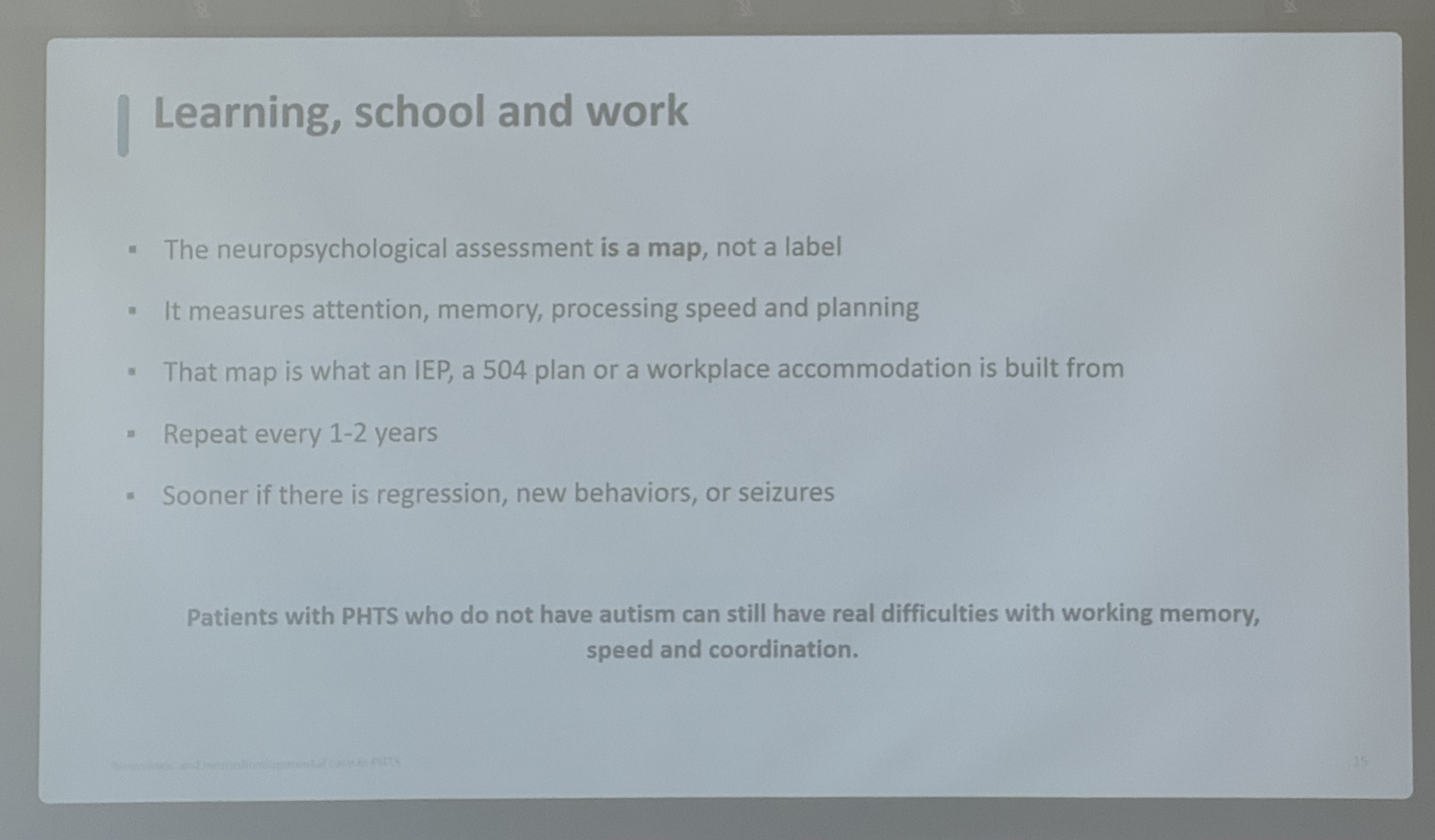
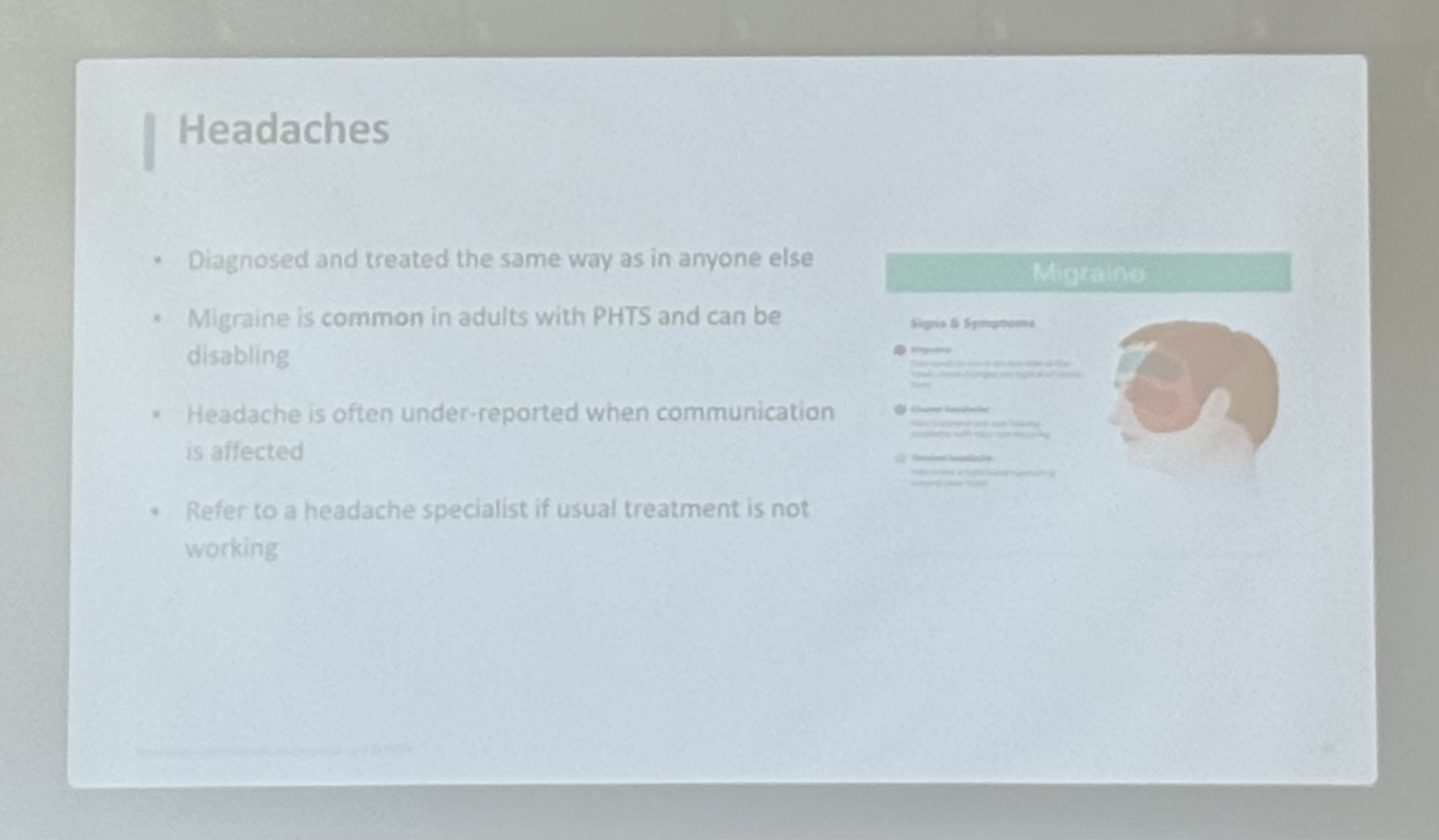
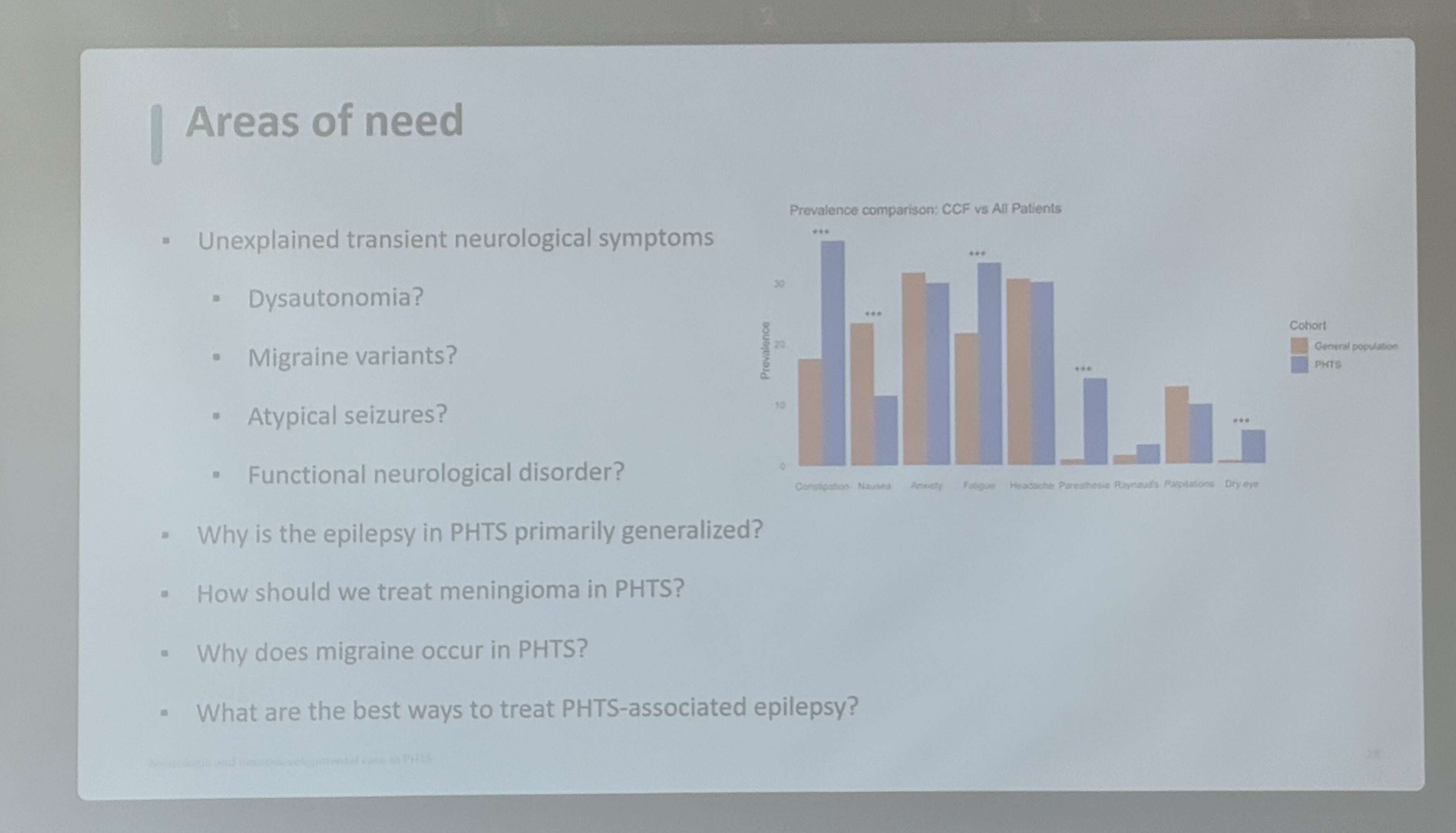
Meghan and I both suffer with chronic migraines. We also both struggle to fall asleep, although her sleep issues are notably more severe.

We both have dysautonomia with slightly different presentation and to varying degrees. I remember this being something Dr. Eng had begun to talk about before her passing, and I am grateful for those who are still working on the connections.
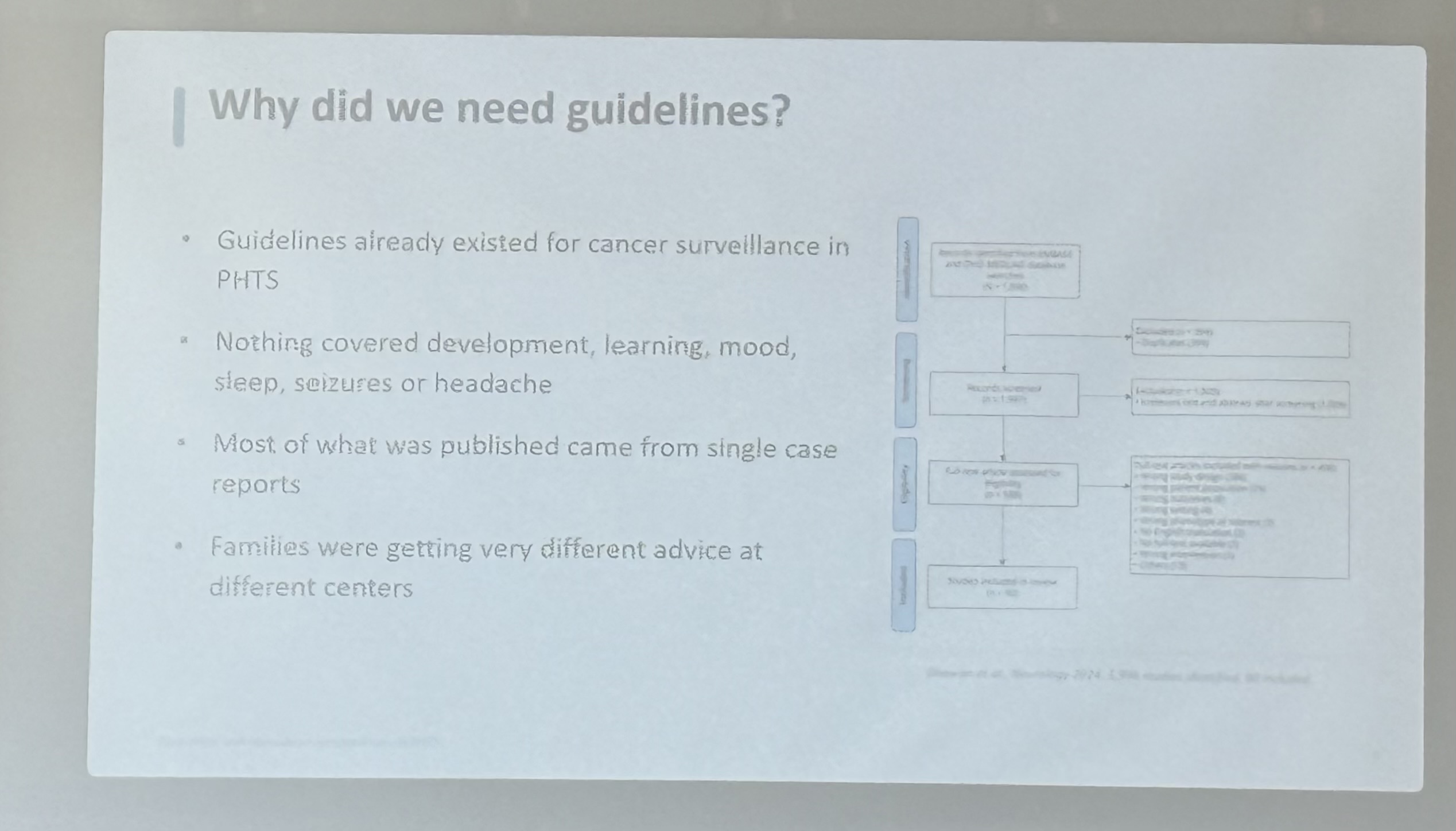
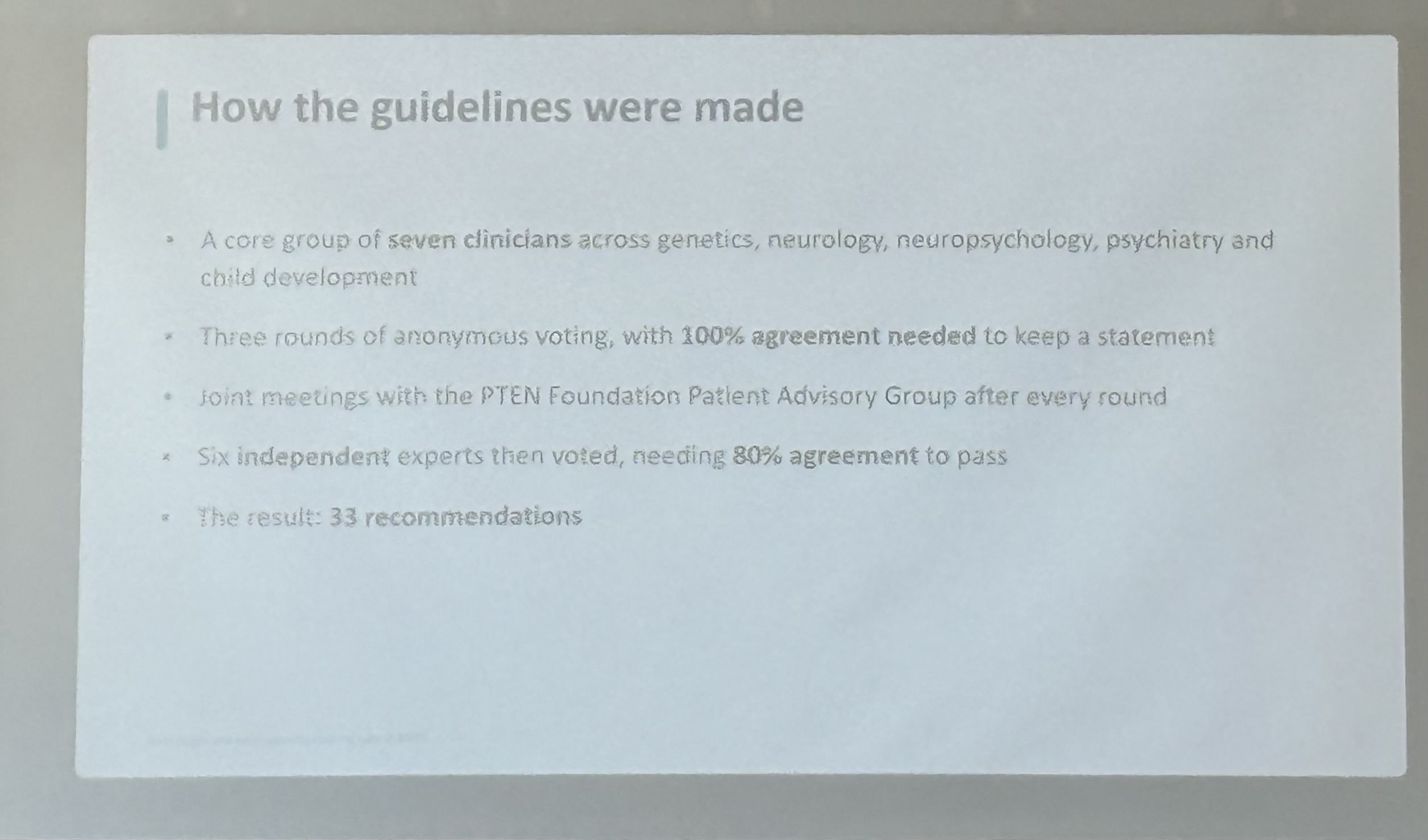
We both feel as though everything we do takes longer than it should- including my work compiling my notes here from yesterday!

And I felt in in my SOUL when he said that PHTS patients are ‘clumsy!’ I felt SEEN! LOL!!

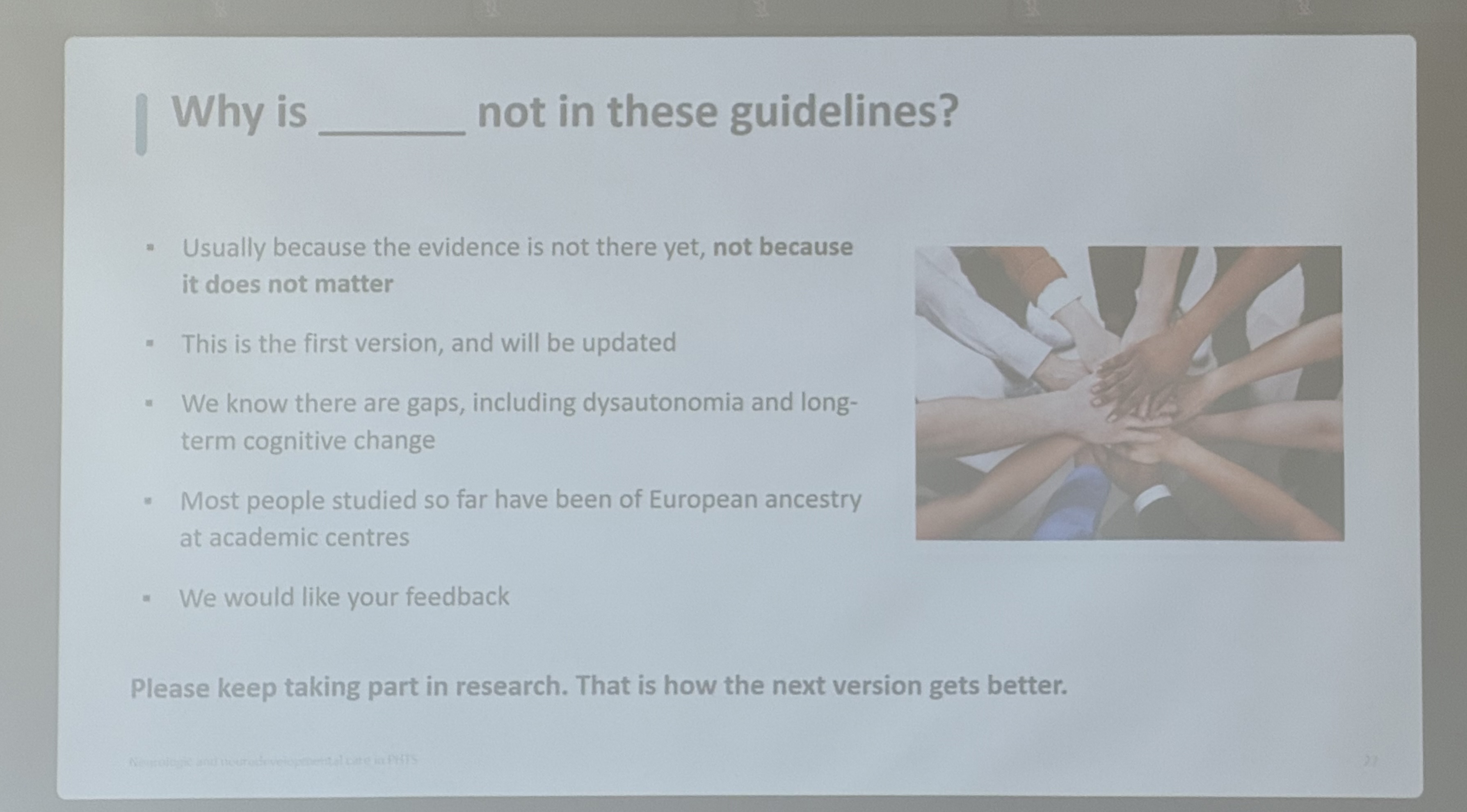
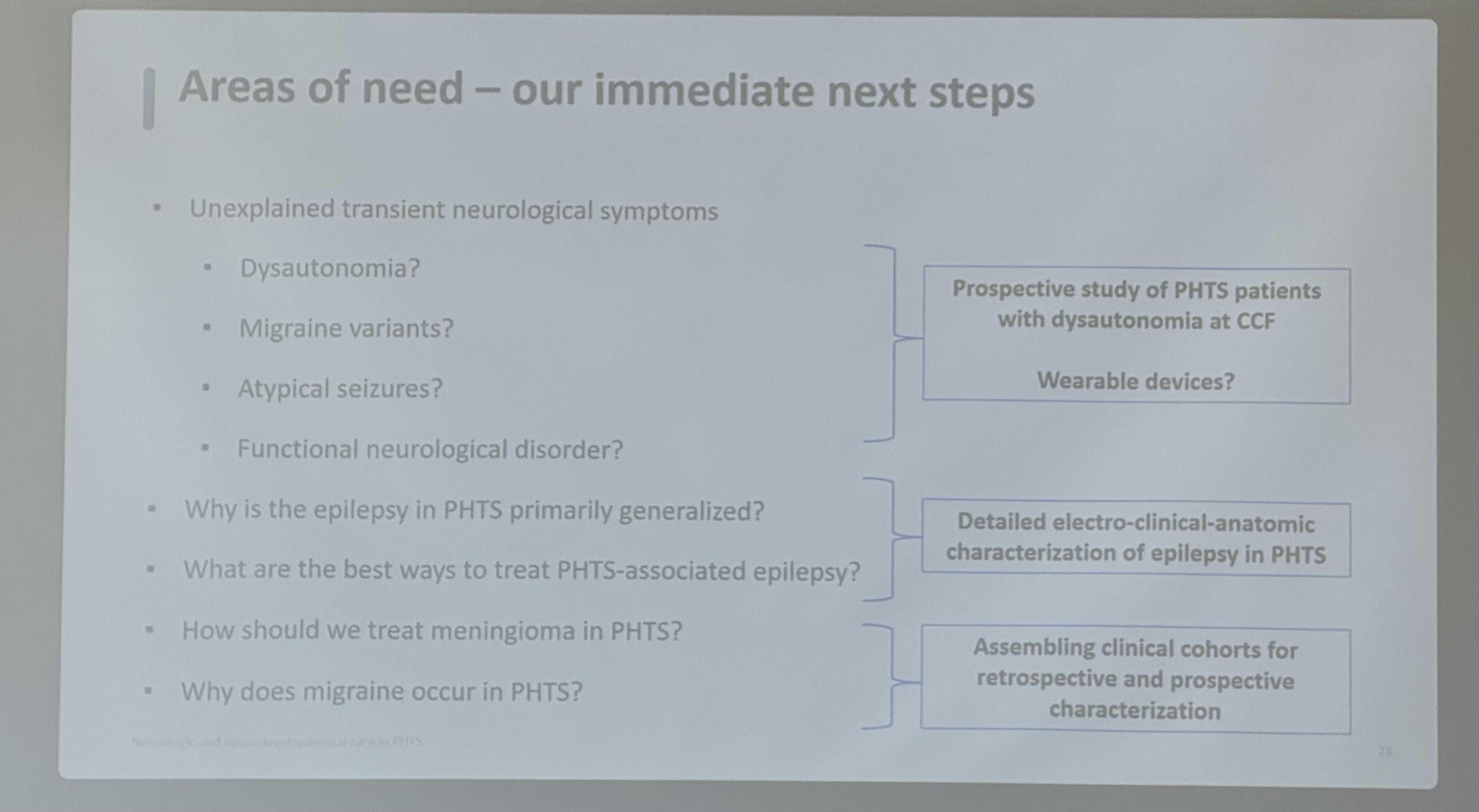
It was reinforced how important patient participation is in research, registries and the like so that appropriately sized and differentiated samples can help lead to even better guidelines.
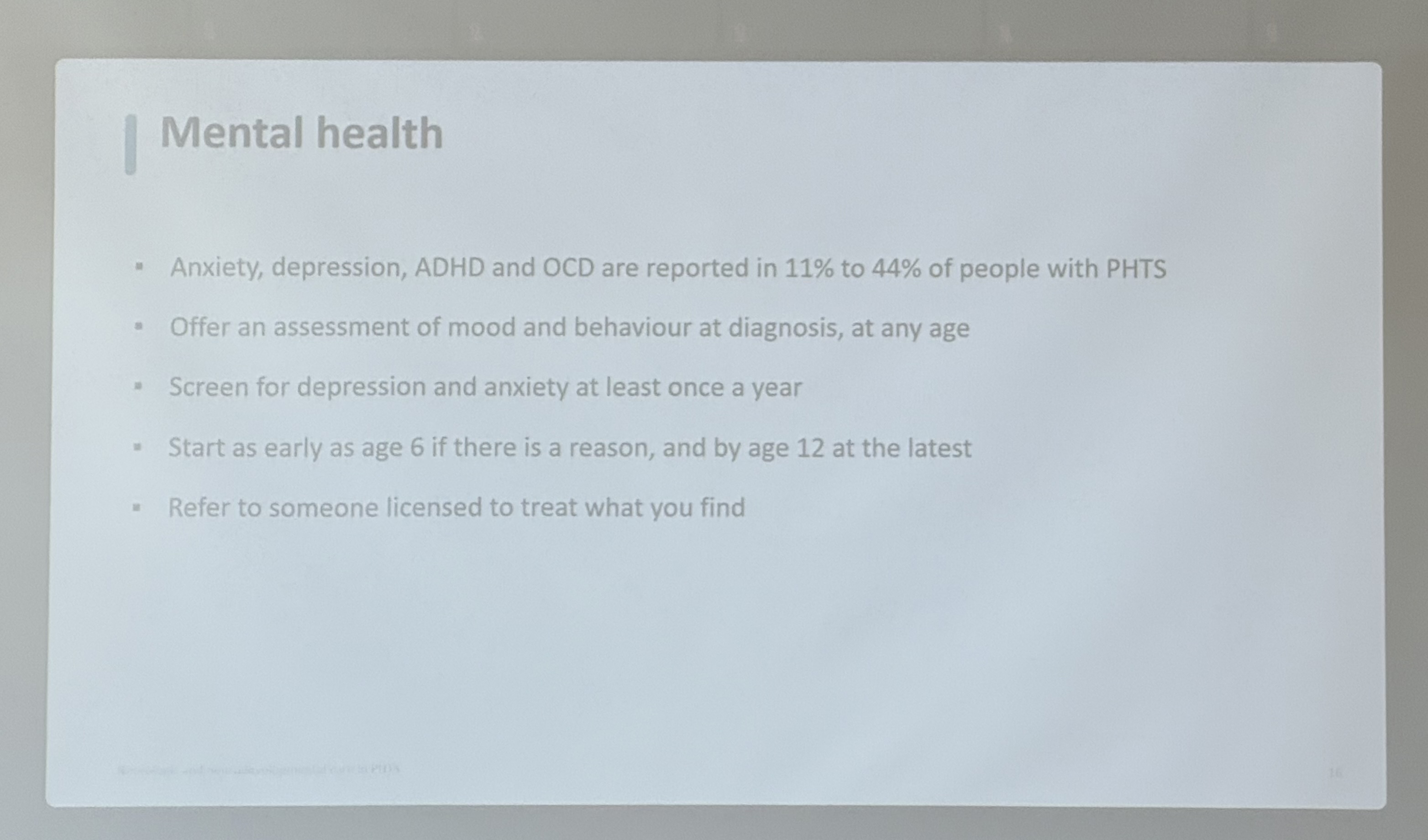
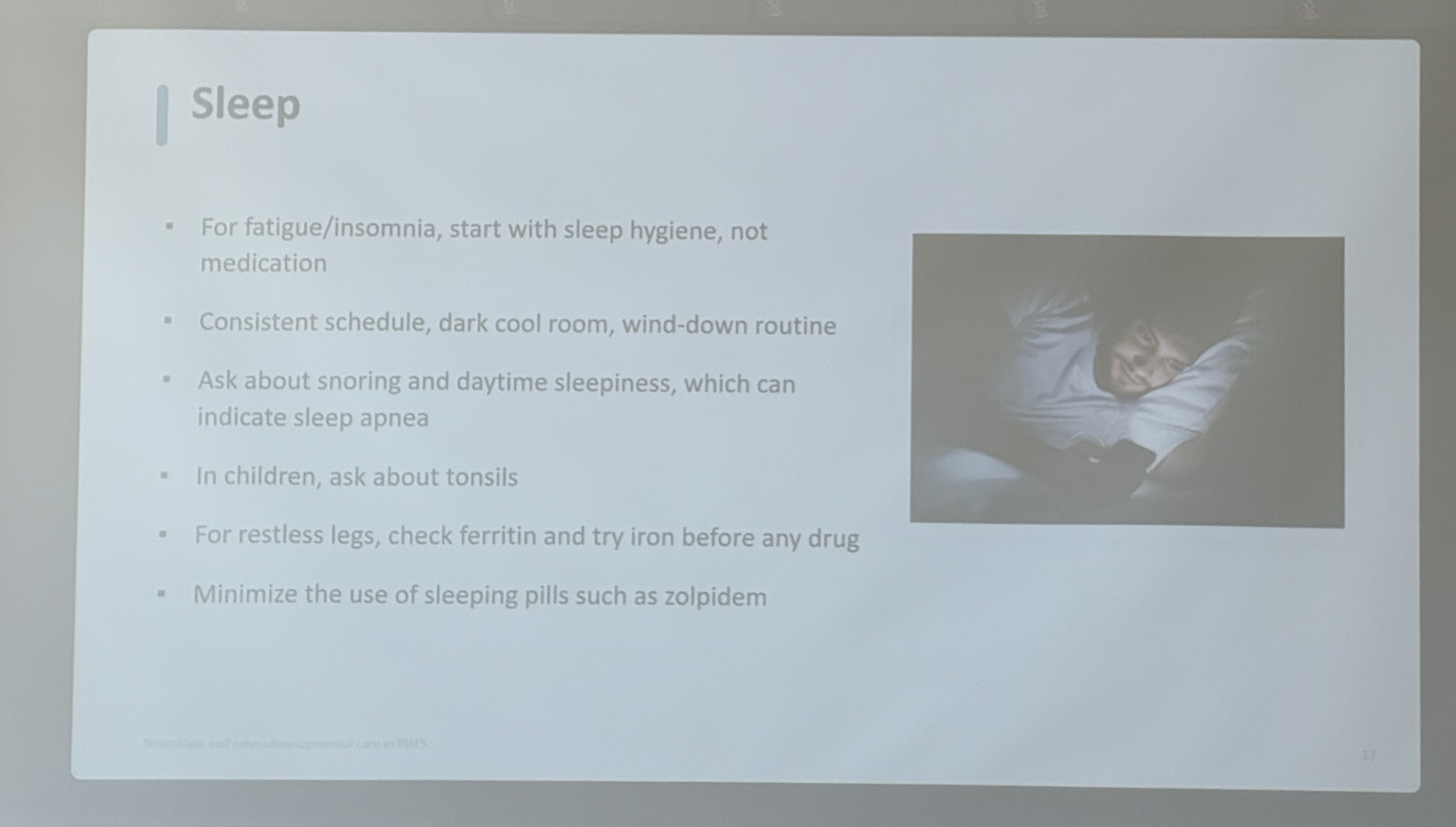
11:15- 12:00 Lunch and Q and A with CHOP genetics team

12:00 Dr. Siddharth Srivastava (virtual) Boston Children’s

PTEN Neurologic Research

My apologies because I do not have any slides to share. The virtual presentation created some projection challenges.

The doctor spoke about upcoming research opportunities.

12:30 Mrs. Kelly Steel 

PTEN Parent and Advocate Experience

This was a super neat presentation for me because I met in person a family I have been following for years.

Kelly and her husband are parents to the amazing Daphne, a 13 year old PHTS patient with a history that reads like a medical text book. (Well, who are we kidding, you’d never find kids like ours in a textbook!)

She shared some of their journey, and while hers and ours are not the same in content, it was something special to hear from her. 

If you are a parent of a medically complex child, there is nothing like looking, standing near, or being in the same room with others. There is so much unspoken understanding, and I was grateful for their family’s openness.

Daphne’s PTEN Diary

12:45 Dr. Joan Tamburro, Cleveland Clinic

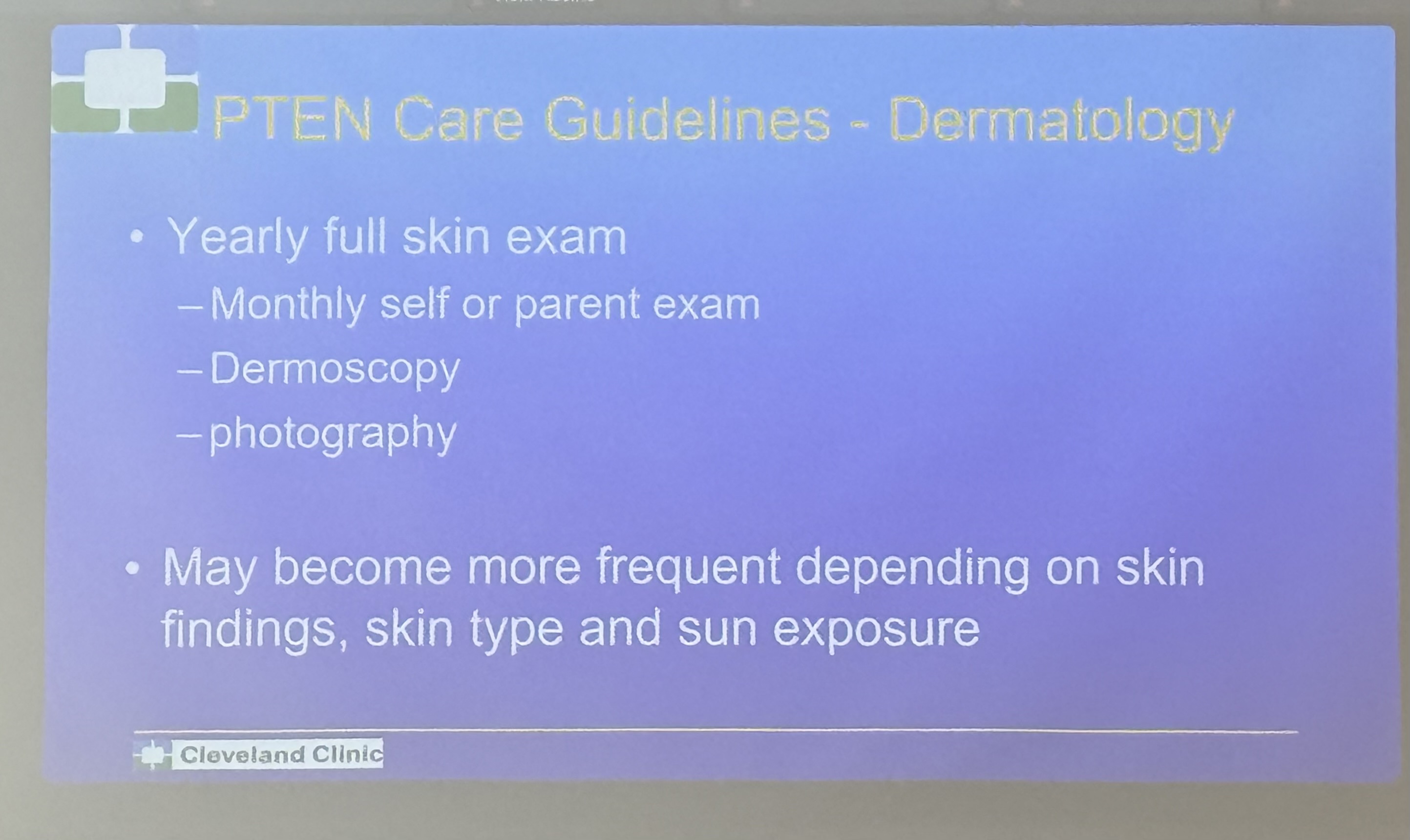
Dermatologic Manifestations of PTEN and Care Guidelines 

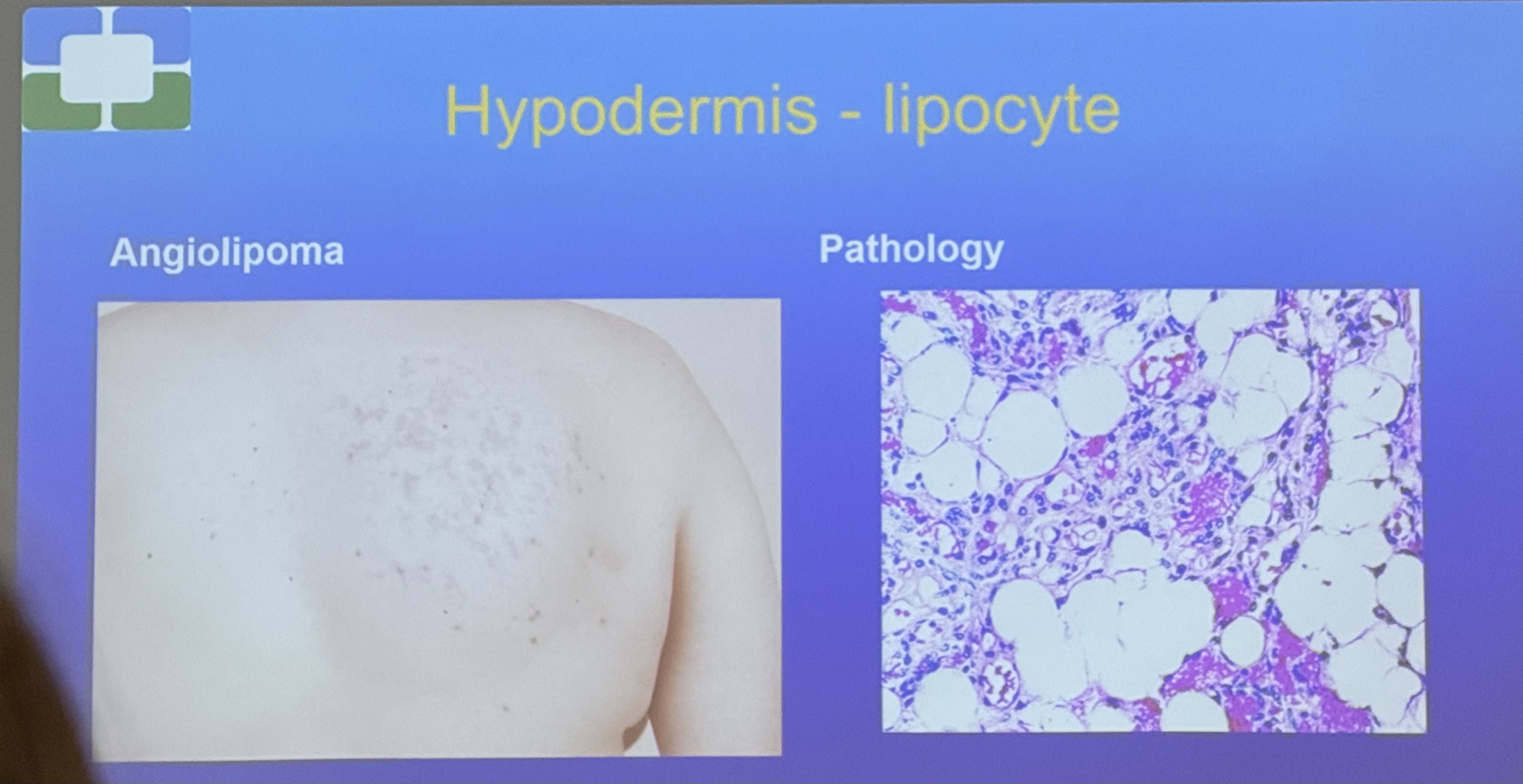
This was an overview of guidelines for skincare. I did not take a large number of photos during this presentation. The first set of photos are common skin findings in PHTS.
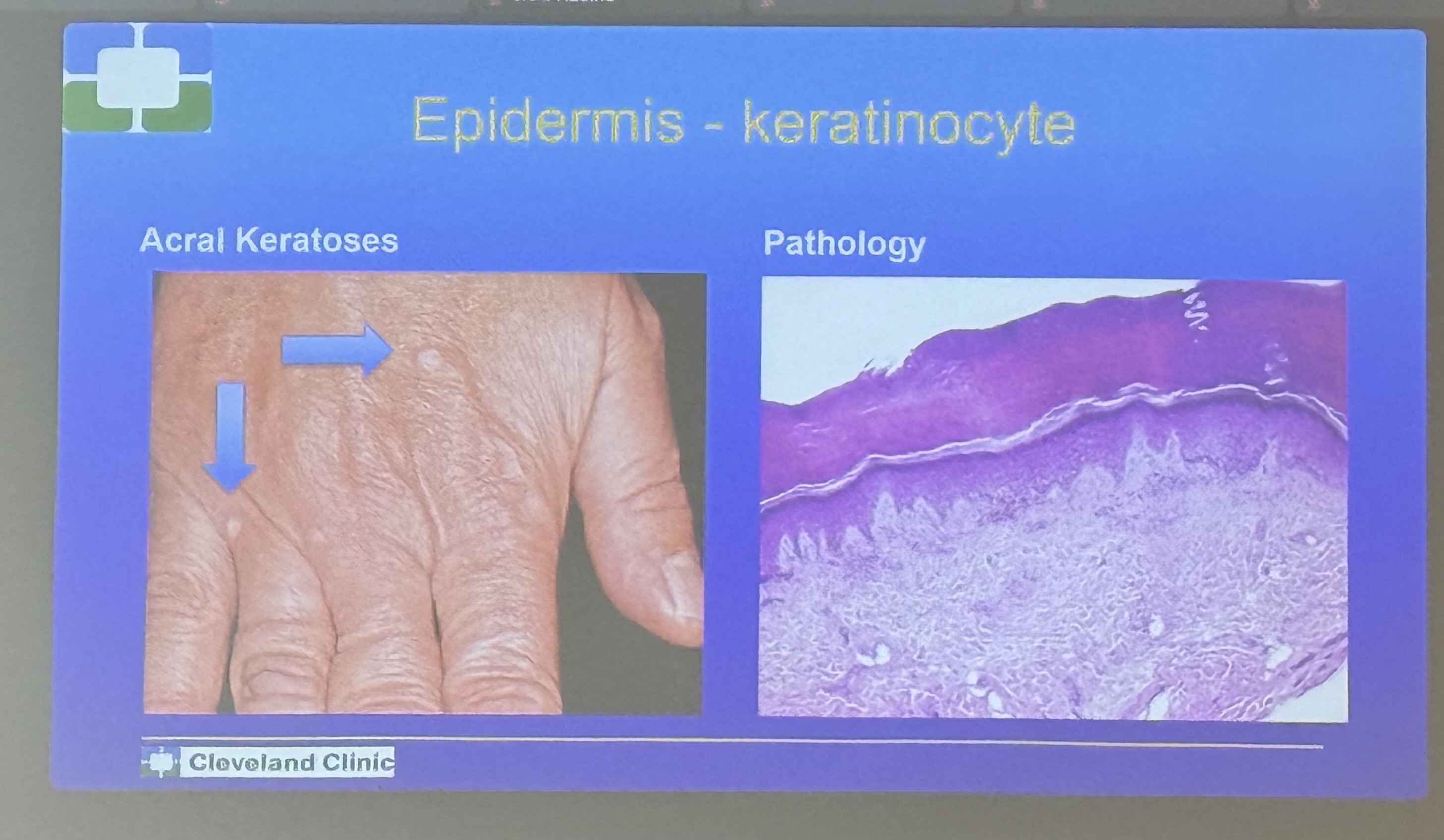
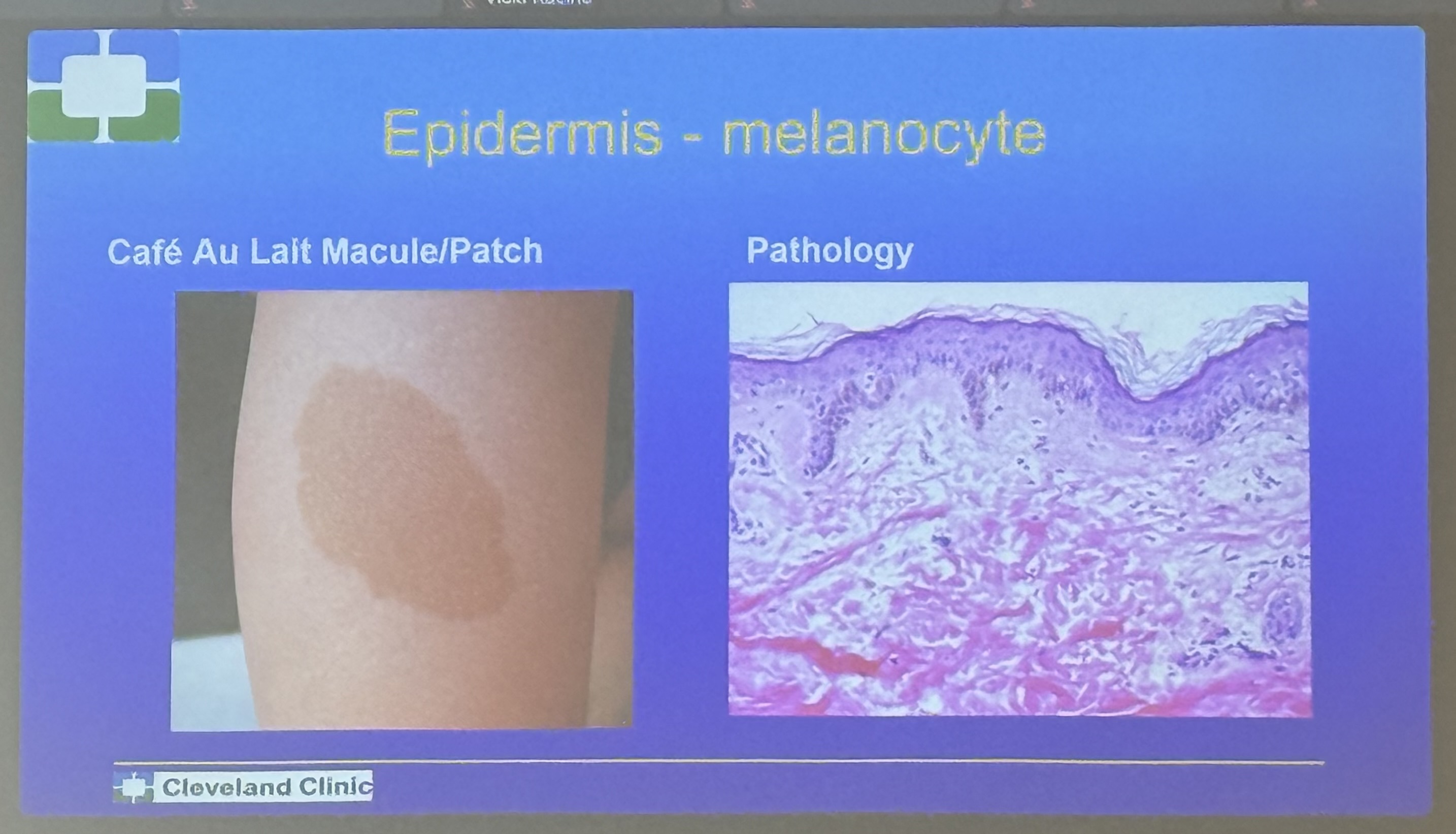
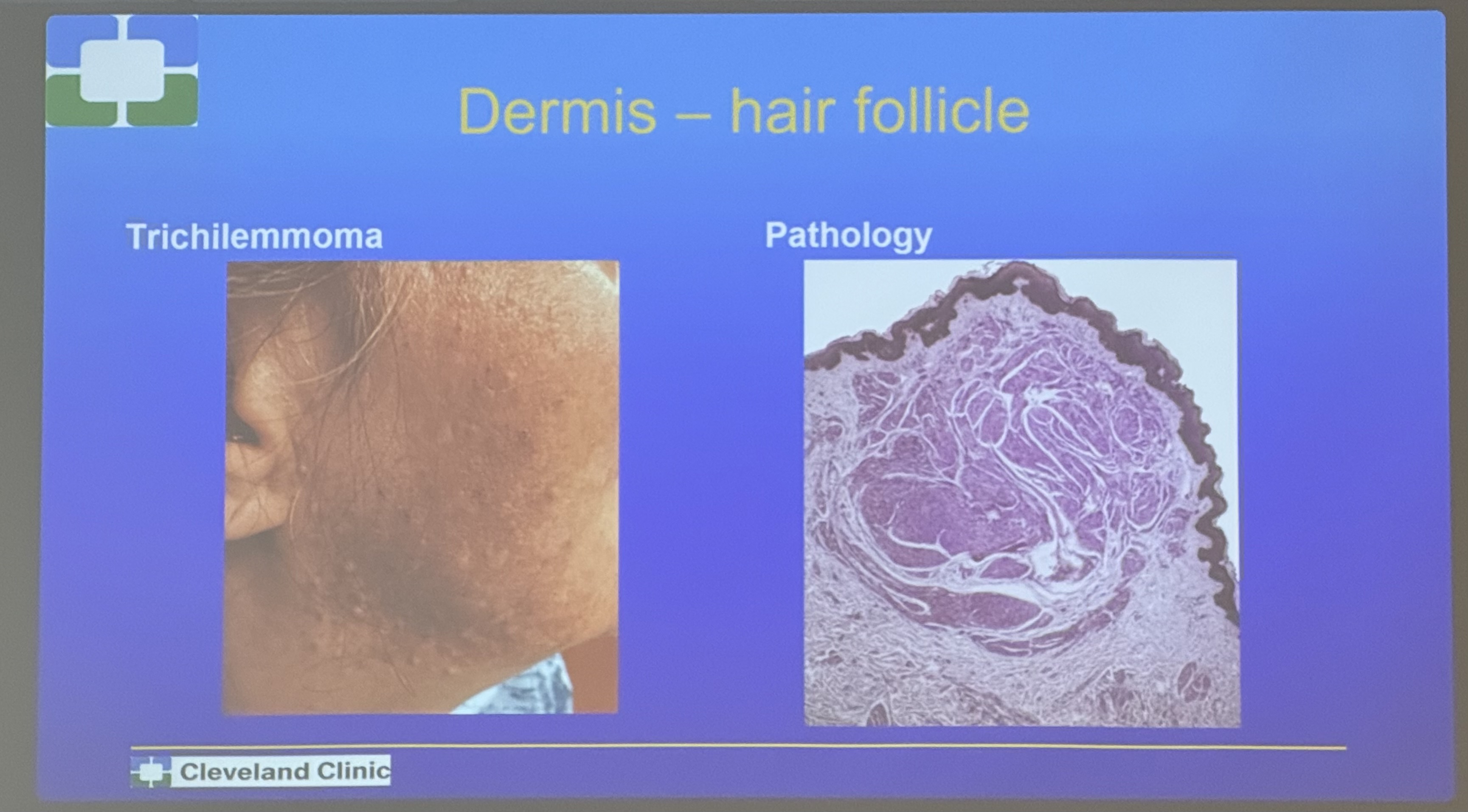
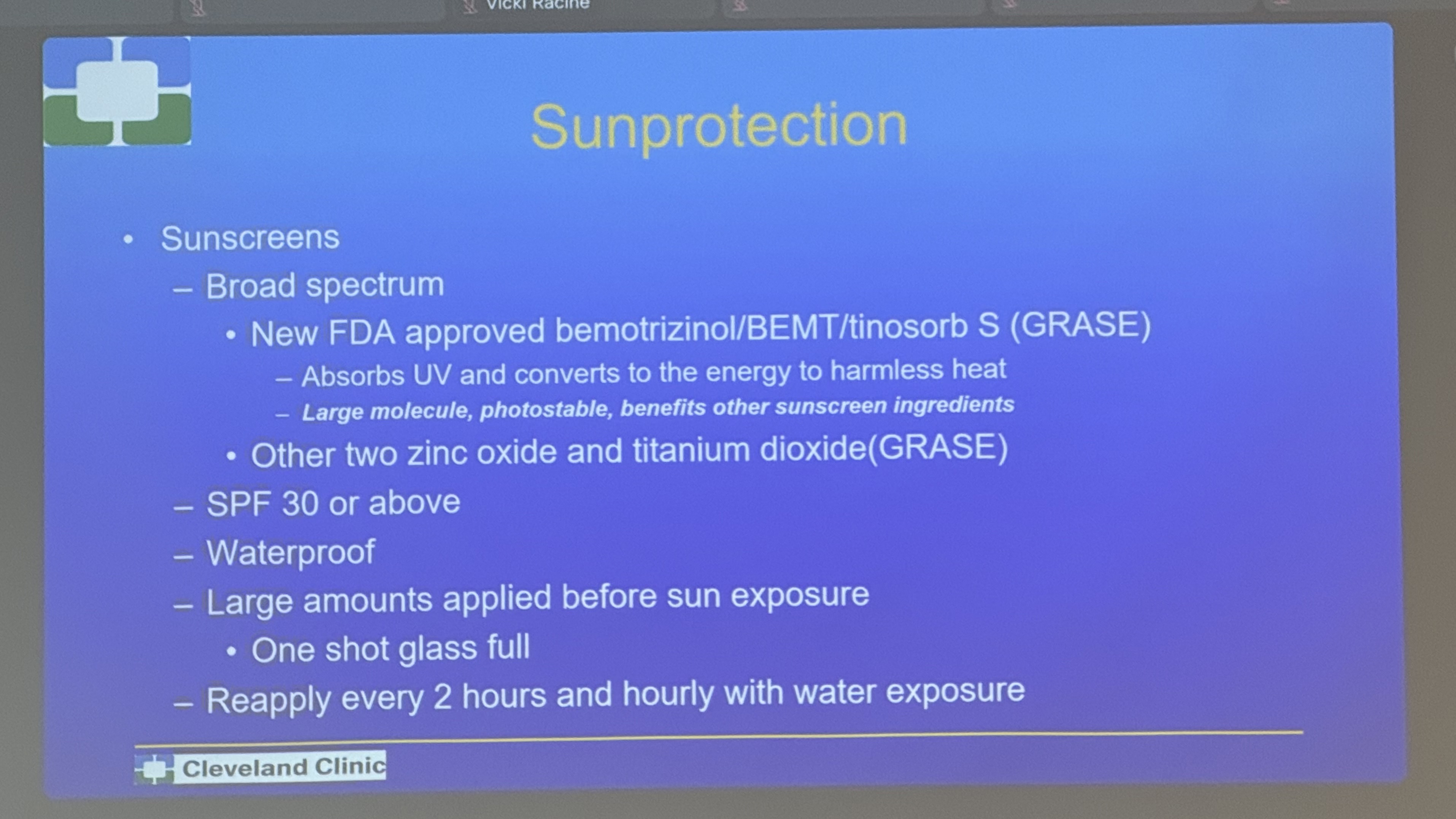
The next included Sun protection guidelines.

I learned that GRASE stands for ‘Generally Regarded as Safe and Effective.’
1:00 Dr. Whitney Eng – Seattle Children’s Hospital 

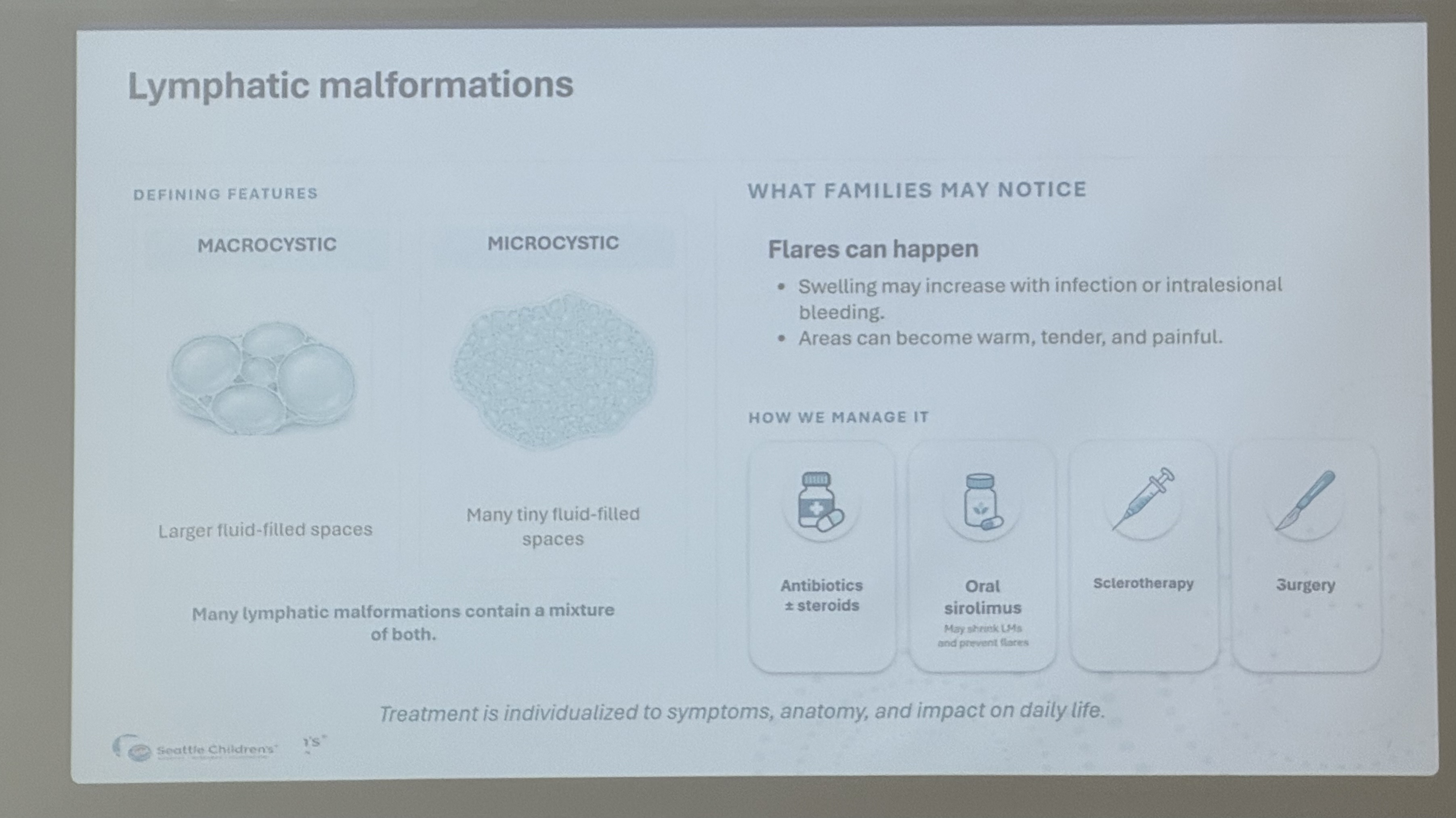
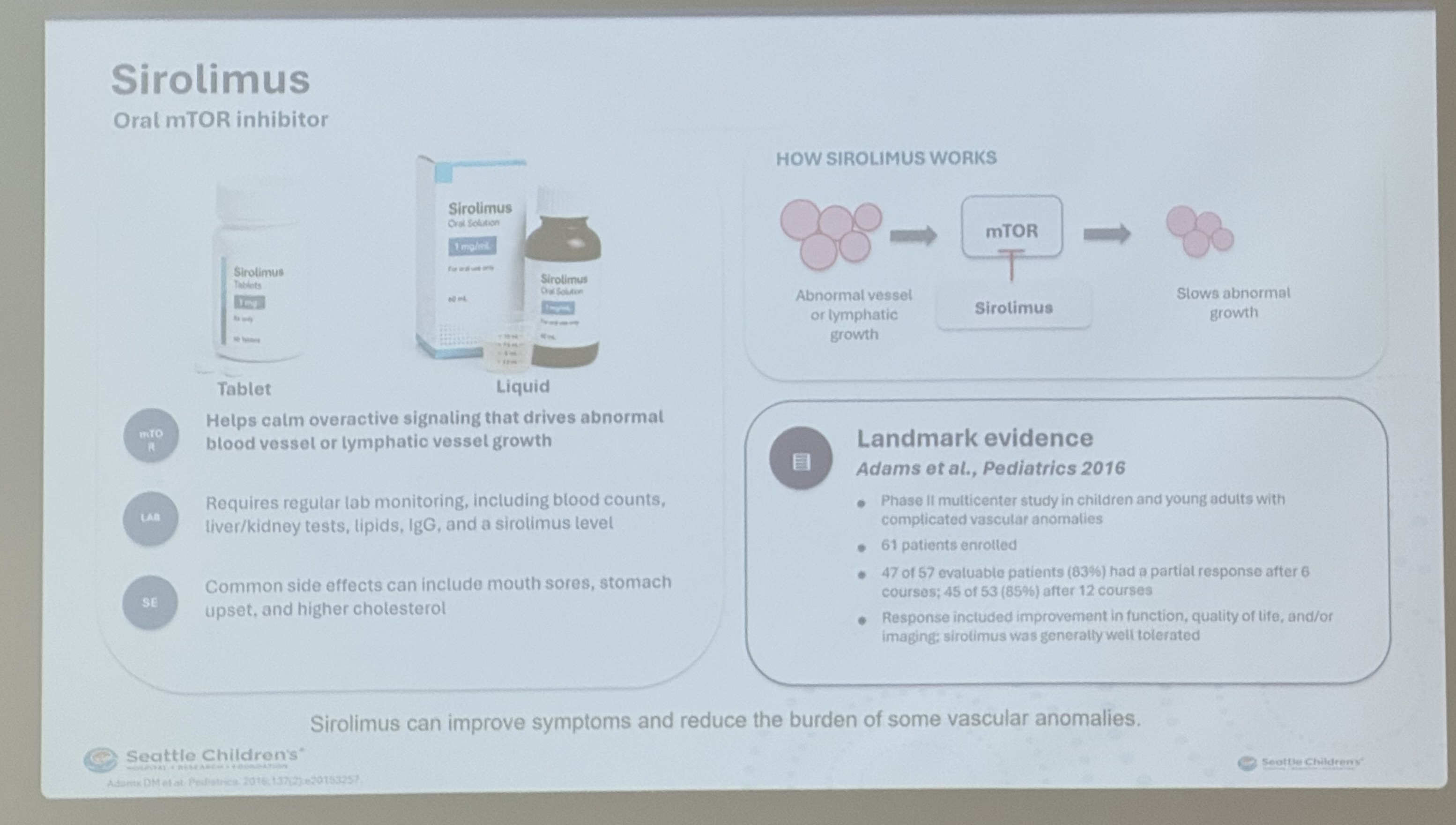
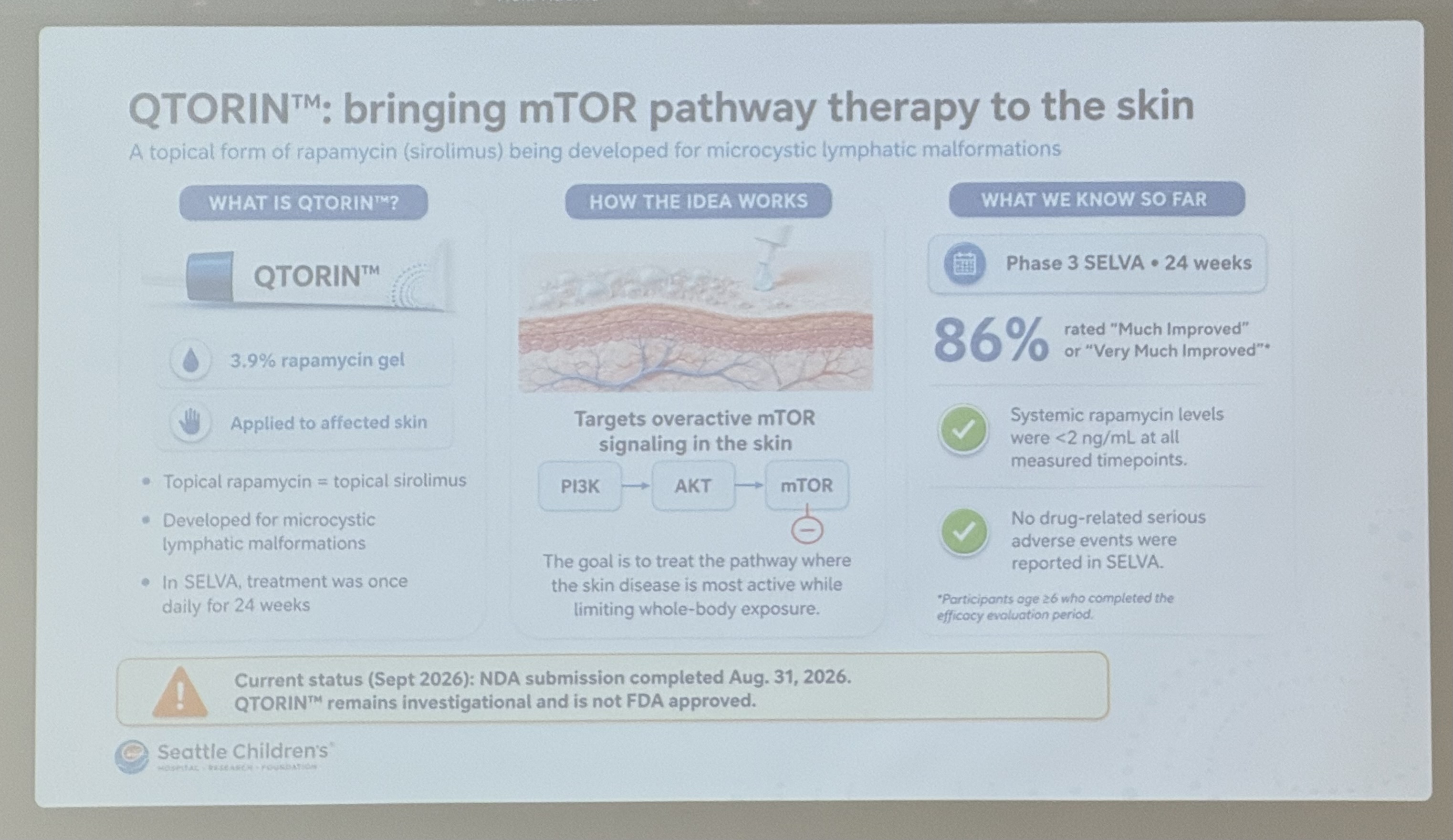
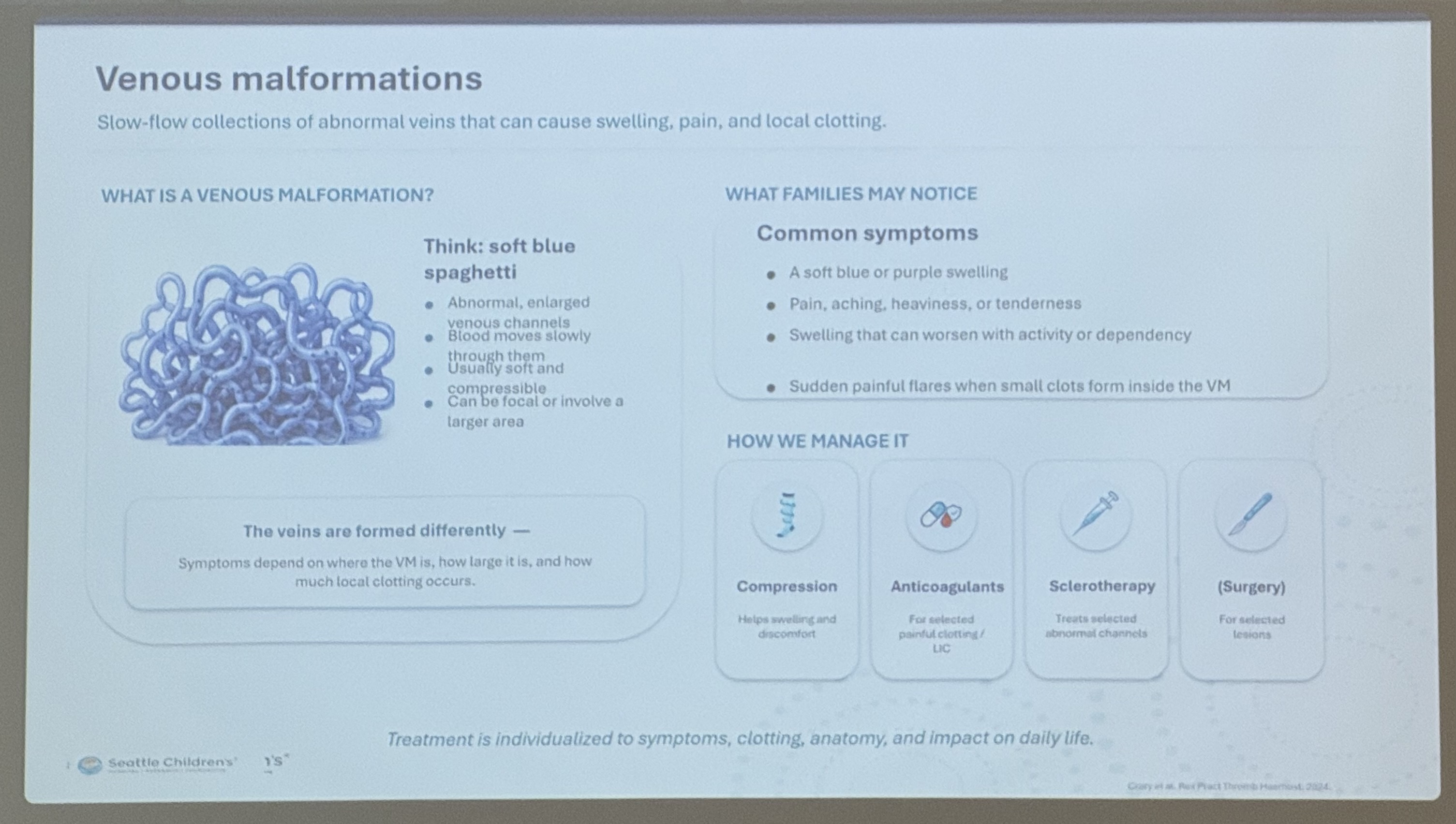
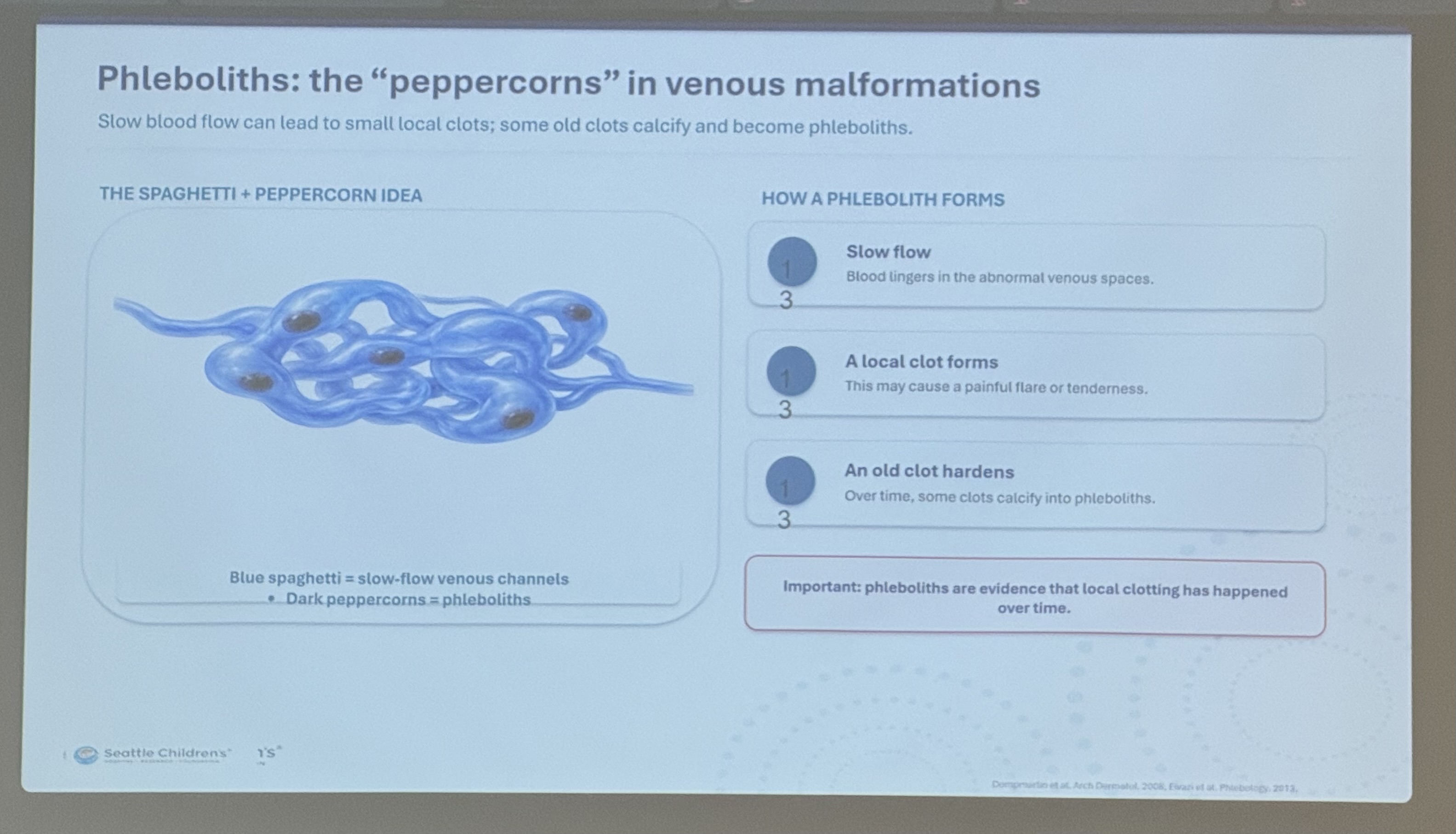
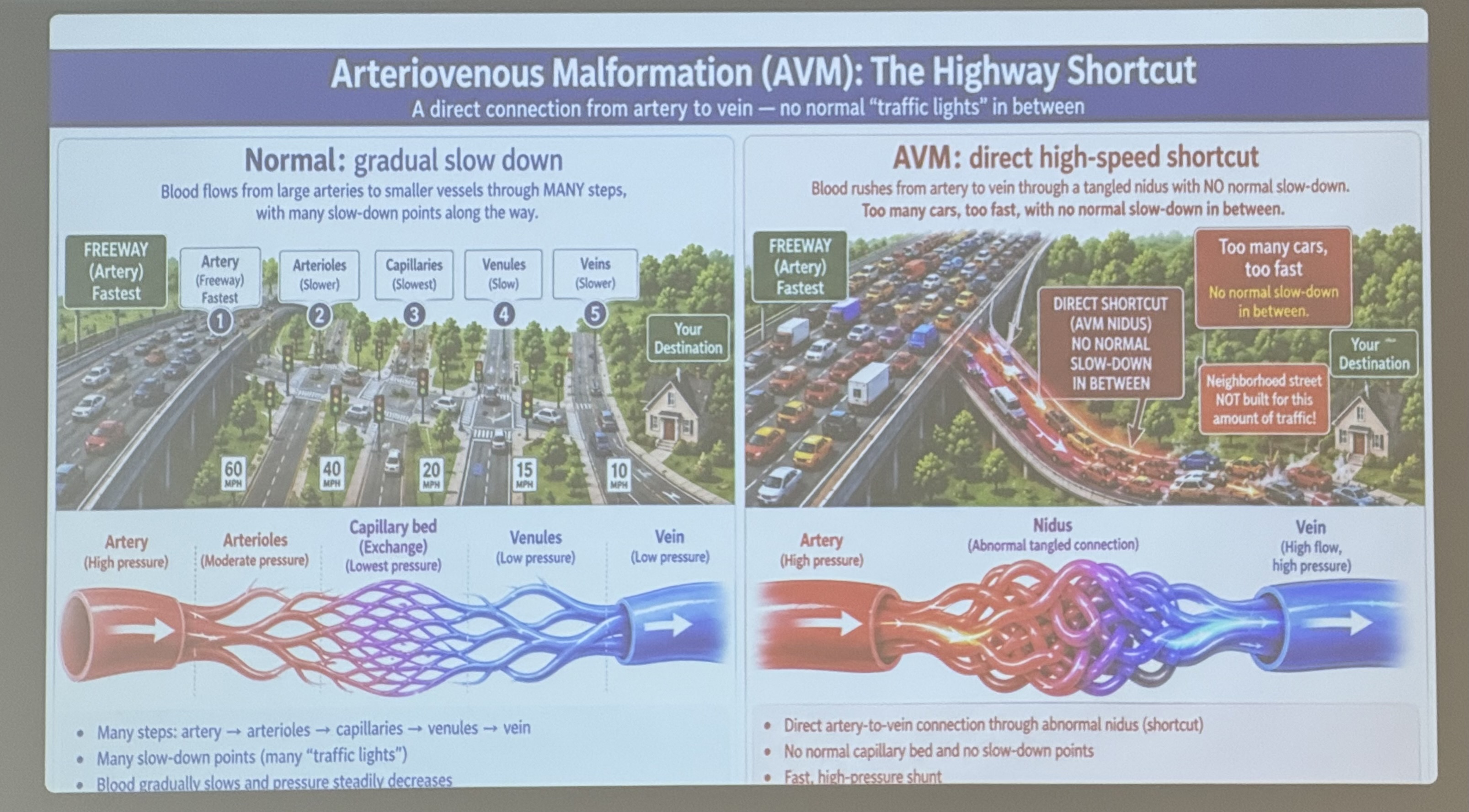
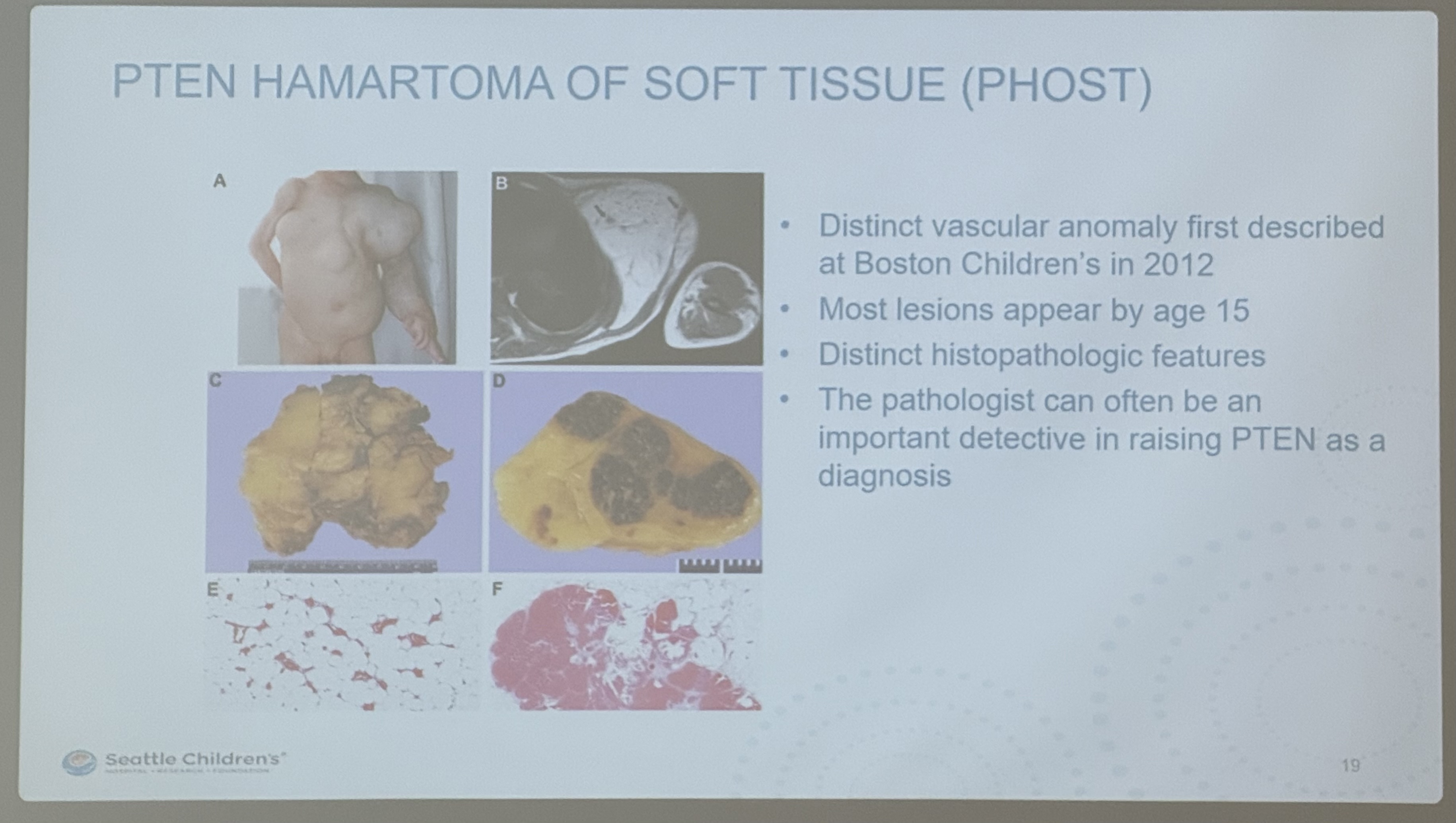
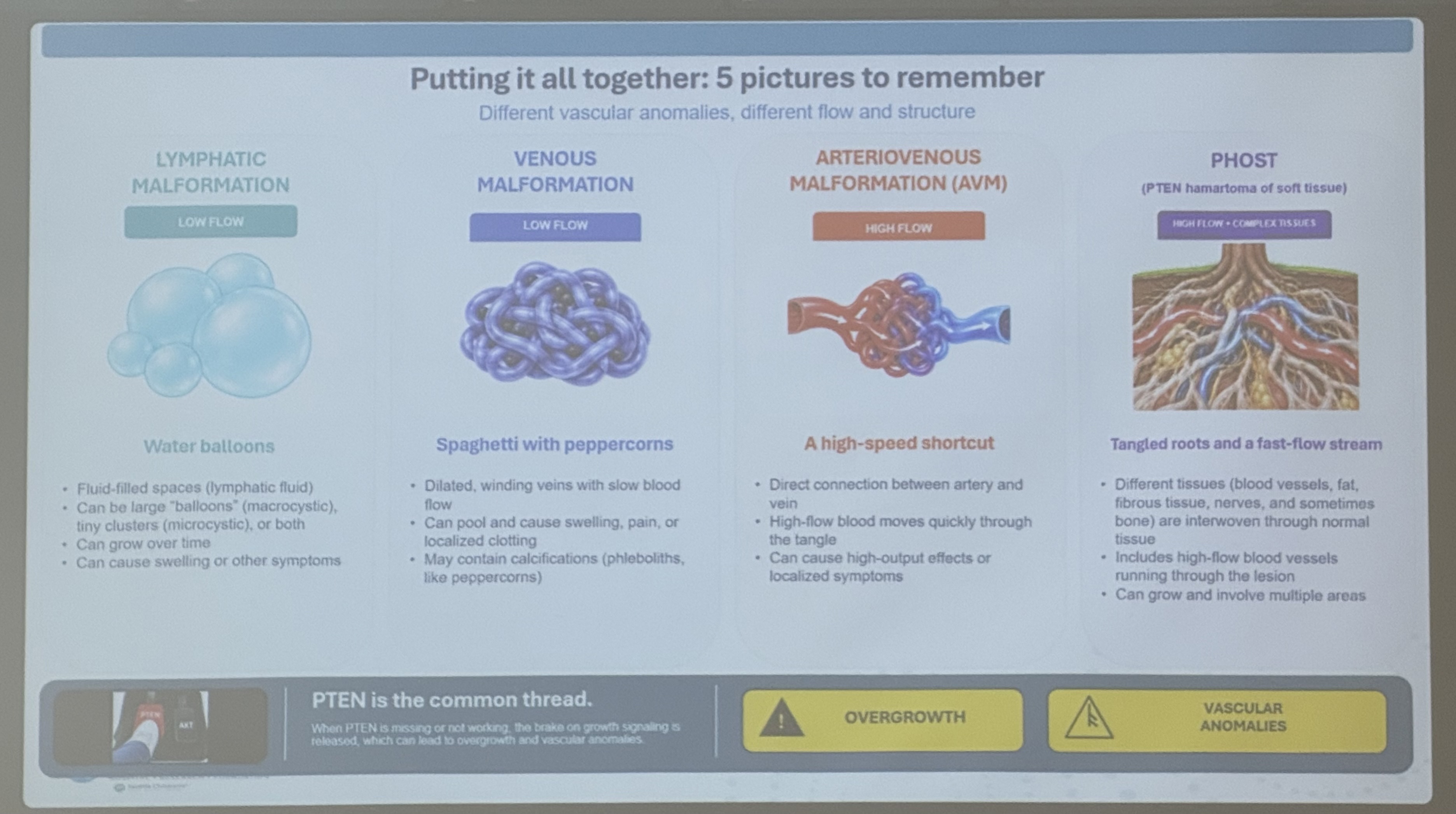
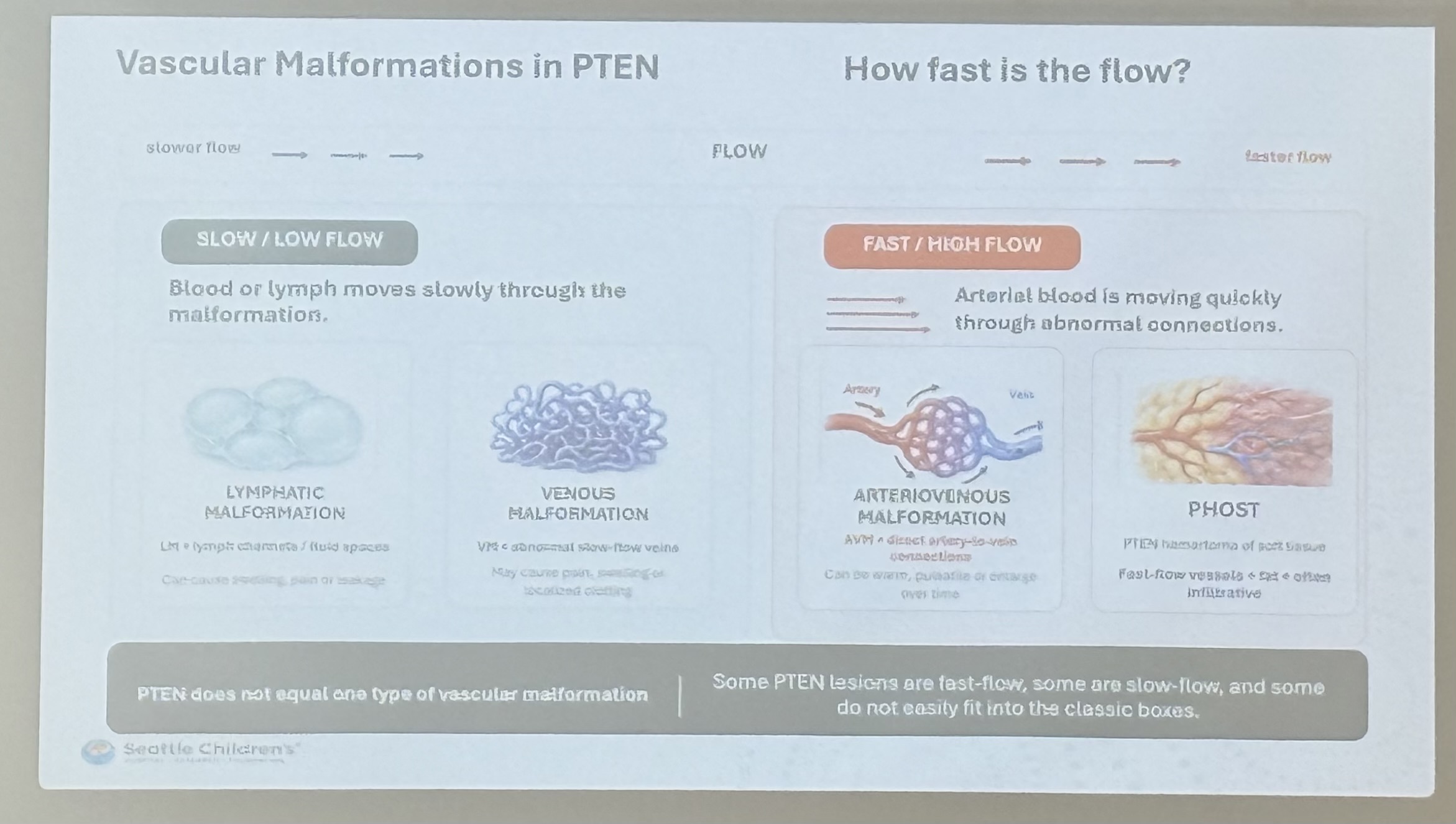
PTEN Vascular Anomalies

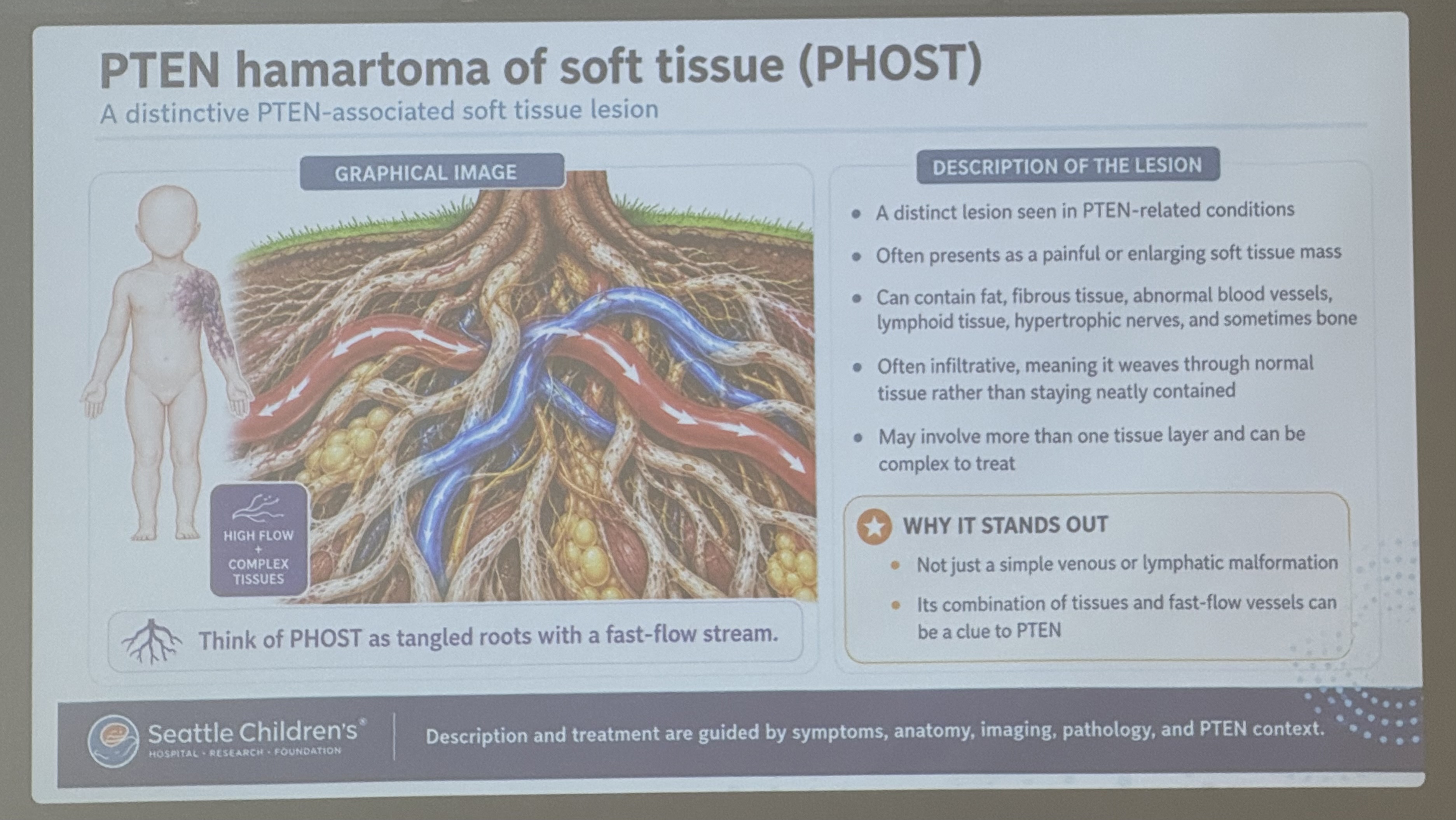
Dr. Eng had my attention from the start for a few reasons. Meghan and I have a heavily vascular presentation of PHTS, and in Meghan’s world, 12 of her surgeries have been on her right leg, due to vascular anomalies.

Also, the teacher in me thought the slides were super engaging and I loved the analogies she used.

I connected a few things in my own life through her presentation as well!
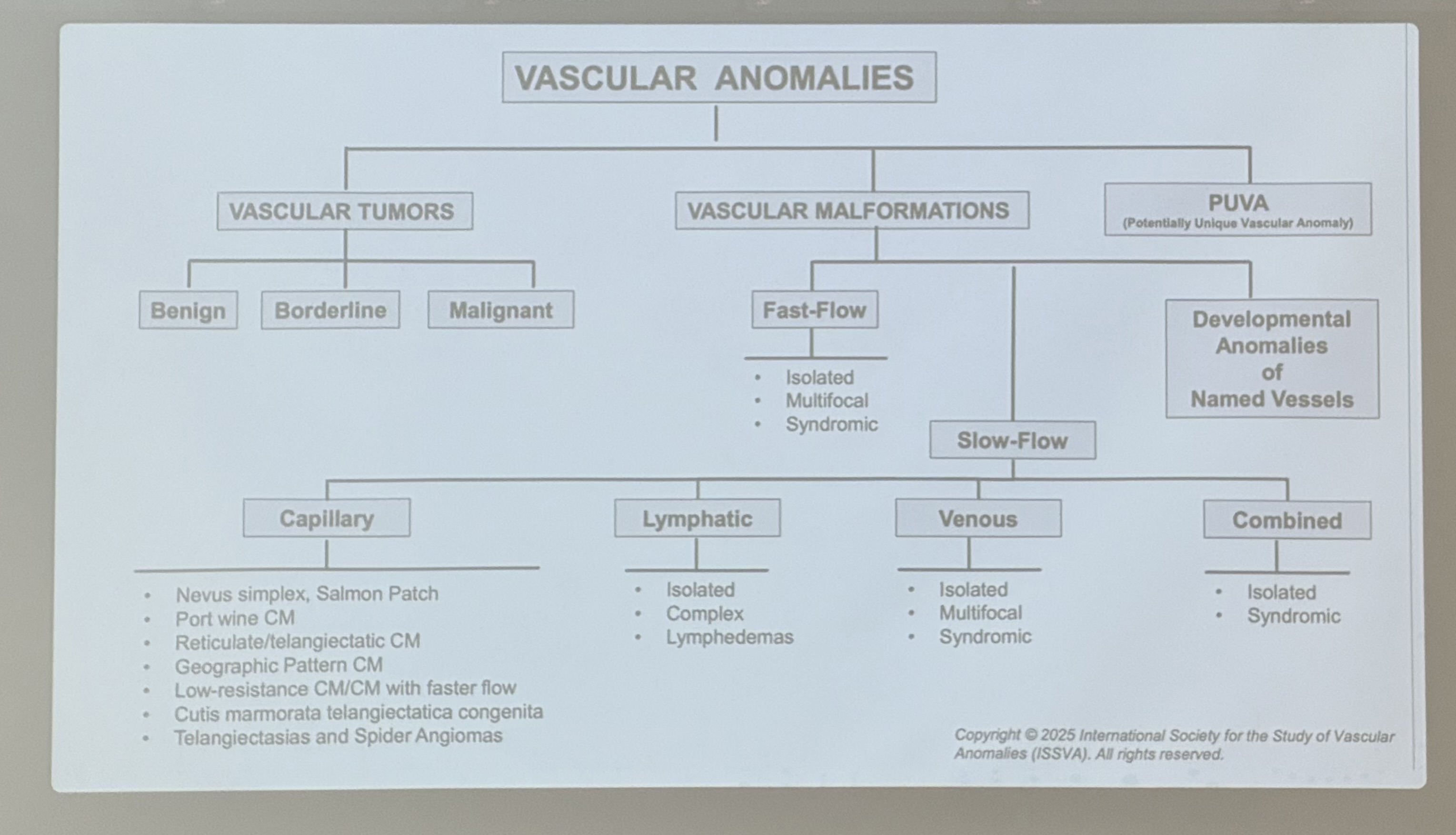
Before the presentation, I only knew of Meghan’s AVM in her knee and the beast of a PHOST tumor that tortured her for years. During the presentation, I came to realize the ‘varicose veins’ I have been battling since my 20s are more than likely connected to my PHTS.

Where that leads remains to be seen, but it was helpful to know it wasn’t that I had DONE something wrong per se. I have simply been seeing doctors who cannot/ or choose not to connect the web of symptoms I have.

I was also unaware that the tumors on my spleen, first discovered during my intake screening in 2012, and frequently classed as “lymphangiomas” by radiology, are, in fact vascular anomalies as well.

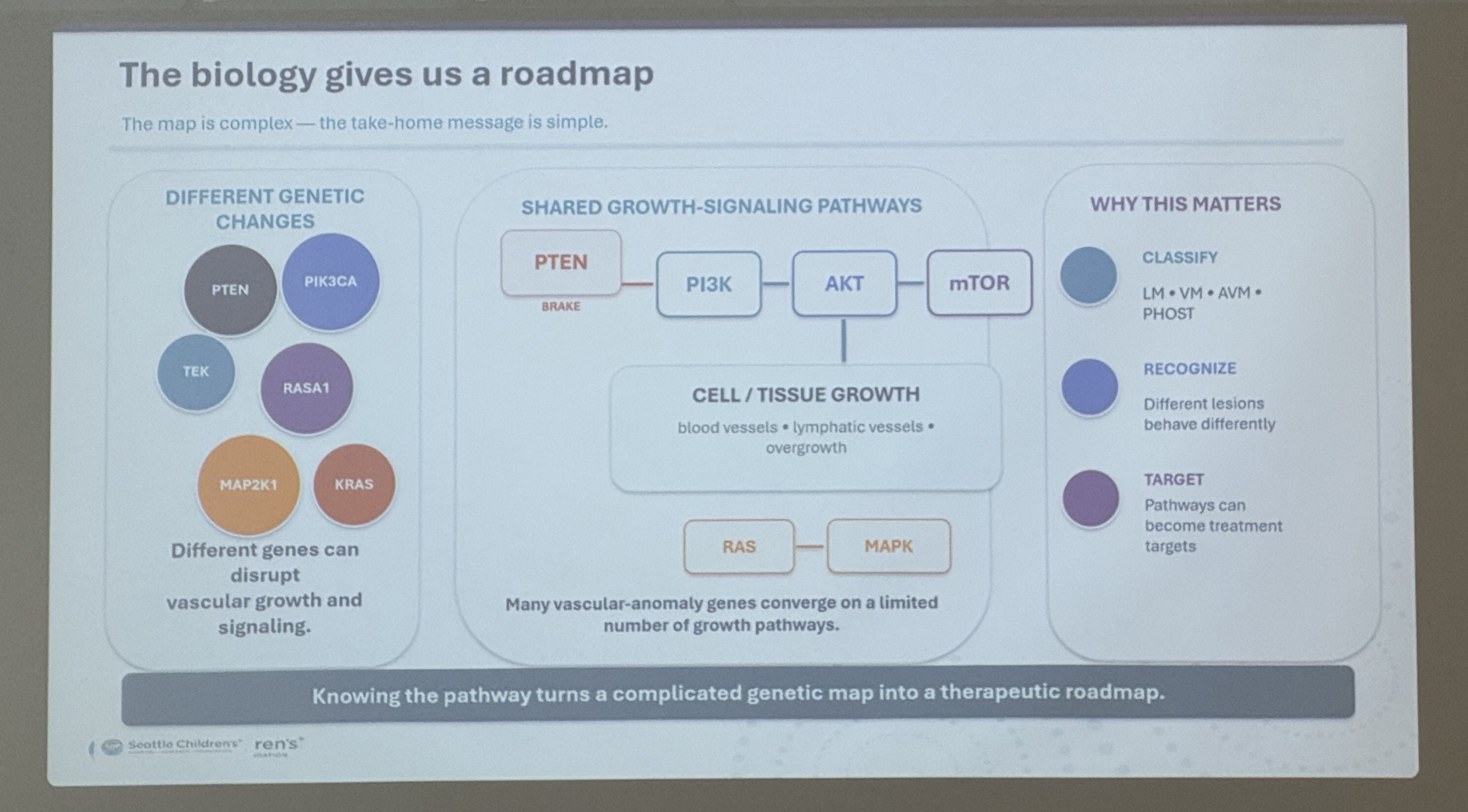
The biology of it takes a lot of work for me to understand, but with persistence and patience I am learning.

Our vascular journeys are far from over – but the knowledge gained is priceless.
1:30 Ying Ni, PhD Cleveland Clinic

Prevalence and Spectrum of PTEN Germline Variants

If I’m being honest, I was a bit checked out of this one. My brain was spinning after listening to Dr. Eng. 

I also think she was so super smart that a lot of the content was above me!

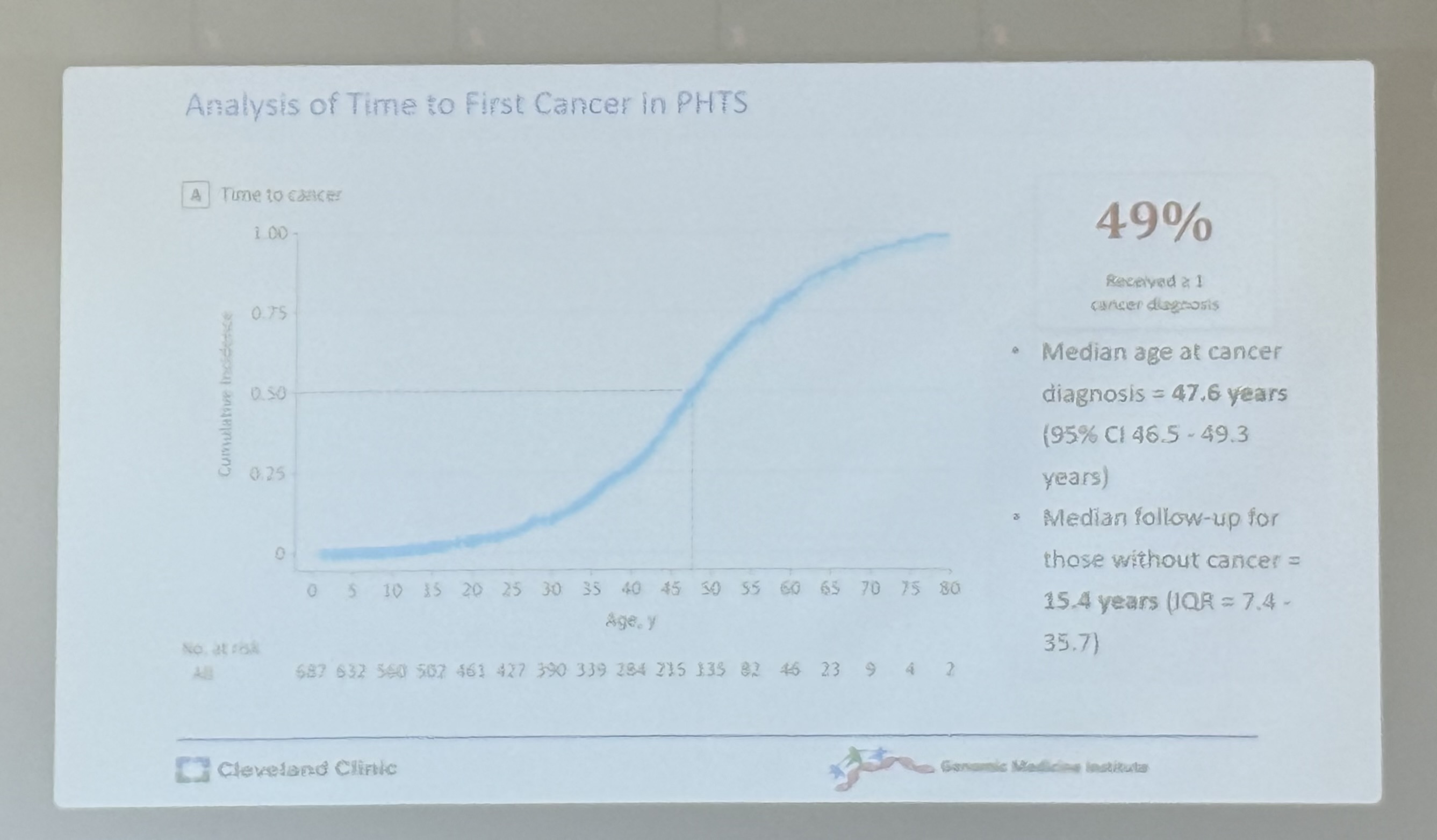
I did write in my notes that we are seeing younger average age of first cancer diagnosis in PHTS patients. It is now 46 down from 59.

I also noted that she said PTEN mutations may be a bit more common than we think/ know.

2:00 Ms. Jana Heady MS, CGC- UT Southwestern 

UT Southwestern PTEN Program

I did not do much better with this presentation. I think it is harder for me to drill down into the genetic part of PHTS now that we are 15 years post diagnoses.

I did learn something about germline mosaicism that I never fully understood. But, it will only play into unproven theories of our disease origin in my own family. 

2:30 Dr. Denise Adams- CHOP

PTEN Vascular Anomalies Research

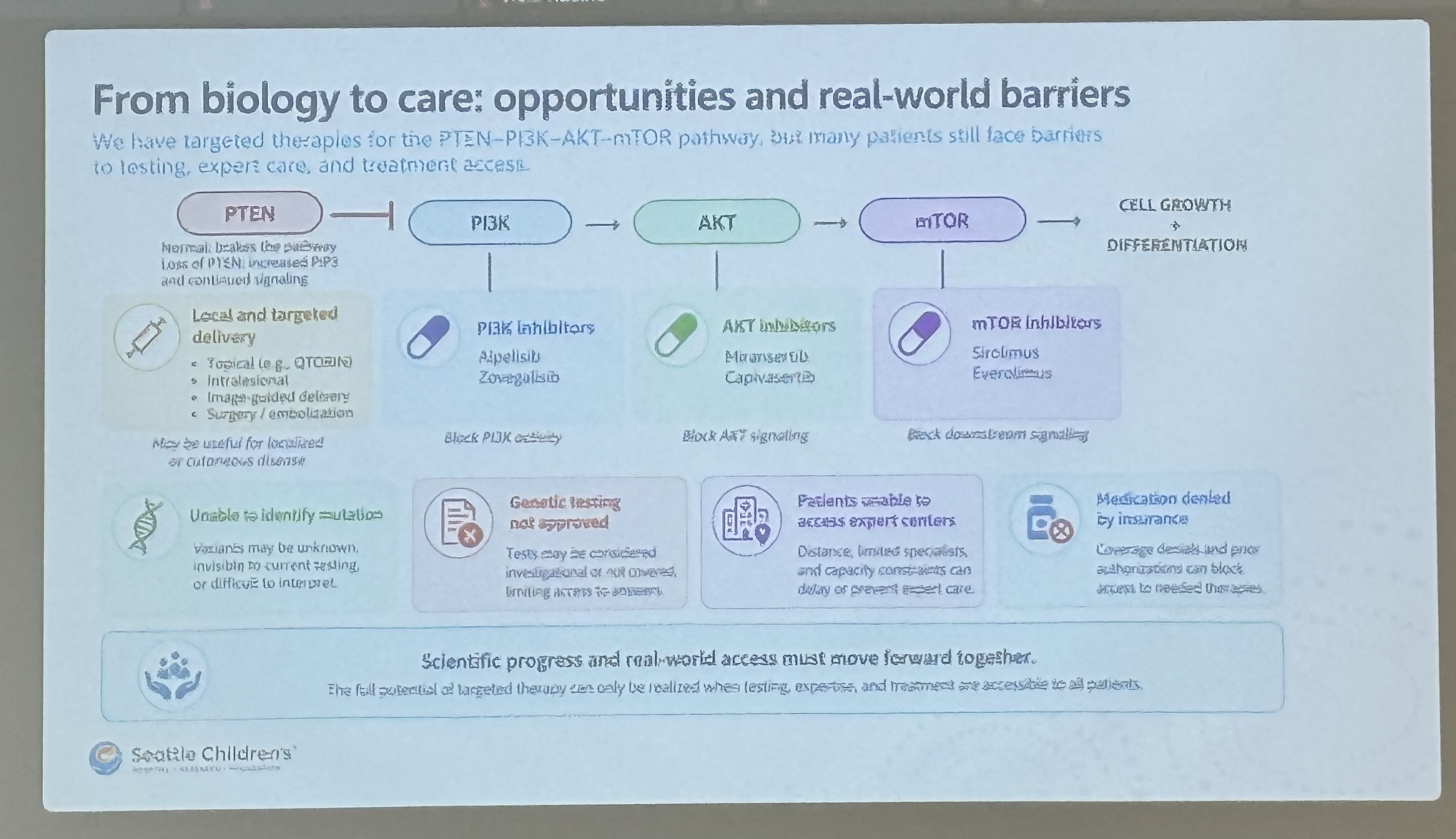
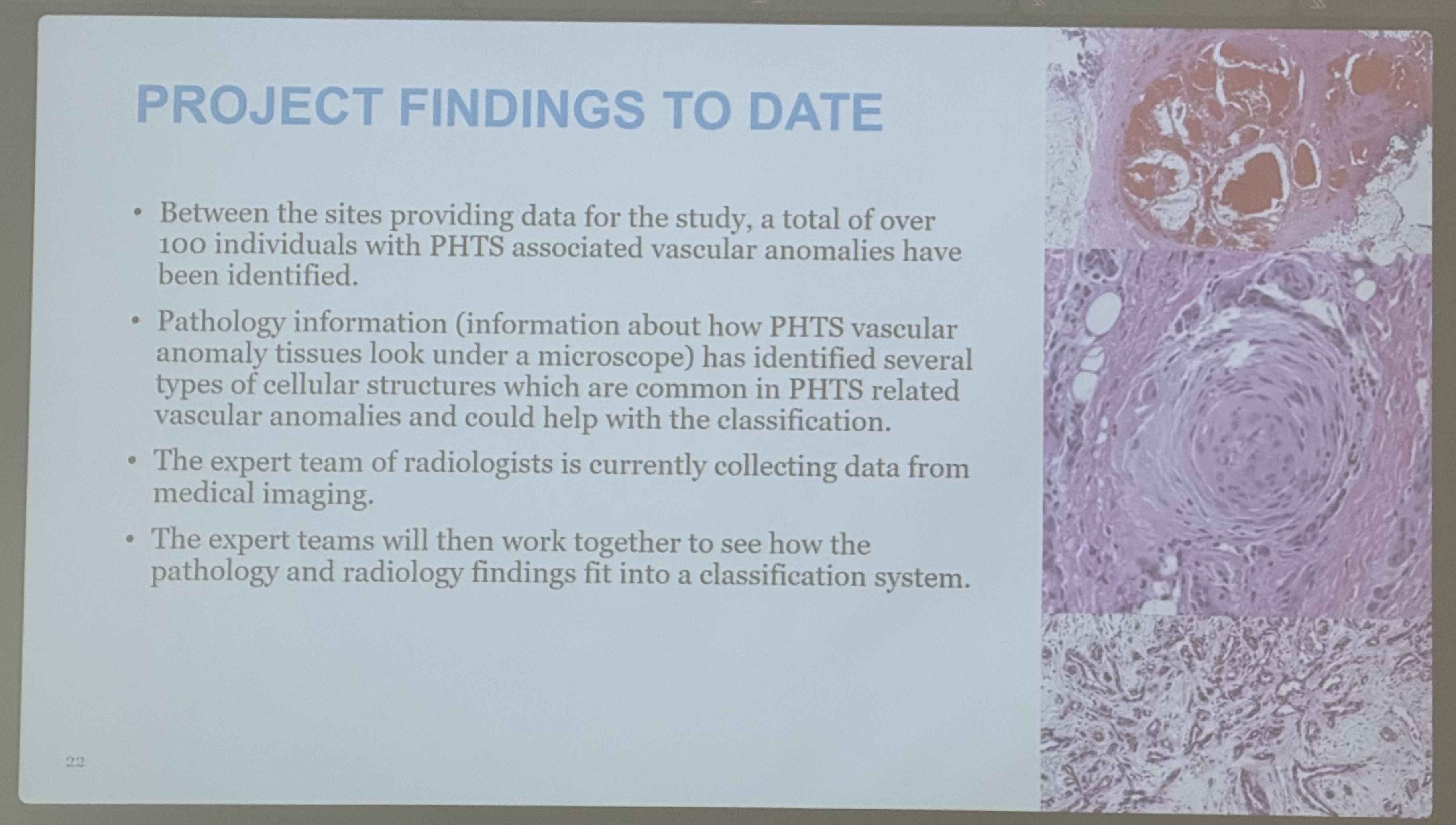
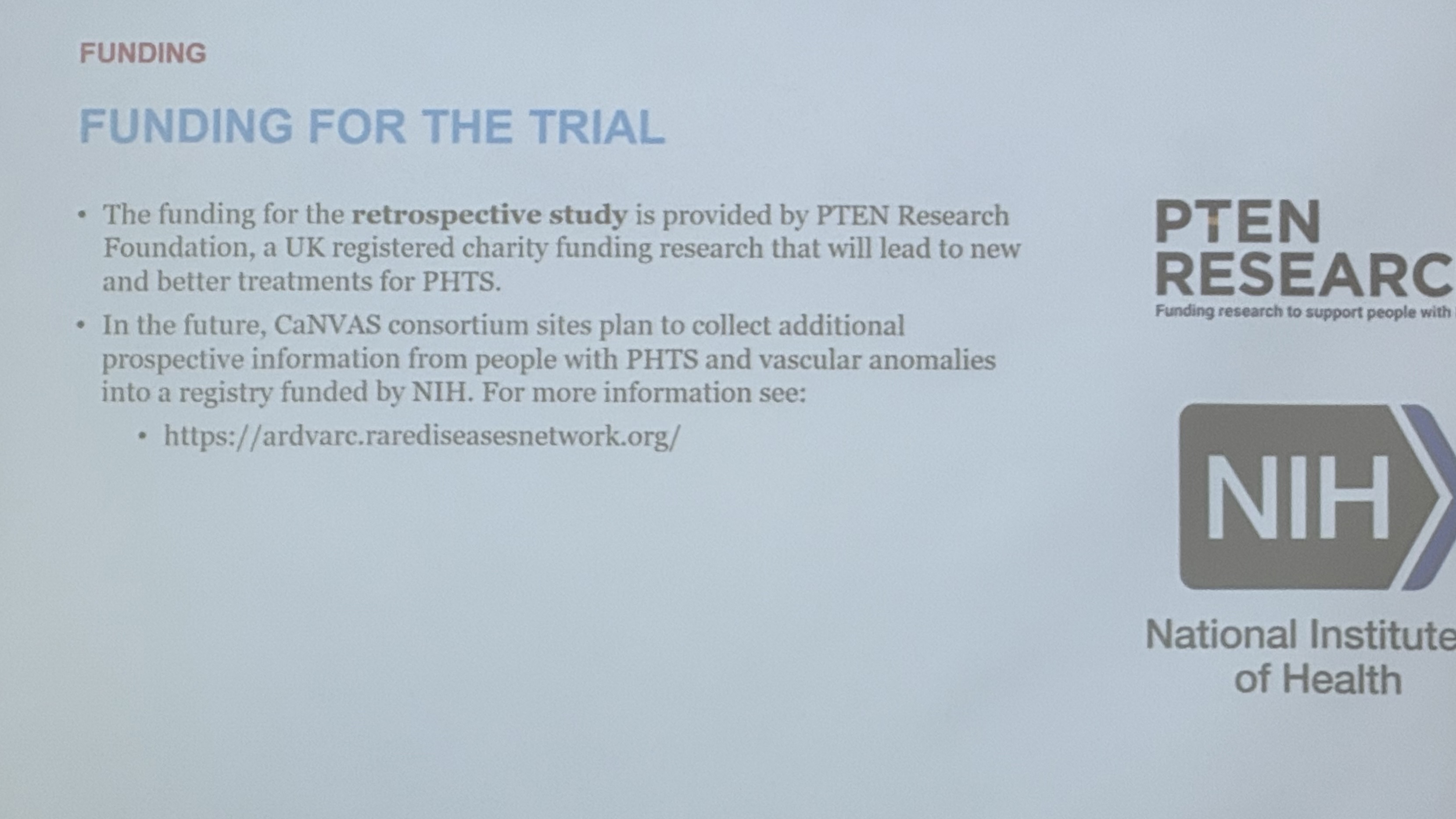
Again, because vascular anomalies are so personal to Meghan and I, I was more dialed in here. I have enough slides to share the gist of the presentation.
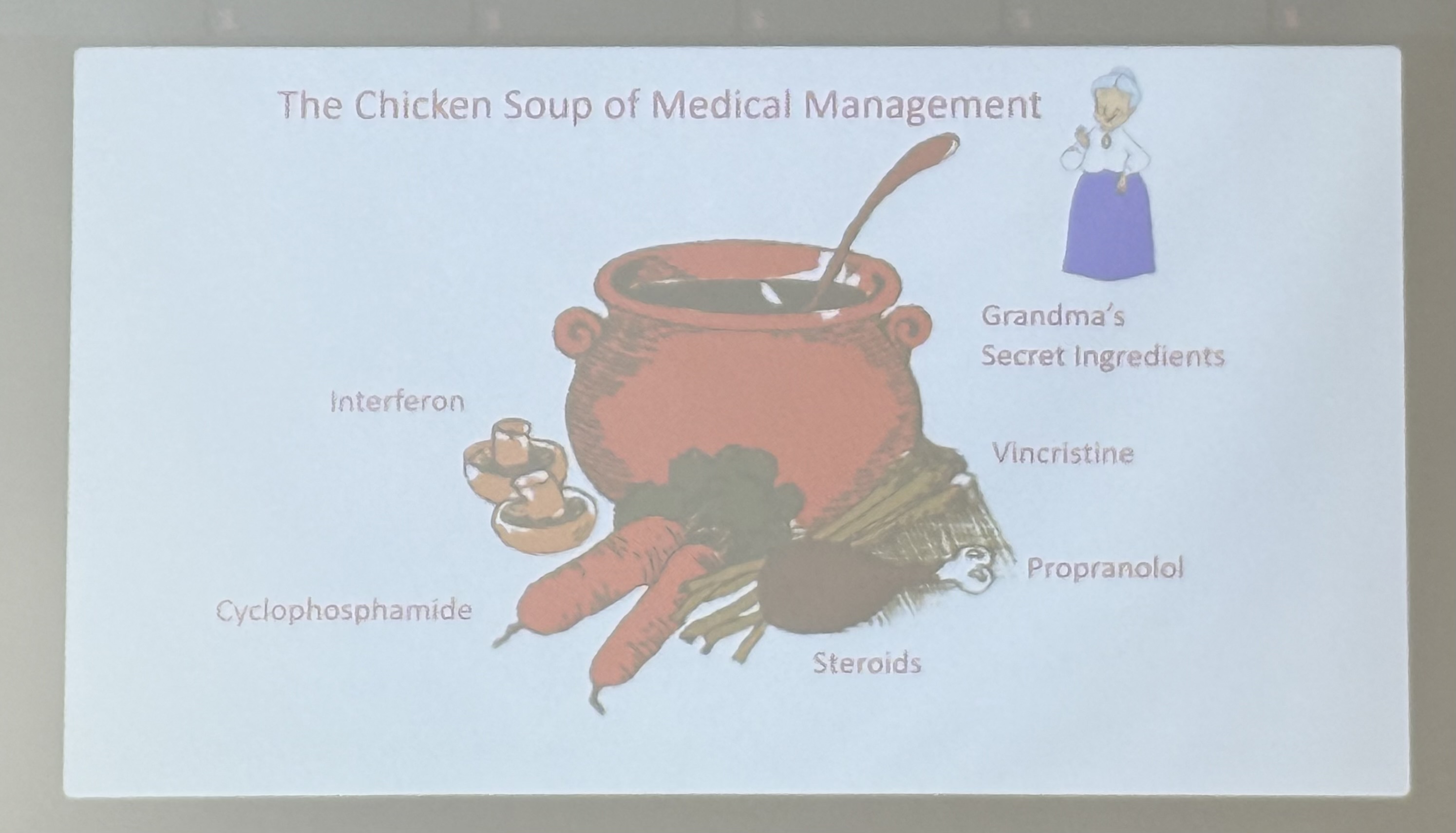
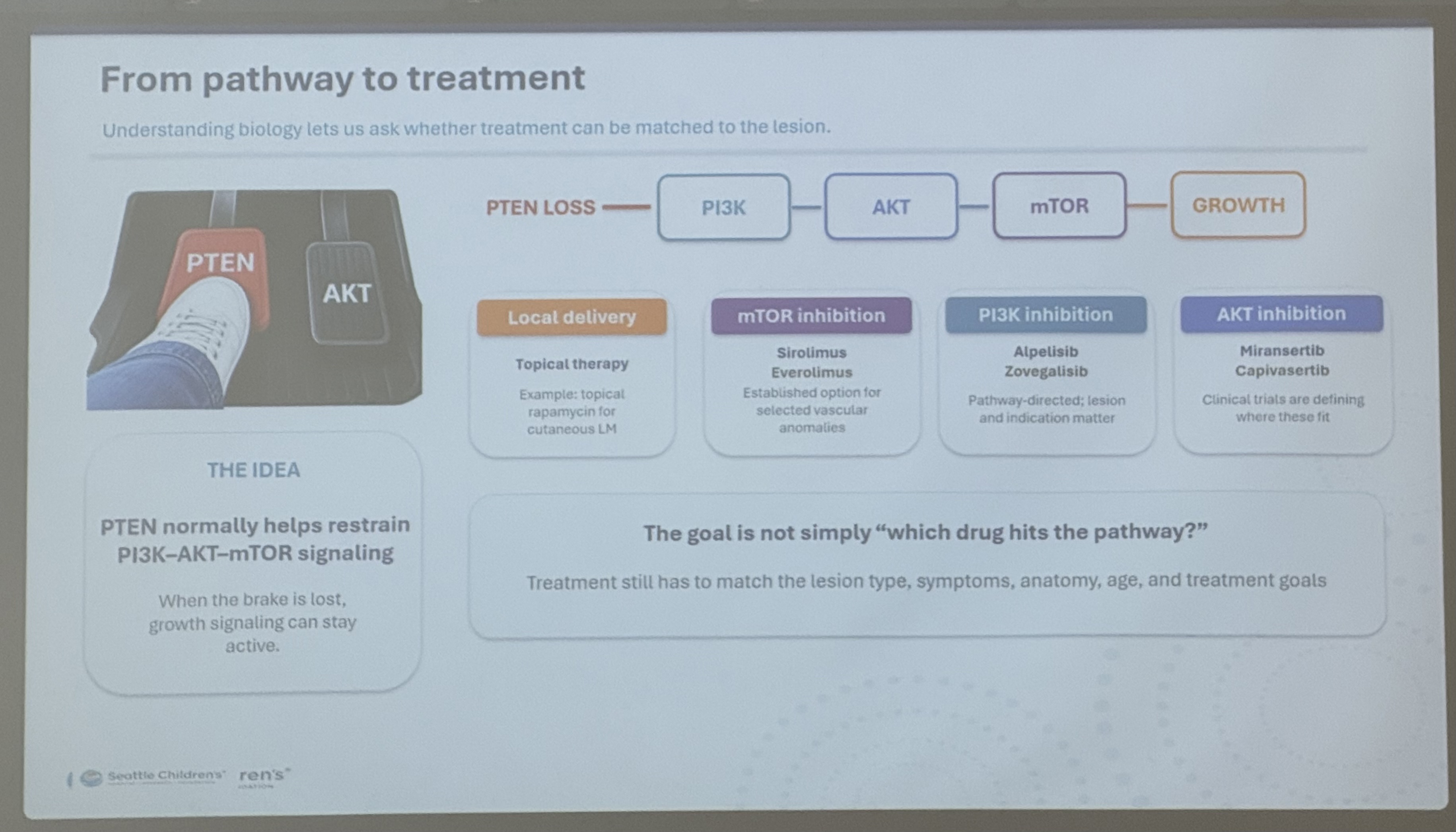
This slide got my attention because I recognized a few drugs, including propranolol, recently prescribed to me to potentially assist in my migraine management.
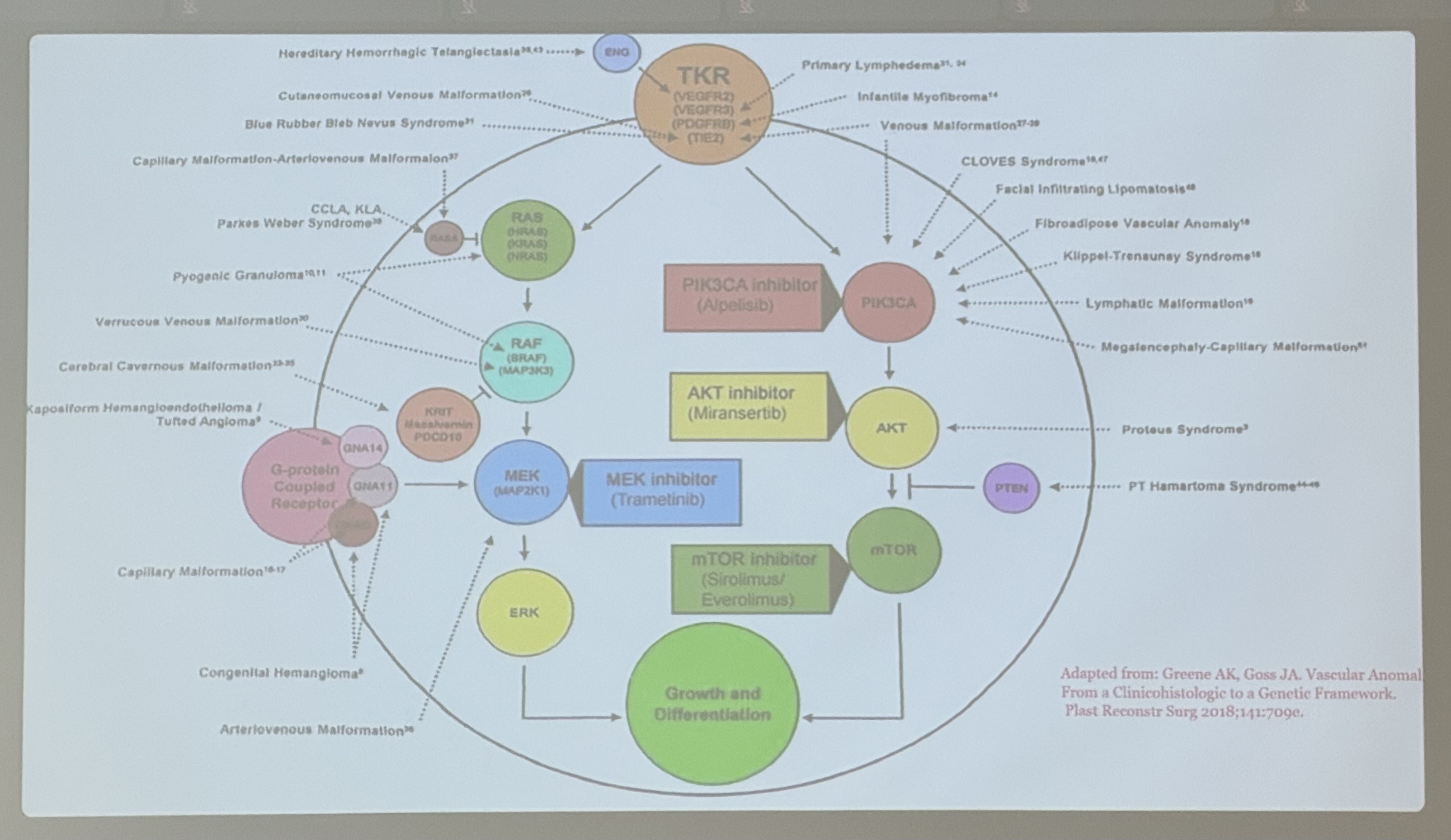
That slide makes my head hurt but I kept it because some of your understanding far surpasses my own. I was excited I knew SOME if the terms!

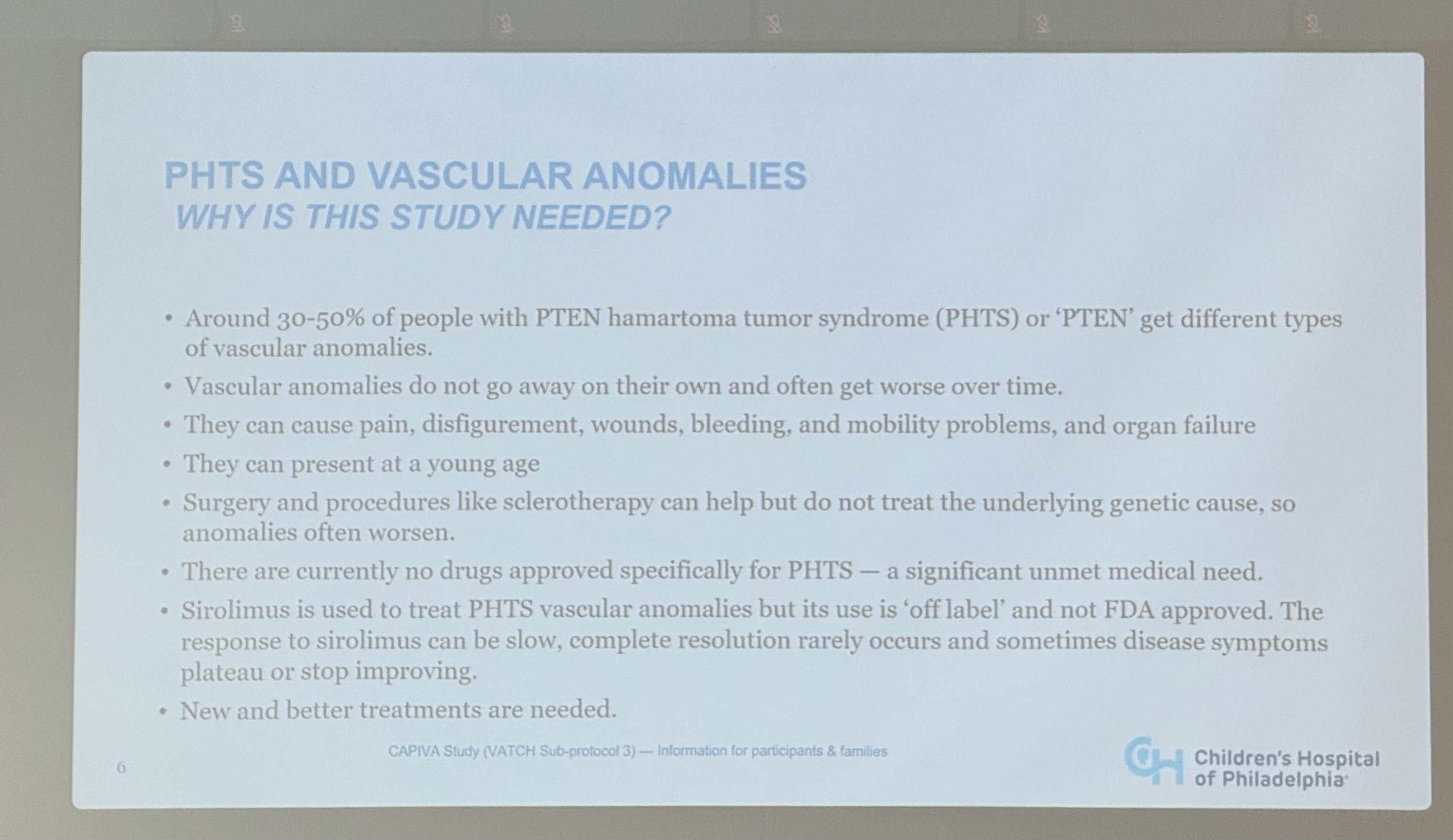
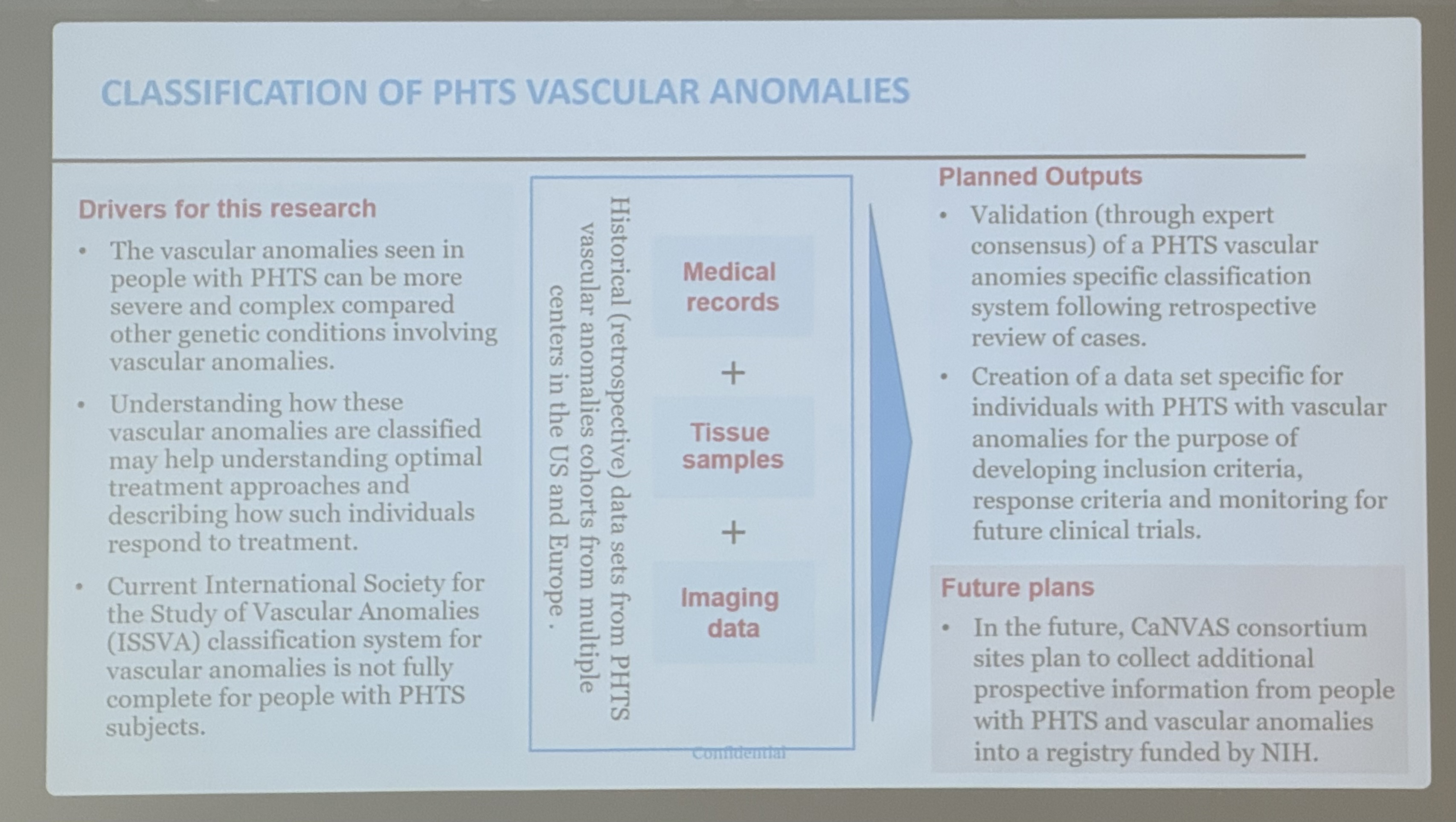
Dr. Adams was speaking of two studies, but proceed with caution because I do not have a full set of slides on either one.

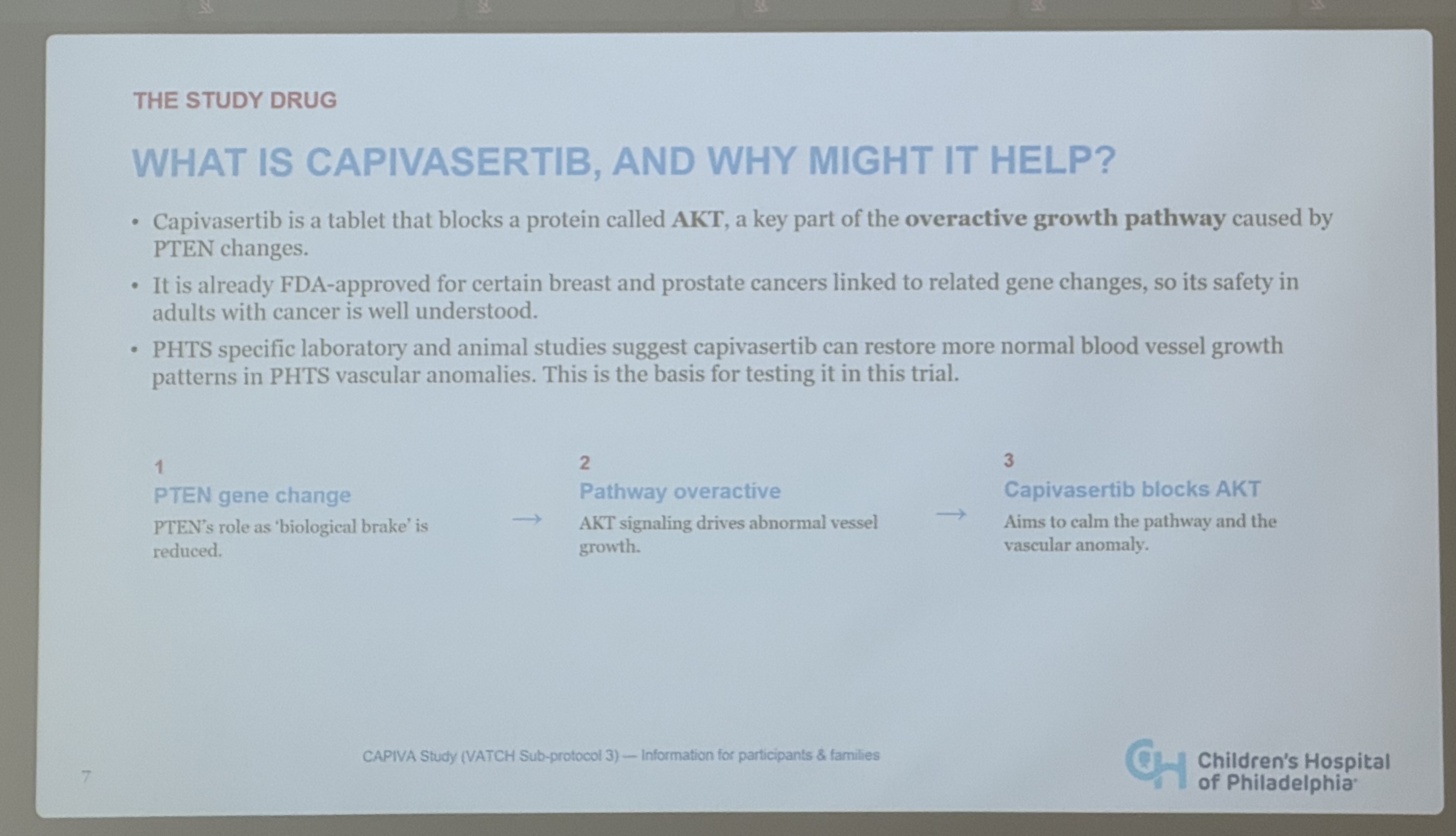
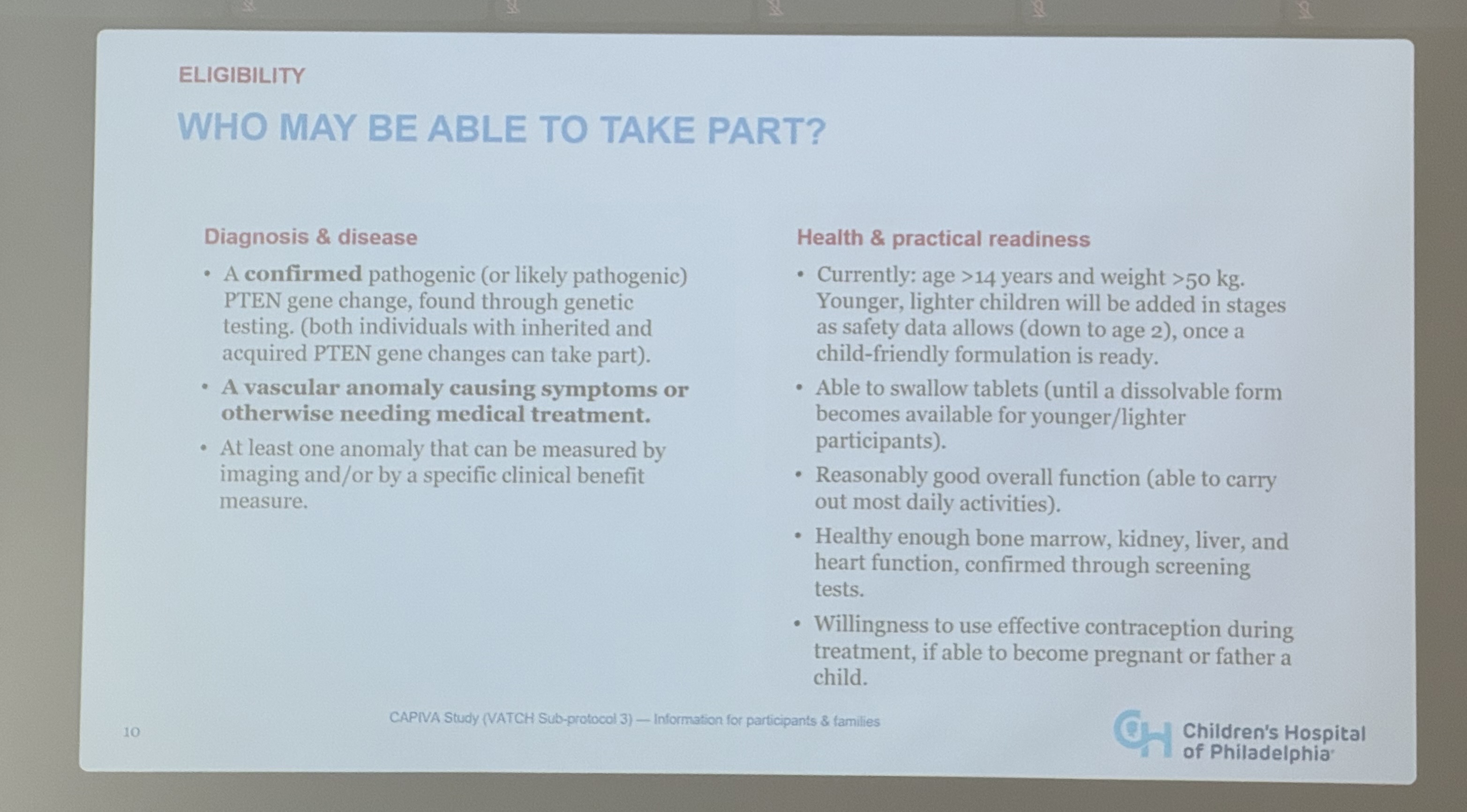
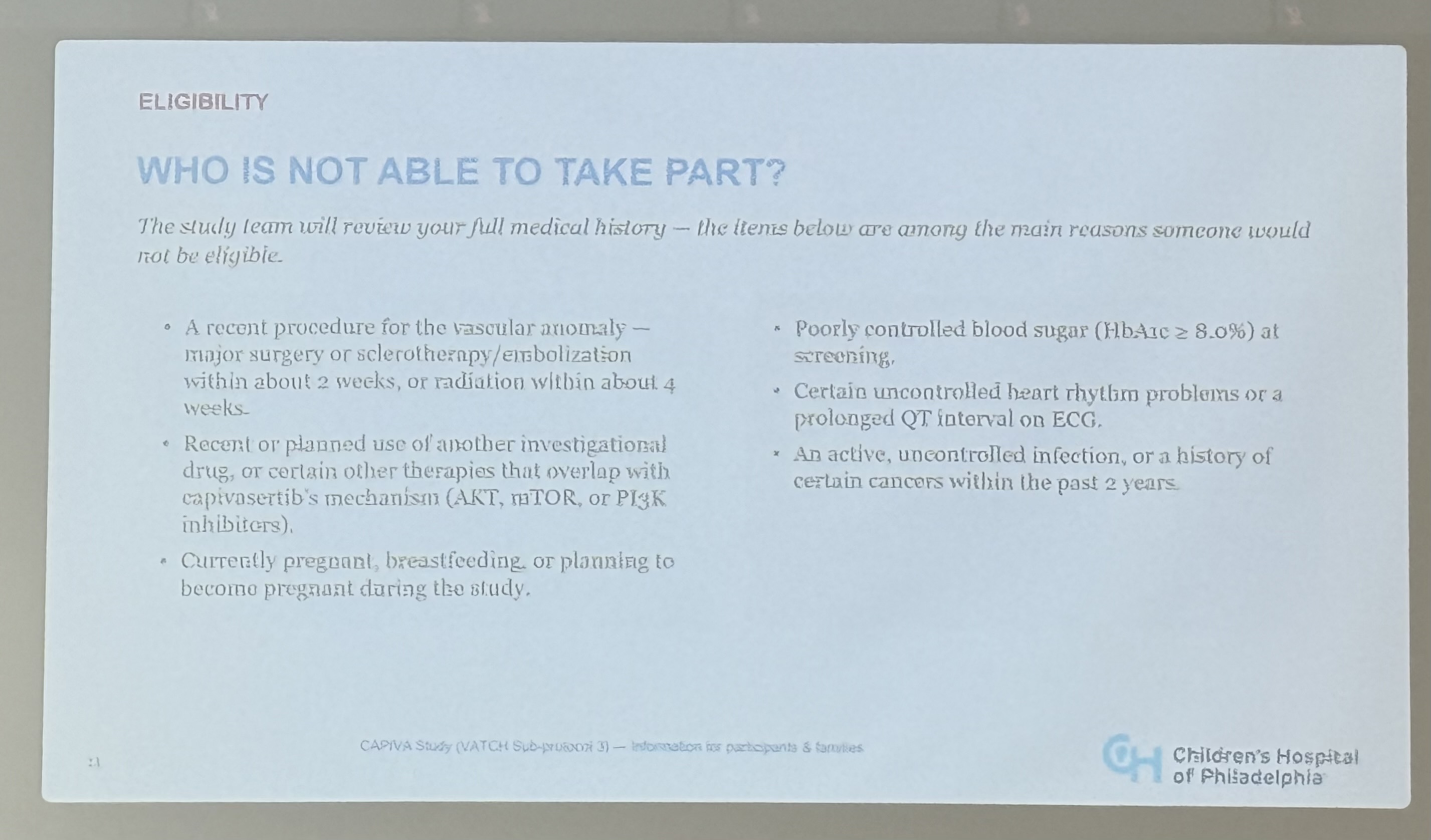
I believe these are for the ‘CAPIVA’ study.


The other one is a research base retrospective of 100 PHTS patients with vascular anomalies.

This girl is the BEST!

Every year prior to this one, I wished I had been at the in person Symposium. I always wished I could have seen and heard the presentations. I hope this helped some of you who were unable to attend.

I wholeheartedly recommend attending in person when you are able and I am grateful that this year I was able to.

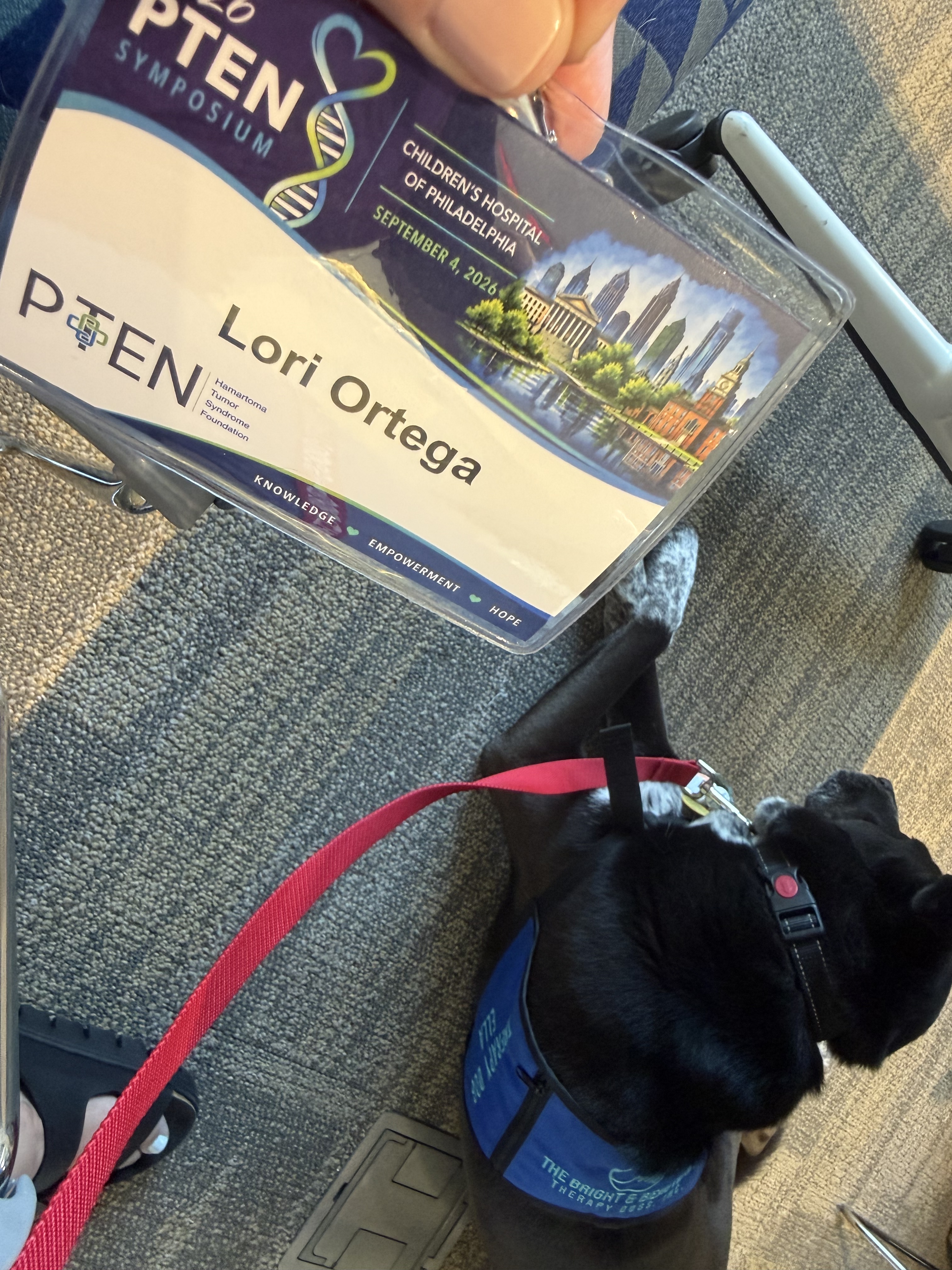
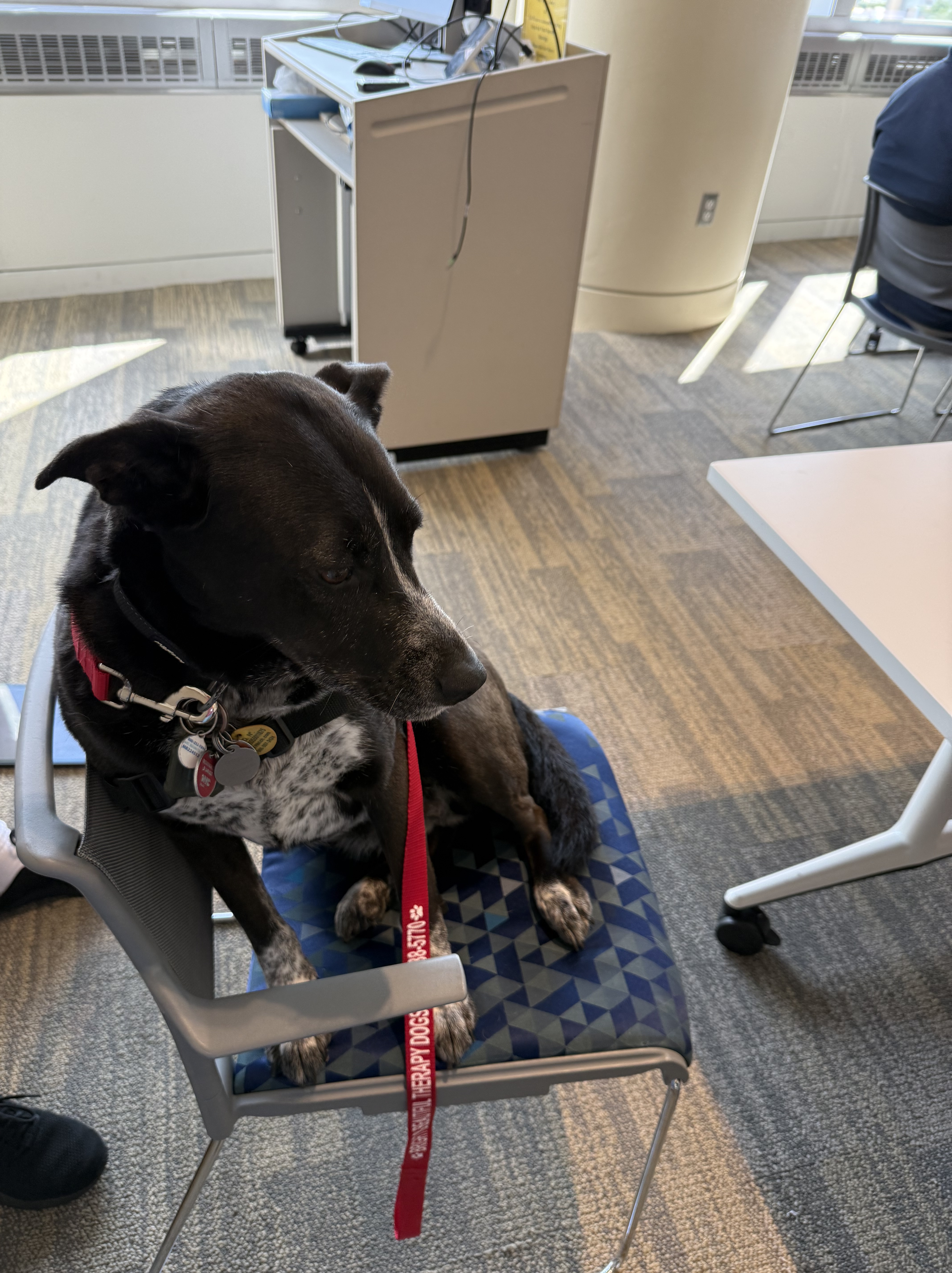
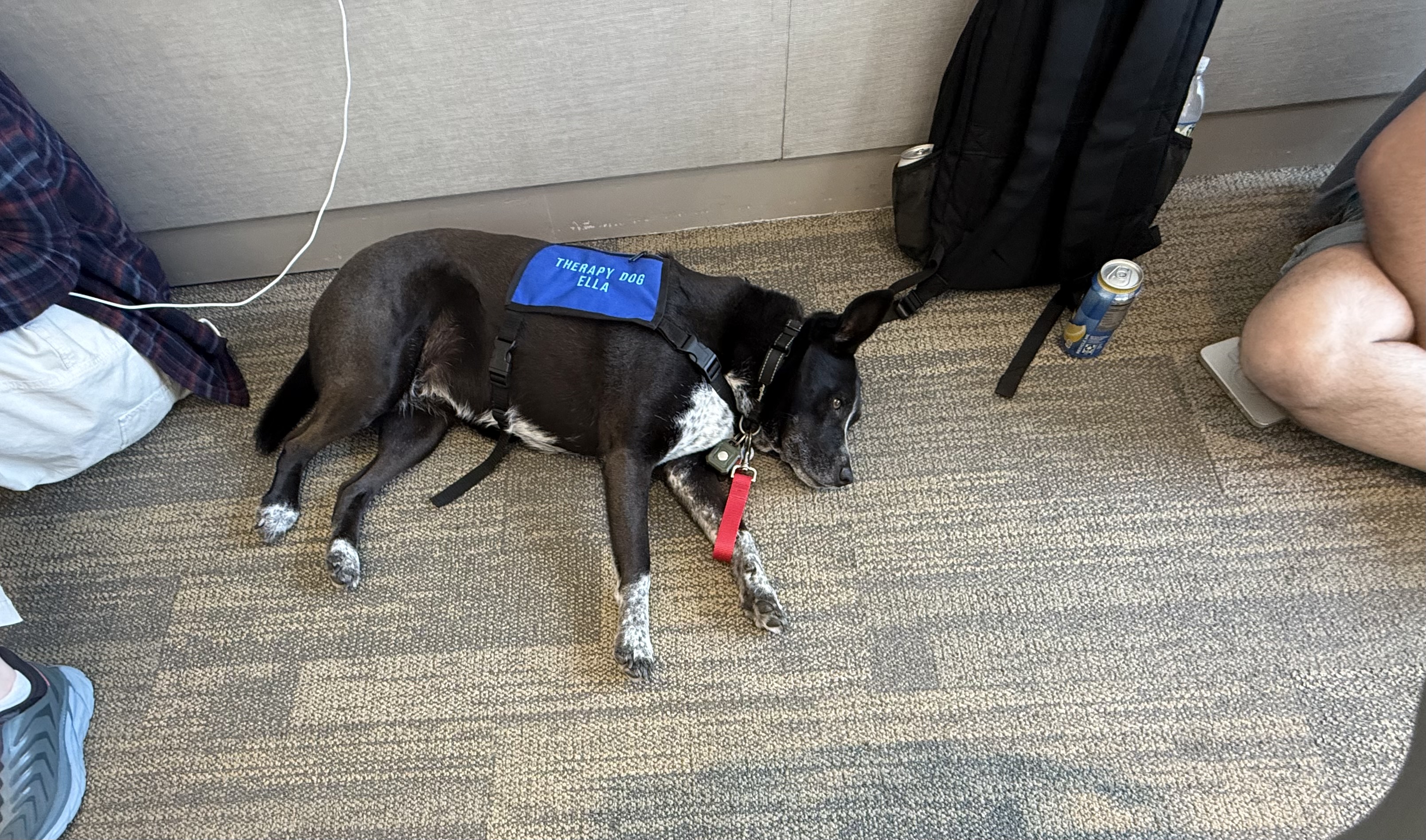
And now, I feel like Ella! So goodnight all.

I am grateful to be

alongside all of you!
When Parents are Patients…

I recently fount this post in my “drafts” from August 2024. I edited only the dates. I have no idea why I never published it. Now, in August of 2026, 3 more Meghan surgeries later (including a double mastectomy) I guess it’s better late than never… Will any of my PTEN moms who are also PTEN patients themselves give a shout out? I’d love to know you.

I spend a whole lot of time in this blog space discussing my girl. Meghan is my amazing, fierce, feisty, never-give-up, never-give-in PTEN kiddo who is so much of my heart, my life, and my every breath. She was born through the craziest birth story and seemed to not feel well literally from day 1. Day 1 was 23 years ago, on August 9, 2003.

She was diagnosed with PTEN Hamartoma Tumor Syndrome in the fall of 2011 after a persistent physical therapist (our forever hero Dr. Jill) led us to a brilliant geneticist. I told him of her struggles during that visit. We talked about her GI issues, the gall bladder that was removed when she was three, the incredibly notable and full of nodules tonsils and adenoids removed soon after, and the AVM (arteriovenous malformation) in her right knee that would not quit despite being treated by the doctor everyone told us was the best. That visit lasted about an hour and during the visit, he asked some questions about my own history as well. I answered everything, desperate to figure out how to help my girl. When he was finished he looked me straight in the eye and said, “I know what she has Mom, and you have it too.”

That’s the only part of the day I can put in quotation marks, but I will NEVER forget that sentence.

What followed was him asking me to trust him. To let him test and get confirmation before he released his suspicions even to me. He told me the internet was not where I wanted to be until we were sure. I never trust anyone. I trusted him.

For 6 anxious weeks, we waited. And, the results were as he had expected. Meghan showed a pathogenic mutation on the PTEN gene, which is a tumor suppressor gene. I was brought in for testing soon after that and since my test was targeted to only confirm that her mutation came from me, the results were faster. Before the end of 2011, my girl and I had both been diagnosed with PTEN Hamartoma Tumor Syndrome or as it is often referred to in its most common manifestation – Cowden Syndrome.

In the summer of 2011 we knew life was medically complicated, but we had NO IDEA where it was headed!
There was not nearly as much information available in 2011 as there is today, and our diagnoses even predated the PTEN Syndrome Foundation. I scoured the internet and dug into Facebook groups. I read and read and read so many things that I barely understood. But, I was in good company. So few medical professionals had even HEARD of this syndrome that they BARELY understood it either.

I connected with some parents/ patients across the globe who became my actual lifeline in those early years. I wanted to hear about others and what their experiences were. I wanted to learn all of it because I was determined to help my girl be the best she could possibly be.

My 30s had been spent seeking a diagnosis for her random and disconnected symptoms. As a mom, my own health concerns got addressed but they were definitely second in my mind and priority to hers. In late 2011, 14 months before my 40th birthday, I was left to process the reality that she had inherited this syndrome FROM me AND that I needed to figure out what this looked like as a parent, AND a patient.

When my diagnosis was confirmed I had little time to think. I was told that the inherent cancer risks that come with this diagnosis begin to peak around 40. I was told that time was of the essence to have Meghan’s thyroid evaluated, and it seemed like everything had to happen, well, yesterday.

It appears this autosomal dominant mutation was “de novo” or new in me, and that I am the first in our family to present with Cowden Syndrome. I had no road map. And I am terrible at directions.

What I did know was that I was reading staggering numbers – putting the lifetime breast cancer risk of PTEN patients at close to 90%. I brought my new diagnosis to my breast surgeon. He was my breast surgeon, not just because he had performed my Mom’s double mastectomy in 1997, but because sometime around 1998 (at the age of 25) he performed my first of 8 surgical breast biopsies I had had through the years. Somewhere around 2007 he suspected something genetic so he sent us for BRCA testing. It was negative. Now, with my confirmed PTEN diagnosis we had something concrete that required some forward motion. Quickly. He sent me for another opinion.

I gathered up all my pathology reports through the years, including the most recent “Atypical Ductal Hyperplasia” and brought it to the cancer center at NYU.

I look back now and am sure it is through God’s grace alone (well, combined with my husband who was often an angel on earth) that I stayed afloat. We had Meghan’s first, and extremely traumatic thyroid biopsy in January of 2012 after an ultrasound found multiple nodules. Thyroid cancer can come really early in PTEN patients, and in the spirit of things that eventually made sense, my thyroid had been partially removed in 1988 with a (now very logical) diagnosis of multinodular goiter. I mention this because, as you’d want to, Felix and I went together with Meghan to that biopsy. We soon learned that was not a luxury we could afford as his job was hourly and without sick time. I soon began traveling to most appointments alone.

As I walked into the cancer center at NYU for the first time a week or so later, I was coming in at the end of a work day. The few sick days that I had needed to be guarded carefully, and with Meghan having had at least 8 surgeries before 2011 and with me having had a few of my own. I was exhausted and overwhelmed when I met the bubbly red-headed no BS Breast surgeon. She did not beat around the bush. She told me she reviewed my history, my family history, my biopsies, and the PTEN results. “When are we scheduling it?” she asked as if she was talking about a haircut. Confused, I asked, “Scheduling what?” “Your prophylactic bilateral mastectomy.”

Um. Um… I so desperately wished I could just check out at that moment, but I was the only one in the room. I had to keep my head on straight.

I tried to challenge her. She was so matter-of-fact. She said, “We are not looking at IF, we are looking at WHEN you will have breast cancer. Let’s get in front of it.”

I remember trying to convince her I could wait until the summer. I remember explaining that it would make sense. I am a school teacher. I will have time to recover.

“March 5th” she was direct and authoritative. I didn’t argue. She sent me to her surgical coordinator and then to the plastic surgeon she did most of her operating room time with.

Mastectomy. Reconstruction? Tissue expanders? Inflations? Additional surgeries? There was no time for this. Meghan was scheduled for her 9th surgery in February. I could not even gather logical questions.

Somehow the plastic surgeon heard me and offered me “immediate reconstruction.” I didn’t even look at a picture. I had no time to consider aesthetics. I needed a return to normal with as much speed as we could muster so that my 8-year-old, who was looking at me as a view to her own future would see minimal chaos surrounding this surgery.

We got through the 4th embolization of my girl’s right knee during the February break as I began to make plans for what would be a 5-week absence from work. I did not have the days to cover that absence and we were looking at a serious financial hit. Plus, the fear of coming off payroll and the anxiety surrounding that was overwhelming to me. In NYC where I live, teachers can donate sick days to other teachers with very specific parameters. First, you need to have 50 or more of your own days. Then, you can donate at a 2-for-1 rate. This means for every 2 days donated, the recipient gets 1.

There aren’t many teachers that even have 50 sick days at any given moment in this largely female field where we are giving birth, and caring for our own tiny humans. But my dear friend Pat, whose generosity still makes me tear up, gave up 50 sick days. She gifted my family 25 days – 5 weeks at full pay, and more than that, the mental peace to recover from this life-changing surgery. She remains one of my angels on earth.

With that handled we pressed forward. And I remember waking up in recovery feeling almost empowered. Like I got to the cancer before it got to me.

I returned home and after a few days of careful babysitting from my own mom, I started processing my new reality. I learned there was a lot I could do with drains at my side, even a parent-teacher conference and closing to refinance my mortgage. But, I sure was glad I couldn’t drive yet, because the post-op appointment blew my mind. While I wish Meghan hadn’t been there for the live show, (she was smart enough to grasp too much of what she had heard,) I was glad I had Felix to keep me together.

The pathology, quite unexpectedly, revealed stage 1 DCIS, or Ductal Carcinoma in Situ. Breast Cancer. I had instinctively not spared my nipples, and in doing so saved myself another surgery. The cancer was far enough away from the chest wall, the margins were clean, and my move to “survivor” was almost too easy. Well, maybe not easy… but you get the idea.

Now all of a sudden everyone was in a frenzy, and when a screen of my uterus revealed a polyp, I found myself at a consultation for a full hysterectomy. I was dizzy but not able to stop this terrible spinning ride. My breast cancer had been estrogen-fed. I was advised to move forward with a complete hysterectomy and no hormone replacement.

On May 16th, just about 10 weeks after my double mastectomy I was welcomed harshly into menopause with a complete hysterectomy. Less than 6 months after a confirmed diagnosis I had undergone another invasive risk-reducing surgery. That polyp they were worried about had been benign, but had I delayed the surgery the plan was for uterine biopsies 4 times a year. That was something I was not signing up for.

And in the midst of all this, they found a ridiculous collection of hamartomas on my spleen. That’s where I drew the line by the way. My spleen, definitely 3 times the size it should be, is still firmly placed in my midsection where it is screened by ultrasound annually. I mean I’ll give it up if I have to, but 2012 had seen enough!

There was no time. There was just no time to breathe.

***

I sit here typing now, in August of 2026. I try my best to summarize the events of the last decade and a half, but I just can’t. Truth be told, we never came up for air.

Surgeries, tests, doctor’s appointments, MRIs, emergency room visits, screening testing, lather, rinse, repeat.

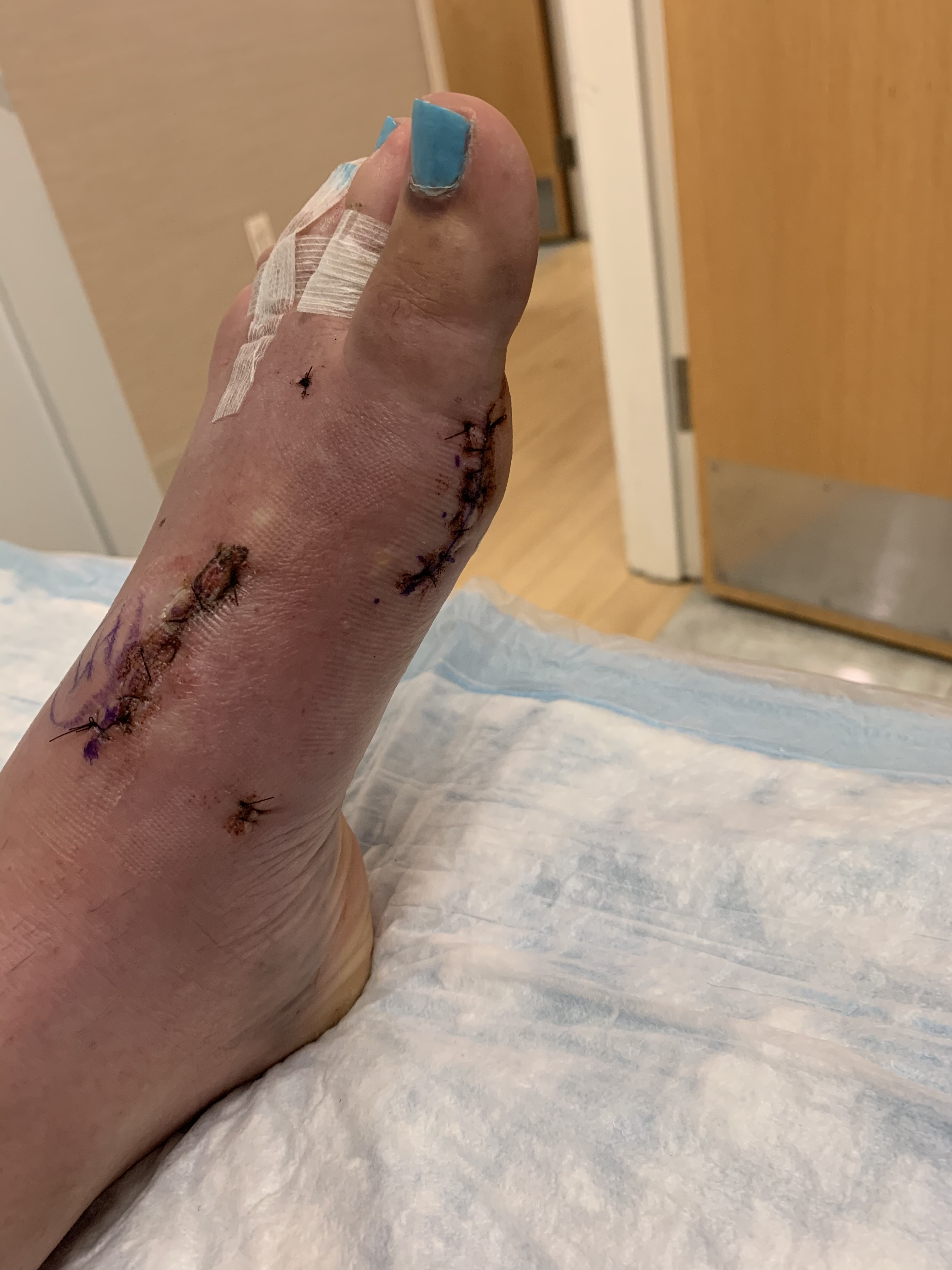
Mix that up with regular life and more than a half dozen very personal deaths, a global pandemic, an obscure foot injury, and surgery to add some hardware to that foot and it’s easy to see why we lost touch with almost everyone in our lives.

I barely turned on the television. I could not identify a musical artist, an actor, or an athlete if they sat down next to me.

All of which makes it really difficult to fit into any conversation. Anywhere. The isolation is remarkable.

***

Meghan challenged me to sit and see if I could write about ME. She asked me to put my thoughts about how being a Cowden’s patient has affected my life. I understand the assignment, and her challenge, the product of years of good therapy, (and maybe some good parenting- LOL) is important and noted.

The truth is it’s all blurry. I don’t see any lines.

They told us when we were first diagnosed not to let the disease define us. I’m convinced it’s not possible.

This diagnosis changes you.

I’ll try to pick it apart more, but for now, my thought is this. As a Cowden’s patient, I would have endured. I would have persevered. I am stubborn.

As Cowden’s patient and the MOM of a Cowden’s patient, I have been blessed with superhuman strength. It has been a gift and a privilege to everyday model for my girl, that it can be done. All of it. It all may seem impossible. It may always be harder than it should be. It may feel flat-out unjust, but it can be awesome. And when you claw your way up to the top of that mountain, and you are muddy, and torn up, and exhausted, you can rest a bit. You can pause to find your footing. And then, you should look around and soak in what you just got done. Never forget to appreciate the successes.

When the parent is also the patient there is a journey like no other.

When you both understand the scope of the positive effects you can have on each other though… that is where things really become remarkable.

No one else better to be #beatingcowdens alongside.

Foobs- When Cowdens Meets Breast Cancer

It was difficult to explain to the plastic surgeon how I had come to be sitting in his office this morning. The short answer of course, was that I wanted my breast implants evaluated for rupture as it had been three years since they were last checked.

The longer answer dredged up an awful lot in me.

In the fall of 2011, after years of medical issues, my daughter was diagnosed with Cowden Syndrome, a rare PTEN mutation that greatly increases the risk of multiple cancers as well as benign tumors, and vascular malformations. My diagnosis, as the carrier who passed that gene onto her, came a few weeks later. By all accounts it appears my mutation was de novo, and it went undiagnosed for 38 years.

When 2012 began, Meghan was 8 and I was 38. We both had complicated medical lives, and our diagnoses made sense. They connected a lot of ‘dots,’ but precious little was known by most doctors about what to DO once the diagnosis of Cowden Syndrome was made.

In the early months of 2012 I was sent to a breast surgeon to assess my risks in light of this new knowledge of Cowden Syndrome. I had been told a good deal of the cancer risks, including the upwards of 90% risk of developing breast cancer, peak at about age 40. I was closing in on that milestone, and I was reminded of that when I met the surgeon. She was a feisty red head who walked into the room armed with papers I had sent detailing the 8 previous surgical breast biopsies I had had dating back well over a decade.

I had gone to the appointment alone and was taken aback when she asked when she could put me on the calendar.

“For what?”

“A bilateral mastectomy.”

She was so matter of fact. I had lost my ability to speak temporarily.

“Your diagnosis, your family history (my PTEN negative mother had had bilateral breast cancer at the age of 48) make your future with breast cancer almost certain. I recommend you take care of this now.”

I remember trying to get her to agree on a summer date when she told me March 5th. I explained I was a teacher and I’d have time in the summer. She was undeterred. She sent me to her scheduler who set me up with a plastic surgeon where I needed to have a consult before March 5th.

I sort of remember the plastic surgeon. She was a tiny woman, kind in her soul. She explained all the reconstructive options in detail. I balked at each one wondering what no one was understanding. I was parenting a sick child. The sheer number of appointments and surgeries she needed left me marveling at how I still had a job. Coming into Manhattan for “fills,” and setting up ANOTHER surgery would not/ could not work. At the time my husband had a job with no sick days. If he was not at work, he was not paid. We carried two medical insurances to save on the co-pays that often felt insurmountable. There was simply no way to make this any more complicated than it was. I convinced her to reconstruct with implants that same day, despite her caution that I would not be happy with the results.

When the pathology showed cancer, a small spot of DCIS in the LEFT breast, a month after an MRI detected nothing, I decided I needed to just be grateful that the entire spot of cancer was removed and no treatment was necessary. Bullet dodged.

And just in time. My complete hysterectomy was scheduled for May16th of the same year!

Four years later, losing my MIND with agitation at the right implant, and sick of literally wearing a bra 24/7/365 to protect my overwhelmed sensory system, I sought out the counsel of a plastic surgeon. I looked for the surgeon who had been so kind to me in 2012. She was not “in network” with my insurance. Obsessed with keeping costs in check, I met with the only “in network” plastic surgeon from the same hospital. He was fine, and suggested changing the implants to see if it helped. I was desperate, asked few questions, and agreed in hopes it would calm things.

In August of 2016 he swapped them for a new set. It didn’t help. In hindsight the insult to my senses was most likely caused by tissue differences after a decade of surgical biopsies of the right breast. I kept the bra on and didn’t look back.

My “foobs,” a term we sometimes use to refer to “fake boobs” were the least of my concerns. My daughter, whose story is largely the one detailed through this blog since 2012, was constantly going through it with this damn disease.

I’d like to say her life calmed, and her medical issues settled, but they didn’t. What happened though, is somewhere along the way, decades of me tirelessly advocating for her made her a force to be reckoned with in matters of her own health. During her senior year of college, she made the difficult decision to remove her doomed breasts after they had begun to show changes and tumors. We used a few long weekends to interview breast surgeons, and she was led to a plastic surgeon. This surgeon, I was informed, accepts my health insurance coverage as out of network, and payment in full when it is related to genetics and cancer diagnoses.

When I saw the door to the office in the fall of 2024, I was transported back to 2012. I was in the same office I had been in, terrified and determined to keep my family afloat. I lost my breath for a minute, and recovered as quickly as I could. That appointment was not about me. And, the doctor was remarkable to Meghan. He was it seemed, almost inspired by her drive to get her own mastectomy done on her time table, and to not let any of it interfere with her acceptance to a Physician Assistant program.

Suddenly though, everything made sense. His associate was my surgeon from 2012. She was not “in network” and the chaos in my mind and soul during that window of time kept me from remembering the “payment in full” that they accepted from my health carrier. If I had remembered ANY of that, if I had not lost large portions of that window of my life to the sheer trauma of it all, most assuredly I would have been back with her in 2016.

Instead, I was left to give the shorter version to her partner this morning.

Brevity does not do this story justice.

The truth is, every piece of this Cowden Syndrome journey takes a bit of your soul. I raced through life from one crisis to the next for so long, that it took years for me to realize how atrocious my own reconstruction looked. I have spent almost 15 years looking straight ahead and avoiding mirrors.

When you are face to face with a plastic surgeon, it’s hard to know what you want them to say. This surgeon is not anxious to be the third surgeon on incisions that were not his own, and I can’t blame him.

So for now, we did an ultrasound and I have someone to verify the integrity of the implants. For today these “foobs” are strong.

The hard truth is that my aging body is allowed to exist because of choices I made. I meditate on that when I am really at a loss. Growing old is indeed a privilege denied to many.

I remain,

“It Doesn’t Suck”

“Thank you…” That’s how she led at 6:30 on a Saturday morning, when I picked her up 140 miles from home so she could squeeze in a uterine biopsy on the weekend, so as not to miss any class her first week of PA School.

“Thank you…” How many 21 year olds lead with that? Nothing to eat or drink. Half asleep. Headed to ANOTHER procedure which would require ANOTHER IV into a vein literally EXHAUSTED from overuse.

She spent a few minutes telling me about her Friday night out with her new classmates before falling asleep. “It doesn’t suck.” This was absolute music to my ears.

Anyone who doesn’t know Meghan, and hasn’t followed her story, and even some who think they know her, but haven’t really been paying attention, might think that describing her first week of classes as a graduate student by saying “It doesn’t suck,” is negative, pessimistic, or a bad attitude. But to me, who has been paying the closest attention, knowing the reality that virtually every school experience has “sucked,” this was music to my ears.

No point in going backwards to the countless times when she was belittled, ostracized, tormented, and tortured. She was never perfect, and she never claimed to be. But years of therapy have taught her not to shrink herself down to fit into anyone else’s box. I don’t know why many kids found her unlikeable. But she knew it. Always. And the ones who didn’t mind her were typically too afraid to speak up. “It doesn’t suck…” cautious optimism. I’ll take it!

I had 5 hours in the roundtrip between home and her school to reflect on this kid. And I have to tell you, I’m so proud of her sometimes I feel like I could burst.

Don’t get me wrong. The years of social isolation have been daunting and exhausting. But, they have given her wisdom and patience well beyond her years. She has gained confidence. She is insightful. She is capable of telling you her weaknesses right alongside her strengths. She is transparent, and straightforward. You never doubt where you stand. She is passionate, loyal and driven. She is resilient.

Writing has been hard for me these last few years. I feel like we mark time in between surgeries, rehab, appointments, tests, and more surgery. I have withdrawn from almost every relationship I have because most people seem exhausted by our chronic cycle and I have grown weary of apologizing for our reality.

Meghan’s tumor in her right thigh took up most of her high school and college years. ’19, ’22, ’23, and with the ultimate torture in the summer of ’24, she became a regular at PT during the years when kids her age were debating which party was better. A mere six months after the worst surgery by far, our New Year’s Eve was spent at NYU in recovery from her bilateral mastectomy. Which, in case you wanted a reference, she said was so much easier than the leg surgery. Well, pain wise anyway… but, I digress.

We are living inside of 2 PTEN mutated bodies with all the trials and tribulations that come with them. My own scans continue. Battles with insurance and radiology alike are the rule, not the exception. In the last 6 months two of our primary providers left their practices and the job of “training” a new doctor begins again.

Pride. Focus. Determination. Dedication.

Meghan and Ella graduated from Misericordia in May. Then, the difficult decision was made that retirement was in Ella’s best interest. Selflessly she put her best friend and closest companion ahead of herself. Again.

Ella is slowly transitioning to retired life with her “brothers.”

She left in early June, a year after that leg surgery that still has me traumatized. She walked away from me with her passport in hand, and traveled 2,500 miles to meet the one friend she will keep forever from her undergrad. They met in Vancouver and they had a 2 week adventure that included activities she had never even dreamed of being able to accomplish. She paid her own way with gifts carefully saved through her entire life. She is a traveler in her soul. This was the first of many journeys that passport will see.

We squeezed in a ton of appointments at the end of June, including beginning to “train” our new endocrinologist. One of the appointments was a pelvic ultrasound. She has had them frequently since her “endometrial hyperplasia” in 2015. And when the report popped into her chart that Friday afternoon – we knew it was going to need follow up.

Her gynecologist is just an utterly superb woman, who trusted me with her cell phone number at our first visit. I texted her and alerted her. She found the report, and we were scheduled to see her July 3rd. Classes started July 7th. Because.. why not?

Her biopsy was Saturday. I stayed with her until the IV was placed and we met up again in recovery. It is a dance so familiar to us that in and of itself it’s unsettling.

We don’t have results yet. But I am tired of waiting. I’m tired of waiting for the next thing to be finished before continuing our story.

This is an ongoing saga. PTEN mutations do not get “fixed.” We may find some lulls along the way, but waiting is so much a part of this life.

Meghan took this at a butterfly exhibit in NYC with her dad, on her grandfather’s camera. I thought the busted wing on this blue beauty was epic.

Meghan walked out of the procedure, stopped, looked me in the eye, and thanked me. Again. I told her to stop, and she said no. “I’m so happy I didn’t miss Friday night, because of that uncomfortable Saturday.”

Maybe that’s the lesson. Don’t miss Friday because Saturday holds a daunting reality.

Two 300 mile round trips in 18 hours. She didn’t skip a beat and was right on time for classes today where she belongs.

Here’s to hoping “It doesn’t suck” continues to transition…

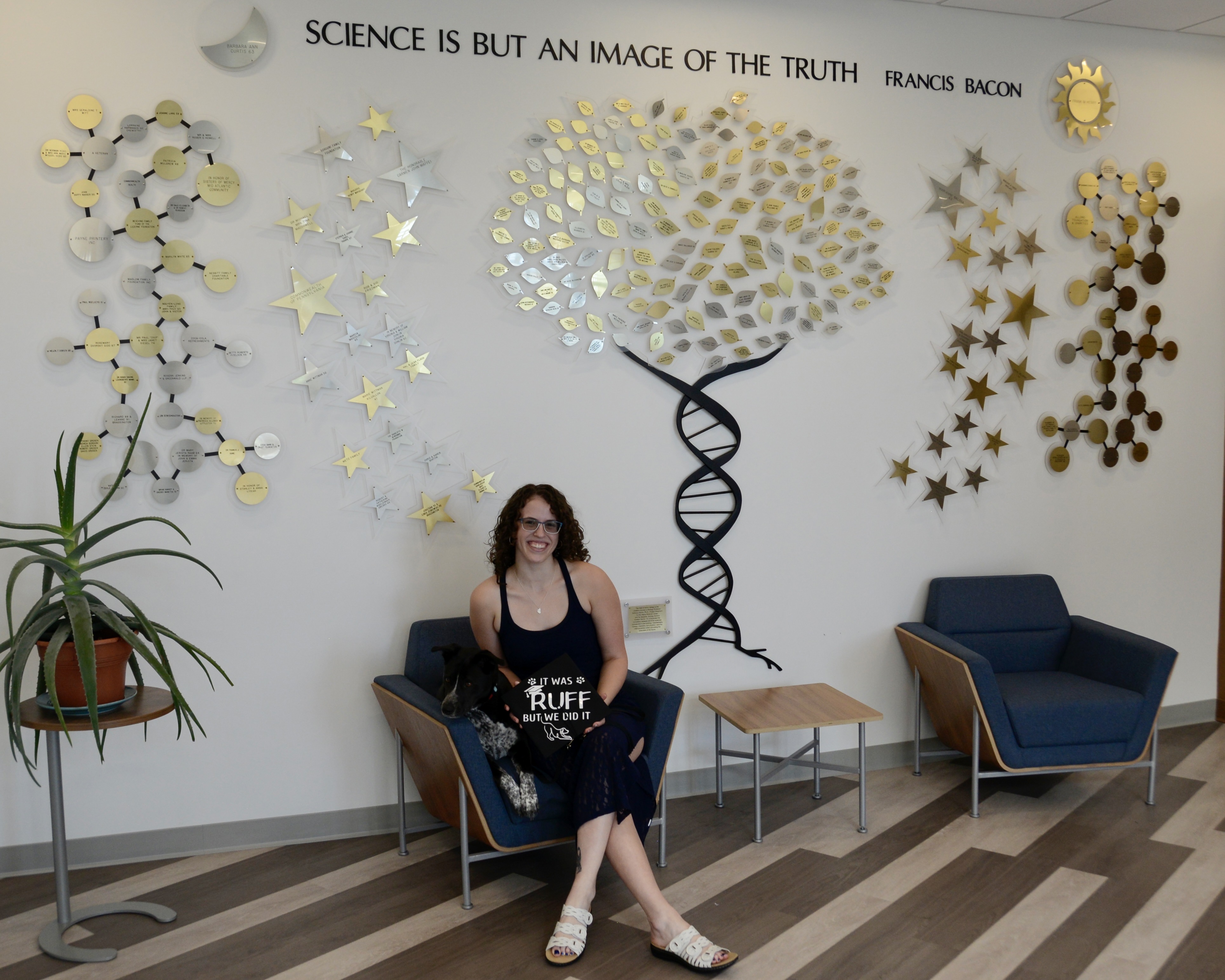
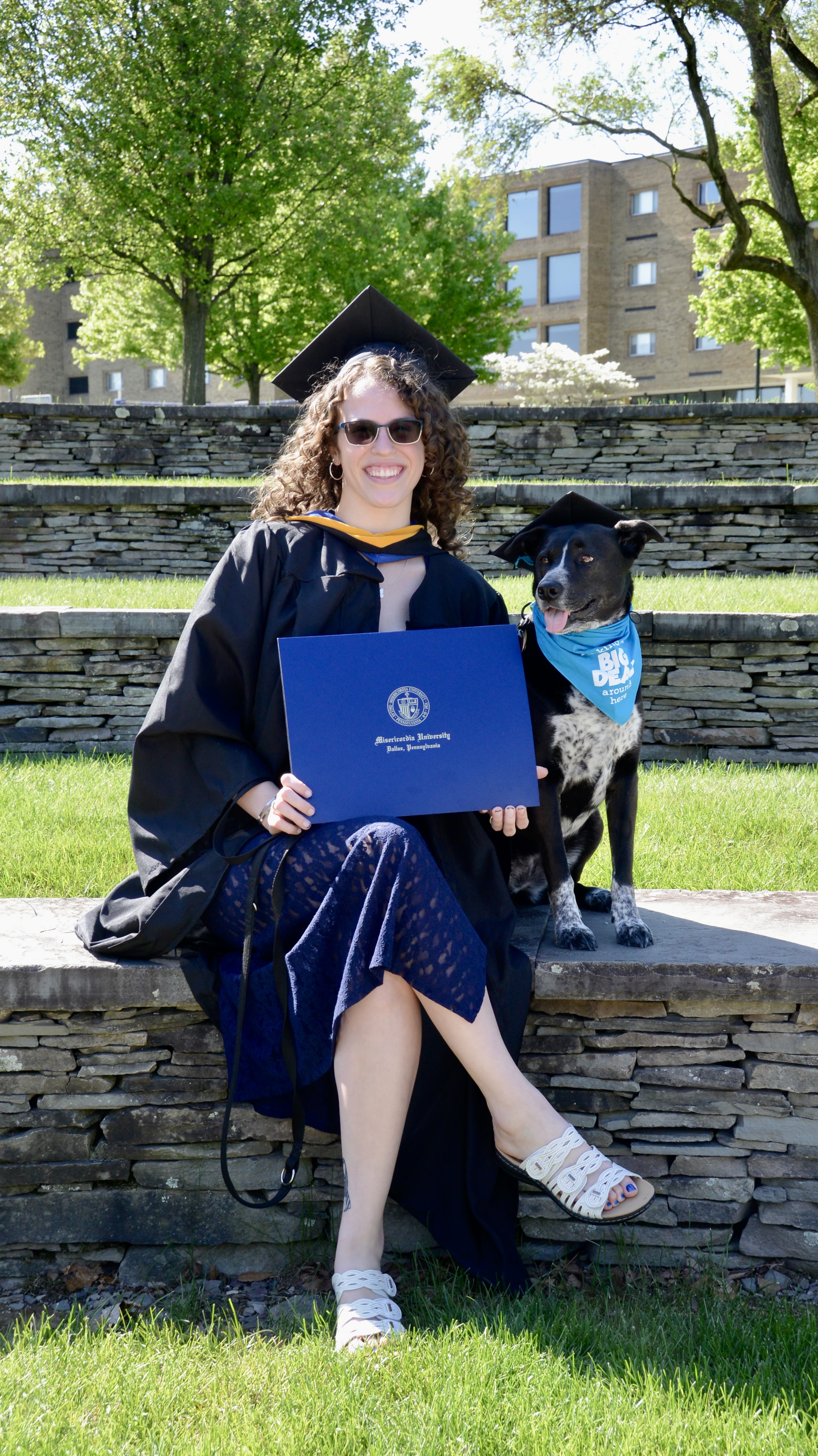
It Was “Ruff…” / Graduation and PTEN Awareness May 2025

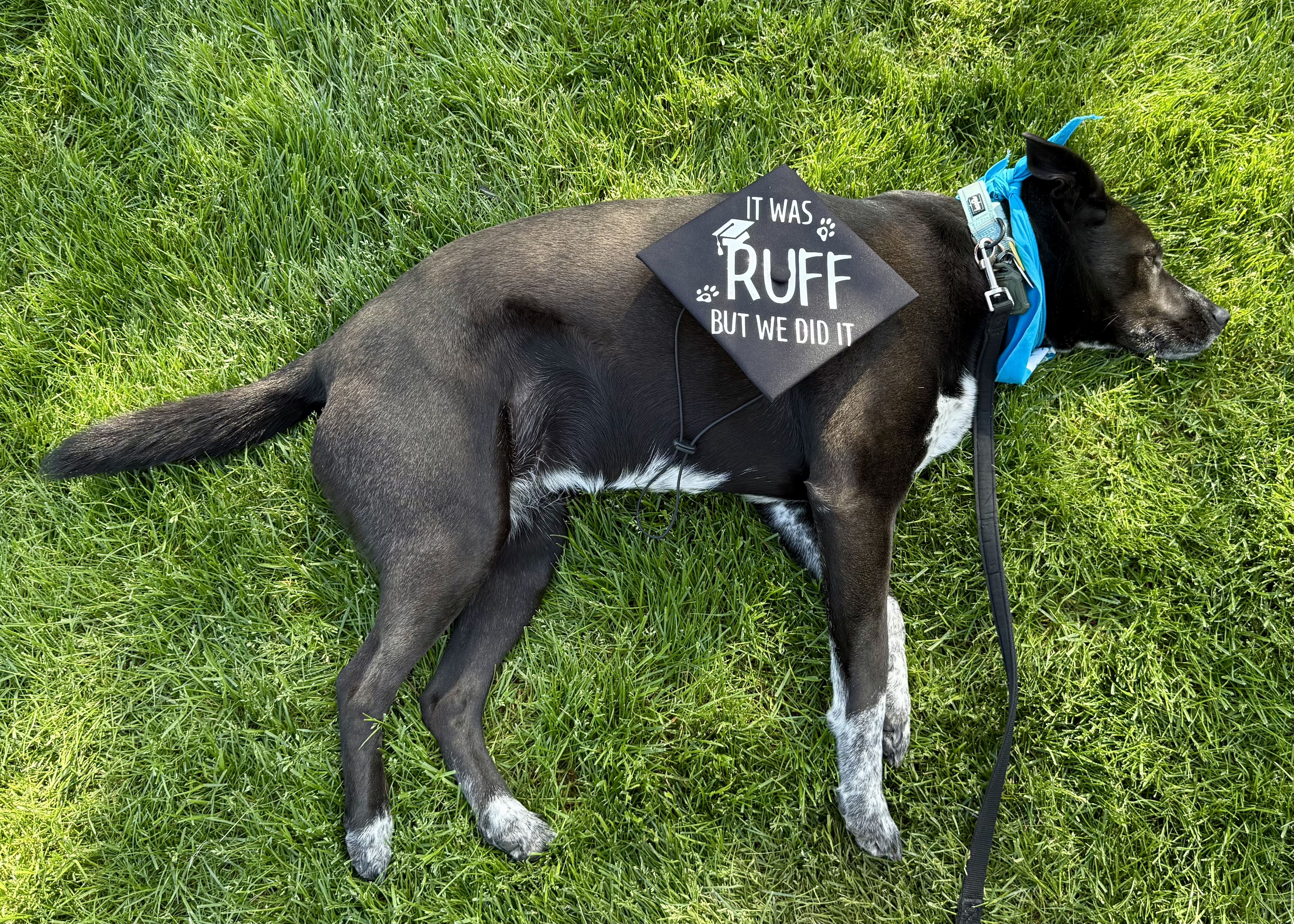
Meghan’s faithful service dog, Ella taking a post- graduation rest.

You’d think at 51 years old, I’d be in better control of my emotions. I mean, you’d think I’d at least have them labeled and organized. For all intents and purposes nothing is “new” here. We are formally 14 years into our Cowden’s journey, at least 14 years since our diagnosis of this mutation that permeates every cell in both of our bodies, and has done so since our births.

I think I have slowed down, and almost stopped writing, because I no longer know where to start. Literally decades have begun to blur together with the same pattern in an ugly loop.

“Don’t let it define you…” well meaning platitudes echo in my ear. And yet, Cowden Syndrome is at the very core of every action, every decision, every step we make. A genetic disorder is forever. We’ve lost friends and family over this reality. There will always be a medical challenge coexisting with whatever stage of life we are at. It just is.

Yet somehow, if we do not do our best to make others feel comfortable with our reality they back away. The “elephant in the room” is a metaphor we reference regularly. Cowden Syndrome needs to exist in every relationship we have. The acknowledgment that it is there and real, and never leaving is essential. And yet, once that is in place, we are more than happy talking and sharing and being part of literally everything else.

I’m told I am “intimidating.” Funny the power that words can have. That one rattles me. I don’t feel intimidating. What I am doing is surviving. I am navigating a wild ride we never asked to be on. I am organizing bills, and appointments and scheduling surgeries. While that is happening I am staying on top of my game at work, because I need my job, and I never know what crisis lurks around a corner.

What my girl is doing is enduring… with honors. “Gratitude, Grace and GRIT,” we sometimes call it.

You’ll meet your people in middle school… NOPE.

You’ll meet your people in high school… well maybe it could’ve been… but, Covid.

You’ll meet your people in college… well, maybe one or two keepers, but largely, no.

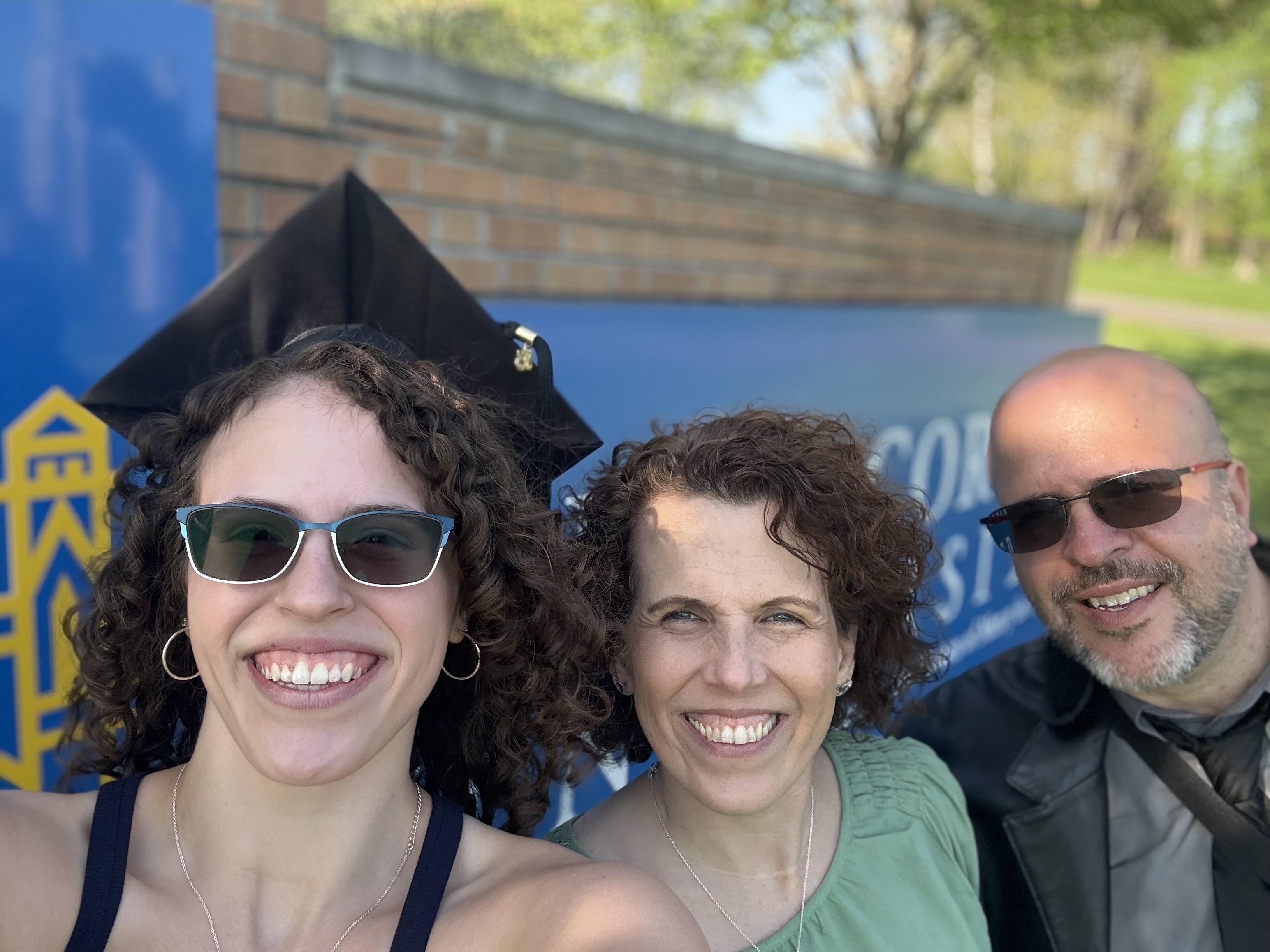
At her graduation on May 10th, we laughed, cried, hugged and ran the full gamut of emotions. She graduated Magna Cum Laude with a BS in Health Sciences. We, her mom and dad, beamed with pride. Her loyal service dog Ella was in some combination of attentiveness and exhaustion.

At some point there were tears, from both of us. Her, forever introspective, and me, wanting to fix it all. At one point she declared she felt as though she “survived” college, like it was some reality television show. But, there were many truths to her words.

She was accepted on a full, 4 year academic scholarship in 2021. She came entered as a swimmer in August of 2021 after a fragmented Covid swim year at home. She entered on new meds for a tumor in her right hamstring that had seen an embolization at the end of 2019 and was coming back at her – hard. That tumor nestled between the femur and the sciatic nerve was not to be beaten by the Lyrica that teased her with relief and beat her body with countless side effects.

In the summer after her freshman year, in May of 2022 there was another cryoablation to shrink this beast in her right thigh. This thing, initially measuring well over 5cm kept her nerves on fire, and the pain untouchable. She rehabbed in PT that summer and came back for her sophomore year.

During that year she dealt with drama in so many places I lost count. New relationships were not easy. It’s difficult to worry about teenage things when you are planning your next surgery, trying to ensure your transcript suits you for physician assistant school, and working daily in a fight with your body. Chronic, grueling, nerve pain isn’t exactly locker room talk. The classes were intense. The swimming schedule was rigorous and she did it all and ended that year, her last year as a swimmer, with a medal at championships.

That year also brought a past due formal diagnosis of ADHD. Not a shock, especially given the PTEN connection, but something I had with her on for a lot of years. Now, in the absence of me, my very capable kid knew what she needed, and got the diagnosis to check a necessary box. Little changed, but she was stepping into a role of self advocacy. I was sad it was necessary, and yet so proud.

The following summer, in 2023 she had another cryoablation. She was done not being able to sit, or stand, or walk, or move, or stay still without pain. Another swipe at this lingering tumor in her right leg. If they could get it off her nerve, maybe she could get some relief… There was work this summer, and PT, and pain, and the exhaustion of recovery. Again.

By the end of her junior year she had had it with the pain, and the orthopedic surgeon agreed finally to remove this beast from her leg. We spent the first week in June in the hospital- Meghan, me and Ella, with a few visits from her dad. The tumor was gone – as was a huge chunk of the muscle in her leg – all needed to clear the margins from the residue left from this tumor. In all my years and in all her well over 20 surgeries, I have never witnessed anything like that post operative pain. The amount of medication she needed, the assistance necessary just to move her… it was grueling. And isolating in the most epic ways.

That was the summer she completed all of her applications to Physician Assistant programs. Always on the ball, she kept her eye on the prize and got them all out – on time.

She spent her junior summer recovering, again. PT x3 days a week and a hybrid class to gain her certification as an EMT. She pulled through both and left us in August to begin her senior year. In a “grown up” apartment, off campus, just her and Ella. The doctor told her it would be 6-12 months before she felt like herself again, but even enduring the 3-6 month phase during the fall semester was progress over the pain she had been in. This one seemed to have finally given her some relief.

So we thought maybe she could catch a break. Until 2 breast lumps became 7 and the talk of a prophylactic double mastectomy to get in front of her 91% breast cancer risk got real – and fast. The surgery was scheduled for 12/31/24 – New Year’s Eve. She stayed with us through early February and then headed back up to school to knock off a few nonsense classes before her degree could be conferred.

That spring brought her the ability to decide to stay at Misericordia and begin her studies in their PA program in July of 2025.

So as we ran the gamut of emotions that graduation day – you can imagine that they were probably not too similar to those of her peers. She “survived” college indeed. “Survived” on a full scholarship and ended with a 3.85 GPA through some of the most ambitious electives I’ve ever seen.

“Don’t let it define you…”

I disagree. Let it define you. Let it make you stronger. Let it make you more determined. Let it make you less tolerant of BS and meanness. Let it make you full of compassion and kindness and all the things you have felt missing in the world.

When you have an all-consuming genetic disorder the notion that it won’t define you set’s you up for failure in my opinion. This diagnosis changed everything. It changed us.

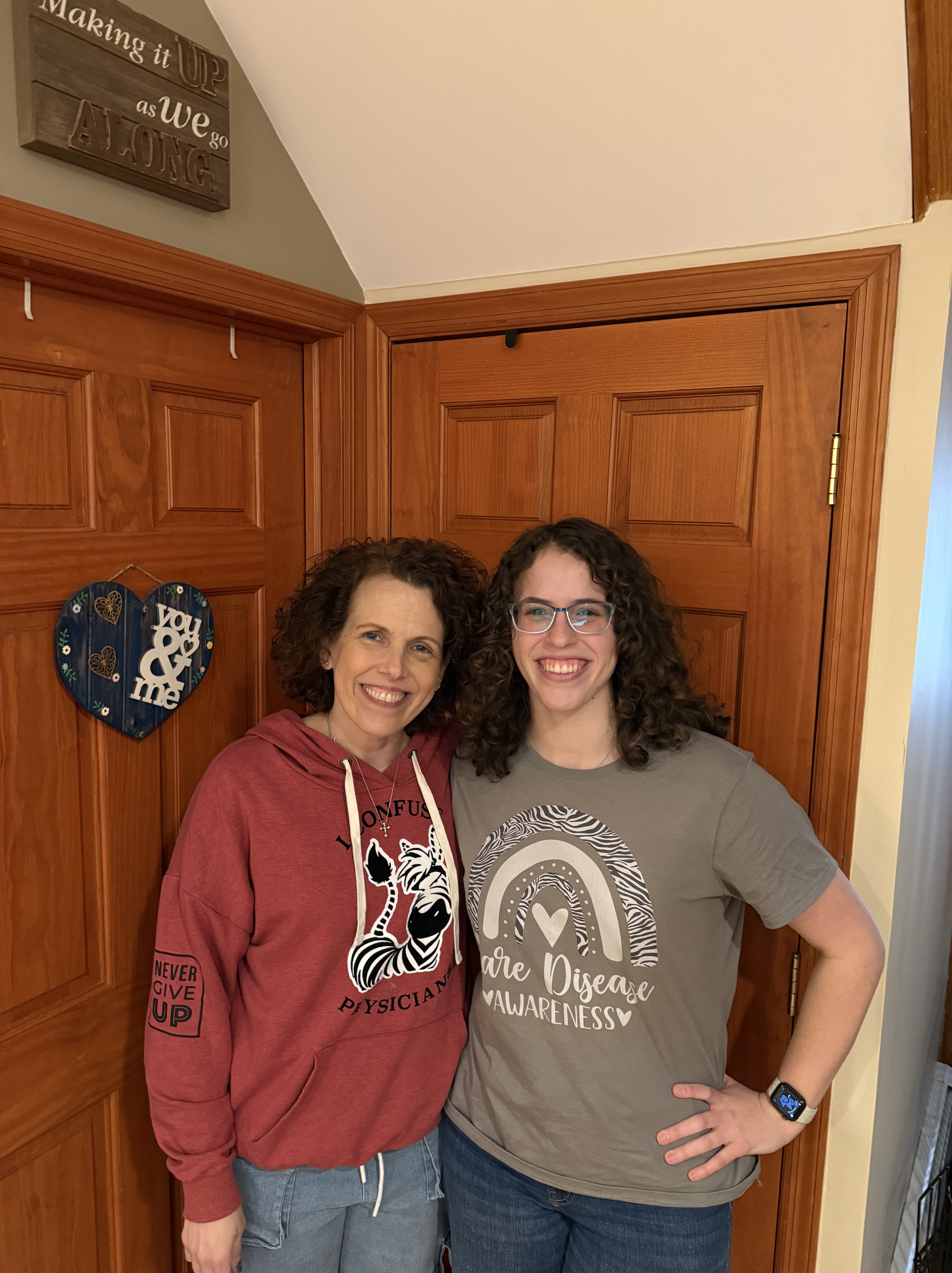
May is PTEN Awareness month. I am lacking in my publicity of this. If our angle, our view is unorthodox and gives you trouble, please know we’re ok with that. This is not a one size fits all syndrome.

But for us, PTEN Awareness means also being AWARE. Being aware of ourselves, and our Cowden siblings across the globe.

We all face vastly different challenges. We all carry hope together as a beacon of light into the world.

We are pretty in touch with reality over here. We are acutely aware of the struggles of others in the world. We believe in sharing, supporting, and showing up. Pull up a chair for our “elephant” and let it have a seat in the room. We will gladly make a space for yours.

Then maybe we can all get about the business of loving on each other…

The Glider- from Birth to Bilateral Mastectomies

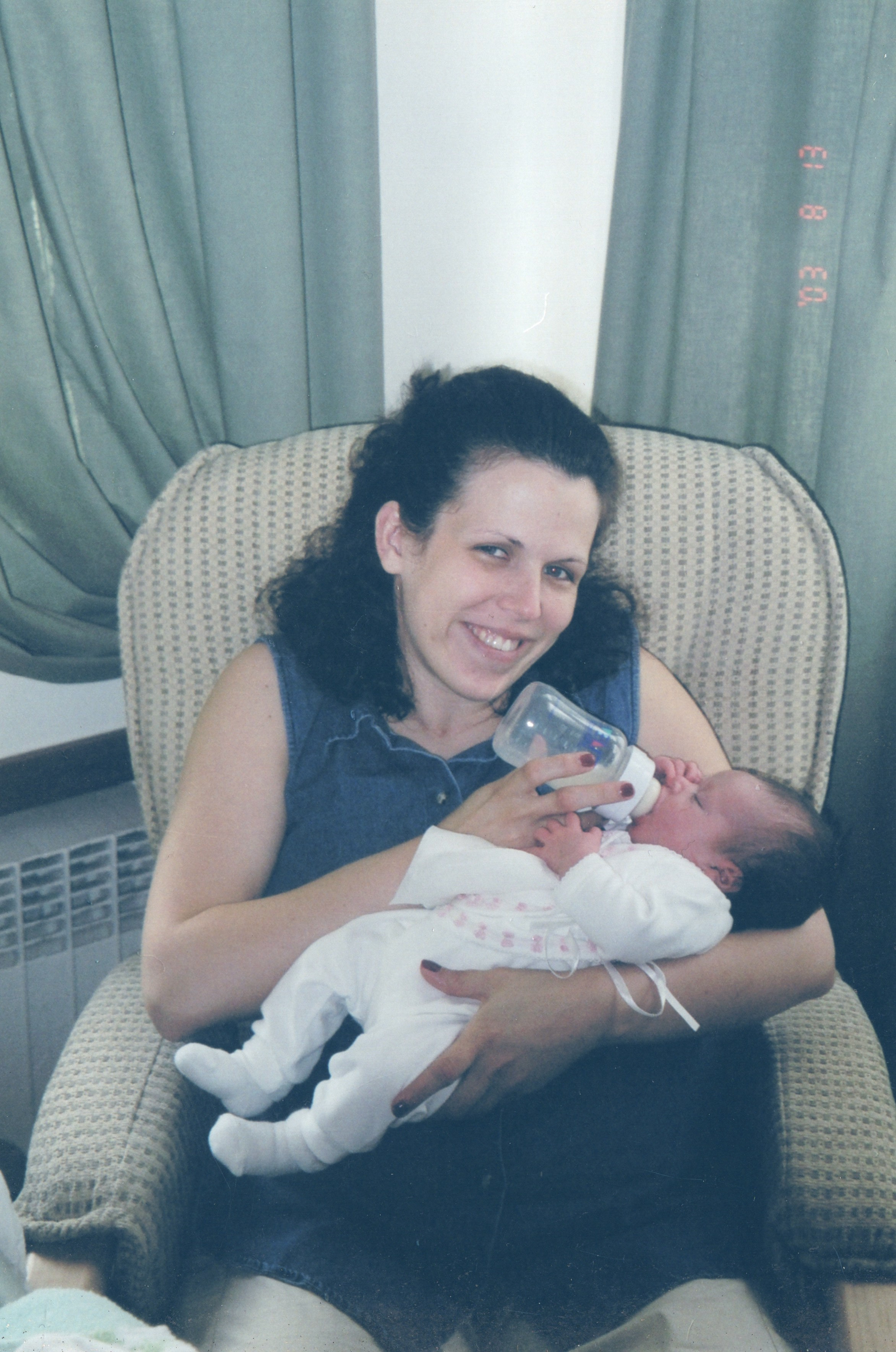
The glider I added to my baby registry in 2003 was arguably the piece I cared the most about. I am not big on stuff, and am unimpressed by “fancy.” I am all about practical functionality.

That glider housed my wide bottom as I awaited the birth of our precious child as she took her sweet time to arrive 10 days late. It held our girl Meghan in the arms of countless relatives and friends who stopped by in the earliest days of her life.

I held her in that glider in the summer of 2003 when the east coast blackout left my sweaty postpartum body begging for some type of a breeze, as at just a few days old, clear signs of colic were showing.

That glider held us for story time and bottles.

The glider held the two of us for the better part of most nights, when despite being told I was spoiling her, every instinct in my body told me not to leave my baby. No matter how bone crushingly tired I got. I knew not to leave her when she was in pain.

And when I was so very tired that I was afraid I’d drop her I would strap her into the Baby Bjorn just in case, and tell her stories from memory, like “My Most Thankful Thing…”

There came a point where we couldn’t fit in the glider together, but even as I knew we’d never have another child and I donated most things, I never parted with the glider.

She snuck in there with me in 2011 when we were processing the news of our Cowden’s Syndrome diagnosis. She sat next to me in 2012 while I used that glider to recover from my “prophylactic” bilateral mastectomy that gave me a “surprise” diagnosis of stage 1 DCIS.

The glider stayed in her first bedroom when the middle school years moved her upstairs and I claimed her old bedroom as an office.

After our then puppy Jax decided the paint on the wall was irrelevant and he used the glider as a battering ram, we repainted and moved it upstairs to her new room.

Every once in a while she would read in it and let her fantasy books take her away from middle school days that were too cruel for words.

She recovered from Covid in that glider.

That one piece of furniture has so many stories to tell.

But this story, the one where I sit across from my 21 year old baby sleeping in the glider, this is one I wish it didn’t have to tell. Or maybe I’m grateful it can be told this way. It is certainly one of the times perspective is critical.

I have so many emotions right now, less than 24 hours after my baby had a bilateral mastectomy and is recovering in the very same glider that has been a huge part of our lives.

She walked into NYU at 1:30 on 12/31 armed with the knowledge that it was her choice to take some level of control of a life that is so often in a free fall. Breast screenings began soon after she turned 21 and a BIRADS 3 screen in August was followed by an MRI that just could not tell her all was ok.

“Probably benign” is not an acceptable finding if you’ve ever met Meghan, especially when it showed 7 distinct and some sizable masses. Already.

We met a plastic surgeon in October who immediately put her at ease. He walked in having read her history and said, “What can I do to help?”

The most current, albeit small, longitudinal study of 700 patients puts PTEN Breast Cancer risk at 91%.

Meghan pays attention. Her maternal grandmother who does NOT have a PTEN mutation had bilateral breast cancer at 48. Her PTEN mutated mom had hers at 38 with a history of 8-10 surgical biopsies spanning the 14 years prior.

A mastectomy was always part of her story. None of us realized it would be this soon.

Cowden Syndrome gives you the tools to screen for our many cancer risks. It also empowers you to not ignore them when those screenings fire a “warning shot.”

The plastic surgeon said pathology will tell the final story but her breast tissue, like so many other parts of her, was older than her 21 years.

Over these last few weeks as we have slowly shared the news of this upcoming surgery, without fail the people who Meghan admires and respects are the ones who have come forward to tell her how brave and smart she is. They tell her how wise it is to control this one thing, in a life that has been too full of unfortunate surprises.

Those who have judgment, or seek only to gossip should keep moving. The older we get the easier it is to sort out who we need by our sides.

I stare at my baby, all grown up in our glider, and I vacillate between sadness and immense gratitude. I despise the ferocity with which this syndrome has made every single thing harder. Yet, my heart bursts with pride as she just continues to overcome things most others cannot comprehend.

This is not her hardest surgery. That hell on earth took place in June, but this one also deserves some time to rest.

Rest my girl. You’ll start that last semester of college a little late, but you’ll be ready. Misericordia Class of 2025 and Misericordia Class of 2027- Master of Physician Assistant Studies. The medical field needs you – and plenty more others like you.

I hope when you sleep you feel my love, and the love of all who ever held you in that glider wrapped gently around you.

I am so proud to be your mom, and we are together…

My Letter to the CEO of Disney

This is not the way I intended to talk about Meghan’s next surgery. However, as I have told her so many times before, we know ours is not the only story that needs telling, but who are we to complain about things that don’t change if we do not start conversations about things that are wrong?

Mr. Robert Iger 

Chief Executive Officer

500 South Buena Vista Street

Burbank, CA 91521-4873

December 13, 2024

Dear Mr. Iger,

My daughter Meghan is a dynamic human. And while I doubt Mr. Iger himself will ever lay eyes on this letter, it is my hope that someone will hear her story and carry it with them. It is my hope that the next time someone looks to speak for the disabled, that Meghan’s story will weigh on their heart.

Meghan’s birth was tumultuous in the summer of 2003 and her health has remained an issue to date.  Before her 5th birthday she had already had 4 surgeries, and doctors were part of her every day existence. She was adept at blood draws and MRIs, and long car rides and emergency room visits. She had been hospitalized twice for infections her body could not fight without IV medicines – each a week at a time. She ran high fevers. The kind that made you stay up all night and stare, wondering if we would get through the night without an ambulance.

The pain was part of her long before her first words. There was aggressive therapy, physical, occupational and speech, all to fight delays in her development.

There were food allergies – gluten, dairy, corn, soy and egg at one point, that made going anywhere that involved food socially almost impossible. There were only a few birthday parties, where she would stare at the cake, and politely refuse the pizza. Those were the ones she wasn’t too sick to attend.  Eventually the kids stopped inviting her. I mean, you need to be around to fit in, and a sick kid, an only child from a small immediate family was easily targeted as the outcast or the weird kid.

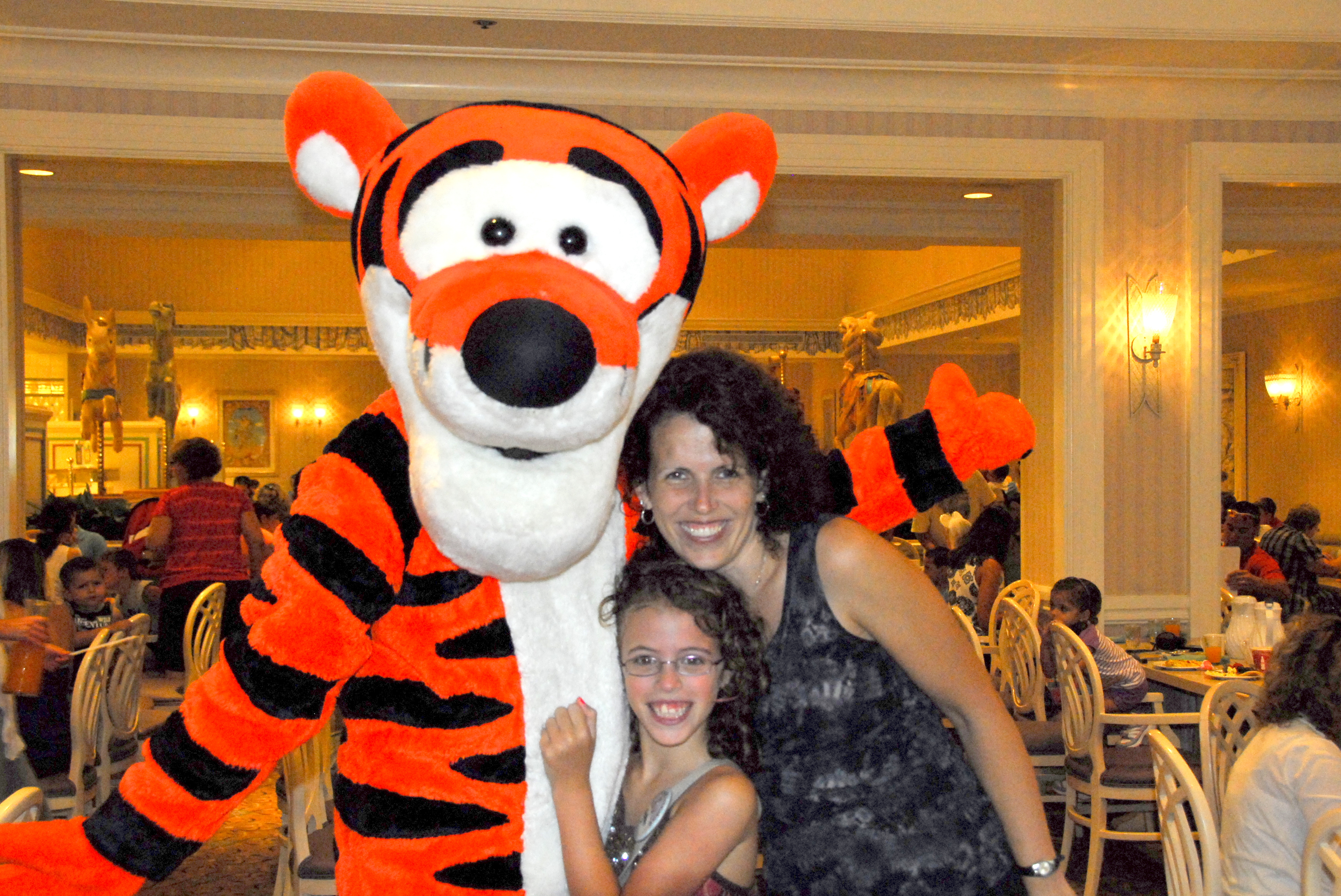
We took our first vacation as a family to Walt Disney World in the summer of 2008. Meghan was too weak to walk, but an adaptive stroller had been donated to us for the trip. We had a backpack full of medicines and contingency plans, but for a brief time that week, we got to be a regular family. We got to leave the medical world, and all it’s isolation behind. We got to fall in love with Chip and Dale and eat food safely prepared in real restaurants. It was just pure magic.

We returned often through the years. The medical issues never calmed down. The kids never got any more kind, well except for a few.  The isolation increased exponentially and the week we spent every summer in Disney was the escape we all looked forward to.

It was soon after our trip to Disney in 2011 that Meghan was diagnosed with PTEN Hamartoma Tumor Syndrome, or Cowden Syndrome, a 1 in 200,000 genetic disorder that caused both benign and malignant tumors, as well as vascular malformations.  I was diagnosed soon after her, and in the early part of 2012 I became a breast cancer survivor as my 8-year-old grappled with questions of her own mortality.

That adaptive stroller eventually became a wheelchair, as surgeries on her right leg alternated with vascular lesions in the hands and the loss of her thyroid.  The weight she carried was heavy as a mass was found in her uterus, and my 12-year-old underwent a D&C, a uterine biopsy.  Fortunately, that biopsy was negative, but there were way too many questions she was forced to grapple with, on topics no one twice her age would have wanted to contend with.

The surgeries never quit, often keeping pace with her age. But Meghan also never quit despite almost insurmountable odds she fought every single time she was told she could not do something. Despite isolation and loneliness, and despite an exhausting medical schedule, she never quit. She became an academic success story and generally a force to be reckoned with.

And almost every summer, sometime around the first week in August, we would find our way to the “Happiest Place on Earth.”  Where even if only for a week, Meghan was able to find joy. Her physical needs were accommodated. Her dietary needs were never a problem, and were often handled magically. We bought into the Disney Vacation Club, committed to the place that made our daughter feel the joy and magic she so desperately sought in a cruel world. Life continued to beat her up, but Disney, that was her break. No one made her feel less than for having a few extra needs. She was made comfortable. She was made to feel like she was worthy of happiness.

This past summer in 2024, Meghan turned 21. She did not go out partying with friends. There are still only a handful of peers who are mature enough to even try to understand the level of physical torment that has been her life. Instead, she stayed home with her parents recovering from her 22nd surgery – this one the most horrifying and invasive of them all.

A tumor had grown at the top of her right thigh. It was almost 5cm at one point, and butted up against her sciatic nerve. It caused unrelenting agony for 5 years prior to its excision.  Her high school and college careers were punctuated by attempts to shrink that tumor through embolizations and cryoablations. Finally, her orthopedic surgeon told her it was small enough for him to remove. But he cautioned he would need to “fillet” her thigh to get it out.

The surgery was on June 3rd. It took about 6 hours. The surgeon told me he removed 4 SQUARE inches of muscle from the back of her thigh. He told us it would take 6-12 months for her recovery. He explained the muscle spasms that take place as muscle dies, and new muscle regrows. But nothing he could have explained would have prepared me for the next 6 days in the hospital. Meghan and I were alone, visited only by her father. In all the surgeries I have had myself and in all I have walked her through I have never seen anything like what I saw that week.

The amount of medication it took for her to get even a brief rest was unnerving. She could not put any pressure on the back of her leg.  She could not bend her hip greater that 60 degrees. There was literally no position of comfort or rest. I drove home from the hospital with the Narcan they had prescribed in my lap, and the rest of the opiods needed to keep her functional tucked in the back seat.

She spent the summer in Physical Therapy three times a week. She fought like a beast to get some of her mobility back and scale back the medications. She is my actual hero. And, while she was working so hard, we promised her that even though we missed Disney in the summer, we’d get her there for Christmas.

This girl, now a woman, entering her senior year in college, having endured the most grueling summer of her life, on sheer determination alone became a certified Emergency Medical Technician, and was dreaming of a trip to Disney with her parents.

Before we even had a chance to begin making plans, the screening breast sonogram for her PTEN Mutation, the Cowden Syndrome I mentioned earlier, came back with 7 notable lesions and a BIRADS 3 rating. She was advised to see a breast surgeon, which we immediately scheduled for her October break. PTEN patients have a 91% lifetime risk of breast cancer and those lesions clearly meant her time would come sooner rather than later.

We scheduled her bilateral mastectomy (yes, she’s 21) for December 31st. We scheduled Disney for December 23-30. 

But the week she is in Disney she cannot take any of the anti-inflammatory medicine that has carried her through the leg surgery.  It will be a bleeding risk for her mastectomy. She cannot sit for any extended period of time. She cannot stand for any extended period of time. Her sleep is broken. She rarely rests. 

So, when we were thinking about Disney we were thinking about the DAS – Disability Access Service- that we had used for the last 13 years.  This year we were told we had to secure it in advance. We scheduled the meeting on line today.

I have to tell you I am nothing short of devastated by the way she was spoken to and the way the whole process has transformed. It was made clear that you have taken a system that was our lifeline, and transformed it into a system where only certain types of disabilities seem to matter, which ironically feels extraordinarily discriminatory.

The cast members on the call were too busy with platitudes and a poorly constructed party line to hear anything that was being said. They were too busy trying to check a box to realize my daughter does not fit in a box. They had never heard of her condition and did not care to listen.

Jackie Lynn determined that Meghan could use a wheelchair (she can’t sit on the 4-inch scar on her upper thigh comfortably for any length of time) and then she could “walk in place” on line if she needed to move, showing no understanding of the mechanisms that cause the swelling and pain all the way down to her foot.  She needs to move to keep comfortable. Jackie Lynn told Meghan she “understood” and when Meghan countered that she could not actually understand, she replied “I do and I don’t appreciate you telling me I don’t.”

When we asked for a supervisor, Claudia actually mocked my daughter for her tears of pure exasperation, wondering what she was crying about when she hadn’t even gotten there. She refused to acknowledge that her only alternative to standing in the que was to separate our family of three was a crushing blow to a much-needed time spent together.

When we asked Claudia for her supervisor, she told there was no one. When we insisted that she has a boss, she told us it was no one where she was working, her boss was Mr. Iger. That is why this letter is directed to him.

Tonight, as I write this I am so hurt, and so angry that the place I considered the antithesis of discrimination could pick and choose which disabilities matter, and would refuse to acknowledge that some situations need special considerations. The world is not black and white. Not everything is easy, and not everything can be solved by a formula.

Not all disabilities are visible, and ignoring those like my daughter who pour their heart and soul into overcoming obstacles those 4 times her age have not had to face is unconscionable.

Meghan has had 22 surgeries. Meghan has had 12 surgeries on her right leg. Meghan lives in constant, unrelenting pain. Meghan is having surgery 23 on December 31 and will be in Disney without any pain medicine. All these are true facts.

Meghan will graduate with her college degree in May. She has attained high honors. She has been accepted into a Physician Assistant program for July of 2025. She has suffered with, and is managing ADHD on top of all of the above.

Parallel truths. Seemingly implausible opposite things can be simultaneously true. Sometimes these parallel truths indicate the reasons that rules should have criteria that is managed more broadly.

Disney, you really messed up here.  We were among your biggest fans. We will take this non-refundable trip as scheduled, but we will cringe a bit when we see the DVC sign that says “Welcome Home…” as we all have seeds of doubt in our heart.

Signed, a very disheartened and disappointed mom,

Lori Ortega

No Rest for the Weary…

I have found when I am just exasperated by life, I get really quiet. Like hide in a corner, under a table in a dark room kind of quiet.

And if you’ve been looking for me, that’s where I’ve been since mid-August.

Mid- August, about 30 seconds after Meghan’s leg started to feel like it was ok to keep it attached to her body without the need to writhe in agony, is when we went for another one of her PTEN “routine” scans. Except nothing is routine when you have Cowden Syndrome.

So a few hours later when the report posted, we took a gut punch. There were definitely things to be concerned about.

And, when her gynecologist called the next day after reviewing the results it got a little harder to breathe. She said, even though the report suggested a 6 month follow-up, she wanted us to go in 3. And book her with a surgeon for a consult soon.

So we scheduled the follow up sonogram for the day before Thanksgiving. And we scheduled the surgeon(s) for her fall break – Thursday and Friday of this week. We will head into the city on the bus together. Not to see a show, or do some shopping, but rather to get her established at the Perlmutter Cancer Center, and learn our next steps.

Meghan and I have talked at length about the likely next steps. We just need the doctors to weigh in. We are not “getting ahead of ourselves” as some like to suggest. We have read more than our fair shares of scans and reports. We know when something is going south.

And so Meghan headed to her senior year of college in August with the crippling pain of her leg slowly receding, and the epic weight of this new news weighing her down like a stone hung around her neck.

Literally it felt like 30 seconds in between.

My beautiful girl continues to make life happen, she and Ella in their own, well-deserved apartment this year. But it is so hard to be free. It is so difficult to be present with peers who even if well-intentioned could not possibly relate.

My girl continues to interview for Physician Assistant programs and to proceed as if success is inevitable. Even though sleep eludes her. Even though her entire life seems to be in a state of flux.

I think about the people who tell us, alone or together that we should “reach out” when we are overwhelmed. And I wish with every fiber of my soul that instead those people, who are rightfully at a loss for words, would send a simple text to her. One that says you’re not as alone as you feel. One that says, it’s ok to talk to me. I will be here. And even if you can’t talk, even if you can’t form the words, I will keep checking on you. Because even though we are painfully aware everyone has something, sometimes the load is just too epic to carry alone.

When you have a chronic, cancer causing condition, there is always an appointment and a scan. But the longest time, the one that is the hardest and the loneliest, is the wait between scan and plan.

Those are the times where you just cannot focus on anything. That is when you are the most vulnerable and alone.

We’re not high maintenance people. But there is literally no rest for the weary.

We will be headed into the first of those 2 appointments midday on Thursday as we have done all the others – side by side.

Because when we are lonely, lost and overwhelmed we remember that we have each other, and a dad/husband who loves us both with his whole soul.

As we push through these next days we remain quietly…

Tuck and Roll

Somewhere in the middle of Tuesday night when they were pulling blood pressures like 68/37 I started to adjust my head that we were not headed home Wednesday. I had hoped, planned and packed for Wednesday, but it was to be another “tuck and roll” kind of experience.

Overnight Tuesday was a different world from Monday. It was not because the pain was gone by any means, but because the pain care team here worked until they got her to a place where she could rest. You can’t heal if you can’t rest.

The problem with all these meds is many tend to lower blood pressure. Her’s runs low anyway. Those two things combined together to create a bunch of nervous PCAs, a whole lot of “redo” action by the nursing staff, and a bunch of pages to ortho and pain management. The good thing is she slept through most of that.

Over the last few days we have pieced together where a lot of the ancillary pain is coming from. Monday’s surgery was over 3 hours and had to be done with her face down. The bruising thought her chest area is extensive, and the numbness on the front of her legs can be attributed to this. Those things are likely to fade away well before the leg.

The leg though…

This surgery, although we knew it might be coming, kind of snuck up on both of us the week after Meghan arrived home from the semester.

This leg, and especially this tumor had been causing her grief since 2019. At the time she asked the orthopedic surgeon, who has been a regular part of her team since 2016, for an MRI of her upper leg. He agreed because anyone who knows Meghan more then 5 minutes understands that she knows her body, and something there was giving her grief.

When the scan was reviewed and the doctor started to brace us for an unusual finding, I remember Meghan saying, something to the effect of ‘Thank God you see it.’ As she showed him with her finger exactly where this beast was buried in her thigh. He was impressed that she was so on point as he verified with the MRI images, but not surprised. She was grateful for the validation that she was feeling a real “thing.”

The next few years we tried everything to get at this beast. First we tried ignoring it. Then we scanned. Then it grew. We asked about removal and were cautioned that it would be akin to “filleting” her thigh through a huge open incision. That was definitely not choice one.

By the summer of 2021 as she was preparing to leave for college, she had reached a place where this precariously placed tumor (in between the femur and the sciatic nerve) could no longer be ignored. We got a hematologist with an interest in vascular malformations to see her virtually the week she was leaving. She headed off to college with a script for lyrica. We tried to go slowly but relief wasn’t coming easily. Still, she did her best to do the things college students do, for better or for worse.

She is the epitome of, ‘Those who say it can’t be done should move over for the people getting it done.’

That year was for studying and for swimming and for trying to titrate a dose of this drug. It would likely not have mattered if it was a magic bullet (it was not) the side effects were just too much and by 2022 it was ditched and there was s new plan and a new interventional radiologist.

In 2022 and in 2023 – he worked to shrink this beast with cryoablation.

It shrunk the tumor a solid amount- by more than half.

But the pain. It has proliferated every aspect of her day to day existence. It is hard to know – until you know. Chronic pain changes you. This beast got in the way of anything that required too much moving, sitting, or just about anything else. It’s hard to be 20. It’s harder when you are trying to relate to people who don’t need pain meds just to exist. It’s like you’re side by side with them speaking two totally different languages. At some point you either learn the other language or move on. Very few people are fluent in pain.

This transition Meghan and I are working on, where I am trying to transition her into primary responsibility for her care, it is a delicate one. This year was difficult for Meghan for so many reasons, but the reason swallowing her up was the pain. I knew the call would come, and it did.

She called and asked me to schedule and MRI – just to see what was happening. She was stating that another cryoablation was not the path she would go, but she reached out to her interventional radiologist to try to troubleshoot the images. From his lens the tumor was markedly smaller, decreased by almost 2/3 from its original 4.5cm. He could not figure out why her pain was so much worse. He called and spoke with the orthopedic surgeon.

We got word that we should head to ortho to review his thoughts on the most recent images. We were expecting advil 800. He led with – Let’s get it out of there.

Tuck. And. Roll.

When it was almost 5cm he dared not touch it. Now at its current size he thought he could get it. One of the smartest men we will ever meet stared at her MRI images and described the constant pain caused by the location of this ugly beast. HE said to her, all the things SHE has been saying. He said that is in a terrible spot, between the femur and the nerve. He spoke of his access to nerve monitoring technology to ensure the motor nerves were not damaged. HE said she won’t feel relief until it’s gone and cryoablation took us as far as it could. I swallowed hard.

I knew at some point she’d need to let him try. Too many things stood to get BETTER if she got THROUGH to the other side. The surgery now on a markedly smaller tumor was going to require a smaller incision and made it seem attainable.

And before I knew it the surgery date of June 3rd was set.

The only way out is through.

So here we are. Night 3 in the hospital. Another additional dose (on top of her heavy regimen) just got administered as the pain started to creep out of control again.

She needs to move before she can go home. She knows. She needs to move because it is just better for you. She know this too. And she will, but she can’t yet.

There is no frame of reference for this surgery. It’s nothing typical. There is nothing to base the experience on. Just Meghan. We have to let her body lead.

Occupational Therapy got us through a wardrobe change and a move to the chair in the room.It was a 20 minute session of activity. The muscle spasms on the back end of that, would have been enough to make me want to stay still forever.

But tomorrow she will move again. Residents and rounds and PT and OT will visit. The pain care team will come too. What I’m almost certain will not come are our discharge papers. And that is ok. As much as I am desperate to leave, I can not take her home too soon. There are times in our lives where we have to tuck and roll. These times are no strangers to us.

On Monday the surgeon dug in, literally to the bone and extracted two inches of muscle along with this tumor beast.The hope is that once this very ugly painful time passes, that maybe the tumor pain, and the chronic sciatica, and all the other ugly after effects of this beast will go too.

But,not today. And not tomorrow. I am trying my hardest to trust the process….

I am working on managing expectations. My goal is to find a sweet spot in this parent recliner…

The last of the dilaudin is in. That is my clue to close my eyes….

Blessings and Sorrows….

Blessings and sorrows are not mutually exclusive.

Disappointment can exist alongside gratitude.

You can have hope while being grounded in reality.

Faith doesn’t mean you’re never sad.

Laura Story wrote the song, “Blessings” many years ago.  It is a song that has played on repeat during a few of Meghan’s hospital stays.

The chorus,

“Cause what if your blessings come through raindrops?
What if Your healing comes through tears?
What if a thousand sleepless nights are what it takes to know You’re near?
What if trials of this life are Your mercies in disguise?”

 Is full of seemingly opposite concepts.  Yet so often through our rare disease journey, and our Cowden’s Syndrome mountains, and Ehlers- Danlos obstacles, this song has just made sense.

And now, during this time of pandemic and isolation, and anxiety it resonates even more.

We are freakishly accustomed to isolation.  Passing through surgeries and rehabilitation, and hospitalizations and illnesses as if they are as normal as a traffic light on the corner of a city block, means that you look at things a little differently.  Any time not spent recovering is seemingly spent traveling to and from appointments that yield little besides new appointments.  And yet, their very existence can consume every spare moment.

Cowden’s Syndrome is a constant “flashing yellow,” a caution sign, so to speak.  It is a blessing that we are equipped with the knowledge that as a people so susceptible to a variety of cancers that we must pause to aggressively screen,often twice a year, for our most sinister well known risks, (breast, thyroid, uterus, kidney, colon, skin…) and that we must investigate each new bump or lump, because you just never know.

And yet that blessing comes sometimes through raindrops, of plans foiled, and journeys rerouted.   All worth it if we have remained as we say, #beatingcowdens.

COVID-19 has rerouted most of the world this spring.

And we have learned.

We feel.  We laugh.  We cry.  We sit still.  We take walks.  We eat together. We pray.  We read.  We pet the dogs.  We sing.  We celebrate.  We mourn.  We watch TV.  We act with caution not terror.  We care about others. We read. We learn.  We talk to each other.

We “attend” church weekly for the first time in YEARS, as we have a church too many miles from us with a message we deeply need, suddenly available in our living room.

We did not pass a single graduation sign without a moment of empathy for what the graduates missed.  We celebrated every birthday drive by with loud honking horns.  We sent virtual cards when the store wasn’t an option.  We thought about sports events and recitals and parades and everything someone, somewhere had their heart set on.

We talked about everyone missing something. Every house, on every street had plans interrupted, and life rescheduled without warning. “Everyone has something.”

And in the most unusual way, for the first time in a long time, we felt a camaraderie with so many.  Everyone’s life was upended.  Everyone’s.

Don’t misunderstand, I’m not happy about any of this.  I just feel like it is easier to talk to people.  That may sound odd.  But currently people “get” isolation a bit better than before.

As swim season cut short days before a college showcase she was prepped and ready for, it wasn’t just HER.

As the SAT, and ACT play miserable games with enrollment and dates, she is united with the class of 2021.

Remote learning was… well I’ll just leave that there and say, necessary based on the state of NY in April.

We saw a 20th anniversary celebration derailed.  And yet, we had the most incredible evening.

I cancelled tickets to my first solo journey, a PTEN conference that was to be in Boston.  But, I celebrated the fact that this time I actually WAS going.  I will get to the next one.

I took the refund for the missed Billy Joel concert.  It took 2 decades for me to get the nerve to want to attend any concert again.  It may take another 2 before I want to be in a crowd that large.

Disney – our August safe zone for 12 summers is cancelled.  There is no way I could do it under these conditions.  Just none.

There were tears cried for all of the above.  But, there was also the awareness of gratitude, for health of family and friends, for two secure paychecks, and extra time with two adorable dogs.

The maintenance appointments are beginning to get caught up.  Some have been live, and some virtual.  I am undoubtedly excited about keeping some virtual medicine where the visits will allow. So far we are all faring well.

We are staying close to home.  We are choosing our interactions wisely.  We are choosing not to be crippled with fear, but rather empowered with logic, faith and compassion.

And when we head out into the world we mask.

We look daily at COVID numbers around us, and quite frankly they are disturbing. Locally we are in good shape now.  But things change quickly.

We spend these days enjoying sunshine.  We are in gratitude for a beautiful yard, and thankful that swim practice has begun again.

I promised to not complain about the 5:45 AM wake ups. And I’m trying to be true to that.

We have real conversations here about a fall schedule, without letting it overwhelm our days.  We talk about scenarios.  Her sport is a fall sport and it grows increasingly likely that her Senior season is in jeopardy.

We have conversations about school.  We know that we want to return.  But we do not know if it will come to be, at least not right away.

We have summer goals.  They are different this year.  And maybe that’s not always a bad thing.

We allow ourselves to feel every emotion here.  And for us, it helps.

Whether you’re fighting a rare disease (or two) or wrangling a teenager, now more than ever we are one.

Forgive yourself.

Blessings and sorrows are not mutually exclusive.

Disappointment can exist alongside gratitude.

You can have hope while being grounded in reality.

Faith doesn’t mean you’re never sad.

#beatingcowdens


  • completing my first post from my iPad on the couch as the FOOT recovers from some pretty extensive, non Cowden’s related surgery.

Adapt.  Onward.