The Glider- from Birth to Bilateral Mastectomies

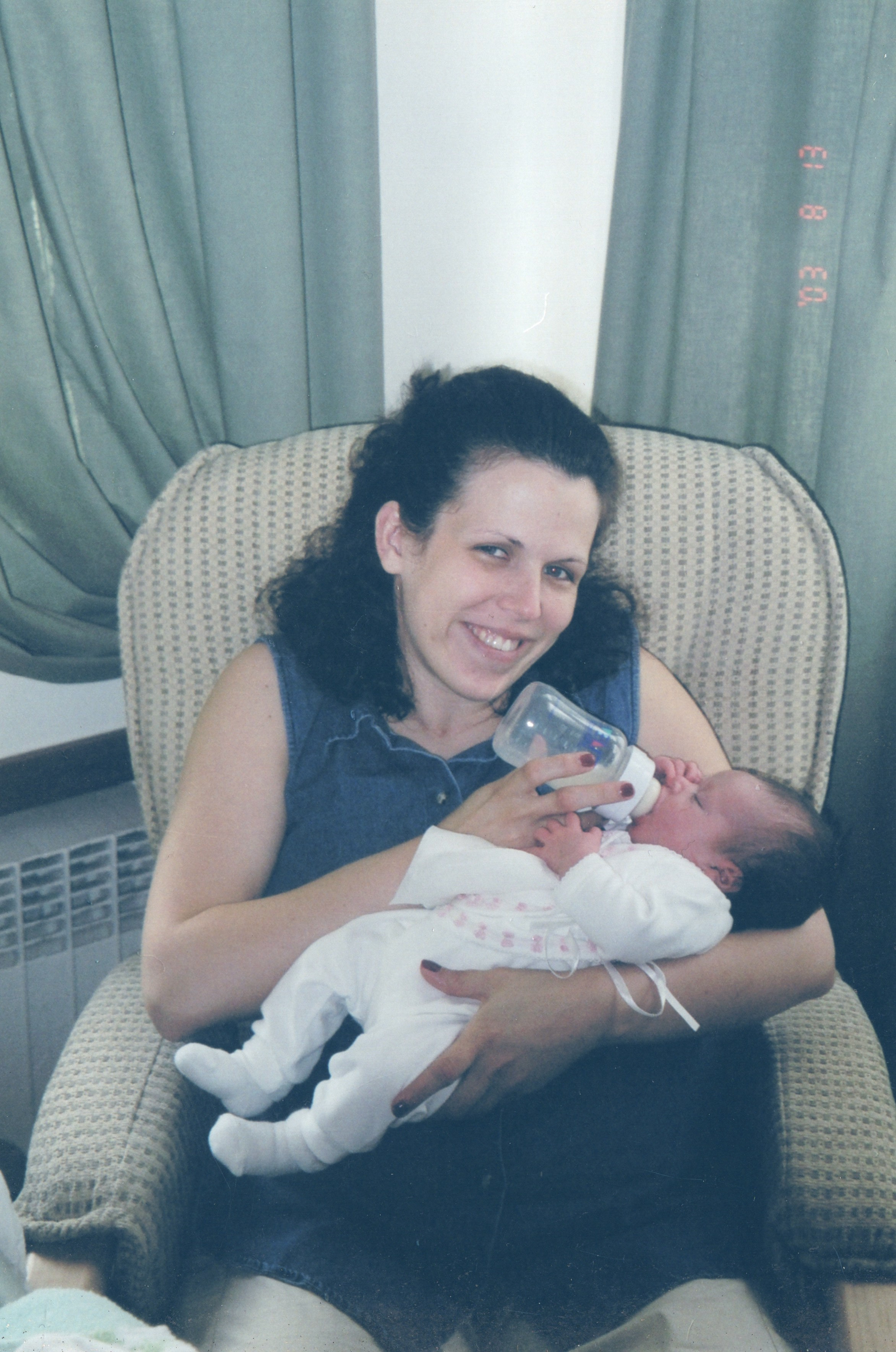
The glider I added to my baby registry in 2003 was arguably the piece I cared the most about. I am not big on stuff, and am unimpressed by “fancy.” I am all about practical functionality.

That glider housed my wide bottom as I awaited the birth of our precious child as she took her sweet time to arrive 10 days late. It held our girl Meghan in the arms of countless relatives and friends who stopped by in the earliest days of her life.

I held her in that glider in the summer of 2003 when the east coast blackout left my sweaty postpartum body begging for some type of a breeze, as at just a few days old, clear signs of colic were showing.

That glider held us for story time and bottles.

The glider held the two of us for the better part of most nights, when despite being told I was spoiling her, every instinct in my body told me not to leave my baby. No matter how bone crushingly tired I got. I knew not to leave her when she was in pain.

And when I was so very tired that I was afraid I’d drop her I would strap her into the Baby Bjorn just in case, and tell her stories from memory, like “My Most Thankful Thing…”

There came a point where we couldn’t fit in the glider together, but even as I knew we’d never have another child and I donated most things, I never parted with the glider.

She snuck in there with me in 2011 when we were processing the news of our Cowden’s Syndrome diagnosis. She sat next to me in 2012 while I used that glider to recover from my “prophylactic” bilateral mastectomy that gave me a “surprise” diagnosis of stage 1 DCIS.

The glider stayed in her first bedroom when the middle school years moved her upstairs and I claimed her old bedroom as an office.

After our then puppy Jax decided the paint on the wall was irrelevant and he used the glider as a battering ram, we repainted and moved it upstairs to her new room.

Every once in a while she would read in it and let her fantasy books take her away from middle school days that were too cruel for words.

She recovered from Covid in that glider.

That one piece of furniture has so many stories to tell.

But this story, the one where I sit across from my 21 year old baby sleeping in the glider, this is one I wish it didn’t have to tell. Or maybe I’m grateful it can be told this way. It is certainly one of the times perspective is critical.

I have so many emotions right now, less than 24 hours after my baby had a bilateral mastectomy and is recovering in the very same glider that has been a huge part of our lives.

She walked into NYU at 1:30 on 12/31 armed with the knowledge that it was her choice to take some level of control of a life that is so often in a free fall. Breast screenings began soon after she turned 21 and a BIRADS 3 screen in August was followed by an MRI that just could not tell her all was ok.

“Probably benign” is not an acceptable finding if you’ve ever met Meghan, especially when it showed 7 distinct and some sizable masses. Already.

We met a plastic surgeon in October who immediately put her at ease. He walked in having read her history and said, “What can I do to help?”

The most current, albeit small, longitudinal study of 700 patients puts PTEN Breast Cancer risk at 91%.

Meghan pays attention. Her maternal grandmother who does NOT have a PTEN mutation had bilateral breast cancer at 48. Her PTEN mutated mom had hers at 38 with a history of 8-10 surgical biopsies spanning the 14 years prior.

A mastectomy was always part of her story. None of us realized it would be this soon.

Cowden Syndrome gives you the tools to screen for our many cancer risks. It also empowers you to not ignore them when those screenings fire a “warning shot.”

The plastic surgeon said pathology will tell the final story but her breast tissue, like so many other parts of her, was older than her 21 years.

Over these last few weeks as we have slowly shared the news of this upcoming surgery, without fail the people who Meghan admires and respects are the ones who have come forward to tell her how brave and smart she is. They tell her how wise it is to control this one thing, in a life that has been too full of unfortunate surprises.

Those who have judgment, or seek only to gossip should keep moving. The older we get the easier it is to sort out who we need by our sides.

I stare at my baby, all grown up in our glider, and I vacillate between sadness and immense gratitude. I despise the ferocity with which this syndrome has made every single thing harder. Yet, my heart bursts with pride as she just continues to overcome things most others cannot comprehend.

This is not her hardest surgery. That hell on earth took place in June, but this one also deserves some time to rest.

Rest my girl. You’ll start that last semester of college a little late, but you’ll be ready. Misericordia Class of 2025 and Misericordia Class of 2027- Master of Physician Assistant Studies. The medical field needs you – and plenty more others like you.

I hope when you sleep you feel my love, and the love of all who ever held you in that glider wrapped gently around you.

I am so proud to be your mom, and we are together…

My Letter to the CEO of Disney

This is not the way I intended to talk about Meghan’s next surgery. However, as I have told her so many times before, we know ours is not the only story that needs telling, but who are we to complain about things that don’t change if we do not start conversations about things that are wrong?

Mr. Robert Iger 

Chief Executive Officer

500 South Buena Vista Street

Burbank, CA 91521-4873

December 13, 2024

Dear Mr. Iger,

My daughter Meghan is a dynamic human. And while I doubt Mr. Iger himself will ever lay eyes on this letter, it is my hope that someone will hear her story and carry it with them. It is my hope that the next time someone looks to speak for the disabled, that Meghan’s story will weigh on their heart.

Meghan’s birth was tumultuous in the summer of 2003 and her health has remained an issue to date.  Before her 5th birthday she had already had 4 surgeries, and doctors were part of her every day existence. She was adept at blood draws and MRIs, and long car rides and emergency room visits. She had been hospitalized twice for infections her body could not fight without IV medicines – each a week at a time. She ran high fevers. The kind that made you stay up all night and stare, wondering if we would get through the night without an ambulance.

The pain was part of her long before her first words. There was aggressive therapy, physical, occupational and speech, all to fight delays in her development.

There were food allergies – gluten, dairy, corn, soy and egg at one point, that made going anywhere that involved food socially almost impossible. There were only a few birthday parties, where she would stare at the cake, and politely refuse the pizza. Those were the ones she wasn’t too sick to attend.  Eventually the kids stopped inviting her. I mean, you need to be around to fit in, and a sick kid, an only child from a small immediate family was easily targeted as the outcast or the weird kid.

We took our first vacation as a family to Walt Disney World in the summer of 2008. Meghan was too weak to walk, but an adaptive stroller had been donated to us for the trip. We had a backpack full of medicines and contingency plans, but for a brief time that week, we got to be a regular family. We got to leave the medical world, and all it’s isolation behind. We got to fall in love with Chip and Dale and eat food safely prepared in real restaurants. It was just pure magic.

We returned often through the years. The medical issues never calmed down. The kids never got any more kind, well except for a few.  The isolation increased exponentially and the week we spent every summer in Disney was the escape we all looked forward to.

It was soon after our trip to Disney in 2011 that Meghan was diagnosed with PTEN Hamartoma Tumor Syndrome, or Cowden Syndrome, a 1 in 200,000 genetic disorder that caused both benign and malignant tumors, as well as vascular malformations.  I was diagnosed soon after her, and in the early part of 2012 I became a breast cancer survivor as my 8-year-old grappled with questions of her own mortality.

That adaptive stroller eventually became a wheelchair, as surgeries on her right leg alternated with vascular lesions in the hands and the loss of her thyroid.  The weight she carried was heavy as a mass was found in her uterus, and my 12-year-old underwent a D&C, a uterine biopsy.  Fortunately, that biopsy was negative, but there were way too many questions she was forced to grapple with, on topics no one twice her age would have wanted to contend with.

The surgeries never quit, often keeping pace with her age. But Meghan also never quit despite almost insurmountable odds she fought every single time she was told she could not do something. Despite isolation and loneliness, and despite an exhausting medical schedule, she never quit. She became an academic success story and generally a force to be reckoned with.

And almost every summer, sometime around the first week in August, we would find our way to the “Happiest Place on Earth.”  Where even if only for a week, Meghan was able to find joy. Her physical needs were accommodated. Her dietary needs were never a problem, and were often handled magically. We bought into the Disney Vacation Club, committed to the place that made our daughter feel the joy and magic she so desperately sought in a cruel world. Life continued to beat her up, but Disney, that was her break. No one made her feel less than for having a few extra needs. She was made comfortable. She was made to feel like she was worthy of happiness.

This past summer in 2024, Meghan turned 21. She did not go out partying with friends. There are still only a handful of peers who are mature enough to even try to understand the level of physical torment that has been her life. Instead, she stayed home with her parents recovering from her 22nd surgery – this one the most horrifying and invasive of them all.

A tumor had grown at the top of her right thigh. It was almost 5cm at one point, and butted up against her sciatic nerve. It caused unrelenting agony for 5 years prior to its excision.  Her high school and college careers were punctuated by attempts to shrink that tumor through embolizations and cryoablations. Finally, her orthopedic surgeon told her it was small enough for him to remove. But he cautioned he would need to “fillet” her thigh to get it out.

The surgery was on June 3rd. It took about 6 hours. The surgeon told me he removed 4 SQUARE inches of muscle from the back of her thigh. He told us it would take 6-12 months for her recovery. He explained the muscle spasms that take place as muscle dies, and new muscle regrows. But nothing he could have explained would have prepared me for the next 6 days in the hospital. Meghan and I were alone, visited only by her father. In all the surgeries I have had myself and in all I have walked her through I have never seen anything like what I saw that week.

The amount of medication it took for her to get even a brief rest was unnerving. She could not put any pressure on the back of her leg.  She could not bend her hip greater that 60 degrees. There was literally no position of comfort or rest. I drove home from the hospital with the Narcan they had prescribed in my lap, and the rest of the opiods needed to keep her functional tucked in the back seat.

She spent the summer in Physical Therapy three times a week. She fought like a beast to get some of her mobility back and scale back the medications. She is my actual hero. And, while she was working so hard, we promised her that even though we missed Disney in the summer, we’d get her there for Christmas.

This girl, now a woman, entering her senior year in college, having endured the most grueling summer of her life, on sheer determination alone became a certified Emergency Medical Technician, and was dreaming of a trip to Disney with her parents.

Before we even had a chance to begin making plans, the screening breast sonogram for her PTEN Mutation, the Cowden Syndrome I mentioned earlier, came back with 7 notable lesions and a BIRADS 3 rating. She was advised to see a breast surgeon, which we immediately scheduled for her October break. PTEN patients have a 91% lifetime risk of breast cancer and those lesions clearly meant her time would come sooner rather than later.

We scheduled her bilateral mastectomy (yes, she’s 21) for December 31st. We scheduled Disney for December 23-30. 

But the week she is in Disney she cannot take any of the anti-inflammatory medicine that has carried her through the leg surgery.  It will be a bleeding risk for her mastectomy. She cannot sit for any extended period of time. She cannot stand for any extended period of time. Her sleep is broken. She rarely rests. 

So, when we were thinking about Disney we were thinking about the DAS – Disability Access Service- that we had used for the last 13 years.  This year we were told we had to secure it in advance. We scheduled the meeting on line today.

I have to tell you I am nothing short of devastated by the way she was spoken to and the way the whole process has transformed. It was made clear that you have taken a system that was our lifeline, and transformed it into a system where only certain types of disabilities seem to matter, which ironically feels extraordinarily discriminatory.

The cast members on the call were too busy with platitudes and a poorly constructed party line to hear anything that was being said. They were too busy trying to check a box to realize my daughter does not fit in a box. They had never heard of her condition and did not care to listen.

Jackie Lynn determined that Meghan could use a wheelchair (she can’t sit on the 4-inch scar on her upper thigh comfortably for any length of time) and then she could “walk in place” on line if she needed to move, showing no understanding of the mechanisms that cause the swelling and pain all the way down to her foot.  She needs to move to keep comfortable. Jackie Lynn told Meghan she “understood” and when Meghan countered that she could not actually understand, she replied “I do and I don’t appreciate you telling me I don’t.”

When we asked for a supervisor, Claudia actually mocked my daughter for her tears of pure exasperation, wondering what she was crying about when she hadn’t even gotten there. She refused to acknowledge that her only alternative to standing in the que was to separate our family of three was a crushing blow to a much-needed time spent together.

When we asked Claudia for her supervisor, she told there was no one. When we insisted that she has a boss, she told us it was no one where she was working, her boss was Mr. Iger. That is why this letter is directed to him.

Tonight, as I write this I am so hurt, and so angry that the place I considered the antithesis of discrimination could pick and choose which disabilities matter, and would refuse to acknowledge that some situations need special considerations. The world is not black and white. Not everything is easy, and not everything can be solved by a formula.

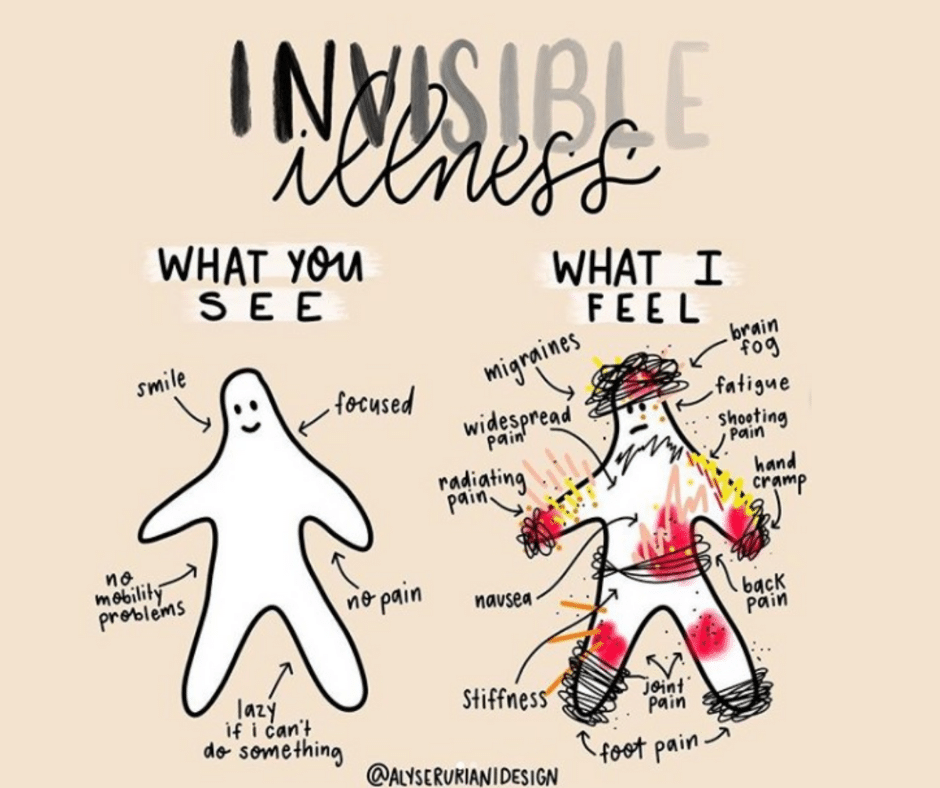
Not all disabilities are visible, and ignoring those like my daughter who pour their heart and soul into overcoming obstacles those 4 times her age have not had to face is unconscionable.

Meghan has had 22 surgeries. Meghan has had 12 surgeries on her right leg. Meghan lives in constant, unrelenting pain. Meghan is having surgery 23 on December 31 and will be in Disney without any pain medicine. All these are true facts.

Meghan will graduate with her college degree in May. She has attained high honors. She has been accepted into a Physician Assistant program for July of 2025. She has suffered with, and is managing ADHD on top of all of the above.

Parallel truths. Seemingly implausible opposite things can be simultaneously true. Sometimes these parallel truths indicate the reasons that rules should have criteria that is managed more broadly.

Disney, you really messed up here.  We were among your biggest fans. We will take this non-refundable trip as scheduled, but we will cringe a bit when we see the DVC sign that says “Welcome Home…” as we all have seeds of doubt in our heart.

Signed, a very disheartened and disappointed mom,

Lori Ortega

Just Let Me Know if I Can Do Anything….

Spoiler alert…

If they are messed up enough from something, a loss, a trauma, or literally ANYTHING that prompts you to ask that question, they are likely INCAPABLE of figuring out what they need, let alone asking you to do it.

My advice to you – SHOW UP.

My further advice is if you are not prepared to listen, sometimes to heavy things, or if you are not prepared to leave your judgment behind, and support them, KEEP GOING. When you offer to do ANYTHING, many times it will not be a THING. Many times it will be letting them talk out their pain, anger, grief, recovery, fear, difficult decision…etc.

But if you truly want to show up, and are prepared that they may actually reply in a way that requires you to do so, then I offer these examples of showing up in increasing levels of challenging in case you like to start small:

*When you are checking on someone, whenever possible, check DIRECTLY on them. Use their own cell phone. Text them. Call them. Checking on someone by proxy may be easier for you, but it’s not helpful to the person suffering.

  • Text. Even If you don’t know what to say. Text anyway. There a million cute emojis that can signal to a human that they are on your mind. Don’t assume they know. Again, if you were prompted to make the statement above, they are in a whirlwind of pain. They literally can’t tell you what they need. Except knowing you’re thinking of them helps. And they can’t know without you reaching out because they are not psychic. One. Single. Emoji. Counts.
  • Text words. Even if you don’t know what to say, but you are more daring than the emoji only suggestion above, use words. Simple words. I’m thinking of you. I hope you see a pretty flower today. You are loved. Or any variation of the above.
  • Text invitations for them. This gets a little trickier because you may have to try a few times. But, “Hey, I’m free for a few, do you want to vent?” Or “Feel like chatting? I can call.” Or, if you live close, “I’d love to pick you up and take you for an ice cream, cup of coffee, loud scream in the park, swing on the swings….” etc. are all good suggestions. These invitations make someone feel valuable, and not pressured. They make them feel like they are on your mind and worth your time. They are currently doubting this while feeling like they are “too much” for human contact and worried that they will drag you down into their abyss.
  • Call them. Now to some this is terrifying, but here is a spoiler alert. Cell phones make it easy to bypass calls that come at difficult times. So if you call them, and they can’t talk, leave them a voicemail telling them they are on your mind, and invite them to call or text you. Hearing your voice may be just what they need.
  • Offer to meet them. Doing something they like. On terms that are good for both of you. Maybe a walk in the park. (Someone did that for me last week and it was so amazingly helpful. 🙂 )Anything that no one feels cornered by works
  • Stop by. Yep, it might seem freaky in this age of minimal contact, but try it. Showing up in person to just sit with someone in their pain is amazingly therapeutic, and might make you feel good too. And when you stop by, be content to sit in a messy, chaotic space and need only a glass of water.

They likely do not want an opinion or a suggestion, or a platitude. If you feel compelled to give those… you may want to refer to paragraph 4 above the picture.

They may never choose to offload their burden, or they may do it repeatedly. I have found once you allow the “elephant” to sit in the room with you, and you acknowledge it is there it becomes an understood, albeit unwanted guest. But only once you have offered that “elephant” a spot in the room, and acknowledged that you see it, can things move forward. At that point, topics change for a time, and sometimes people even laugh. It’s incredible. And when the person needs you again it is so much easier, because they know the “elephant” a bit. They know it is there. No one needs to start from zero again.

If you have truly decided to show up, then whatever way you decide to show up. Do it. Don’t make yourself feel better by saying “I didn’t want to bother them.” They’re bothered. Their life is in turmoil. Your caring will not make them feel worse. I can almost guarantee it.

The older I get the less I understand social dynamics, and the more of a recluse I become.

I am pretty in touch with real life. I am totally aware that other people have epic chaos in their lives. As a matter of fact I would dare to say, when given the chance, I am a pretty good listener. To be honest, I enjoy the opportunity to listen because it means someone cares enough to share their life with me. But chronic illnesses are, well, CHRONIC. Genetic disorders are FOREVER. And I am finding that people, the same ones who can be so supportive in the moment, experience fatigue over the CHRONIC nature of Cowden’s Syndrome. I mean, there’s a pretty good chance every time you speak to Meghan or I there is a new chapter in the life of medical drama.

Sometimes we want to talk about it. Sometimes we want to ignore it. Sometimes we want to sit under a table in a dark room and cry. Sometimes we want to scream. Sometimes we are sad. Sometimes we are scared. Sometimes it’s an ugly combination of all of the above.

Most of the time we feel lonely and isolated.

Yet, we dust off and keep moving forward. Not in a quest for a medal or accolades, but with the fervent desire to do what we can to live the life we’ve been given to the best of our ability in these often faulty bodies.

A screening scan in August that was less than stellar tipped off a lengthy week in October that will bridge to another surgery for Meghan in January.

One day soon we will share more about it.

But for today I will leave this here…

Whether you are reading this because you know us, or this found its way into your path because you have someone in your life to whom you have said “Just let me know if I can do anything…,” please show up for them. In some way, shape, or form, show up.

I hate a lot of things about cell phones. I love the ease with which we can show up for each other.

Never in the history of text messaging have I seen or heard of someone who felt angry or sad that someone checked in on them.

In this age of disconnectedness… SHOW UP….

No Rest for the Weary…

I have found when I am just exasperated by life, I get really quiet. Like hide in a corner, under a table in a dark room kind of quiet.

And if you’ve been looking for me, that’s where I’ve been since mid-August.

Mid- August, about 30 seconds after Meghan’s leg started to feel like it was ok to keep it attached to her body without the need to writhe in agony, is when we went for another one of her PTEN “routine” scans. Except nothing is routine when you have Cowden Syndrome.

So a few hours later when the report posted, we took a gut punch. There were definitely things to be concerned about.

And, when her gynecologist called the next day after reviewing the results it got a little harder to breathe. She said, even though the report suggested a 6 month follow-up, she wanted us to go in 3. And book her with a surgeon for a consult soon.

So we scheduled the follow up sonogram for the day before Thanksgiving. And we scheduled the surgeon(s) for her fall break – Thursday and Friday of this week. We will head into the city on the bus together. Not to see a show, or do some shopping, but rather to get her established at the Perlmutter Cancer Center, and learn our next steps.

Meghan and I have talked at length about the likely next steps. We just need the doctors to weigh in. We are not “getting ahead of ourselves” as some like to suggest. We have read more than our fair shares of scans and reports. We know when something is going south.

And so Meghan headed to her senior year of college in August with the crippling pain of her leg slowly receding, and the epic weight of this new news weighing her down like a stone hung around her neck.

Literally it felt like 30 seconds in between.

My beautiful girl continues to make life happen, she and Ella in their own, well-deserved apartment this year. But it is so hard to be free. It is so difficult to be present with peers who even if well-intentioned could not possibly relate.

My girl continues to interview for Physician Assistant programs and to proceed as if success is inevitable. Even though sleep eludes her. Even though her entire life seems to be in a state of flux.

I think about the people who tell us, alone or together that we should “reach out” when we are overwhelmed. And I wish with every fiber of my soul that instead those people, who are rightfully at a loss for words, would send a simple text to her. One that says you’re not as alone as you feel. One that says, it’s ok to talk to me. I will be here. And even if you can’t talk, even if you can’t form the words, I will keep checking on you. Because even though we are painfully aware everyone has something, sometimes the load is just too epic to carry alone.

When you have a chronic, cancer causing condition, there is always an appointment and a scan. But the longest time, the one that is the hardest and the loneliest, is the wait between scan and plan.

Those are the times where you just cannot focus on anything. That is when you are the most vulnerable and alone.

We’re not high maintenance people. But there is literally no rest for the weary.

We will be headed into the first of those 2 appointments midday on Thursday as we have done all the others – side by side.

Because when we are lonely, lost and overwhelmed we remember that we have each other, and a dad/husband who loves us both with his whole soul.

As we push through these next days we remain quietly…

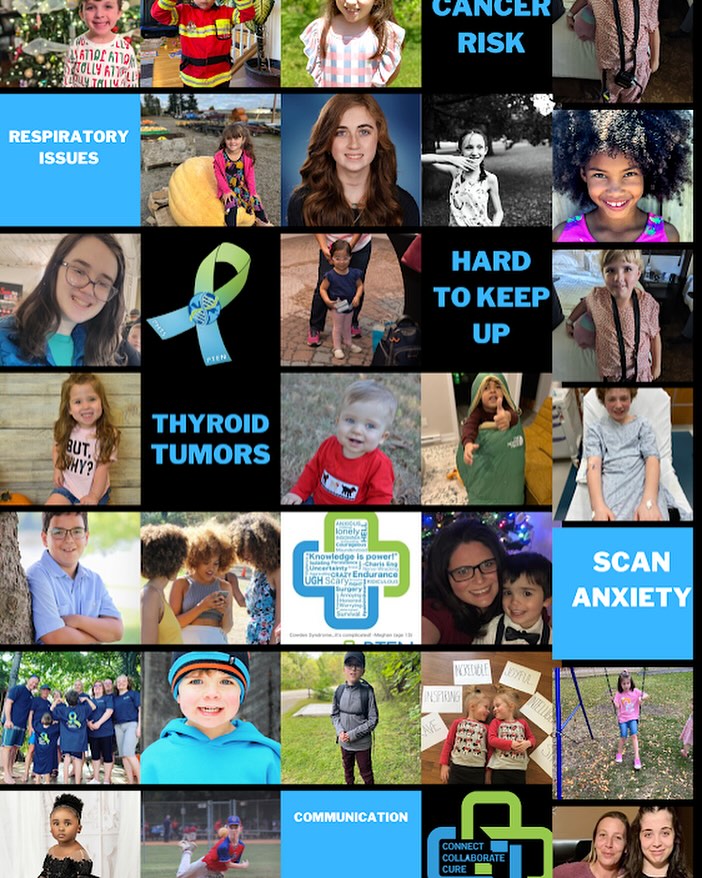
Let’s talk about PTEN

… said almost no one except us. Ever.

That’s why it was intriguing and exciting when Kristin Anothony from the PTEN Foundation contacted me last spring and asked me to share my story on a podcast. Kristin and I have been in touch since before she started the foundation that now represents all of us.

We met Kristin in person in 2018 when she flew to New York for a dinner where Meghan was being honored

We were interviewed for episode 2 of a 5 part podcast. The link is here…

I am constantly humbled by the number of people who interface with this blog. It is mind-blowing to me that people either stumble across this or come here on purpose to learn what our PTEN journey has been.

Back when we were diagnosed in 2011 the internet had sparse mentions of PTEN mutations or anything related to it. But, since I was a mom on a mission my first goal was to create a survival network of others who knew this journey. I connected with Australia, Virginia, California, Colorado, and Alabama. I later found others in places across the globe. And, even though we were all too far for gatherings, in many ways they became my closest confidants.

People dismiss social media, and as a teacher and a mom, I have seen the damage it can do. However, as a rare disease patient, I literally cannot imagine my life without it.

When a diagnosis that is new, scary, and uncertain comes your way, you need hope. You need success stories. You need to know that although it is hard, so hard that sometimes it seems impossible, you are not alone. Like so many other things in life, when used properly, it is good for us. When used in the spirit it was intended social media can be our lifeline, giving us the connections that we so desperately need.

And sometimes if you are lucky, one of your internet lifelines travels to New York from Virginia and you get to hug her in person…

Margaret and I in November 2021

And if you are not that lucky, well, you still are. Because we have an entire team right now, climbing Mt. Kilimanjaro in Africa to raise awareness for us, and to raise awareness of PTEN mutations across the globe.

The rest of the podcasts are linked here. The content is amazing, from Kristin, the founder, and president of the PTEN Foundation, to Ashley and Keegan, a PTEN mom and son who amaze us every day, to Dr. MacFarland and Dr. Frazier, much-needed and appreciated medical professionals helping us navigate this wild ride.

As we head into World Rare Disease Day this week, I encourage you to share your story. Share it here in the comments, or share it wherever you feel heard. It matters. You matter.

Dark Days/Finding the Light

I am a March-August kind of girl. I love warm weather and lots of sunlight. Long walks are my favorite. There is nothing that soothes me more than putting on a pair of sneakers, putting my music on, and just going.

I find the fall stressful. Maybe it’s years of being a teacher. There is hopeful anticipation about school in September, but the organization and logistics take forever, and the fall germs are just… a lot.

Before I have time to look up, the days are getting shorter, the leaves are falling, and it is time to pull out the sweaters.

I go through the motions dutifully, cleaning and organizing, but I lack the excited anticipation people have when they smell pumpkin spice and start to see their breath. I just don’t get it.

I think I was always this way, but in fairness, so many emotional events in the fall and winter may have given me the final shove into my aversion for those seasons and bolstered my affinity for my spring allergies.

Given all that, it might seem contrary to say that we decorate early for Christmas, but we do.

Remember, I love the light.

Our tree is up by Thanksgiving, and the lights around the house are on every possible second. I love buying and wrapping gifts. I take comfort in our advent calendar and the excitement of the impending arrival of the baby Jesus.

My faith anchors me through the tumultuous turns life tends to take. It keeps me grounded and focused on the fact that this life is merely a stopping point on a journey to forever.

I grew up in a church. I spent so much of my life there as a child, and a teen that I could navigate the building with my eyes closed. I stayed at that same church after my husband and I met, and it was there that we married and had our daughter baptized.

And as ironic as it is, it is the place I had to walk away from when our worlds got turned upside down with all things PTEN and Cowdens Syndrome. I had to walk away from the place to continue to nurture my faith.

When you grow up in a community of faith, it is hard to accept that reality. I miss weekly services, Angel Trees, and Christmas shows. And sometimes that disconnect can make the dark days extra hard. Yet, in the apparent contradiction that is often reality, my faith has continued to grow through the years.

So, this morning my new normal involved my air pods, my iPad, and my orchids.

Today I “went” to church in Buffalo and in Sarasota, and I never left my house. I sang and prayed and smiled and pondered through Western New York Church Unleashed, and Faith Lutheran Church in Sarasota, Florida. The pastors are comforting and familiar, especially Eric, my brother-in-law in Florida, and also Roger, Jeremiah, and Steve in Western New York whom I have never met. The same internet which often isolates us from each other, keeps me connected to my faith through Advent and beyond.

I took some time with my orchids. My beautiful, perfectly imperfect orchids, that I feel a strong kinship with. Somehow, despite the odds, and without any traditional interventions, they blossom and grow in the most amazing ways.

I spend too much time alone and find it easy to be lost in, and overwhelmed by my own thoughts. Cowden Syndrome is ever present in our minds and bodies, even when the medical drama is on “pause.” The anxiety and anticipation of a lifetime of justifiable worry can make so many things, just hard.

Today I was reminded to give thanks in all circumstances. I was reminded to pray without ceasing, and I was told that you can have joy in your heart, even when you are not happy. 

Life is a contradiction. Emotions yield guilt way too often. But, I have learned that feeling all the feelings is the only way I will survive and thrive in this crazy life.

I do not like the winter. I will never enjoy the darkness. I love the lights of Christmas and I eagerly await the birth of the baby Jesus.

I promise to stop and smell the “orchids” while anxiously waiting for the first sneezes of spring.

Wishing you and yours peace throughout this season.

Ella, Buddy, and Jax bring us so much joy…

Dirty Little Secret

Remember that killer headache you had last week? Or the time you fell off your bike? Or the day you slammed your finger in the door? What about the time you had a gallbladder attack and you ended up in surgery? Remember your most painful experience. Think about how it consumed you, and how hard it was to get through. Think about the people who cared for you and how glad you were when you were past it.

Remember the support you received after your injury/ surgery/ accident. Remember those people checking in on you and encouraging you. I bet if you think about it, one of the things that carried you through was knowing it would pass. No matter how dark it got, you knew that one day, with rest and medication and therapy and support you would feel better again.

But what if the pain never went away? What if there was always a residual pain, just present enough to occupy precious space in your mind 24/7/365?

I was, yesterday years old when my almost 20-year-old said something I don’t think I had ever really given much thought to. She said some people have no pain. I think I struggled to process what she was saying. So she said it again. To be honest the thought of having no pain was kind of mind-blowing to me. She and I both deal with pain, pretty much all the time. I think maybe it has been easier for me to deal with because I never realized or gave much thought to the fact that this is not the same for everyone.

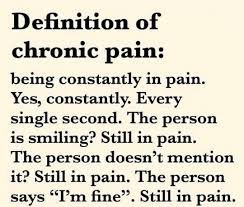
Chronic pain is treated like a dirty little secret. You can’t talk too much about it. It is a buzz kill. It makes a room heavy. It makes people uncomfortable because even the most well-intentioned people do not know what to say or do. And if your chronic pain lasts, well, forever, talking about it is frowned upon. Talking about it can also generate unsolicited advice, “cures,” and shame. Many people cannot imagine that some bodies hurt. All the time. No matter what you do. So they resort to blaming the person who hurts. It must be their fault. They must be lazy, stressed, overweight, have poor eating habits, lack exercise, or they should just “relax.” It must somehow be their fault.

Blaming the sick person is a protection we use. I have done it. I think we all have. We often do it because we are glad it is not us who is sick or in pain. We want some concrete intellectual assurance that it can’t/ won’t be us. So, when you have chronic migraines, and someone asks you why you haven’t found your triggers yet, or when you have joint pain, and you get told to stretch and strengthen, or when your stomach pain is met with “calm down, it’s just stress…” someone is trying to make sense of what you are feeling. In this society, we want a pill or a medication or an easy repair. They are trying to “fix” it, but in doing so often the person in pain is now left also feeling like a failure.

And that patient blaming is not limited to colleagues, friends, and family. Patient blaming is on fire in the medical community. While some practitioners understand that most people do NOT want to spend their whole lives at the doctor, there are others who will find every reason in the world to make you believe you are a depressed, pill-seeking fool.

So those who endure/ survive/ function with chronic pain start to feel like they have a dirty little secret. They feel the pain is their fault and they have something to hide. They feel burdened by this pain that is involved in every single thought and every single move. All day. Every day.

Imagine a song you hate so much. Now imagine that song playing in your ear. All the time. When you try to sleep – it’s there. Taking a shower – it’s there. At work – still there. Out to dinner – yep, still there. The volume button broke. The song is stuck in a loop. It is just enough to keep you distracted but not loud enough for anyone else to hear.

The first few times, you tell someone it’s there. It’s loud. It is annoying. It is hard to concentrate. At some point people tire of hearing this, and tell you to get it fixed, or get over it. They can not even hear the song, but the thought of you mentioning it gets them twisted. So, you stop talking about it. But it NEVER STOPS PLAYING.

So, being aware that you need to do herculean things in a body that has the strength of a sloth, you press on.

You go to school. You meet up with friends. You go to work. You make polite small talk. You pursue career goals. Because you know that we only get one chance at this life and you don’t want to miss it.

And you bargain with yourself. You make little deals along the way with this body that has this terrible song playing so loud that a chunk of your focus is off, and everything you do is just harder than it should be.

You try so many things to get better. But you don’t talk about them. Because hearing someone tell you what should have made you better by now, or listening to the stigma of many alternative treatments has you wiped out and on the defensive. You don’t need to explain. You don’t want to be scammed, or judged. You just want to feel better.

While you are pressing forward, using every ounce of strength that you have to complete daily tasks, it is easy to pull away, even from those closest to you.

It can be so hard to be appropriately sympathetic to a skinned knee when the thought of amputating your most troublesome appendage crosses your mind at least every few days. Your rational mind knows the skinned knee in fact does hurt. Somewhere in the chasm between “I wish someone understood me” and “I want to be a generally decent and kind human” you find the words to say that you hope that skinned knee heals quickly.

Hope. It is the most powerful weapon we have. And sometimes we have to dig it up and polish it off and look at it for a long time. Sometimes we are afraid to dare to hope because we have been disappointed so many times before. But, hope. Hope is everything.

So what can you do if you love someone with chronic pain? How can you relieve some of the burden of this dirty little secret?

Some tips? Remember that it is there. All the time.

Be available for a hug if they want it.

Be encouraging but not patronizing. Use empathy over sympathy. And nudge them forward.

Don’t try to fix it. You can’t. If you could they would have already done it.

Sometimes quiet proximity is the best thing in the world. Being “alone together” can be reassuring.

Believe that they will do all they can when they can.

Don’t stop making plans, but be flexible whenever you can. Pain levels are not on a schedule.

It is hard to be in pain. It can be torture to watch the person you love in pain. By the way, they know how tough it is on you. It is why they worry so much. They have been abandoned before for being “too much” and they don’t want you to go too.

Show your person you want to stay. Show them that despite the dark times, their light is something spectacular you want in your life forever.

It is ok to remind them sometimes that they are a total badass. It’s not a title they were seeking, but it is well-earned all the same.

Cowden Syndrome in and of itself does not cause chronic pain. But, the ramifications of living a life of it, well that can. In our house, we stay active. We stay healthy. We go to work. We go to school. We pray and laugh and love each other. Together. In this house, we know that great things are possible even in the midst of relentless physical pain.

We have goals and we will succeed. So if you see us sitting on the bench, don’t count us out.

We remain….

This topic has been on our minds this summer. Send us your thoughts on chronic pain. We’re especially interested in the best and worst things people have said to you or a loved one in pain.

Meghan and I on our best days will always choose ‘Joy!’

My (Unsolicited) Advice…

I remember sitting at my computer in early 2004, sensing that things were not right with my then 4-month-old. A tumultuous birth was followed by months of colic. I was sure I was doing everything wrong. There were formula changes and pediatrician changes. Then in February of 2004, she was hospitalized with a cellulitis infection on her face. Ultimately we were released from the hospital, but I knew I would never rest too easily again.

We searched and searched as illnesses lumped on top of each other and bled into surgeries of odd growths. We started early intervention for Speech, OT, and PT. There was gall bladder surgery for “milk of calcium,” tonsils and adenoids, and so on. This slid right into an arteriovenous malformation in her knee, and the list just kept growing. We saw so many doctors I could not keep up. It was a giant game of “whack a mole” and there was no end in sight.

I buried myself in the internet, trying to find anything to help me understand why my girl was just not healthy. The internet in 2004 had a fraction of what is available in 2023, but it was a start. I learned to find credible sources and to look up words as I read the vocabulary in complex medical journals.

Although nothing could have prepared me for the diagnosis that came late in 2011 after our PT and angel Dr. Jill sent us to genetics because, well, “something isn’t adding up.” Dr. Jill was right, and it took the geneticist about 45 minutes of skillful conversation, some sneaky analysis of her motor skills, and a tape measure to declare, “I believe I know what she has, and I think you have it too, Mom.”

6 weeks later a genetic test confirmed a mutation on her PTEN (tumor suppressor) gene, and 4 weeks after that mine was confirmed as well.

And suddenly, at 8 and 38 we were members of a very tiny community that seems to be experiencing exponential growth these days. The numbers we got were 1 in 200,000, and the inheritance was “autosomal dominant” although we can not see evidence of it on either side of my family besides me. There were a lot of answers to a surgically rich history of my own that came with the diagnosis.

A good deal of our journey is chronicled in this blog which began in May 2012, and things I have learned along the way are peppered through the posts. But, as my girl turns 20 this summer I have a chance to look at things as the mom of an adult child with a PTEN mutation.

I’ll share this (unsolicited) advice with you:

  1. You ARE an expert on your child and you ARE a valuable member of their team. Go ahead, read that again. The team should be filled with brilliant and well-researched doctors. Who you choose to be the CEO of that team is up to you, as long as the parent, or the child as they age, are a part of the team as well. It is my opinion that a doctor who lacks confidence in their own ability is the one threatened by well-intentioned questions from those on the front lines-the family. If a doctor is upset by your internet searches, do not promise to stand down, ask for guidance as to how to seek reputable sites and worthy information. Most of them have searched your condition soon after they met you, or right before your first appointment. I have even found practitioners searching Google in the ER before seeing us. I do not fault them for not knowing everything. No one can learn about every rare disease in medical school. However, if they make you feel foolish or less than for seeking answers – FIRE THEM. A solid medical professional knows your disease well enough to ask the right questions and is comfortable learning for you and alongside you. You are parenting a zebra, a beautiful, perfect, rainbow unicorn zebra. They should be treated as such. Do not let a doctor who is uncomfortable learning new things, or thinking outside the box intimidate you.
  2. Your child knows something is up. Trust me. No matter their age, their IQ, their ability to verbalize, or their personality, they KNOW. They may not know the details but they know you are worried. Think about how many hours you are spending trying to find answers/ juggle appointments/ balance a job/ fit in additional costs/ care for their siblings, etc. There is no shame in your struggle. You endure what would level most and you push through on all cylinders from the depth of the love a parent has for their child. Just never assume you’re hiding it all. You never want them to interpret your quest for their health as a result of something they did wrong.
  3. Control the narrative when you can. I had an endocrinologist soon after diagnosis plow right through my wishes and explain the cancer risks in depth to my 8-year-old. In hindsight, I should have at the very least fired him on the spot. I did not because I was at “the best” facility. I was intimidated. We do not use that facility anymore.
  4. Tell the truth. I know this seems to go against what I said above, but the trick is simple. Answer the questions they ask you, honestly. I mean everything from, “Yes, the needle for the bloodwork will probably hurt when it goes in. Then, when it comes out and we, (insert something fun here) you will feel better.” Use as few words as possible. Do not restate or belabor the point. When they’re done listening you will know. But, if you are honest and basic with your answers, they will trust you and come back for more when they are ready.
  5. Nobody has all the answers. Take good notes. Bring another set of ears when you can. Establish ways your specialists can be reached if there are follow-up questions. If your specialist does not listen or value you as a critical source of information, fire them. Respect them for what they know. Keep them if they are looking to learn more. If not, move on.
  6. THERAPY. Start early. Search for quality. Hold on until you find quality. Then step away. Let your child have a safe place to work through the physical, mental, and emotional ramifications of this mess. They say they are fine. They seem fine. They are probably struggling. That is not your fault, and you can not fix it all. Truly some kids are just mean and by being different your kid is a solid target. This internet/ social media world is ruthless. They need to be able to say things that are on their mind without worrying about what you will think/ say/ do. And, if you lack a healthy outlet, consider therapy for you too. They are watching. Your ability to handle their diagnosis, and yours if you also are positive, will be something they are observing even when you don’t think they are. Make your own mental health a priority as well.
  7. Make the boring and stressful things as much fun as you can. Quirky selfies, a favorite lunch spot, a special trinket, and some of the best conversations you will ever have may happen on those trips to the doctor. Instead of waiting for the “storm to pass” choose to “dance in the rain.” You are making memories, just not exactly where you had hoped.
  8. Do not underestimate your child. With the right balance of love, acceptance, medical screening, therapy, and time for child-like joy, they will be the absolutely amazing human they were meant to be.

That is not an all-inclusive list by any means. Feel free to drop a comment here or on our FB page about the things you have learned about parenting a child with a PTEN mutation.

I remember in my earliest days after diagnosis there were a few kind souls who pulled me forward. I hope this blog, and knowing you are not alone provides you some comfort.

Unanswered Prayers

Sometimes my unanswered prayers end up being what I am most grateful for.

Sometimes what happens is not what’s “right.”

Sometimes we can fight to change it.

Sometimes we have to stop fighting and move on.

Sometimes we have to consider that there might be a bigger picture we can’t see yet.

There are a handful of songs that have shaped me as a person. Among them is “The Gambler” by Kenny Rogers. Somehow the chorus has come into my mind at some of the most challenging times in my life.

“You got to know when to hold ’em,
Know when to fold ’em,
Know when to walk away,
And know when to run.
You never count your money
When you’re sittin’ at the table.
There’ll be time enough for countin’
When the dealing’s done.”

My life, sometimes my very existence, feels like it has been one fight after another.

I don’t mean aggressive battles among peers or friends. I mean battling “the system.” Whether it was fighting the limousine company that tried to change the contract 5 days before our wedding in 2000, (yes we walked away, got to the wedding in another limo, sued them, and won,) or health insurance companies that don’t want to pay for tests, procedures, scans, and surgeries Meghan and I have had, or doctors themselves who sometimes just don’t listen, the list of fights goes on and on.

I have a stellar record in this never-ending stream of confrontations.

But at what cost?

I sometimes worry my memory is failing. There are so many things I can not recall. I am sometimes comforted by the movie “Inside Out” and the notion of my brain making room for the things that matter.

The last decade has definitely been among the most formative of my life. Mom always said you do more changing in your 20s than in your teens. I’m not sure where that leaves your 40s!

Sometimes I shake my head in amazement at the journey that included removing a few organs between us, attacking a few tumors, hospitalizations, appointments, graduations, celebrations, and loss. Sometimes the loss hurts maybe more than it should.

I was lucky enough to arrive in my 40s with grandparents. Not many people can say that, and yet not a day goes by when I wouldn’t gratefully accept another one with them.

My father died in 2013, soon after I turned 40, and the ache from that loss, after we had so recently found each other is constant.

And that brings me back to “The Gambler.”

“You got to know when to hold ’em,
Know when to fold ’em,
Know when to walk away,
And know when to run…”

I’m not sure anyone knows Dad referenced that chorus in December 2013 in his VA hospital room when I was tasked with telling him his kidneys were shutting down in response to a cancerous tumor in his pancreas. He was so calm. I wanted him to fight so badly. I wanted to keep him with me. I wanted to scream. But he simply told me it was time. He had fought plenty in his life. And he had overcome. But, this time he knew…

School was not ever Dad’s strong suit, but he was a student of life. He knew the numbers, the stats, and the odds. He knew the reality of how his situation was going to end.

Unanswered prayers. Maybe they prevented things he never would have wanted. Maybe they were what we all needed. I am not sure, and I look forward to hugging him tightly again one day. But for now, the lesson of the value of those unanswered prayers is something he left behind, that I can call upon right now when I need it most.

I fell in January of 2019 in my classroom. I was teaching and a chair moved as a restless student changed position ever so slightly as I circulated the room. My feet did not anticipate it, I could not have seen it, and my left foot stayed on that chair while the rest of me hit the ground. Hard. It was one of those moments where I just knew things would never be the same.

I filled out all the accident reports before leaving for x-rays and MRIs. And, as so often seems to be the case, things got complicated.

My injury wasn’t properly diagnosed until March of that year, much later than I needed that diagnosis, as the damage done walking on a partial Lisfranc tear during those first 8 weeks proved irreparable.

I have fought for that foot on repeat since 2019. Surgery in 2020 did nothing to make things better. As a matter of fact, the addition of 3 screws, well, let’s just say the foot is unimpressed by their presence. And, the rock/ hardplace scenario continues as the surgeon told me removing them will make things worse.

A year of remote teaching did nothing for my foot, although that year, unanswered prayers brought me closer to some amazing colleagues, students, and families.

Teaching in person seems to accelerate things in the wrong direction.

I applied for accident-related disability retirement in 2021 and again in 2022. The denial that came this time, which follows a transcript of me being berated by a doctor who has never been in a classroom, shook me to tears on more than one occasion. The decision actually reads that the fall was not an accident.

I am pretty sure it is the textbook definition of an accident.

I was chastised for going to work. No one could explain how I should treat this injury if I stopped working and lost my medical coverage.

My foot is in never-ending pain. My left hip aches. My right knee is wearing from a constant subtle limp. Complex Regional Pain Syndrome is quite real if you ever wondered. Sleep is often more of a goal than a reality.

I should fight. I should appeal again. I should write a letter of complaint for the way this doctor handled me. I should. But, I am not going to.

I can’t fight this one.

And as many times as I have modeled for my daughter on repeat that she should fight with all her might, I am going to model this time, that sometimes you need to “… know when to walk away, know when to run…”

“If it costs you your peace; it’s too expensive,” and this fight is way over budget.

I spent a few years pulling back. The world has gone mad. The battle of #beatingcowdens alone is typically enough to keep me busy. In this post-pandemic and politically divisive country, I could not continue to be the additional heaviness in every conversation – so I stopped having them. I missed a lot in other people’s lives I am sure. But I think pausing to reflect on my own unanswered prayers, has put me in a better place than I was before.

People can judge all day about my new desire for some global and systemic ignorance. I know all too well that “knowing” is subjective and often solves nothing.

Unanswered prayers – well, maybe they are answered, just not on my terms. Maybe I just need to pause and think and shift perspective, no matter how hard it is.

And as a 49-year-old mom of one amazing young woman, wife to a seriously incredible human, a rare disease patient, and a cancer survivor, I have decided this battle for my foot has to get set free.

Who knows, maybe the answer came in forcing me to slow my roll and look around with more feeling and sincerity than ever before? The only speed I ever knew before was fast. I did not even know there were lower settings on the dial of life.

I have prayed a lot for the healing of my foot. I prayed a great deal that the medical review board would be compassionate and see the facts of my case. Both were not answered as I asked, but maybe they were answered in a way that was better or necessary.

In just the past few years I have spent a week on my knees as my husband, the healthy one, endured that week in the hospital battling Covid pneumonia. He came back to us, and our relationship, our central triangle has never been stronger.

I have prayed to have my child delivered back to me safely from more operating rooms than I care to count. I prayed fervently for Ella, Meghan’s faithful service dog, to arrive in time for her to transition to college. At college, both Meghan and Ella now flourish.

I have prayed extensively for things that I was blessed to see.

I have prayed for things that did not come to be.

I have prayed for peace, clarity, and understanding when things did not go as I hoped.

I have prayed for patience and wisdom, especially for things I can not comprehend.

And I find, on repeat, that when I sit still and really listen, I can find blessings pretty much anywhere.

I have come to wonder if maybe my unanswered prayers are just answered prayers I don’t quite comprehend…yet.

So, I am looking to take this life one day at a time. I am trying my best to make the world a tiny bit better and find joy in the little things. I am moving much slower. I am noticing things I never saw before.

And, remarkably, I am finding peace in this slow-paced gratitude.

Trying each day to be a better human, we remain…

#beatingcowdens

Romans 5:3-5

This is 49!

Some days I look in the mirror and wonder who that lady is. Some days I hop on a scale chasing numbers that were there 30 years ago. Some days I am self-conscious about the gray hair and crows feet that stare back at me from the mirror. Some days I work extra hard to cover the age spots taking over my once fair, plain skin. Some days I am harder on myself than anyone else would be.

Today I looked at this photo from yesterday. I cringed a bit. I scrutinized as only the subject of a photo can.

Then I stopped.

Because the truth is, I am not the me of 30 years ago. Or 10 years. Or 5. Or even 1.

That is where it goes wrong sometimes.

It is so easy to tell my daughter to be present. To forgive herself. To not worry about how she thinks she compares to the standards of a flawed world. To not sweat the small stuff. But, sometimes I am a giant hypocrite.

Today I forced my own hand.

You see, this is 49. There is no living in this moment again. I can be miserable, or I can be content. In reality, if I have learned anything, I have learned that is one of the choices that changes everything. And it really is a choice.

Everyone you meet fights battles you know nothing about. And even when you think you share those battles, you only know what they choose to share with you.

Life is heavy. We can’t talk about our fears, our worries, and our sadness all the time. We can’t ask for others to fully absorb the weight of what we carry into each day. We can’t compare levels of difficulty. And we can not ask the world to adjust for us. Some of us are exhausted before the alarm goes off. But we still need to show up and make it happen.

So what can we do? I think we have to acknowledge where we are, and where we have come from. I think we have to offer gratitude to the higher powers in this universe. I think we have to carry a bucket of grace wherever we go, drinking from it when we are thirsty, sharing it when others have none, and allowing our own to be refilled by others.

But who am I? I am no more or less than you.

I am stream of consciousness writing,

I am 49.

I am wrinkles and declining vision.

I am scars and cellulite.

I am always prepared with a bottle of hair dye.

I am always hungry for chocolate and thirsty for caffeine.

I am sneakers and jeans and T-shirts.

I am quiet until I am not.

I am a long history of medical drama.

I am a professional at surgical recovery.

I am an athlete inside of a body that doesn’t know it yet.

I am a daughter, a sister, a granddaughter, a niece, a cousin, and a friend.

I am a wife.

I am a mother.

I am an absolutely ferocious beast at protecting my girl, her health, her rights, and her heart.

I am a sentimental fool.

I am a forgetful mess.

I am a nervous wreck.

I am an advocate.

I am a rare disease patient.

I am a medical biller on the side.

I am a teacher.

I am a life-long student of life.

I am one who loves deeply.

I am loved.

I am a believer in angels.

I am sure our loved ones never leave us.

I am ok with sloppy dog kisses, as I try not to overthink joy.

I am not 19, or 29, or 39, and I’m glad.

I am confident that lessons learned make me a stronger version of myself.

I am 49.

And I promise to work every day to be my best self.

#beatingcowdens