PTEN Patient Symposium 2026: A Community Connection

I had the exciting experience of attending the 2026 PTEN Patient Symposium yesterday at CHOP. Sometimes, 15 years after diagnosis, you can get in a rut, thinking you know everything you can know.

Instead I am learning in the rare disease world, longevity of diagnosis can be your enemy, and it can make you complacent or accepting of what already is without seeking more!

The biggest reality check I had yesterday is that NONE OF US knows everything, because what is relevant is changing constantly.

The mind blowing revelation that I was already a college graduate in 1996 when the PTEN gene was connected to Cowden Syndrome gave me a great deal of perspective.

Getting to meet people I only “know” on line was amazing.

I came away with a long ‘to do’ list and a pressing need to recategorize all of our medical files in ways that are easily accessible without relying on a digital chart or a doctor to keep them for me.

I have already found answers to questions in Meghan’s reports from 2004!

Those of you who normally follow because you are kind, and looking to stay connected to us, this is likely to bore you very quickly.

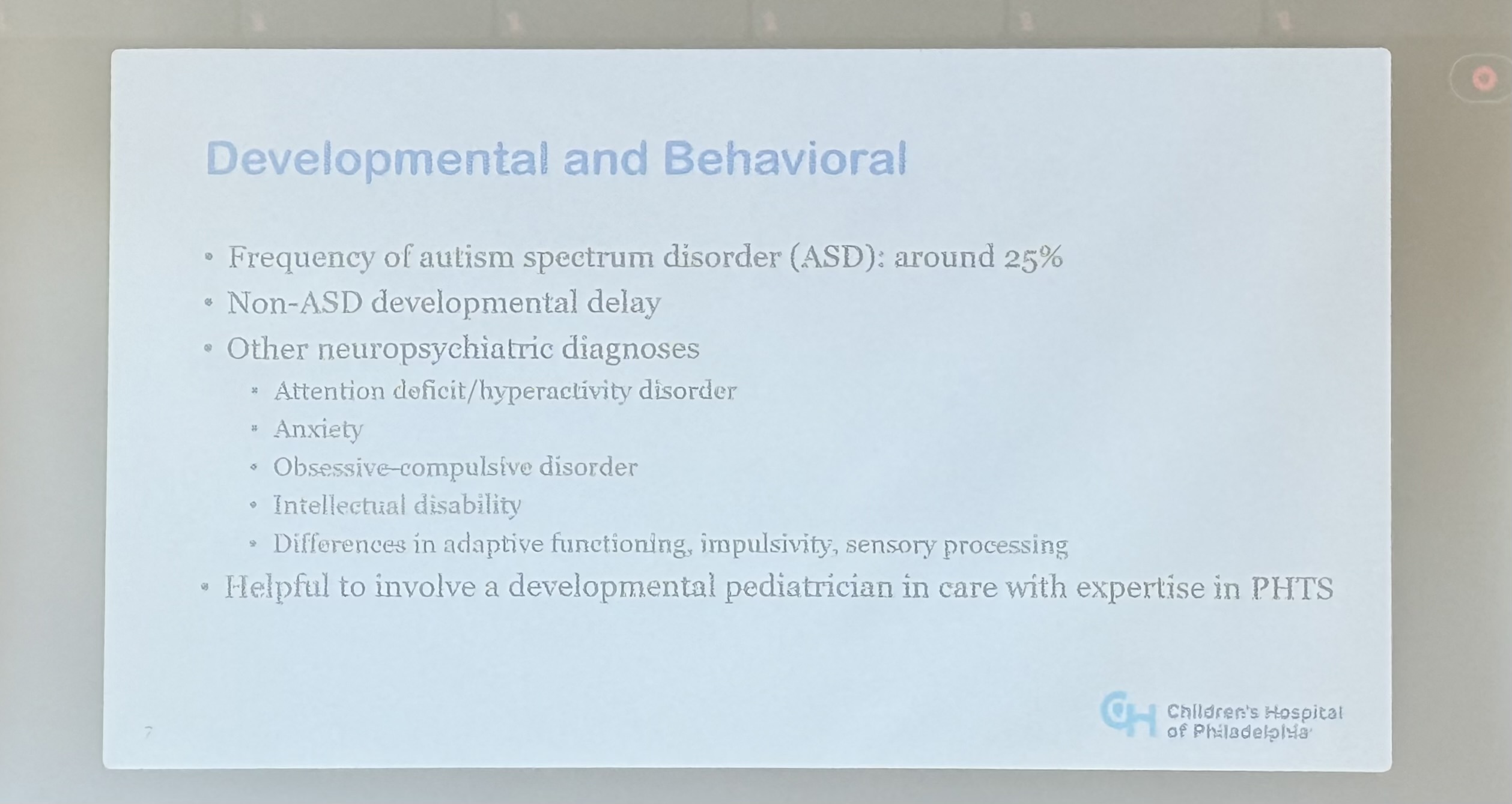
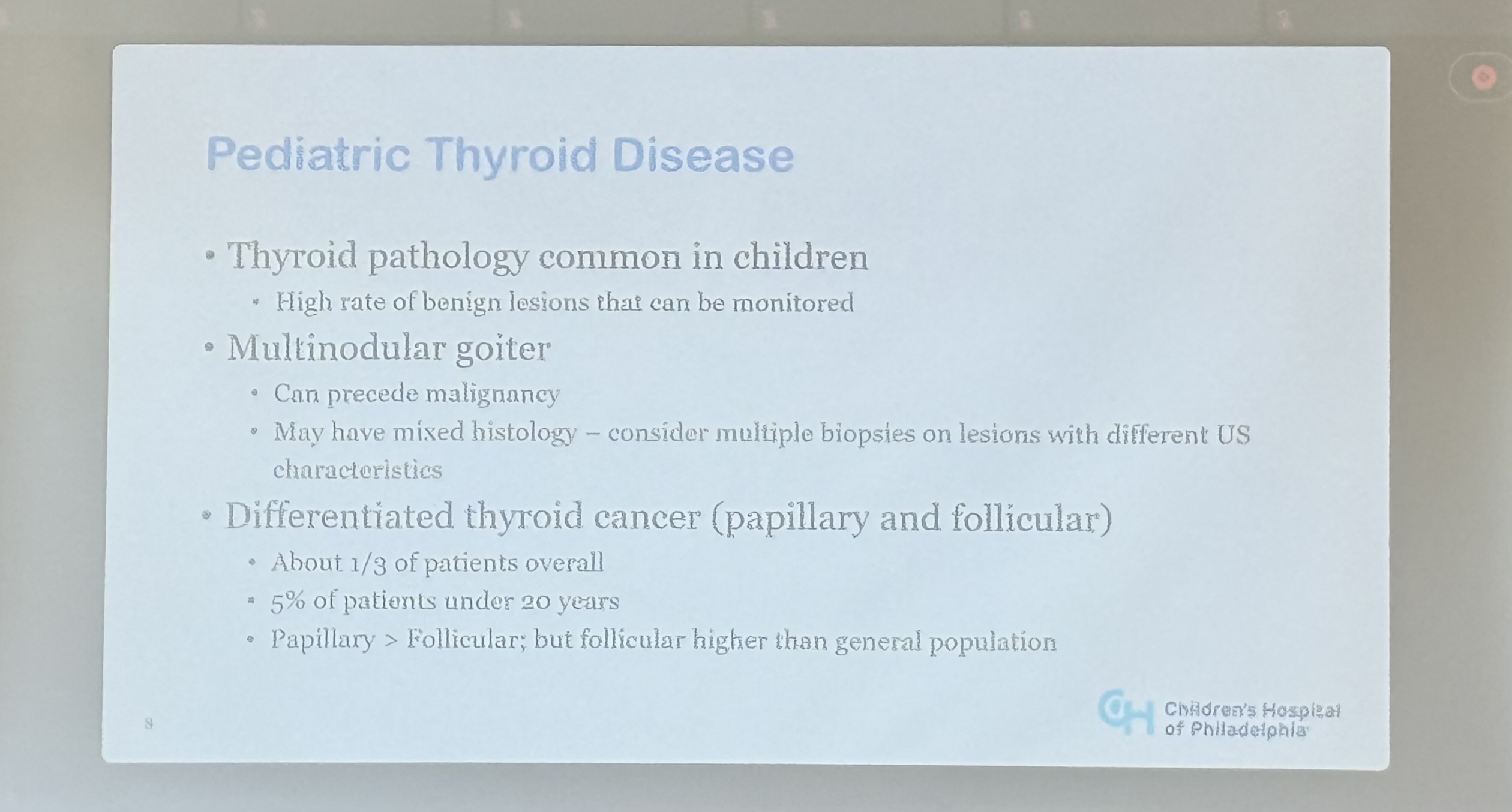
Those of you who are PHTS patients or parents, I hope my rundown of the day helps you! It is definitely slanted towards the things that drew me in for Meghan and I, but I included many screen shots of the slides!

We are indeed “Stronger Together!”
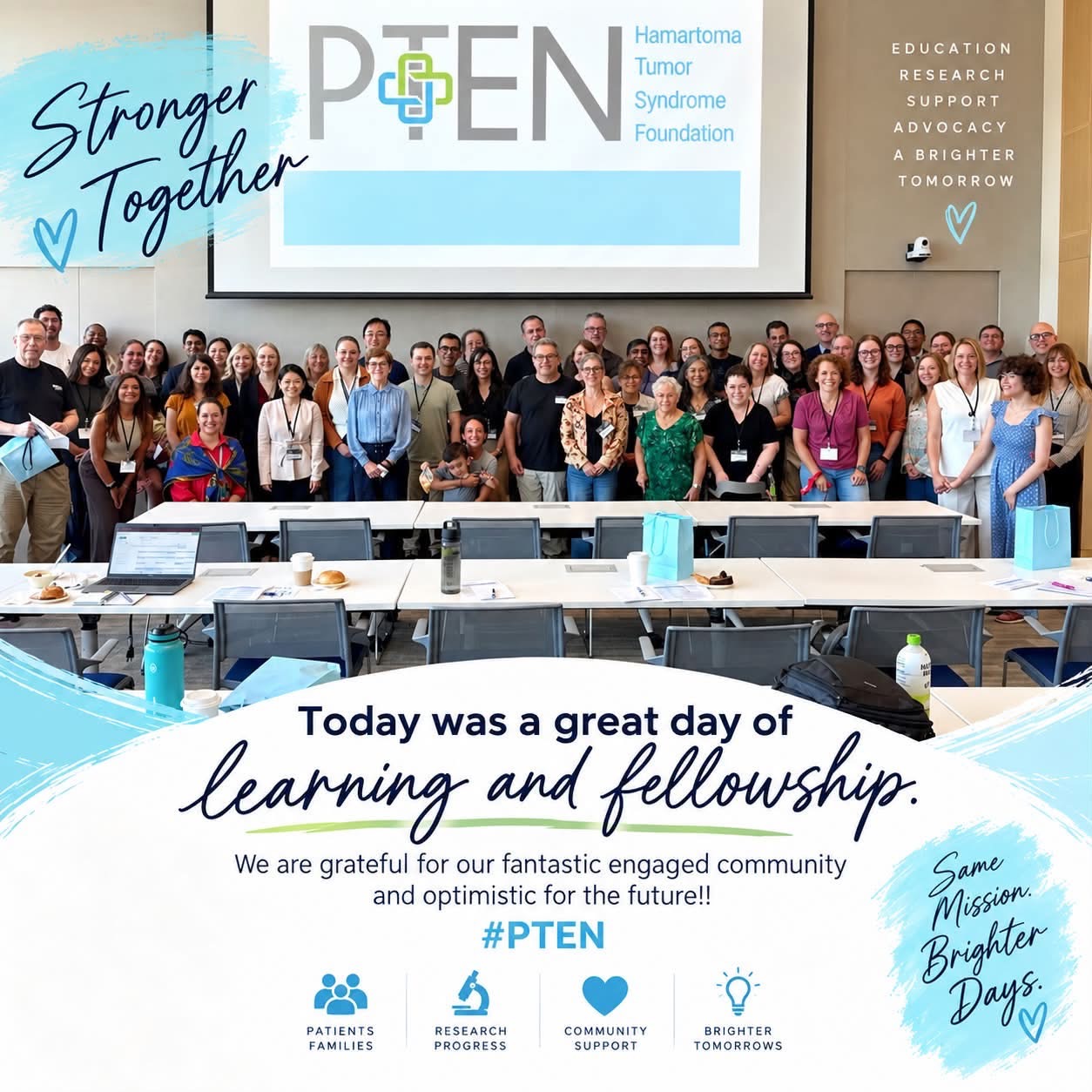
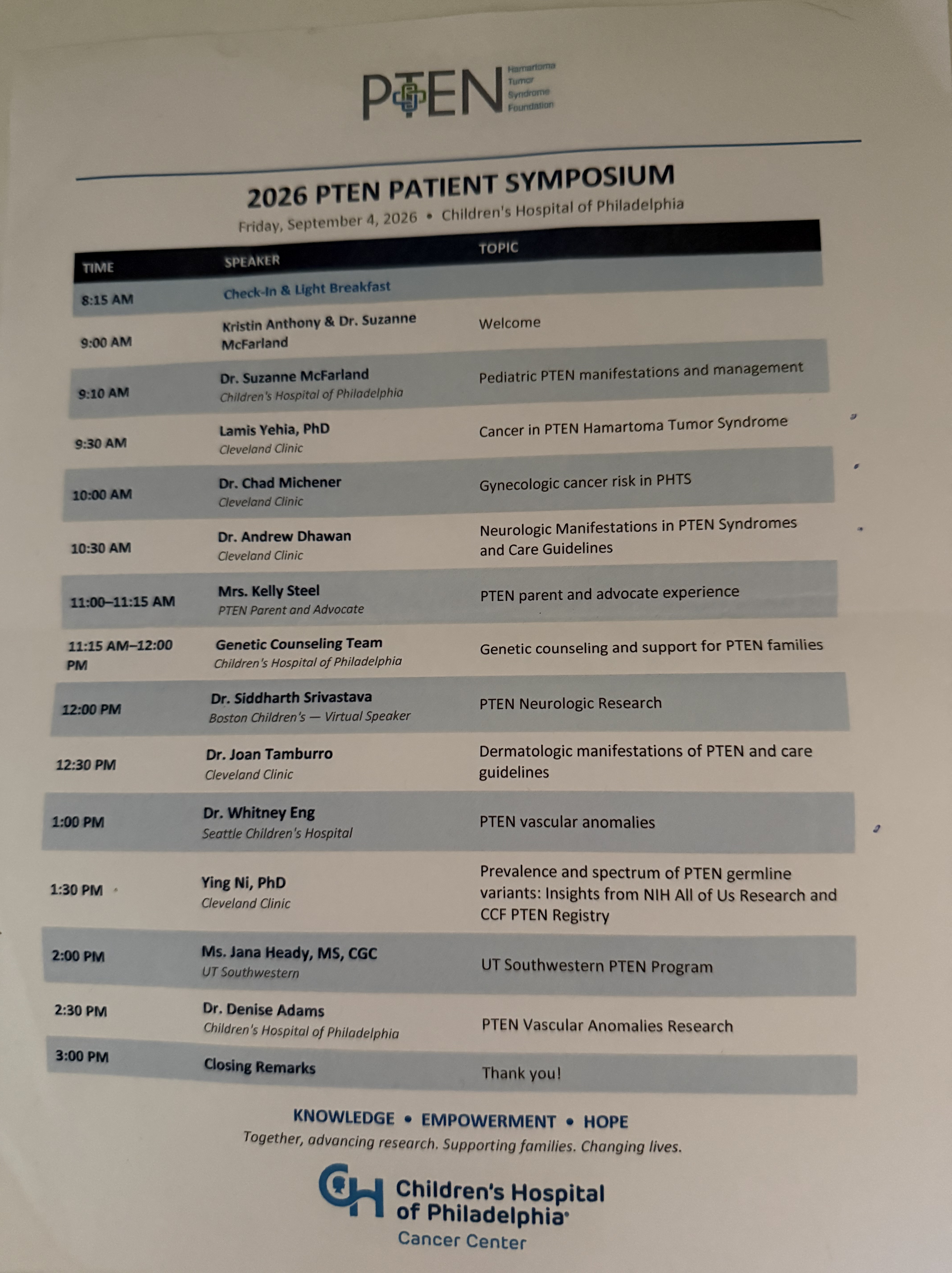
PTEN Patient Symposium

September 4, 2026

CHOP

9:00 Kristin Anthony PTEN Foundation
Kristin welcomed us and gave a heartfelt thank you to all attendees. She also told us that the PTEN Foundation will be posting an opportunity for a Scientific Director role. The position will be located in the Southeast and it will help the foundation move forward! Exciting times!!

9:10 Dr. McFarland (CHOP) 

Pediatric PTEN Manifestations and Management
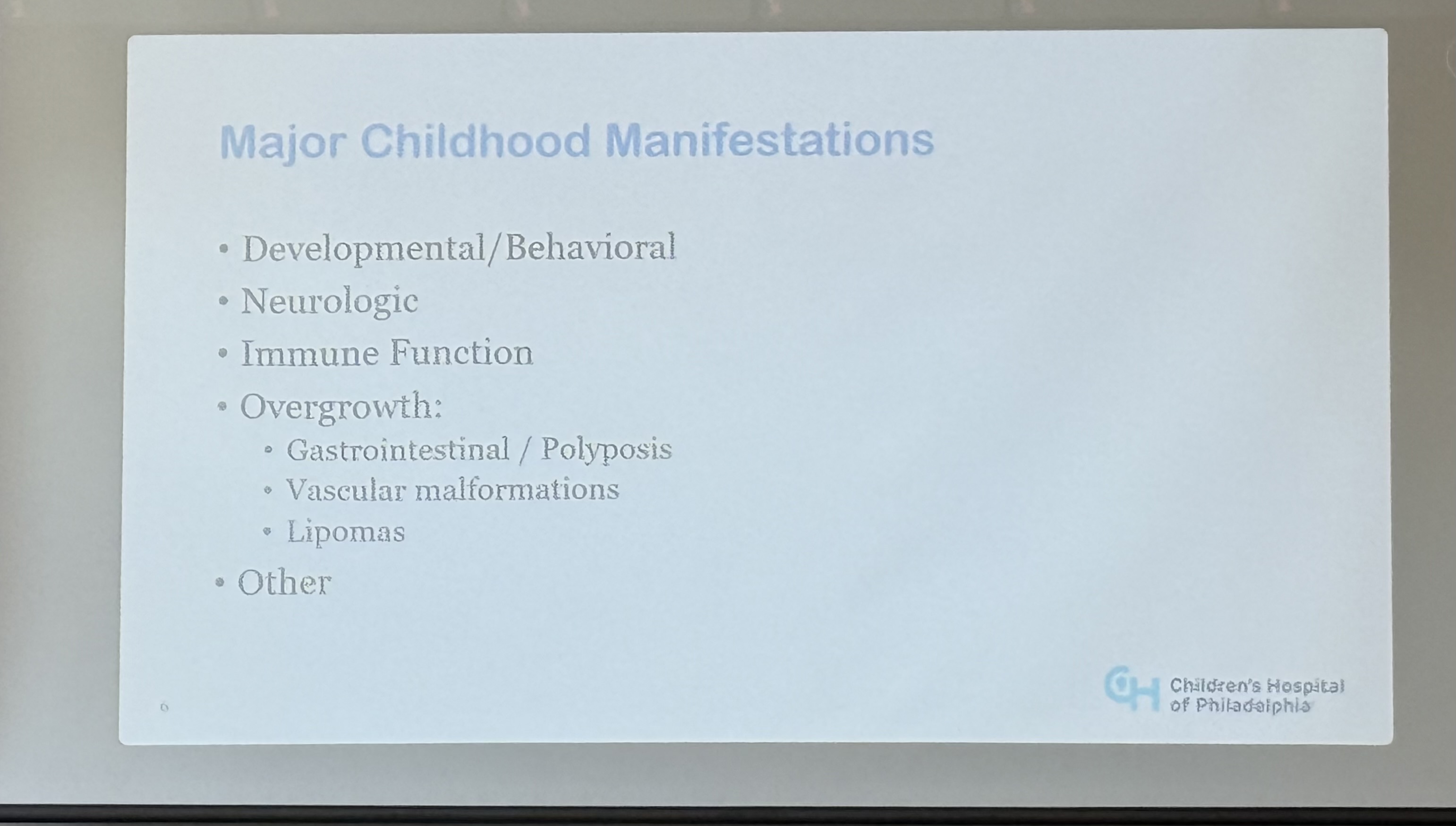
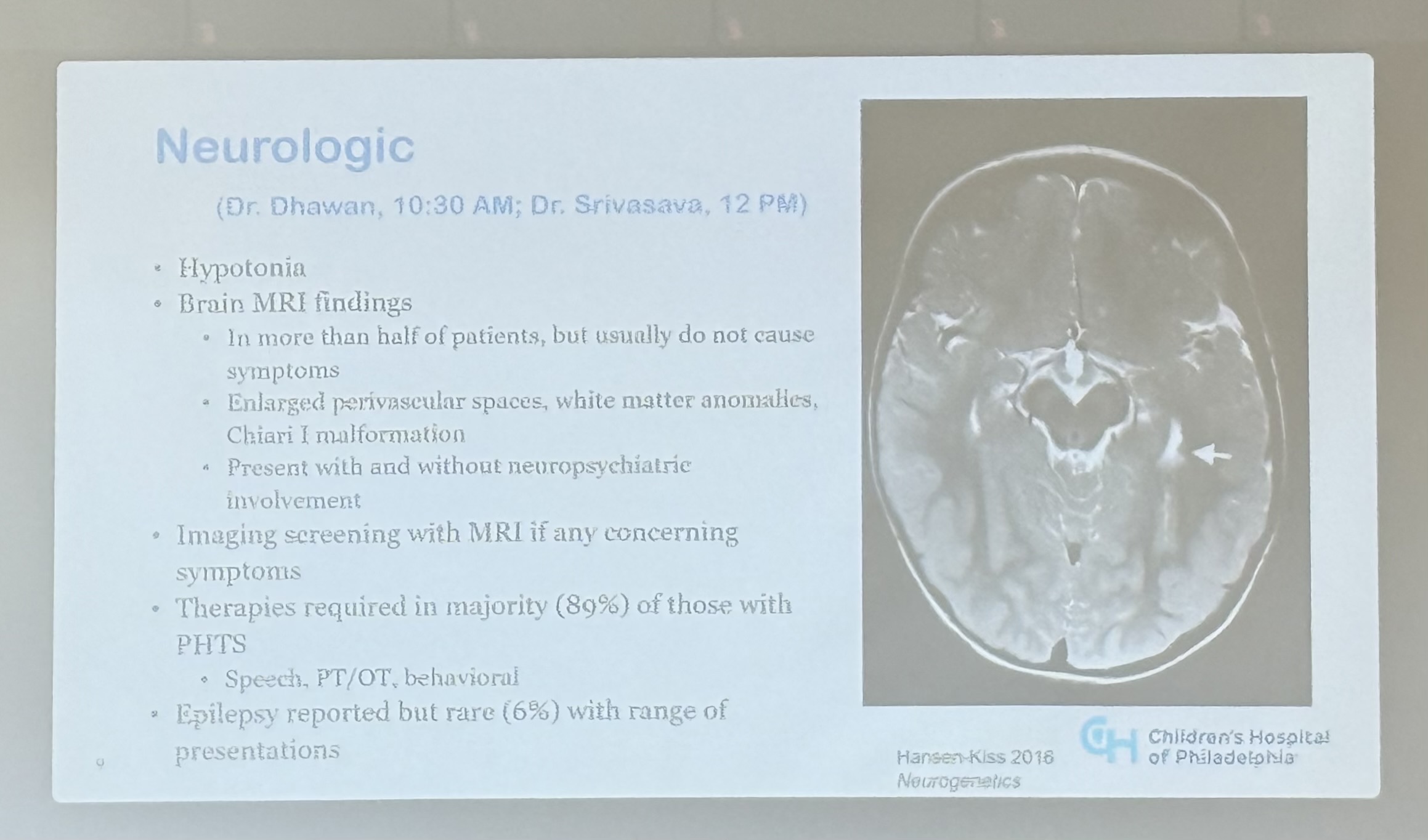
*Almost half of all patients when scanned will have a finding that does not require intervention, but causes unnecessary anxiety. They only scan the brain if a patient is symptomatic.
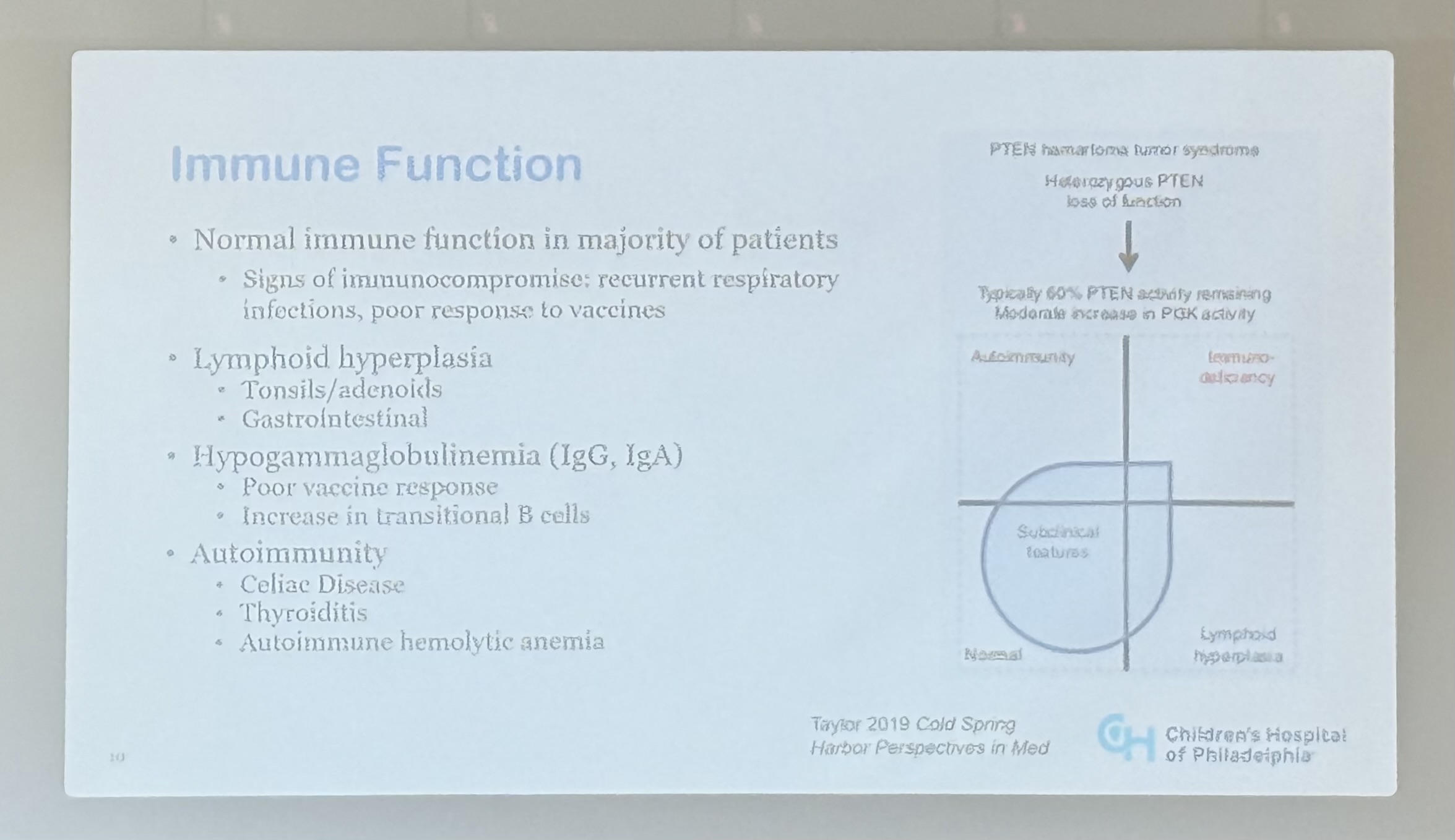
Hypogammaglobulinemia of Infancy was Meghan’s diagnosis at about the age of 2. ( PTEN diagnosis did not come to us until she was 8, so we ware learning many things in hindsight!) In addition to that, her IgG subclasses were often low as a child. Her Pediatrician/ Infectious Disease doctor treated liberally with antibiotics which were often needed to come through “simple” infections. Immunizations were paused and later completed at the age of 16 when immune function was considerably improved. That was an area of disagreement among the MANY specialists we saw. We are in no way opposed to vaccinations!

Meghan’s tonsils and adenoids were removed at 4, after repeated bouts of chronic strep. Although the pathology was “chronic tonsillitis and reactive lymphoid hyperplasia,” a relatively common finding, the doctor told us they were “the most diseased tonsils I’ve ever seen.”

I am told that I suffered from chronic infections as a child and was hospitalized for pneumonia. I was often sick and frequentlyneeded antibiotic treatment as well. As an adult I get sick only 2-3 times a year, but still typically require antibiotics for even “simple” infections.
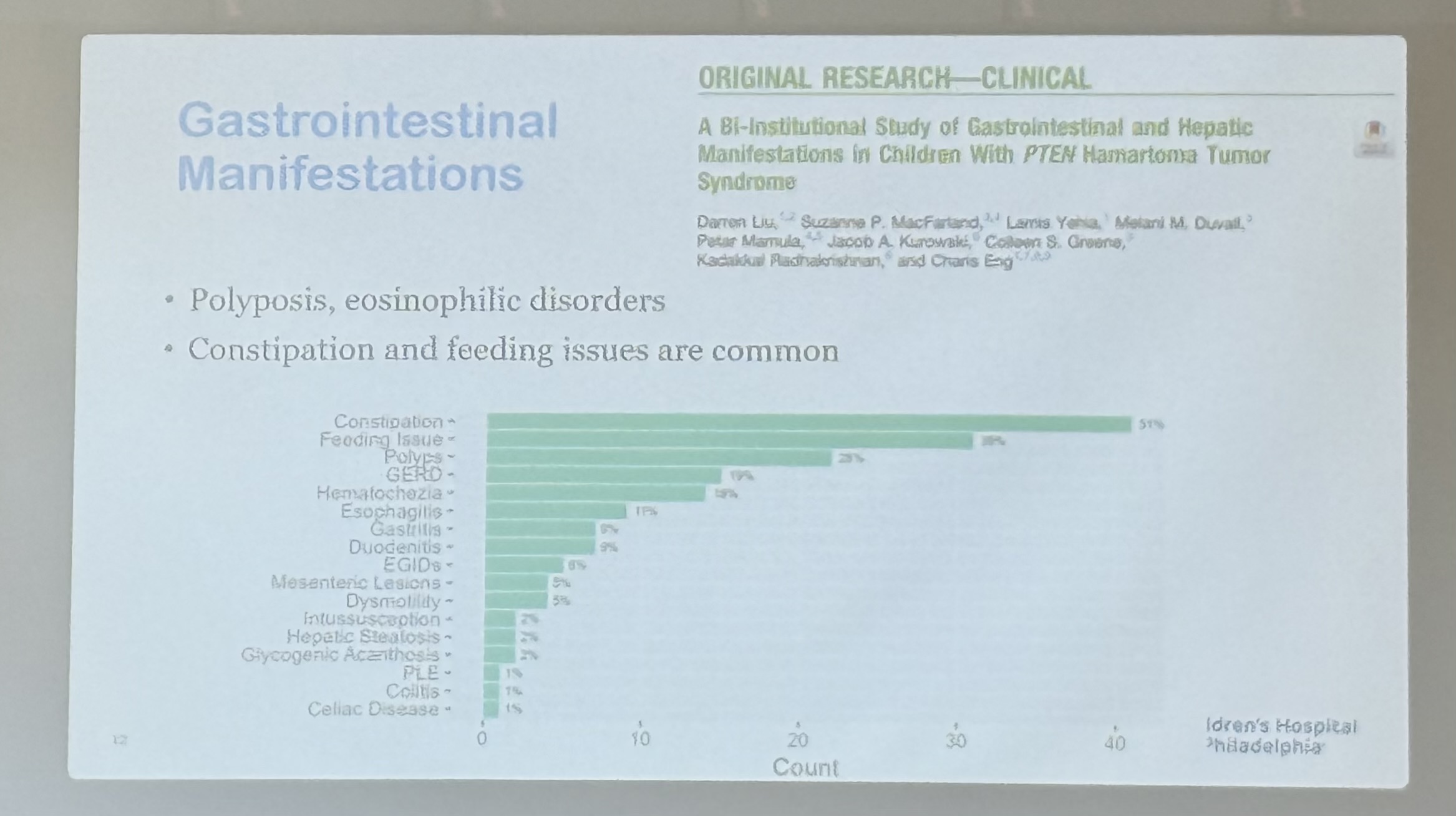
My own GI “issues” consisted of me somewhat regularly vomiting as a child, and finding myself in very embarrassing situations. I realized early to stick to a basic and somewhat bland diet. I avoid high fat foods, as they make me uncomfortable, and treat constipation with additional fiber. Most recent colonoscopy in 2022 was uneventful. I will have my next one in 2027 and remain diligent as “90% of PTEN patients over 35 have GI polyps” and the elevated colon cancer risk is not to be ignored.

Meghan’s GI issues have been present and at the forefront since her birth. She was colicky. She tolerated only a very specific formula, and even that was a struggle. She spent a good deal of childhood on PPIs and various acid reducing medicines. A cursory search of our medical files finds at least 4 endoscopies and one colonoscopy. All were essentially inconclusive and polyps were minimal and benign.

Meghan’s gall bladder was removed in 2007 after a diagnosis of ‘milk of calcium’ and significant pain.

Her diet through the majority of development was gluten, dairy and soy free for GI comfort. Early on corn and egg were also problematic. Allergy testing only showed a mild positive (level 1) for dairy, and GI biopsies at 13 months were negative for celiac. 

Reflux remains an issue to this day, as does constipation. Eating is sometimes a struggle as certain foods/ textures seem to cause esophageal spasms making eating impossible at points even though the desire exists. 

9:30 Lamis Yehia, PhD Cleveland Clinic

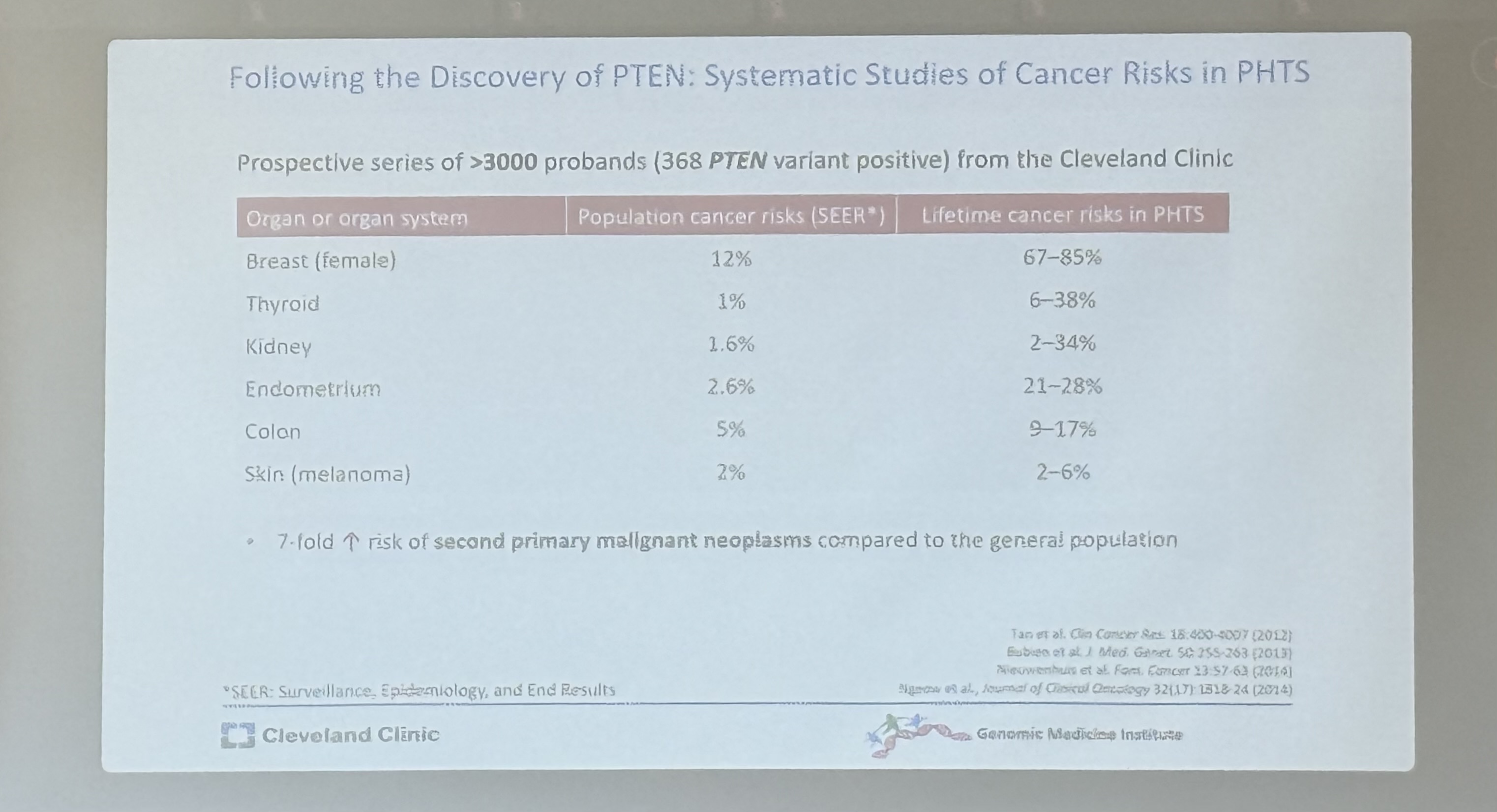
Cancer in PTEN Hamartoma Tumor Syndrome

As someone who was born in 1973, hearing that Cowden syndrome was only first labeled in 1986, and that the corresponding PTEN gene mutations linked to Cowden syndrome were not characterized until 1996 can be mind-blowing. I was out of college and working as a substitute teacher in 1996. Literally all of the meaningful work on this syndrome has taken place during my teaching career!
I also noted a quote from this presenter, “There’s nothing (PTEN) cannot do.” Indeed!

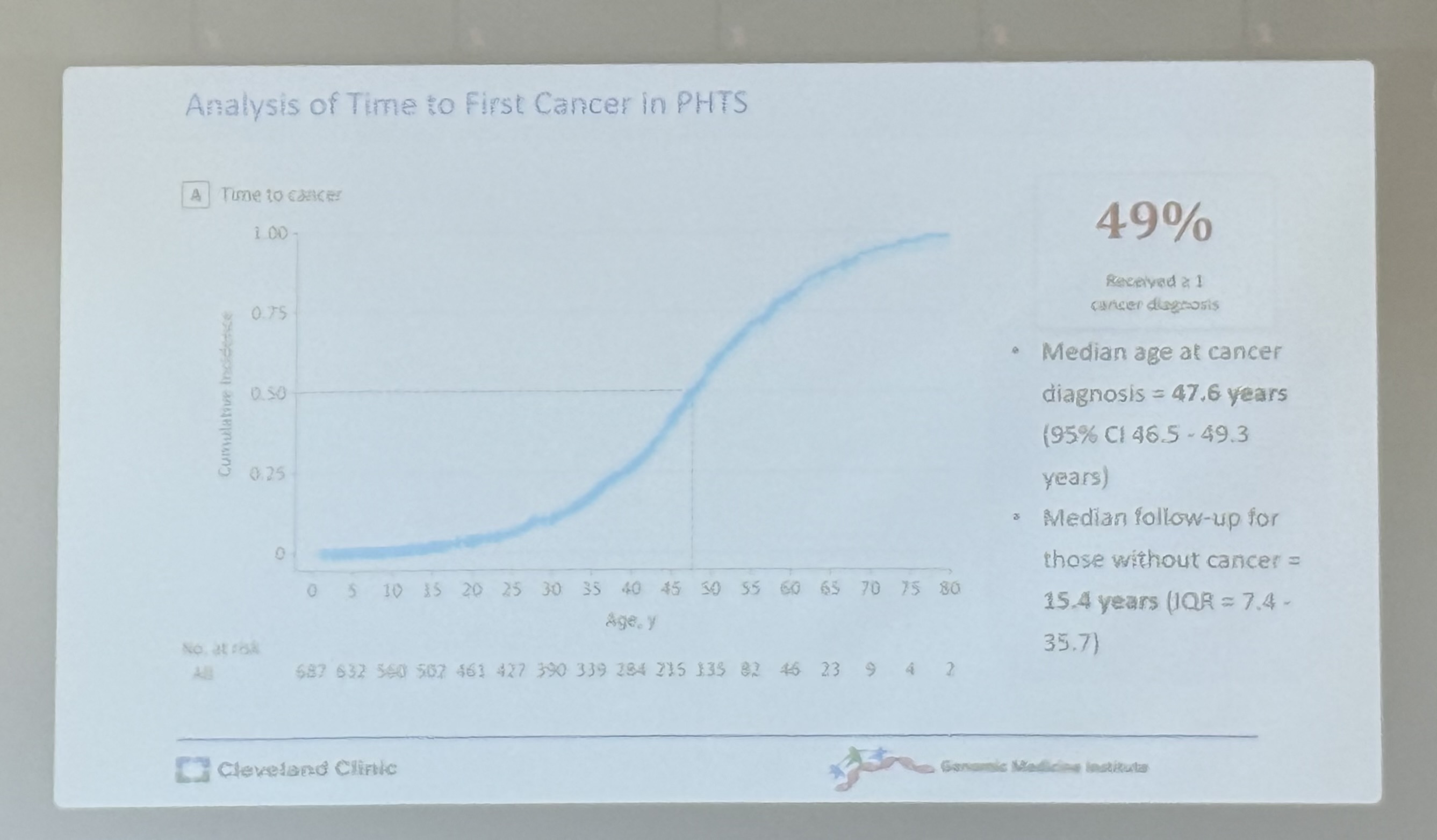
A lot of this presentation was technical and statistics that are better seen on the presenter’s slides.
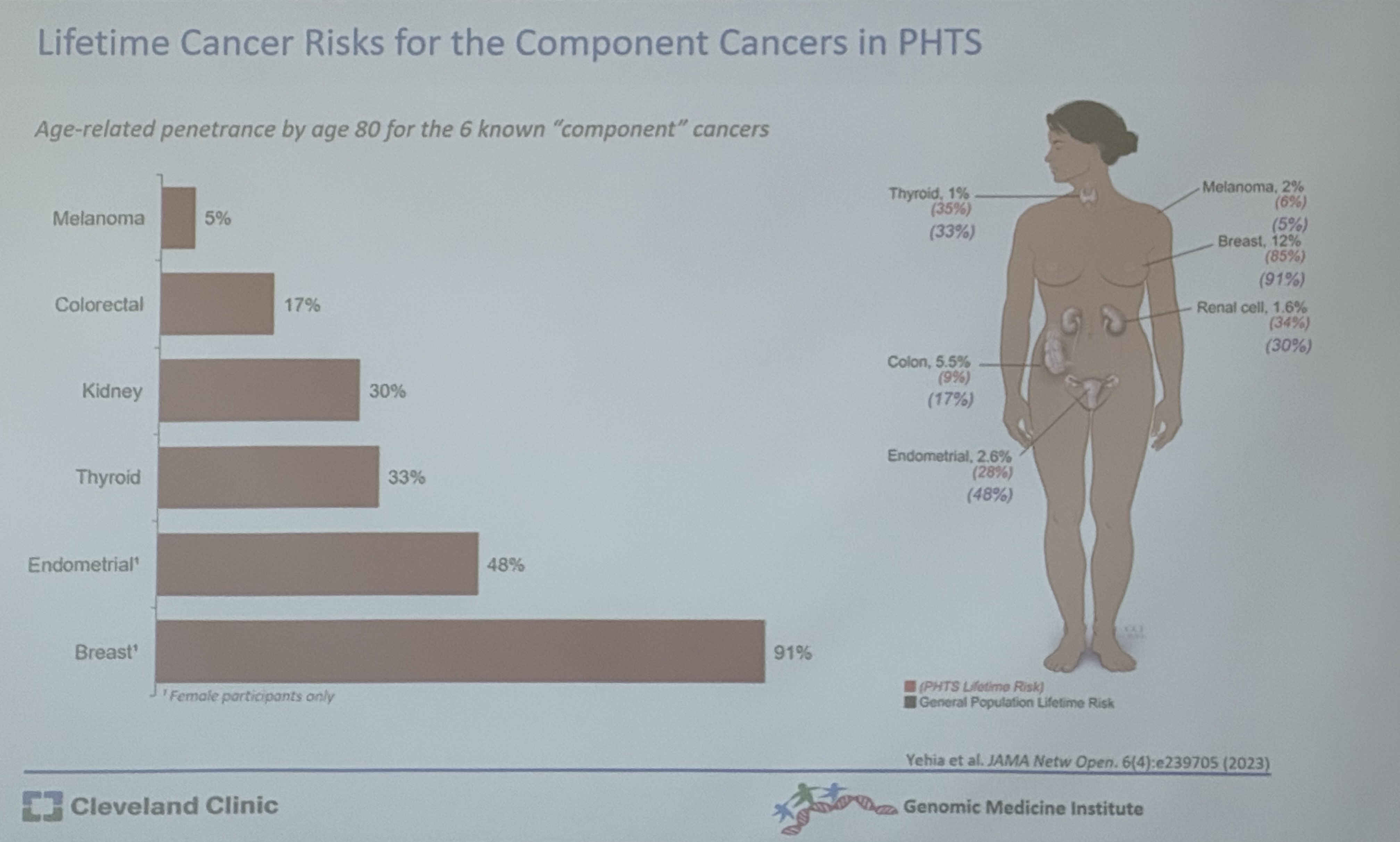
The slide below shows cancer risks for the six ‘component’ cancers in PHTS, both in a graph and by body part. On the human model, the black numbers indicate the general population. The red numbers are from a study published in 2012, and the purple numbers are the updated percentages of those with PHTS. The age related penetrance is 80 years.
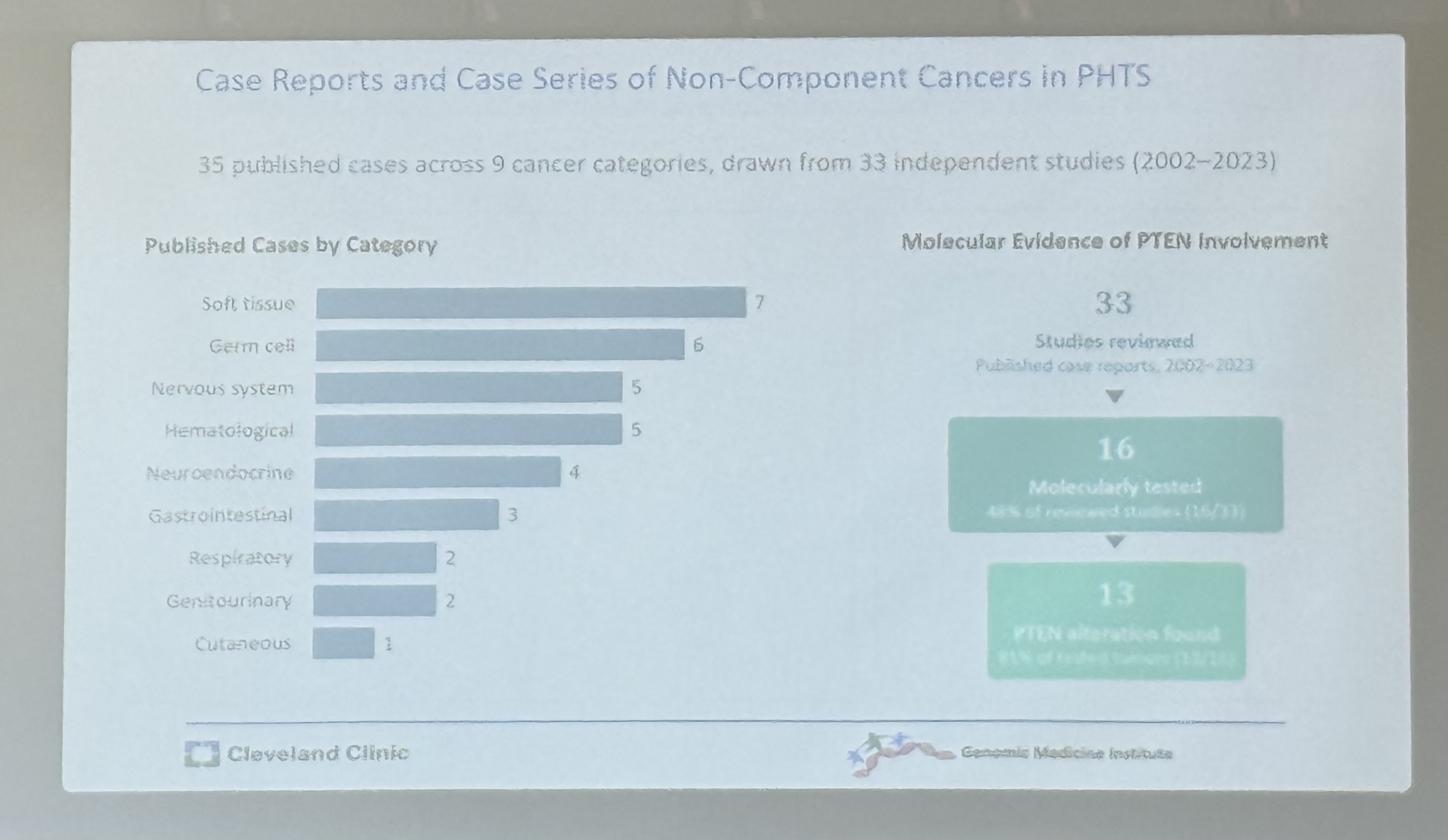
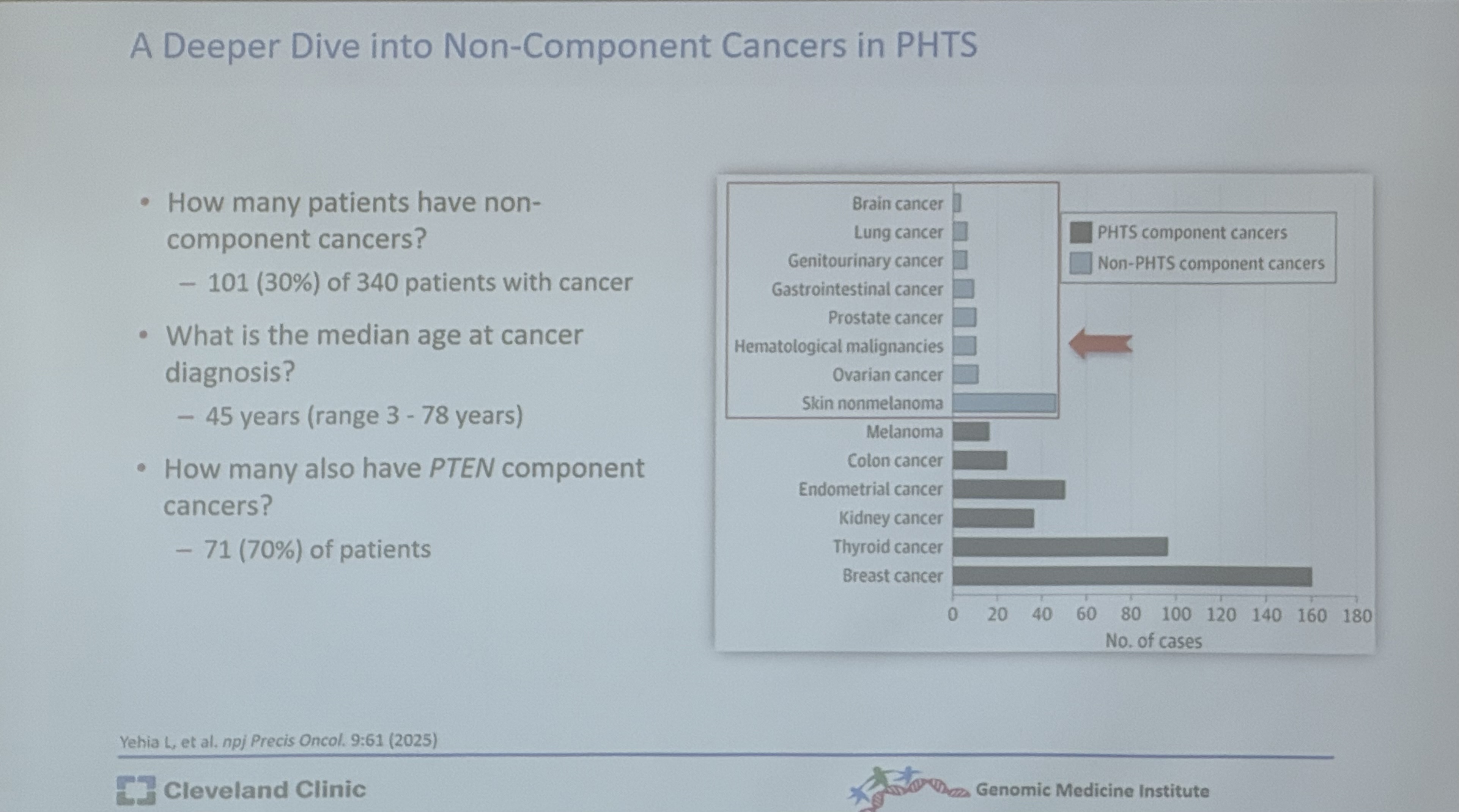
There was discussion on ‘non component’ cancers, and they are listed on the slide below. Attention should be paid to the small sample sizes, a hazard of working in a rare disease population. We were assured they are working on studying modifiers.
10:00 Dr. Chad Michener, Cleveland Clinic

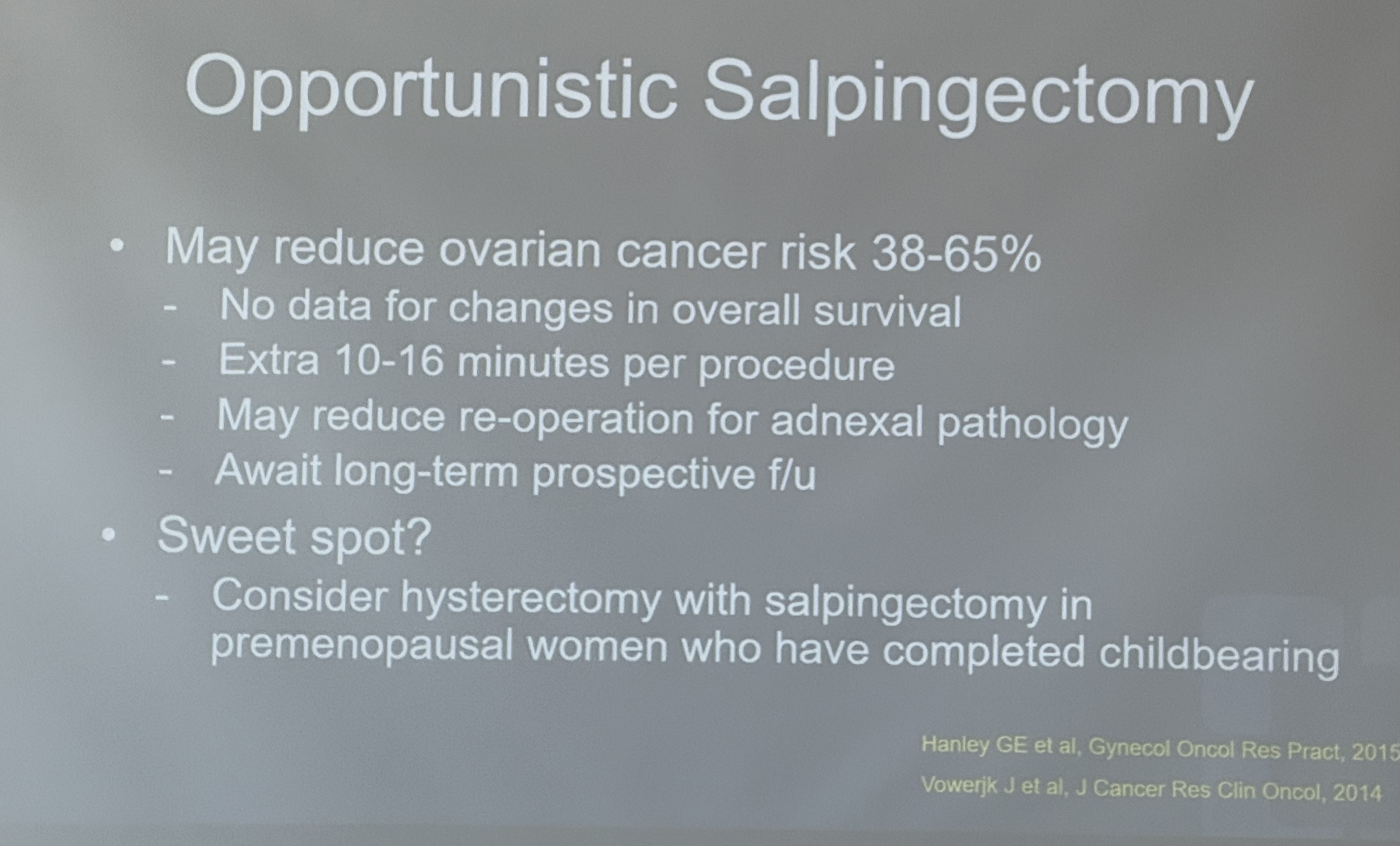
Gynecologic Cancer Risk in PHTS

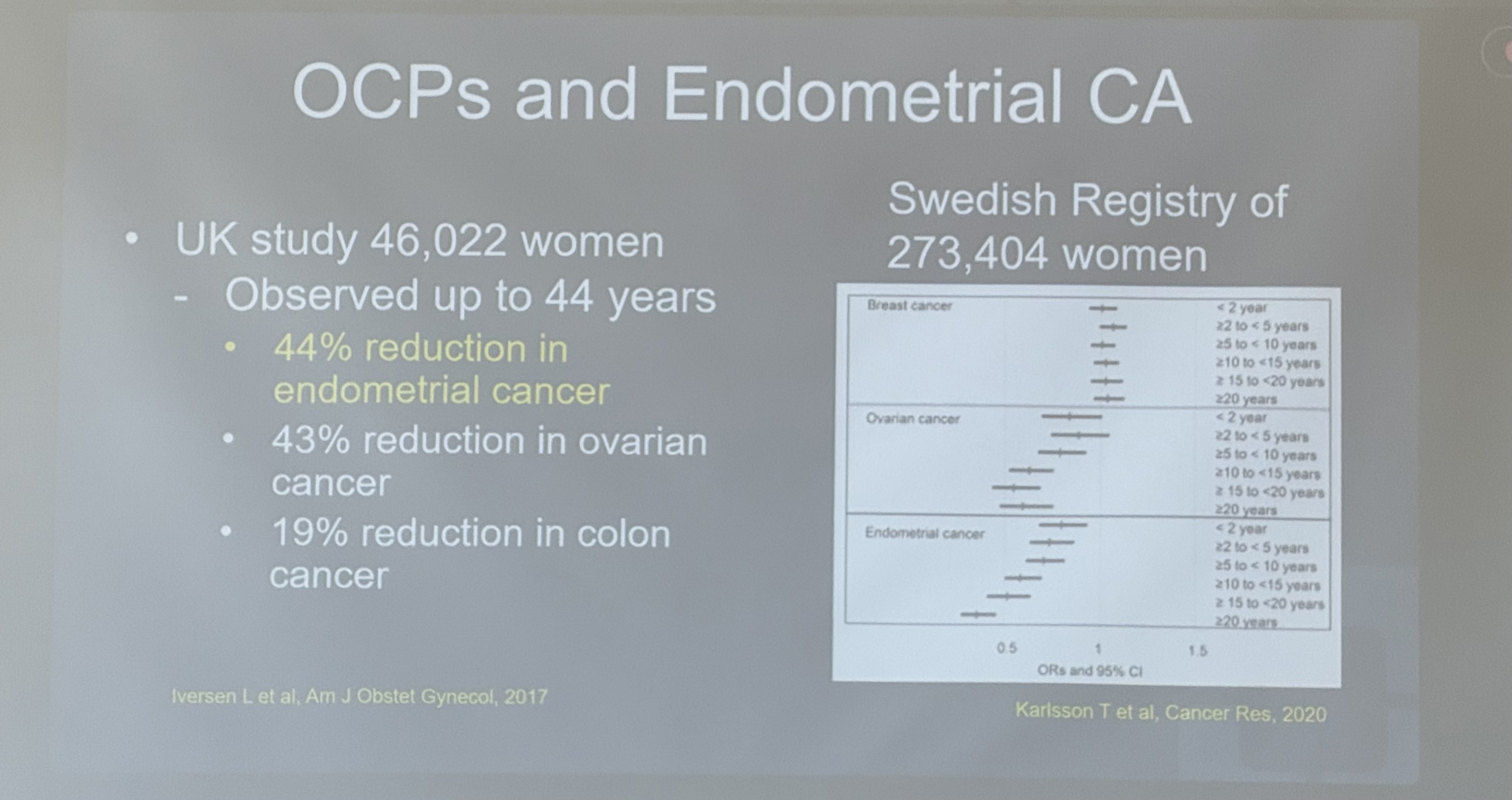
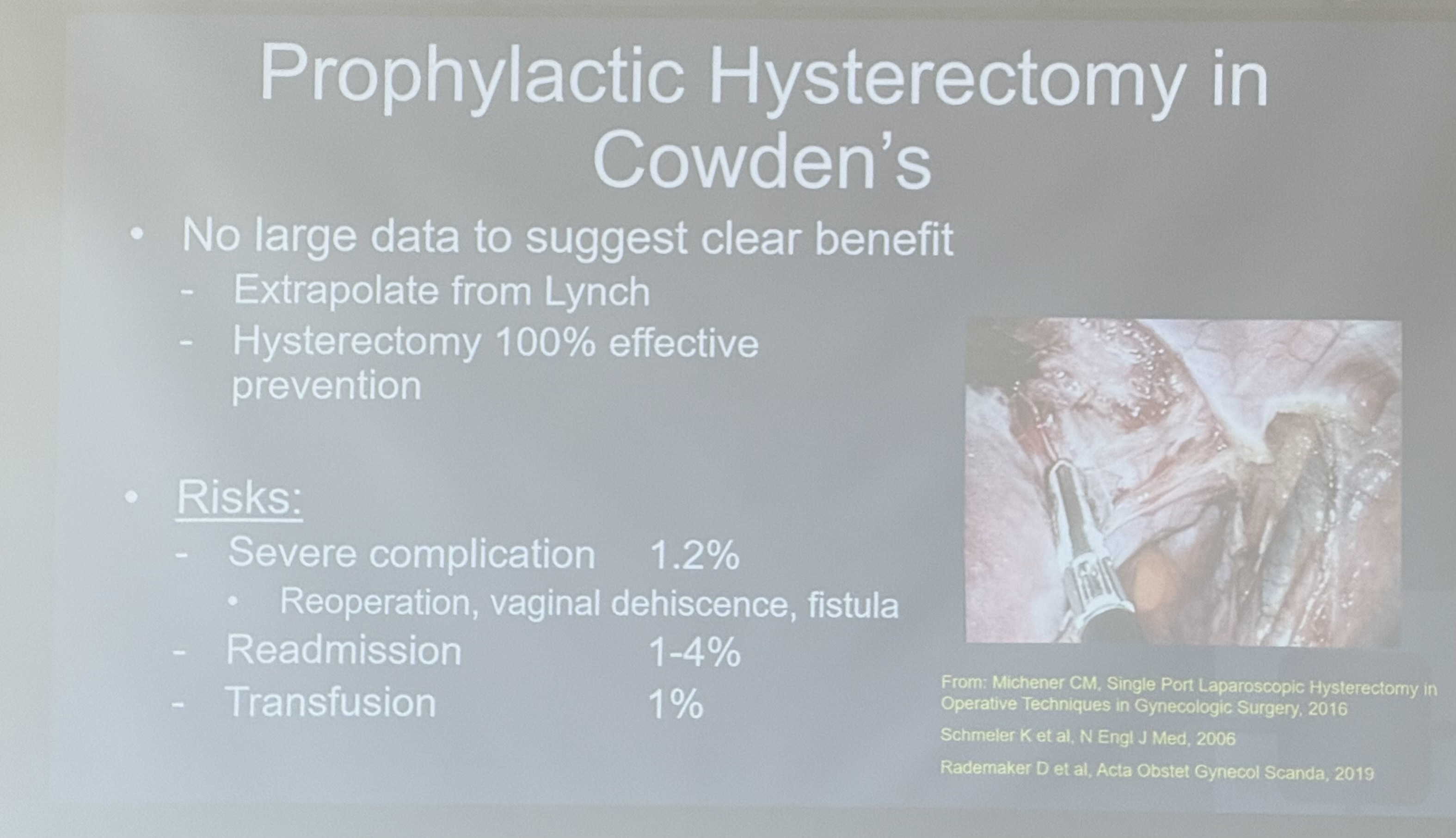
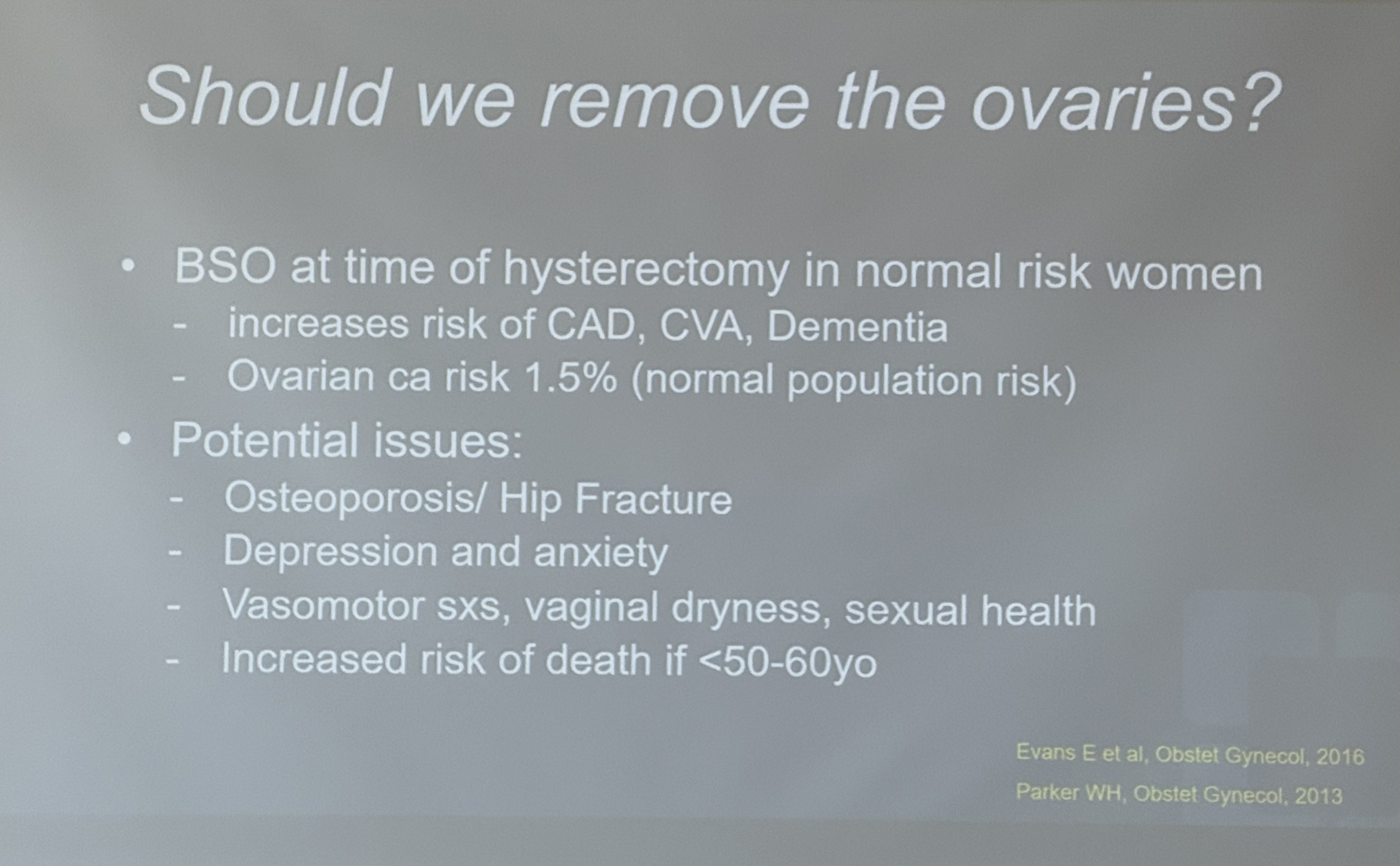
As a breast cancer survivor, a PHTS patient who had a full hysterectomy weeks after my double mastectomy and a mother of a PHTS patient who is post double mastectomy and who has already had more than her share of trouble with her uterus, this one had my attention. Meghan has also been on a continuous (no placebo) birth control pill since 2017. At the time an adolescent gynecologist suggested it after her first biopsy. I know she is not alone with what were utterly miserable, and in my opinion, beyond humane, periods.

I was reminded of the information on a previous slide, that while the risk of endometrial cancer used to be listed as 28% in the PHTS population, it is now at approximately 48% for those of us with pathogenic PTEN variants.

That was definitely tough to swallow.

I also learned my daughter’s gynecologist is on top of things as there is a low threshold to biopsy when there is suspicion of malignancy. “Just do it.” 

I will insert the slides I clipped below.
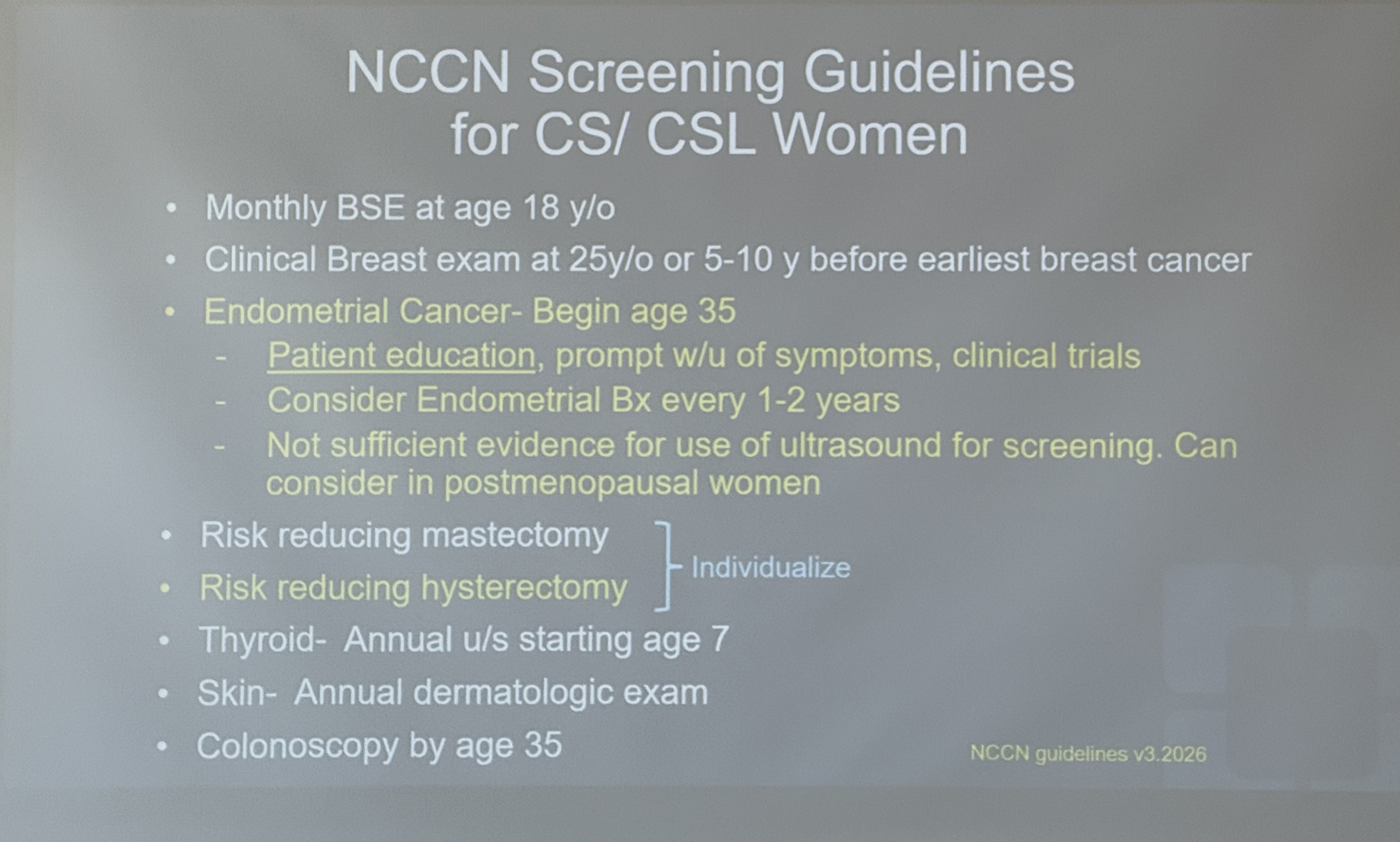
10:30 Dr. Andrew Dhawan, Cleveland Clinic
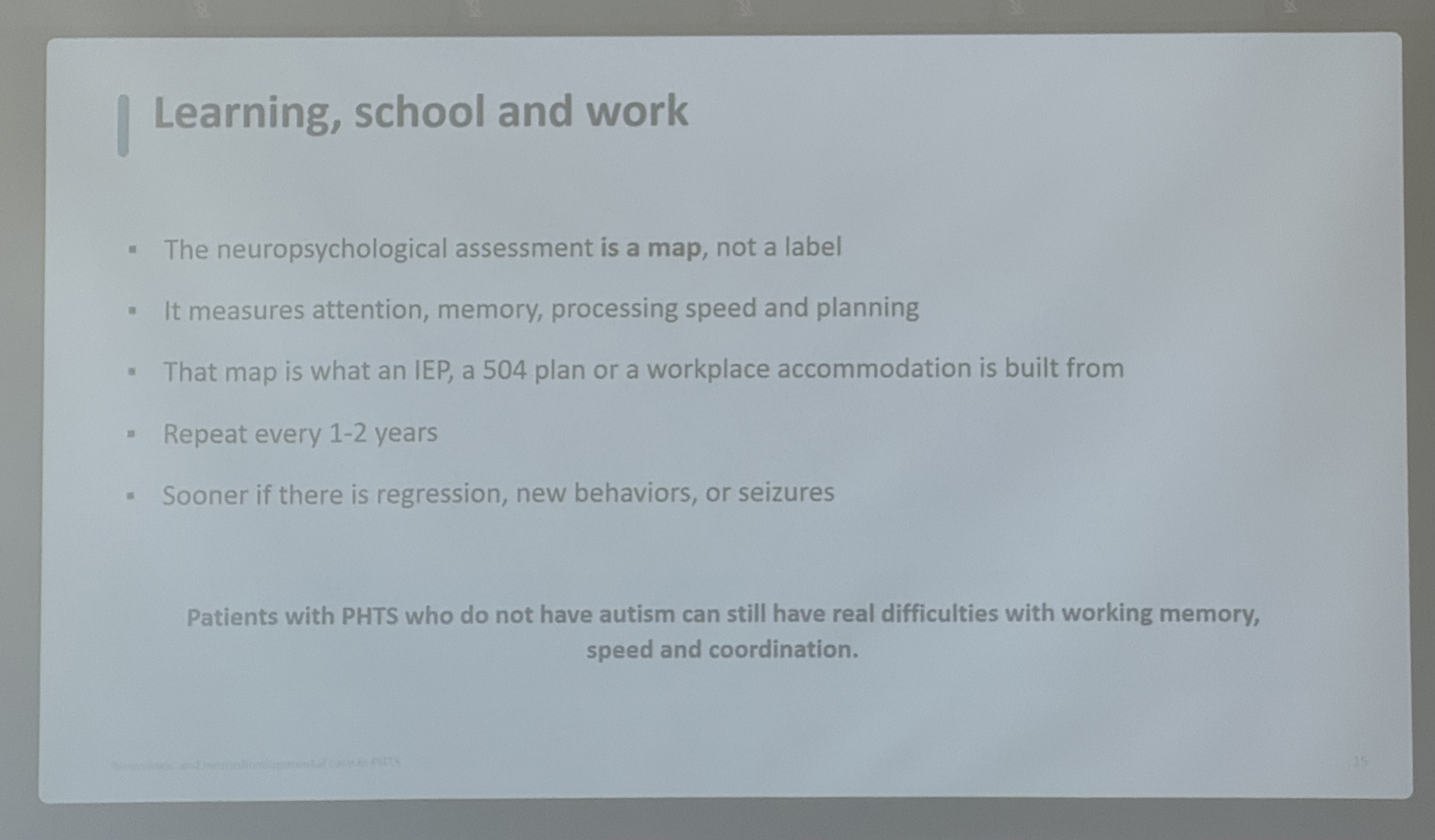
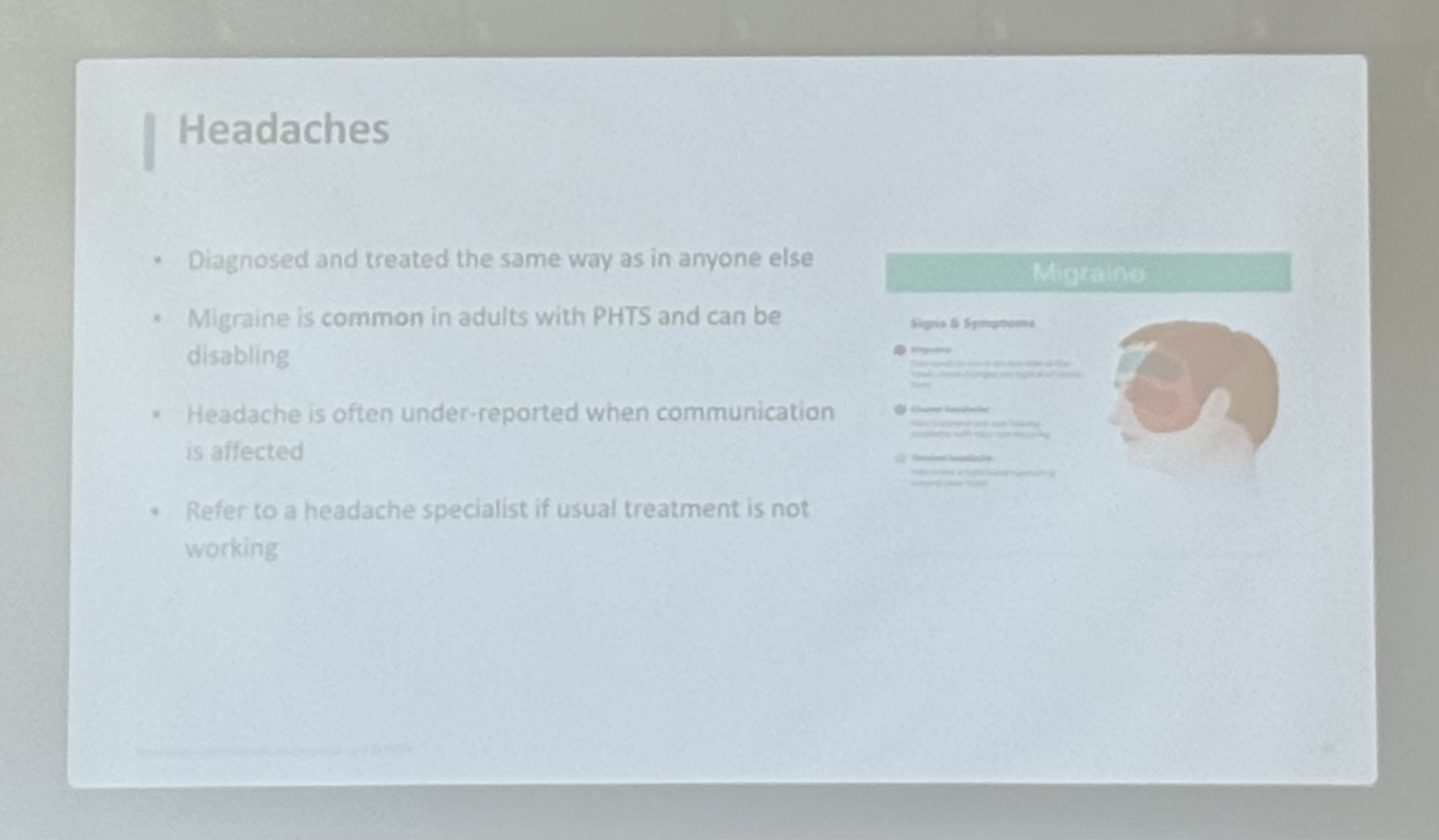
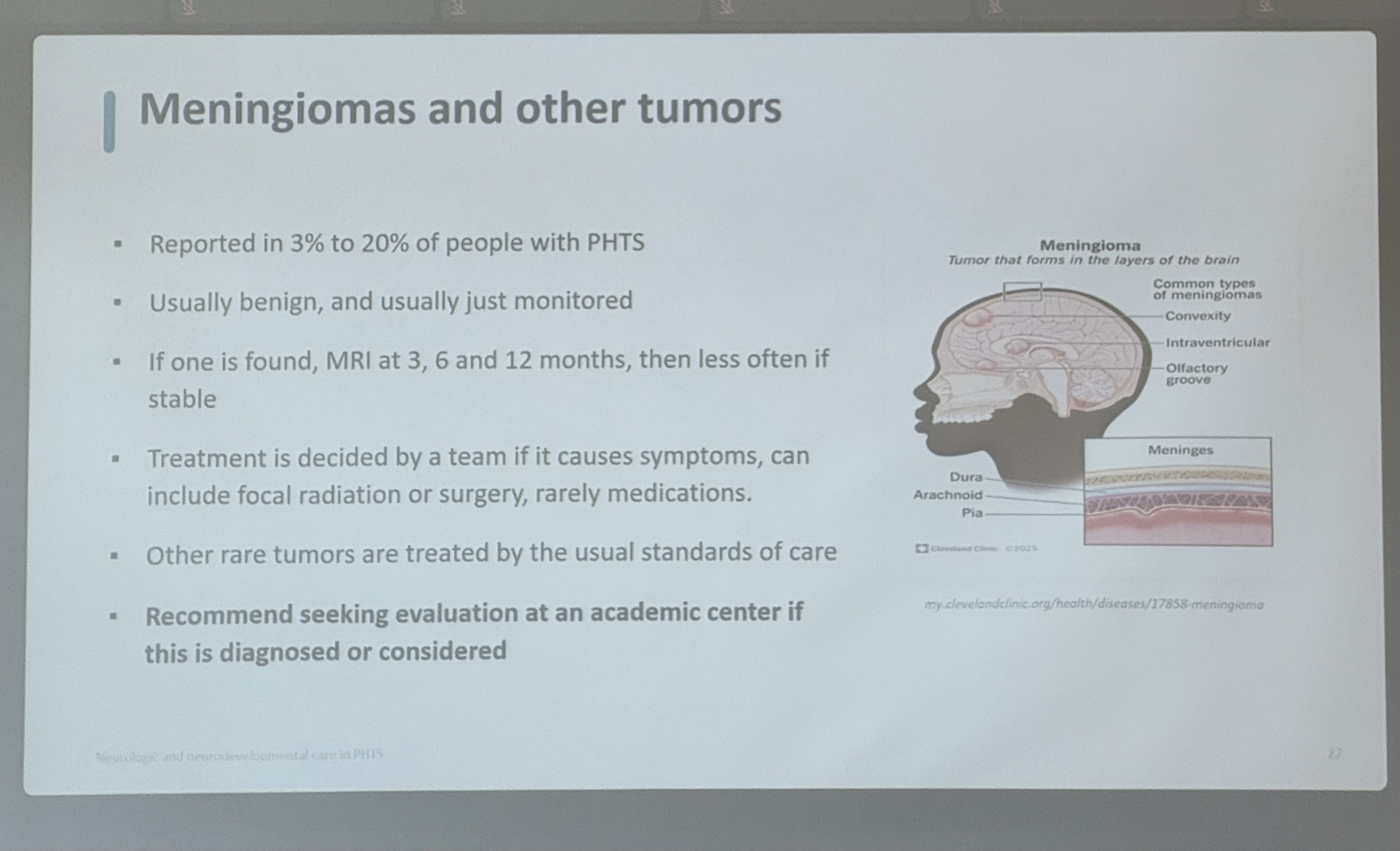
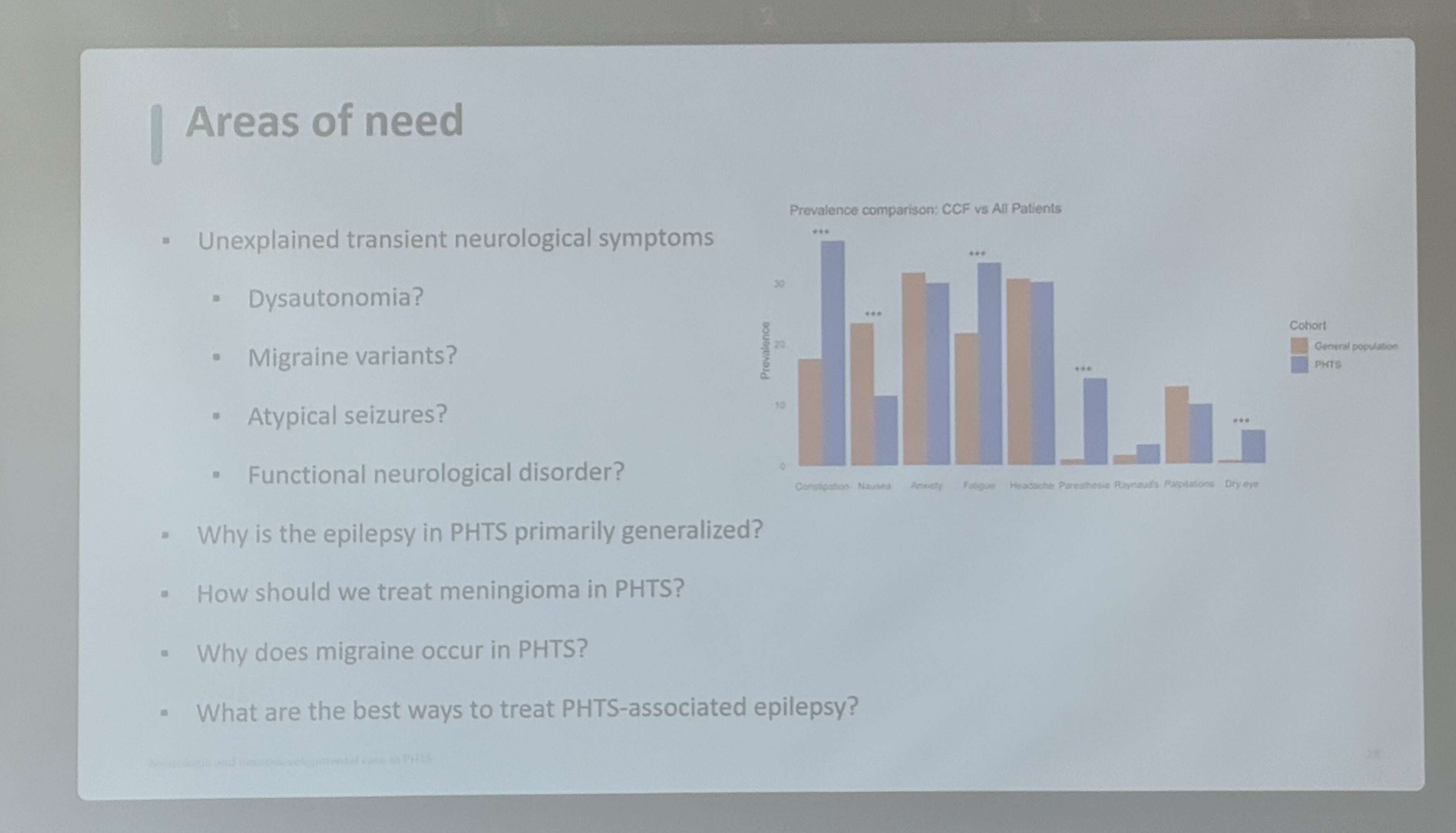
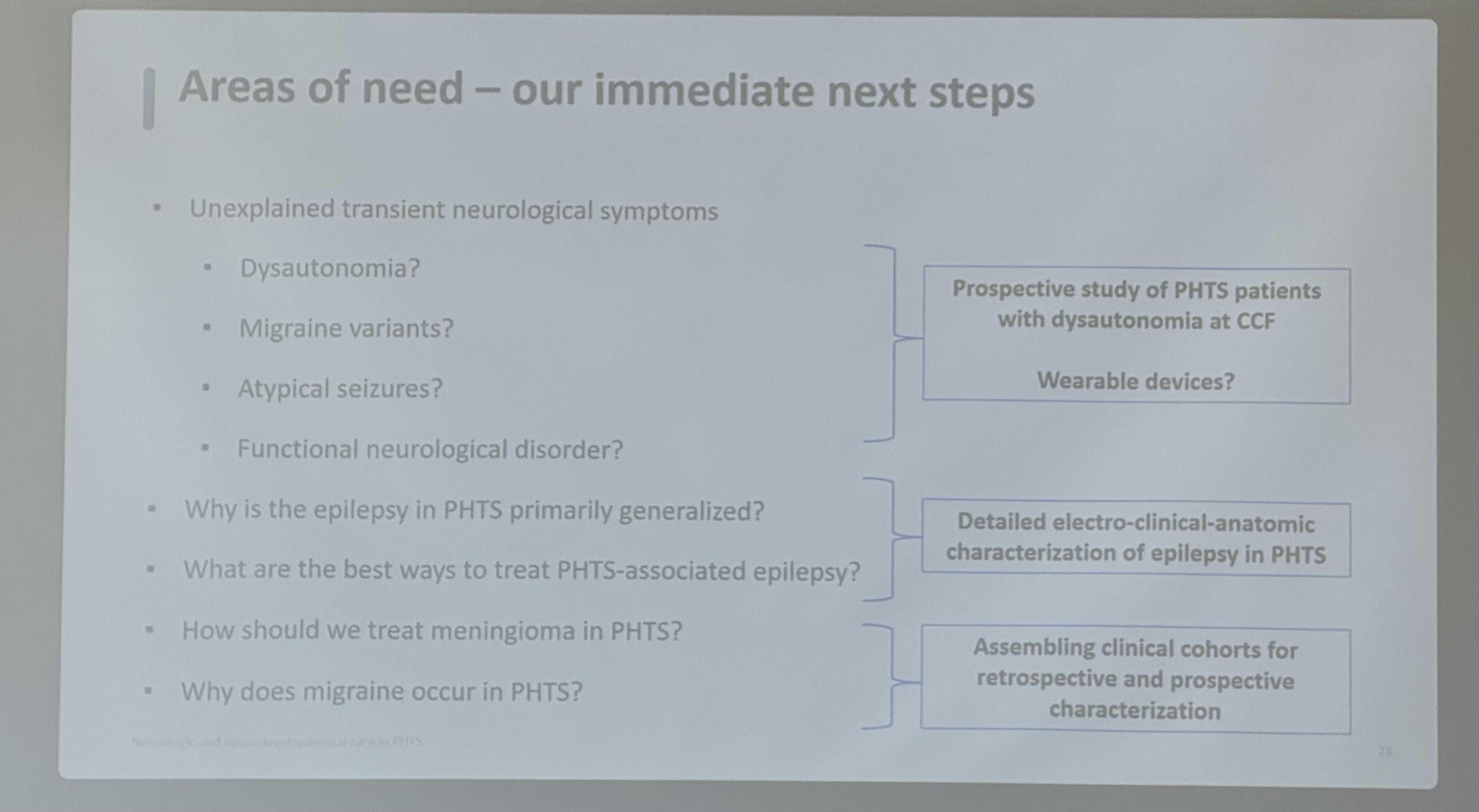
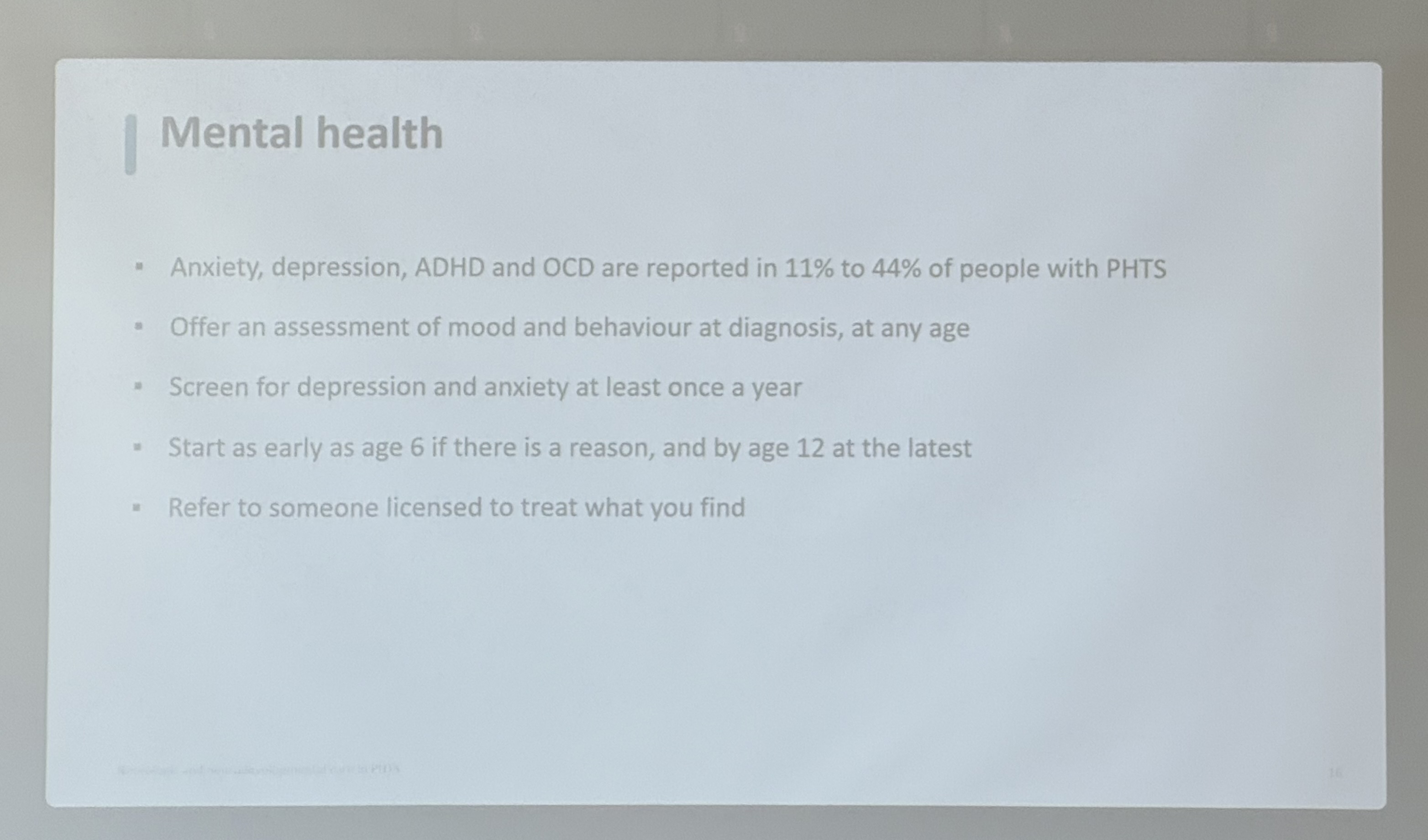
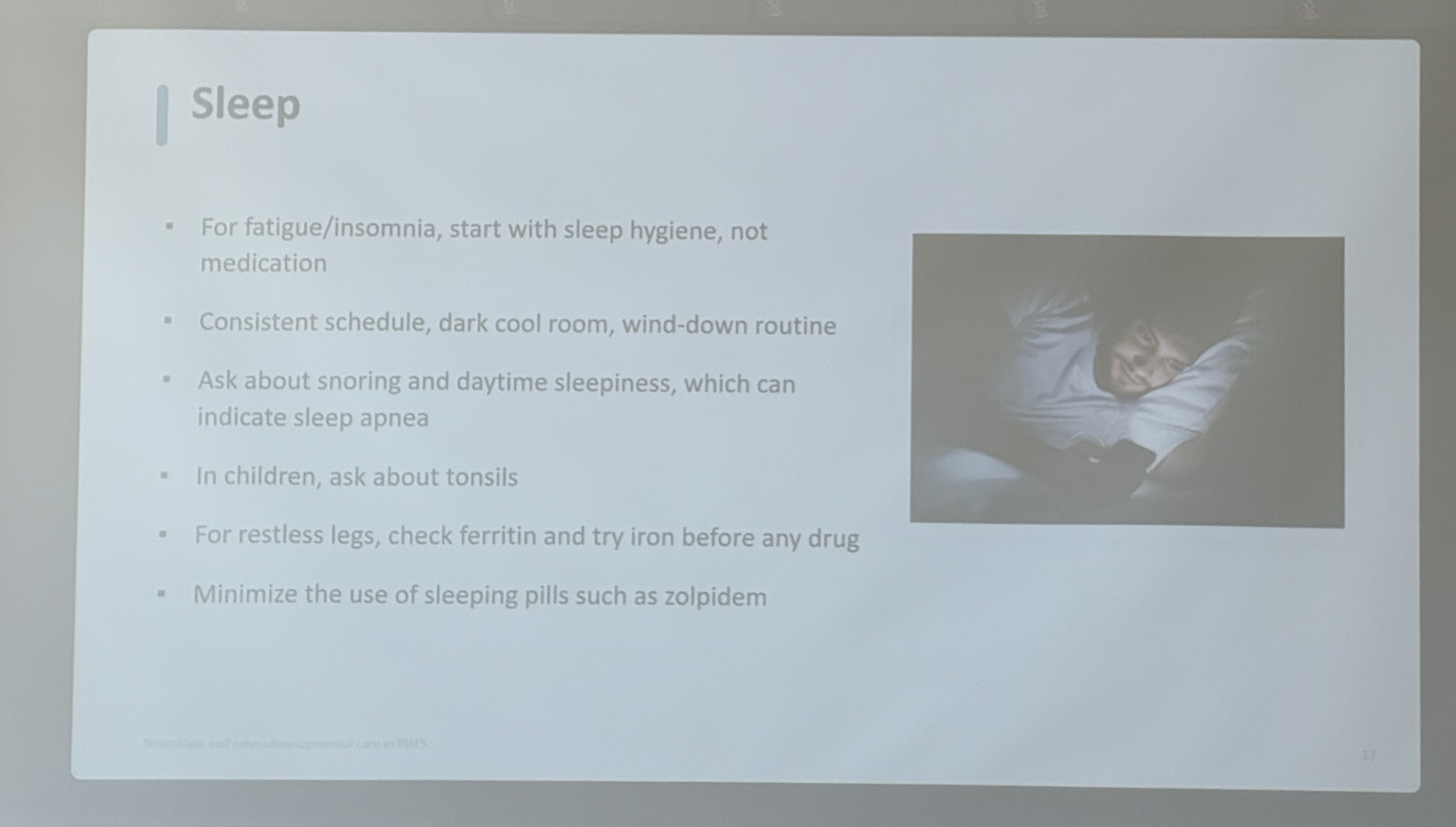
Neurologic Manifestations in PTEN Syndromes and Care Guidelines

Meghan and I both suffer with chronic migraines. We also both struggle to fall asleep, although her sleep issues are notably more severe.

We both have dysautonomia with slightly different presentation and to varying degrees. I remember this being something Dr. Eng had begun to talk about before her passing, and I am grateful for those who are still working on the connections.
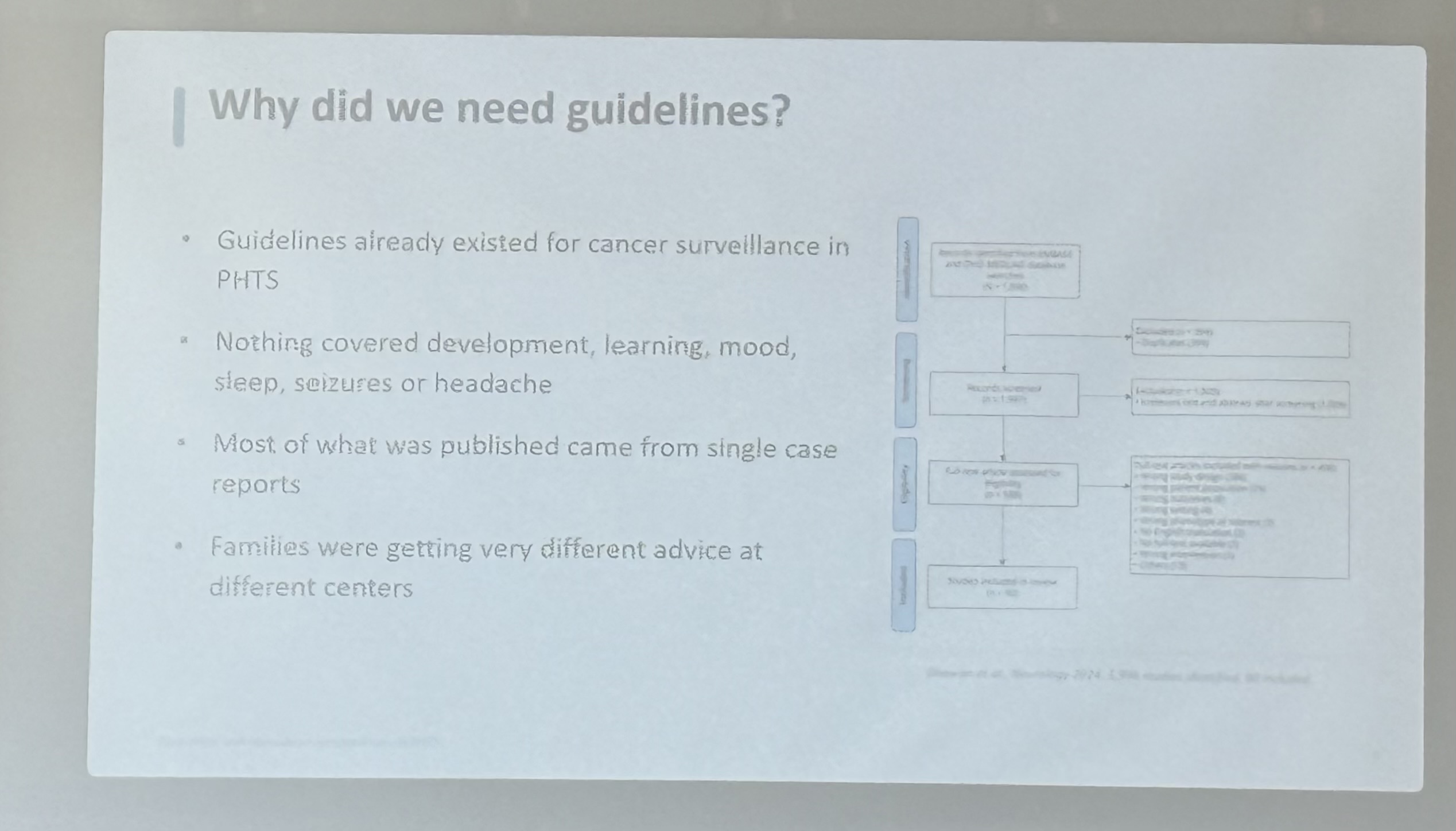
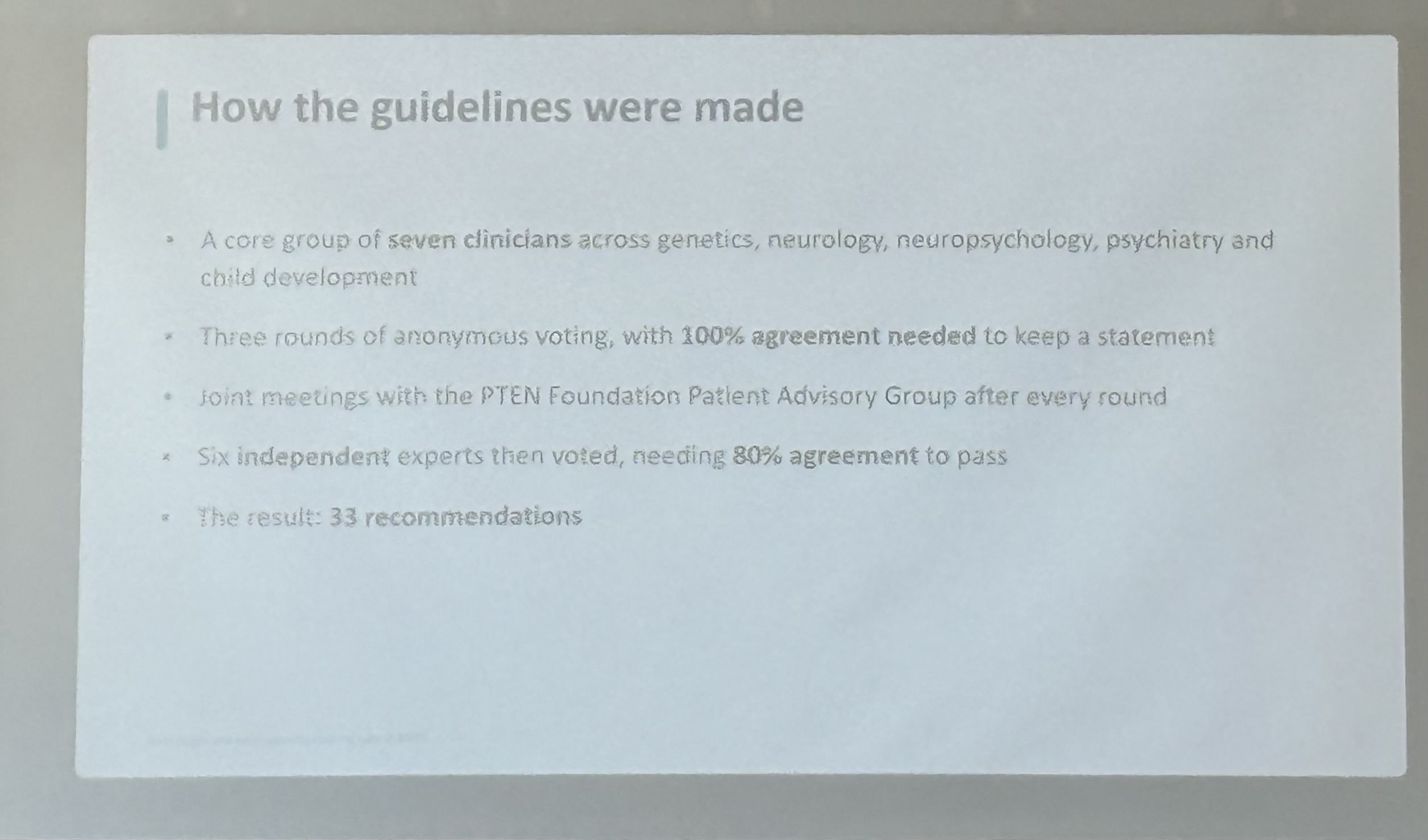
We both feel as though everything we do takes longer than it should- including my work compiling my notes here from yesterday!

And I felt in in my SOUL when he said that PHTS patients are ‘clumsy!’ I felt SEEN! LOL!!

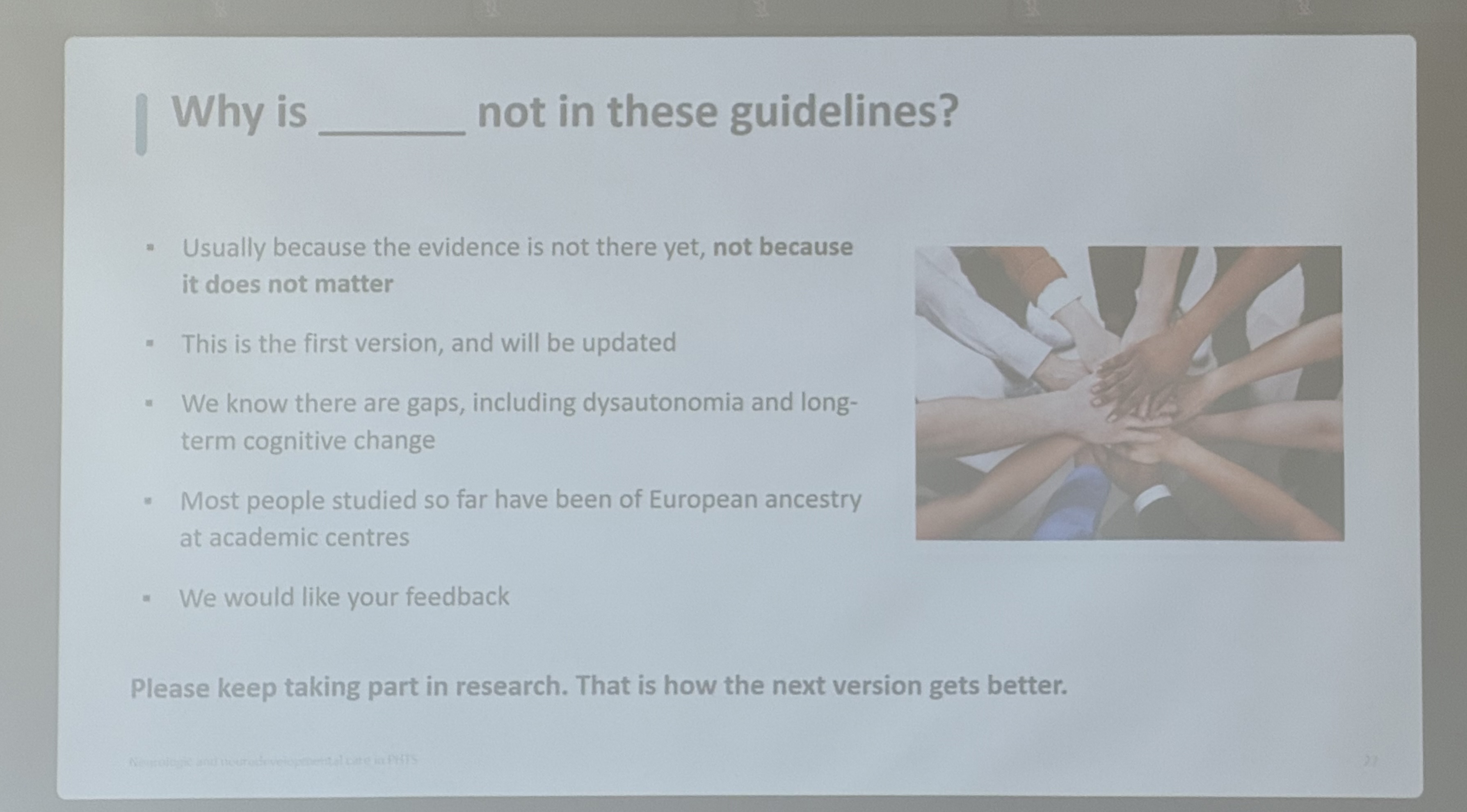
It was reinforced how important patient participation is in research, registries and the like so that appropriately sized and differentiated samples can help lead to even better guidelines.
11:15- 12:00 Lunch and Q and A with CHOP genetics team

12:00 Dr. Siddharth Srivastava (virtual) Boston Children’s

PTEN Neurologic Research

My apologies because I do not have any slides to share. The virtual presentation created some projection challenges.

The doctor spoke about upcoming research opportunities.

12:30 Mrs. Kelly Steel 

PTEN Parent and Advocate Experience

This was a super neat presentation for me because I met in person a family I have been following for years.

Kelly and her husband are parents to the amazing Daphne, a 13 year old PHTS patient with a history that reads like a medical text book. (Well, who are we kidding, you’d never find kids like ours in a textbook!)

She shared some of their journey, and while hers and ours are not the same in content, it was something special to hear from her. 

If you are a parent of a medically complex child, there is nothing like looking, standing near, or being in the same room with others. There is so much unspoken understanding, and I was grateful for their family’s openness.

Daphne’s PTEN Diary

12:45 Dr. Joan Tamburro, Cleveland Clinic

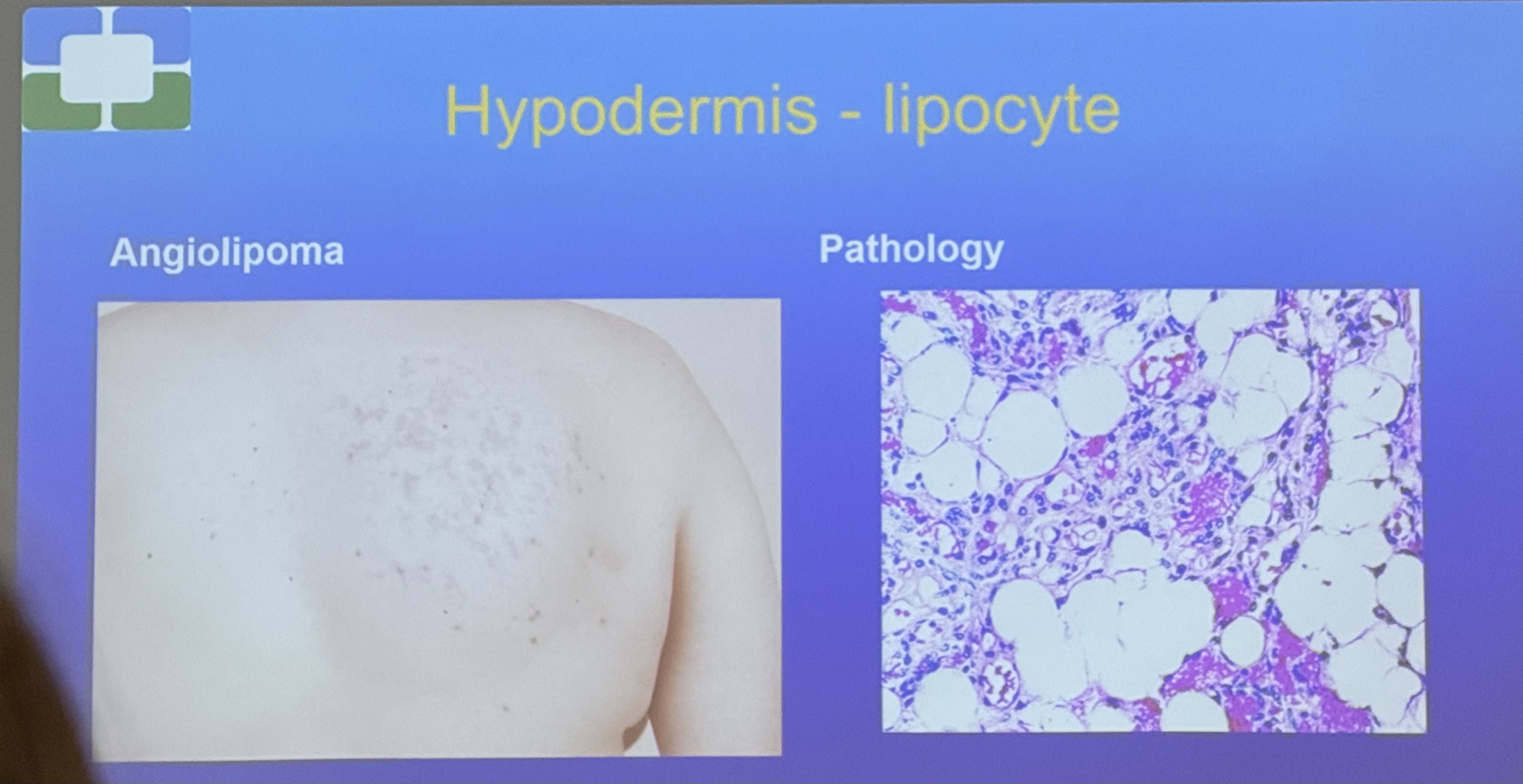
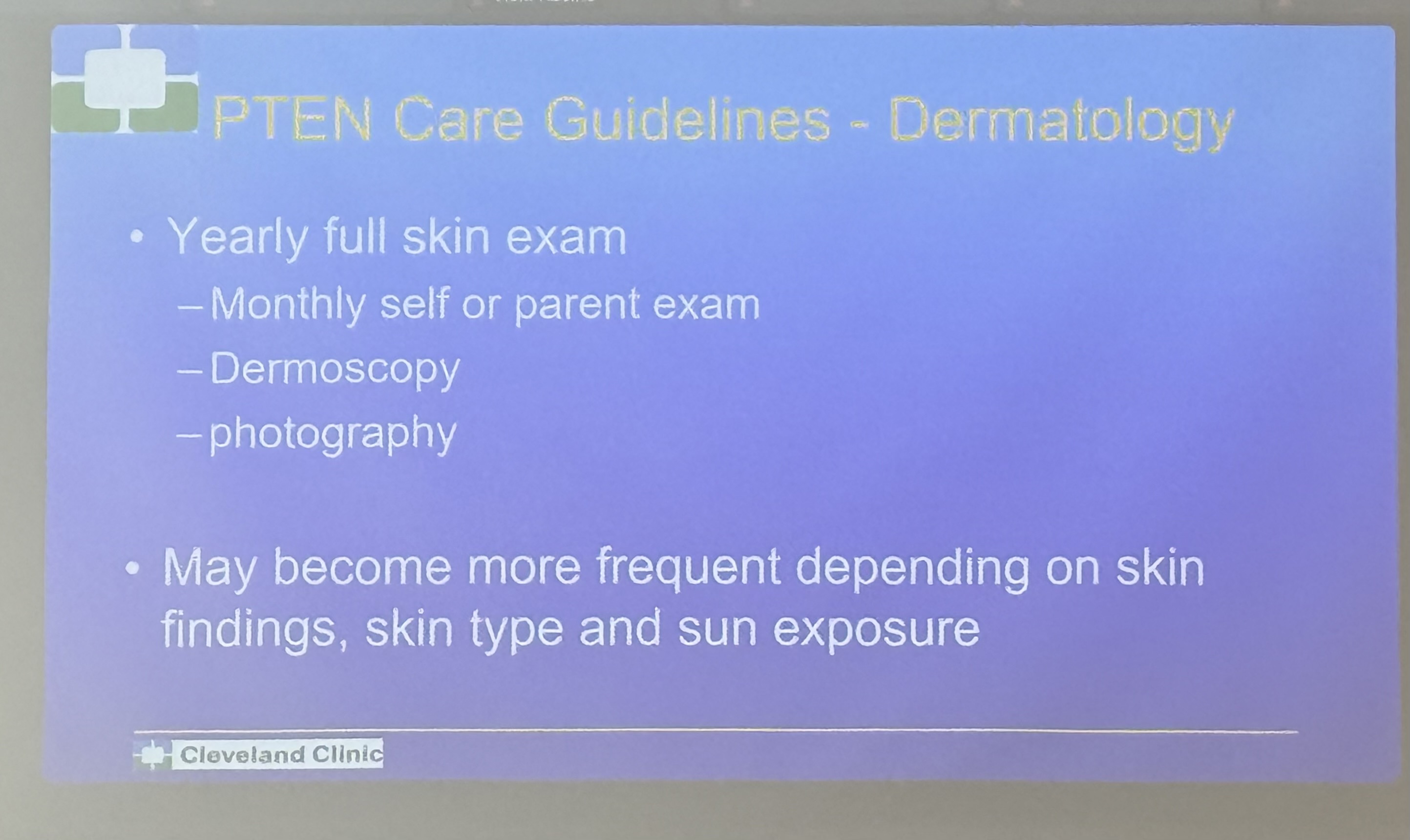
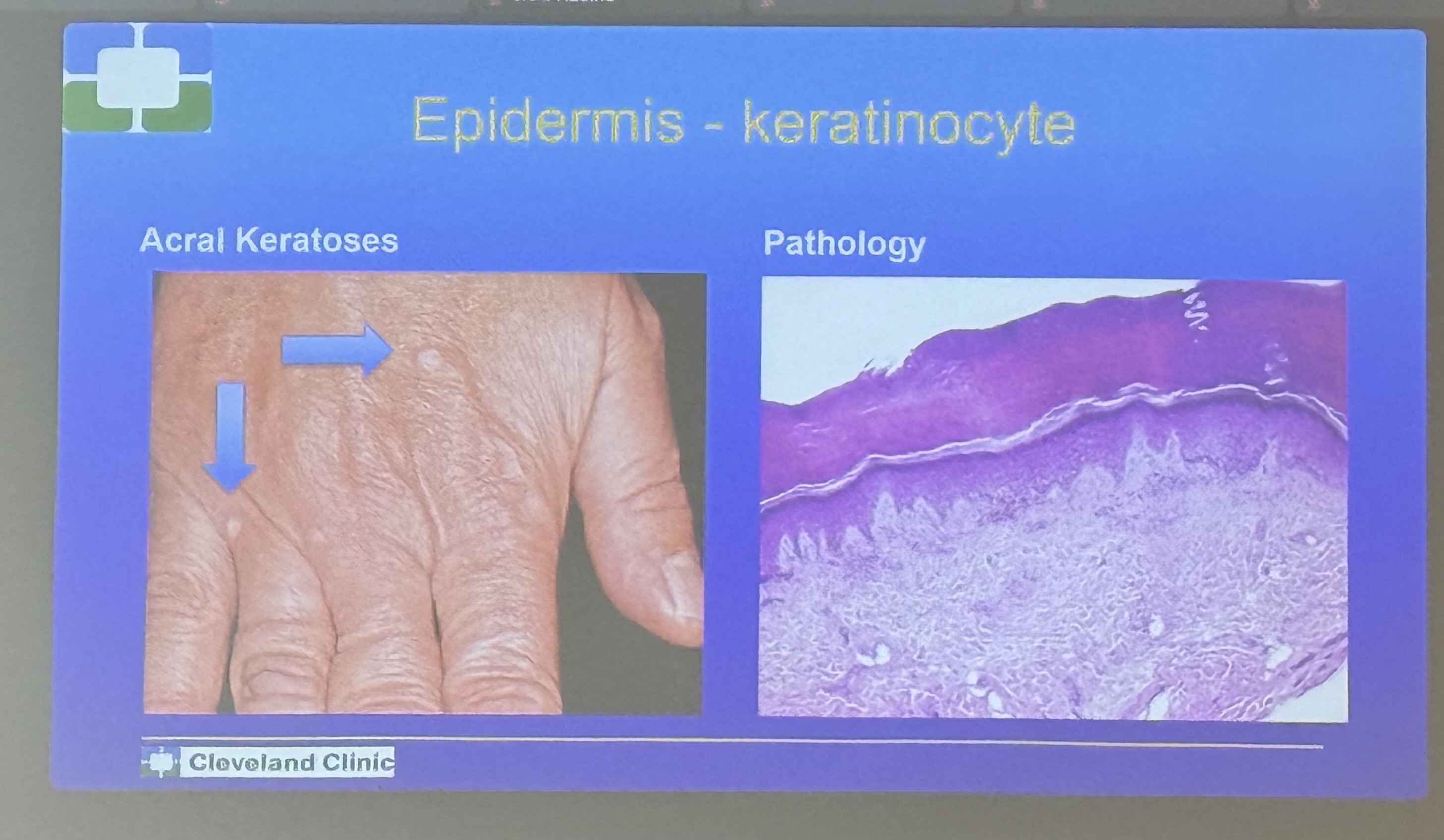
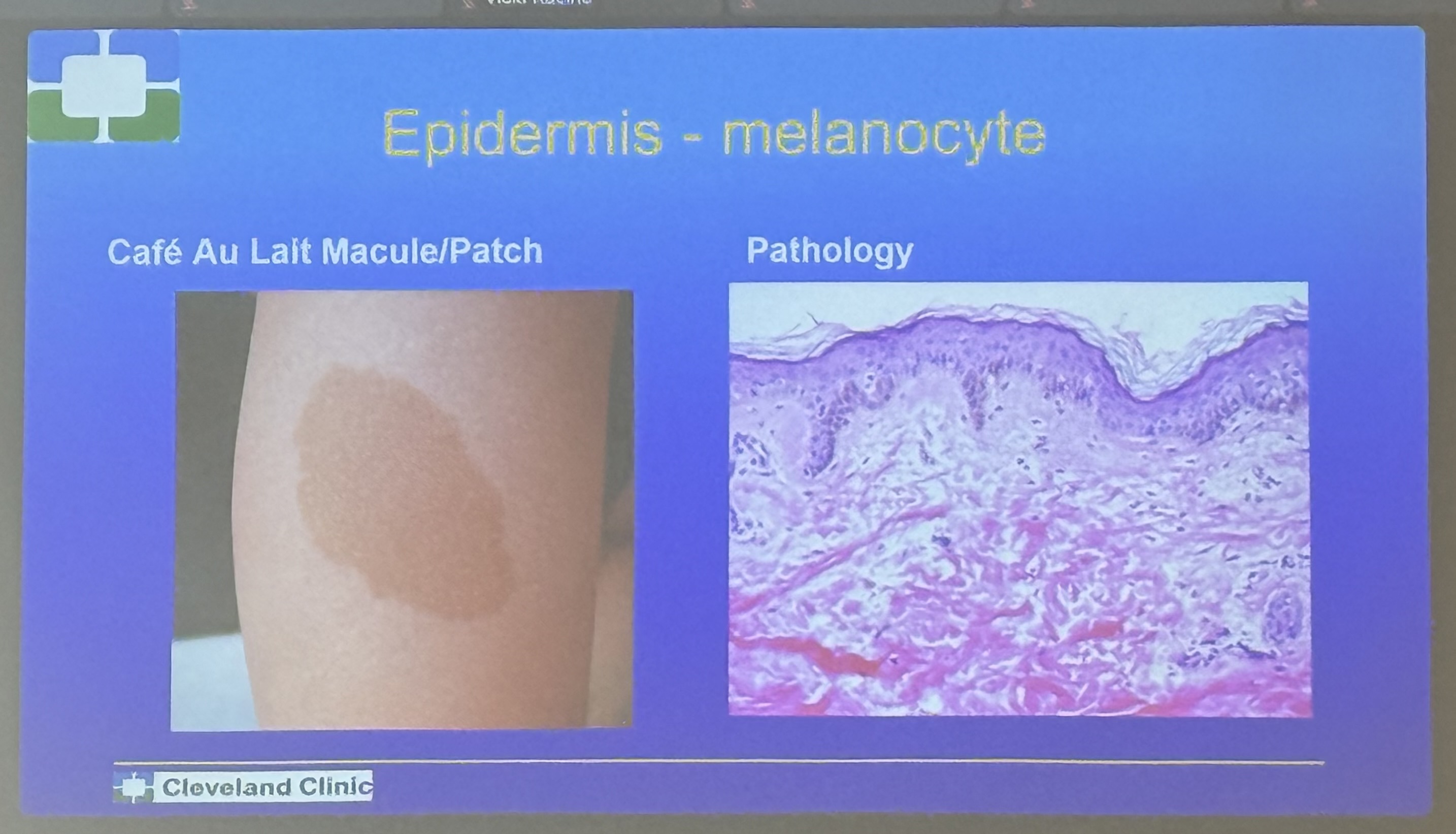
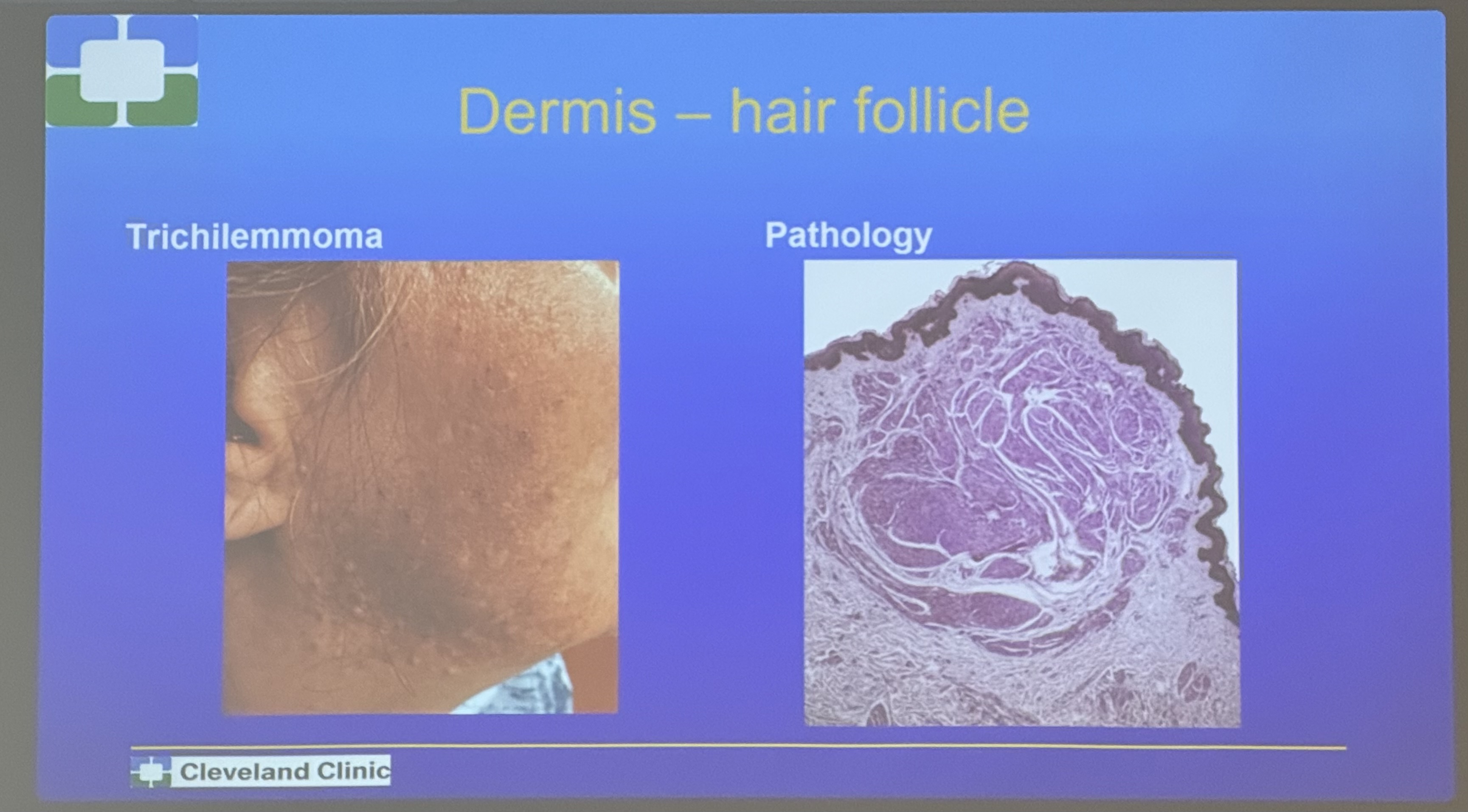
Dermatologic Manifestations of PTEN and Care Guidelines 

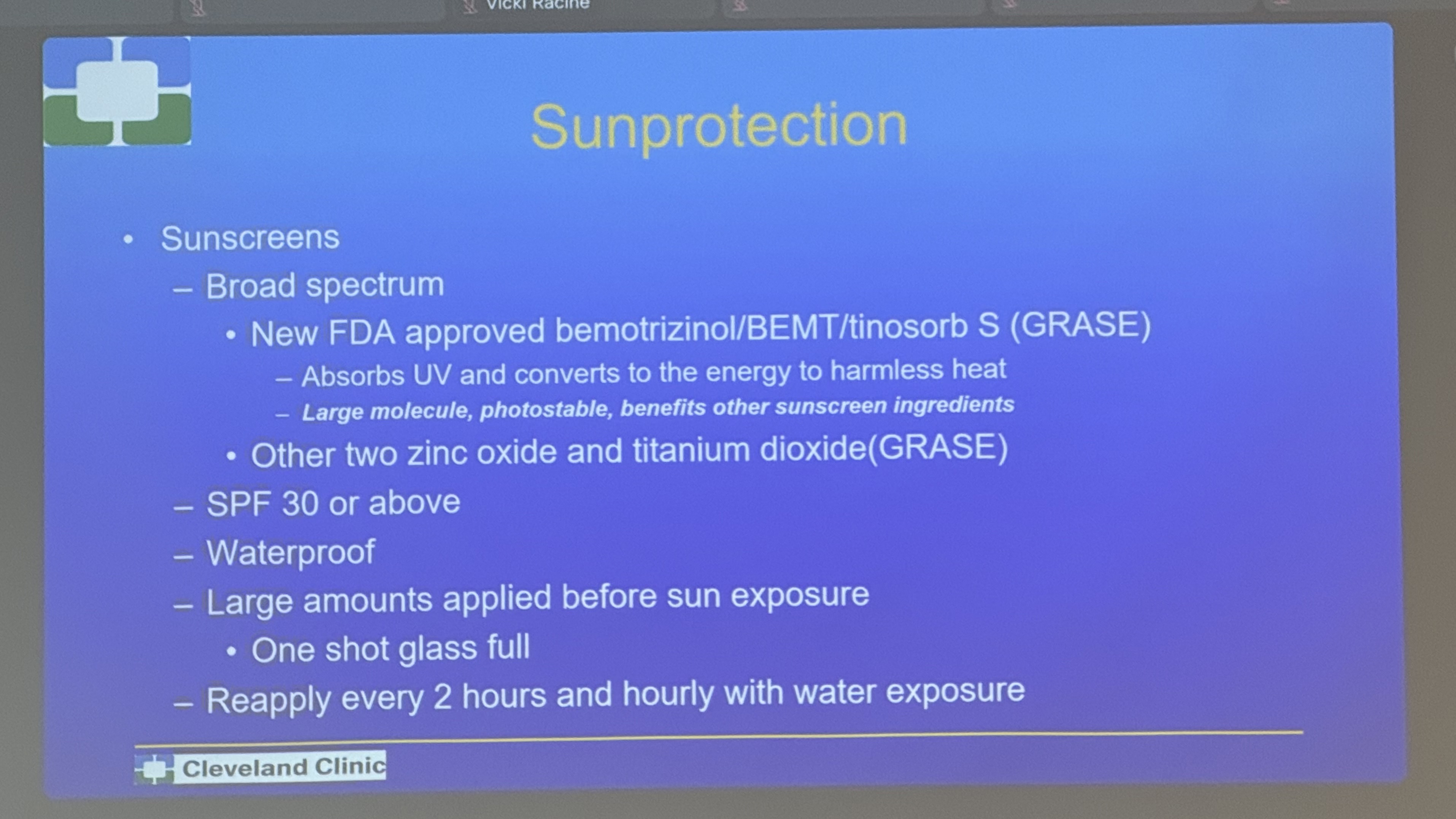
This was an overview of guidelines for skincare. I did not take a large number of photos during this presentation. The first set of photos are common skin findings in PHTS.
The next included Sun protection guidelines.

I learned that GRASE stands for ‘Generally Regarded as Safe and Effective.’
1:00 Dr. Whitney Eng – Seattle Children’s Hospital 

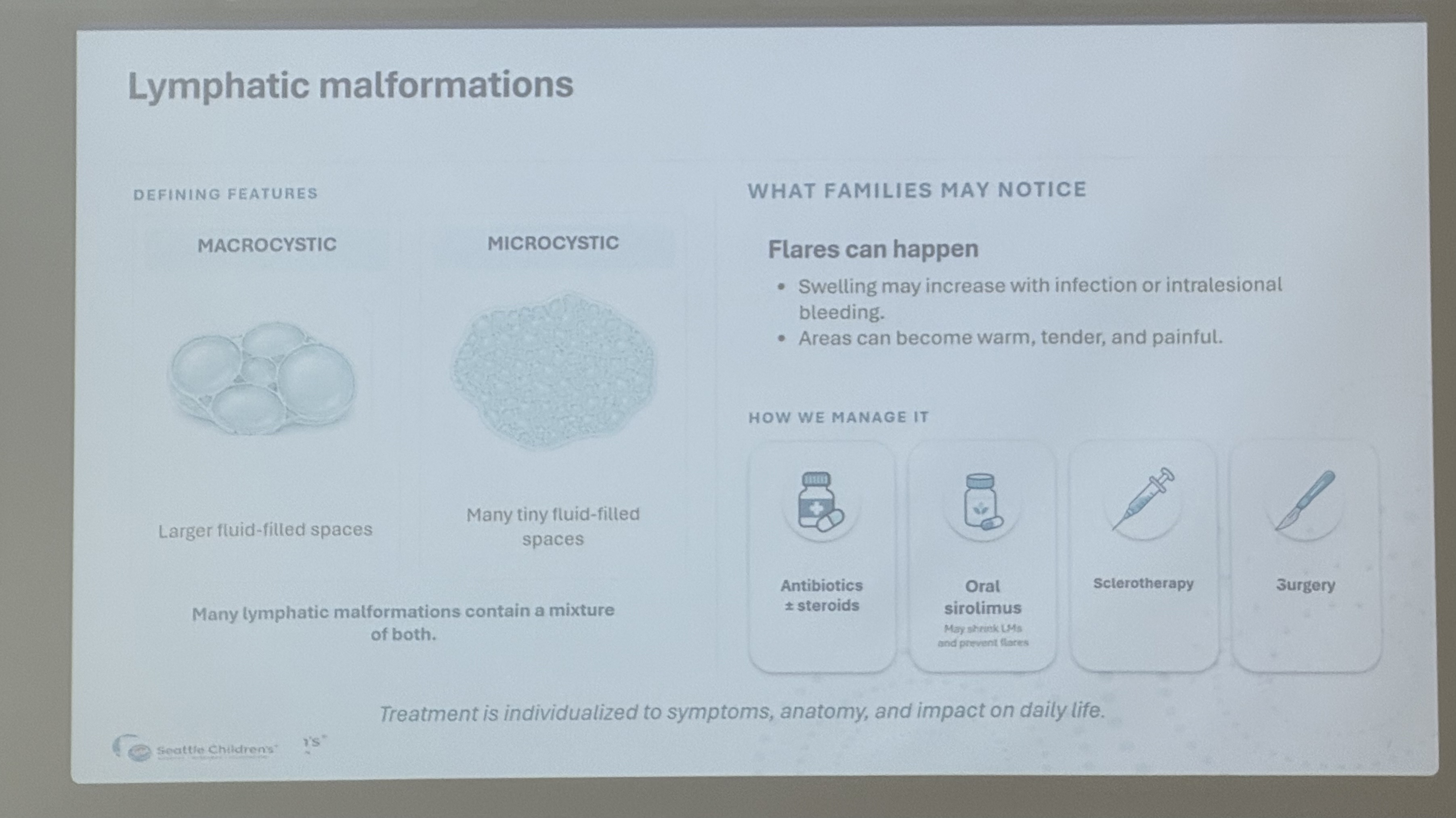
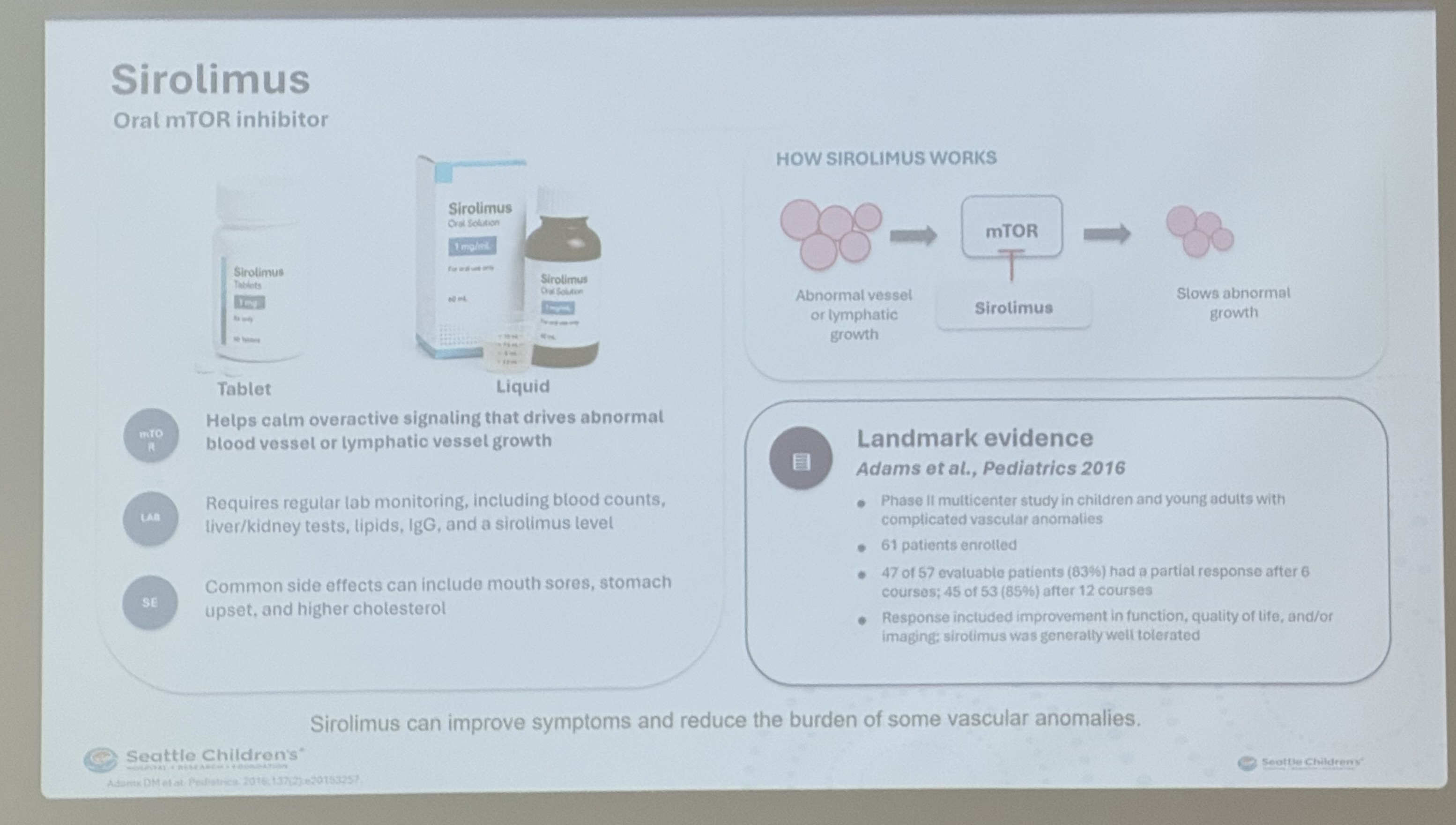
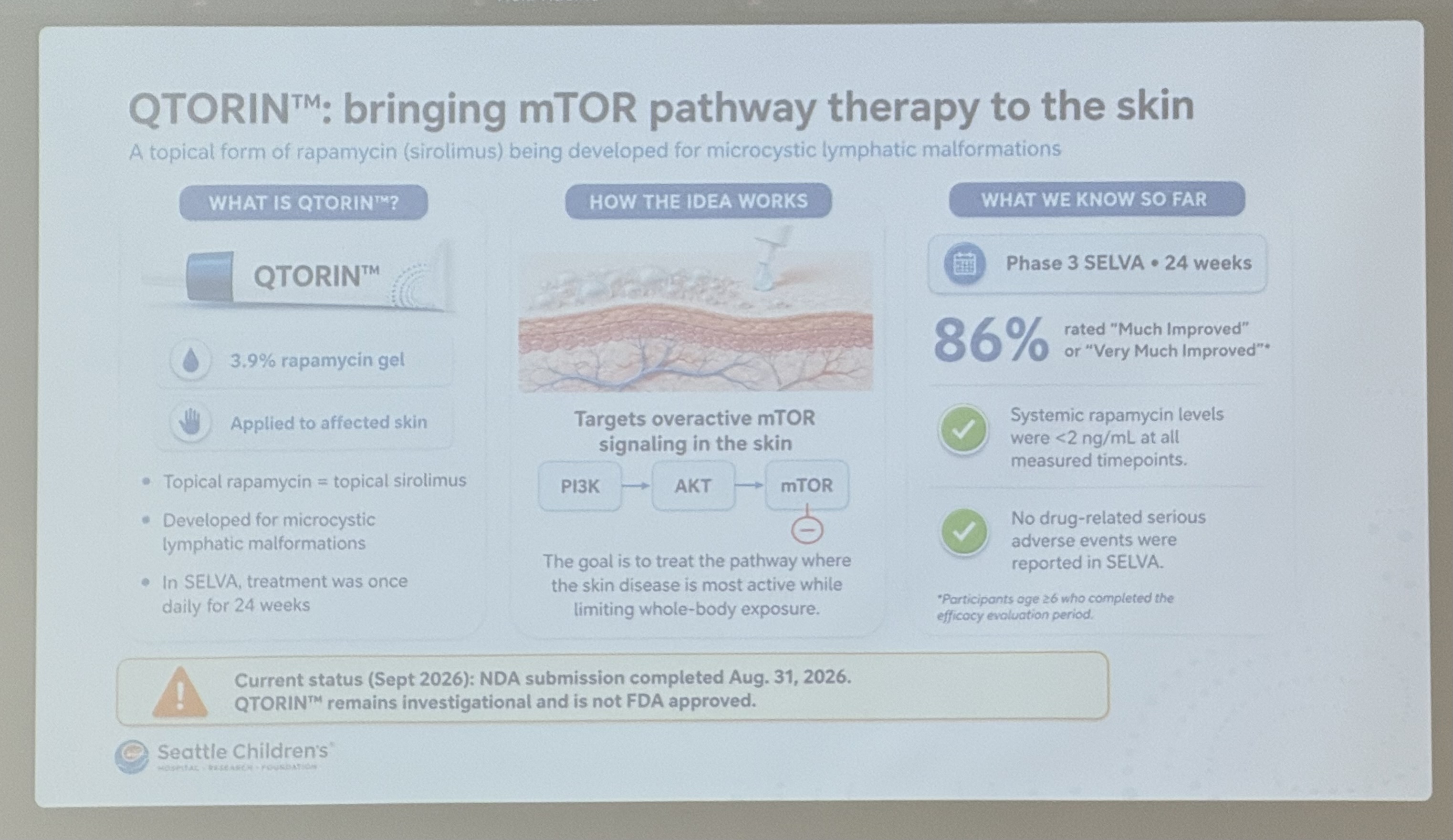
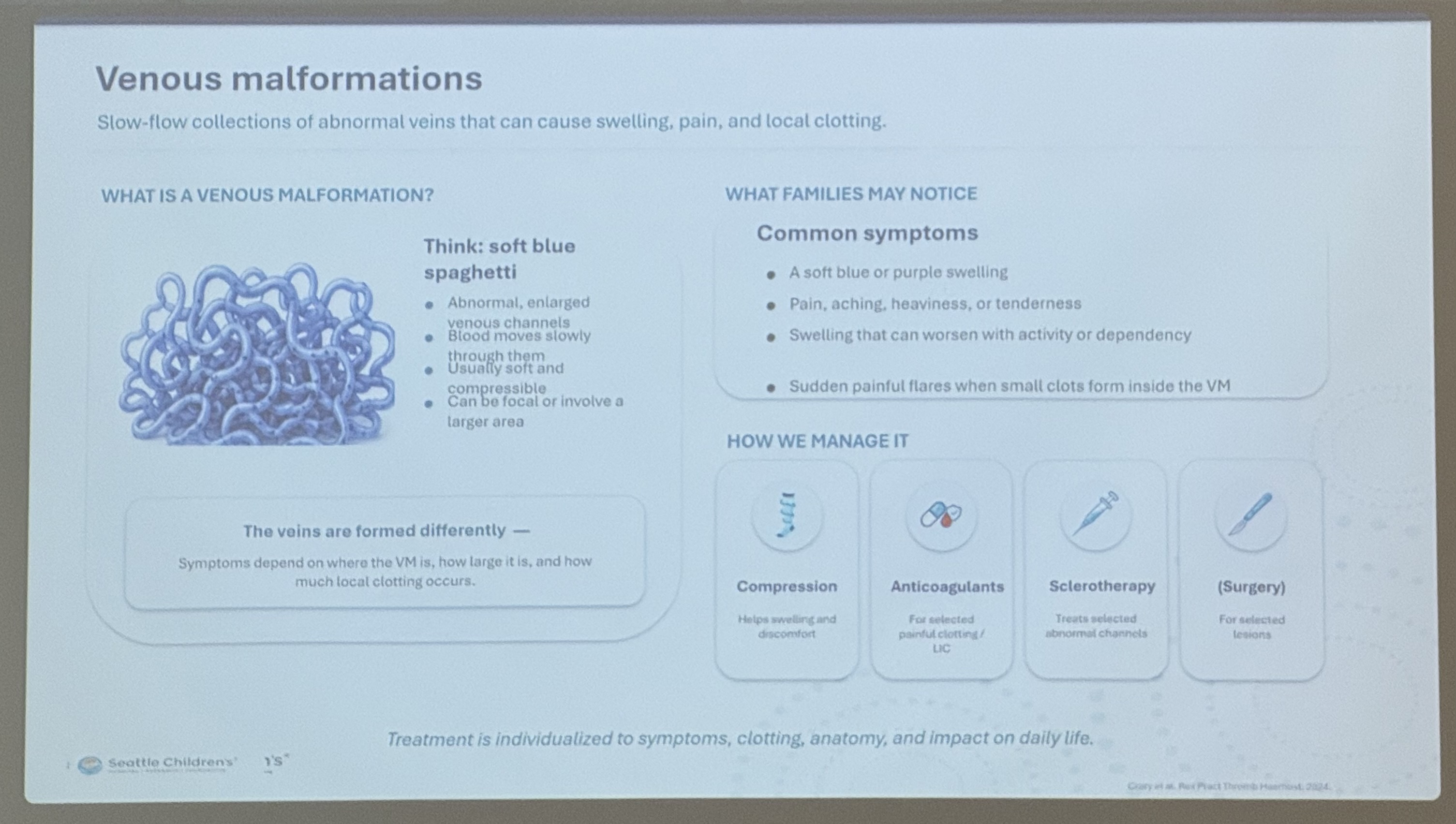
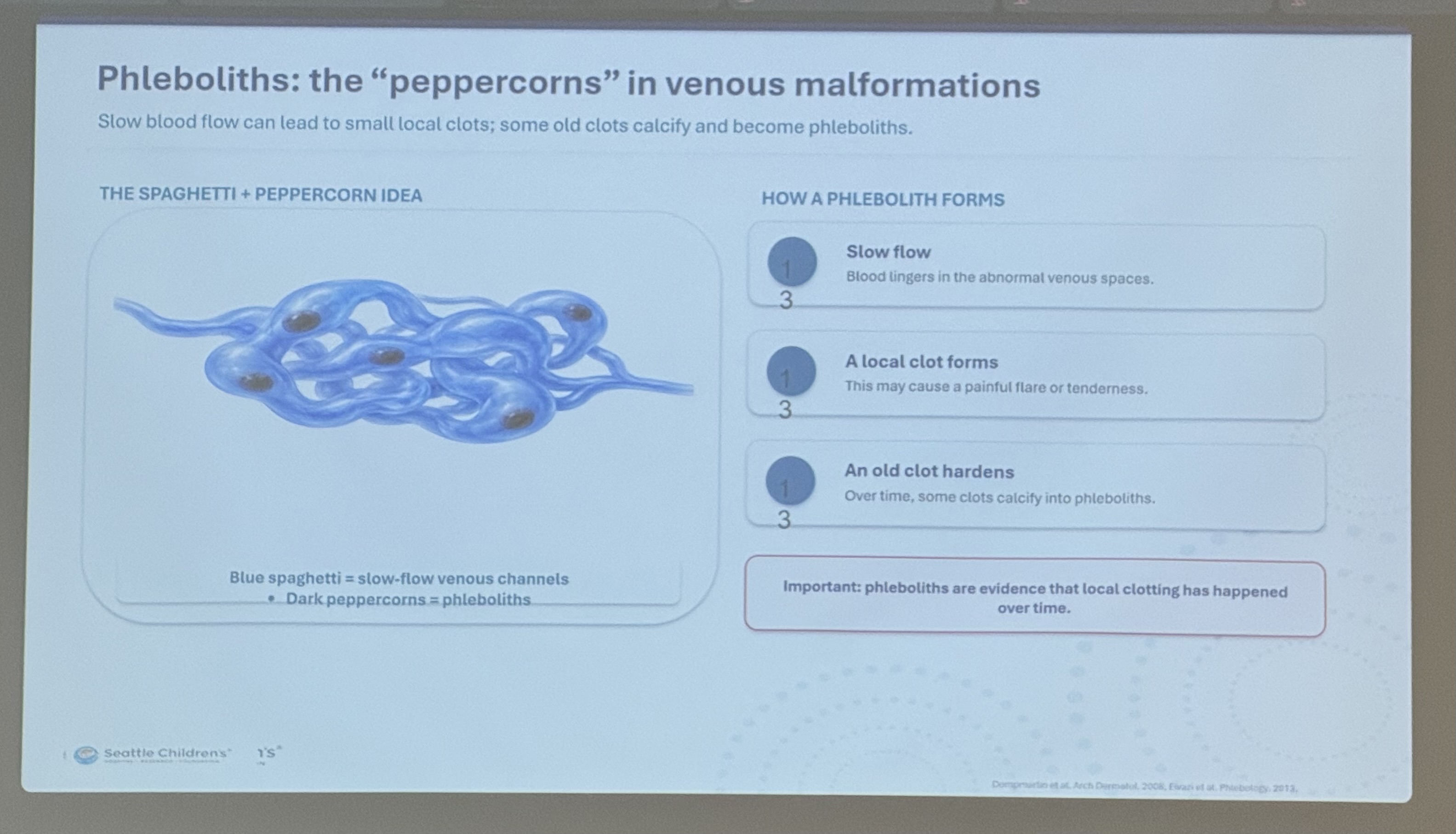
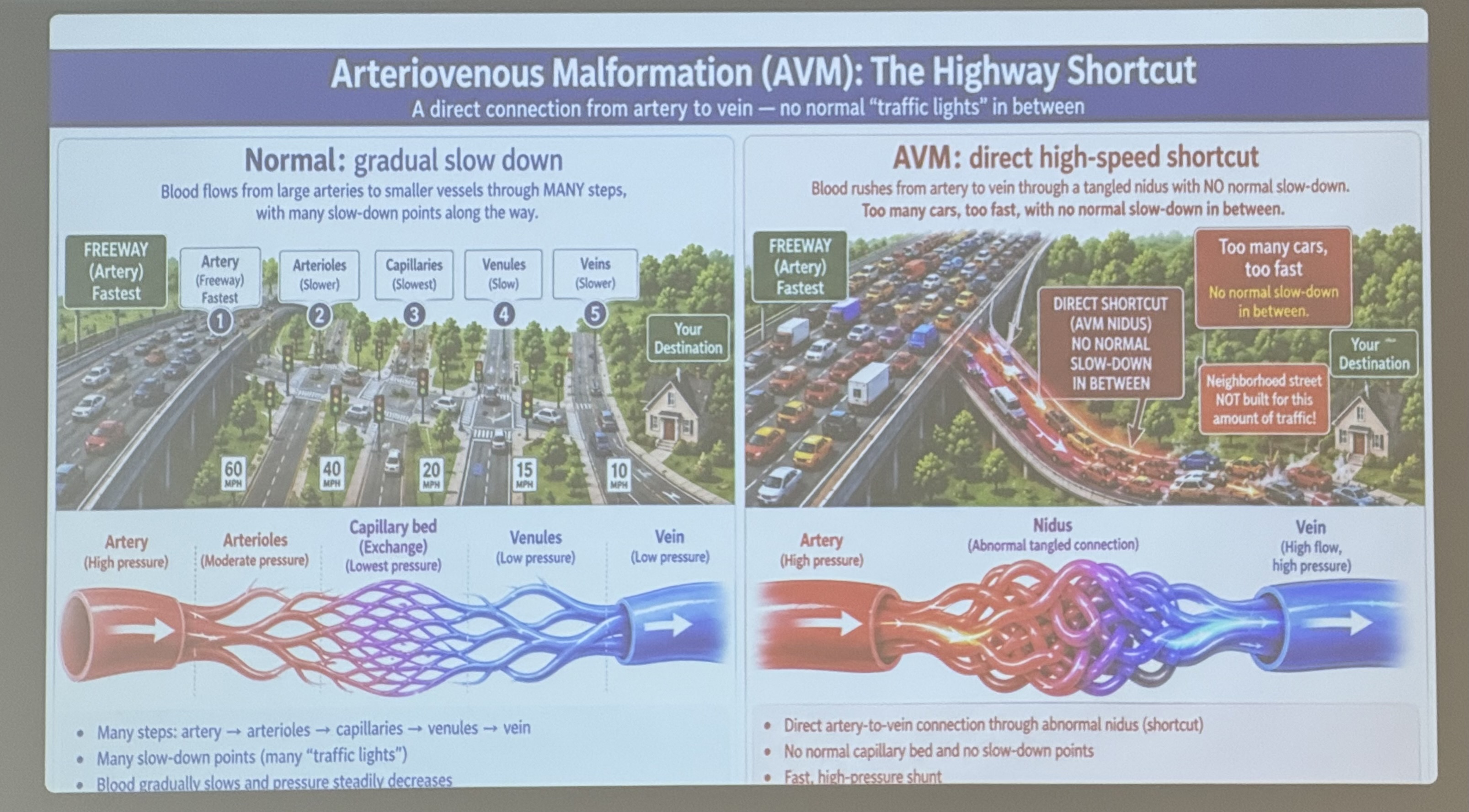
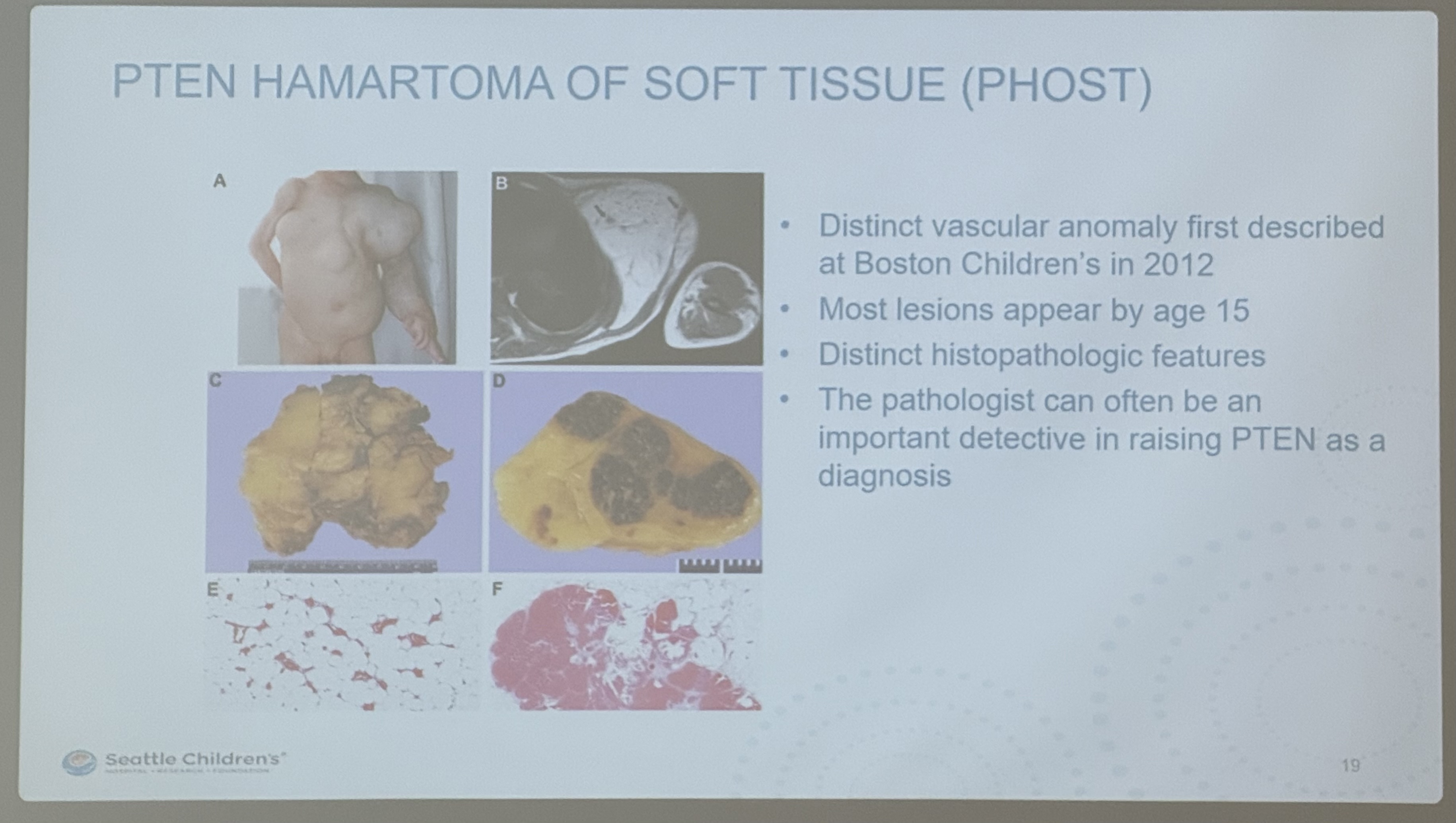
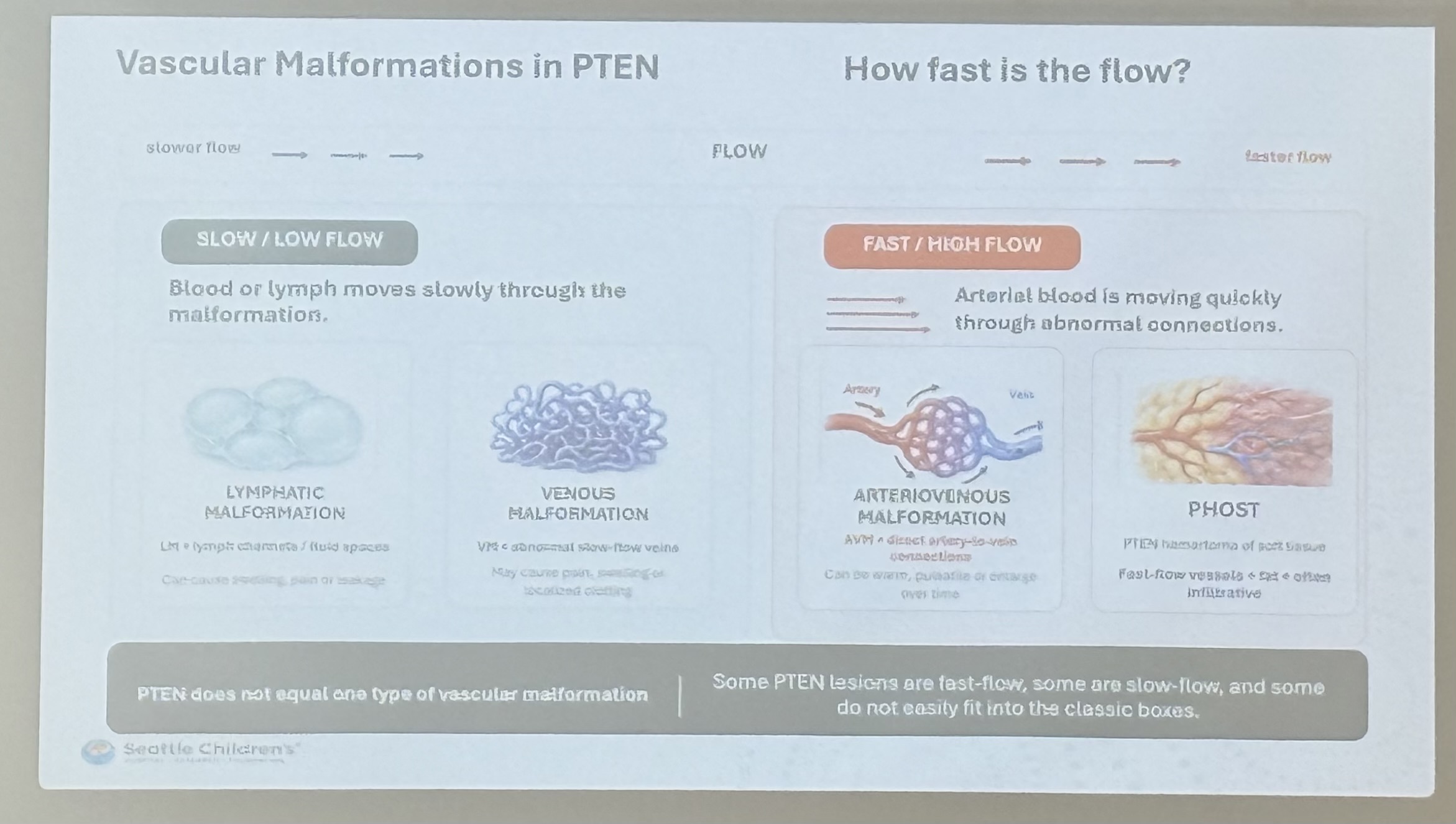
PTEN Vascular Anomalies

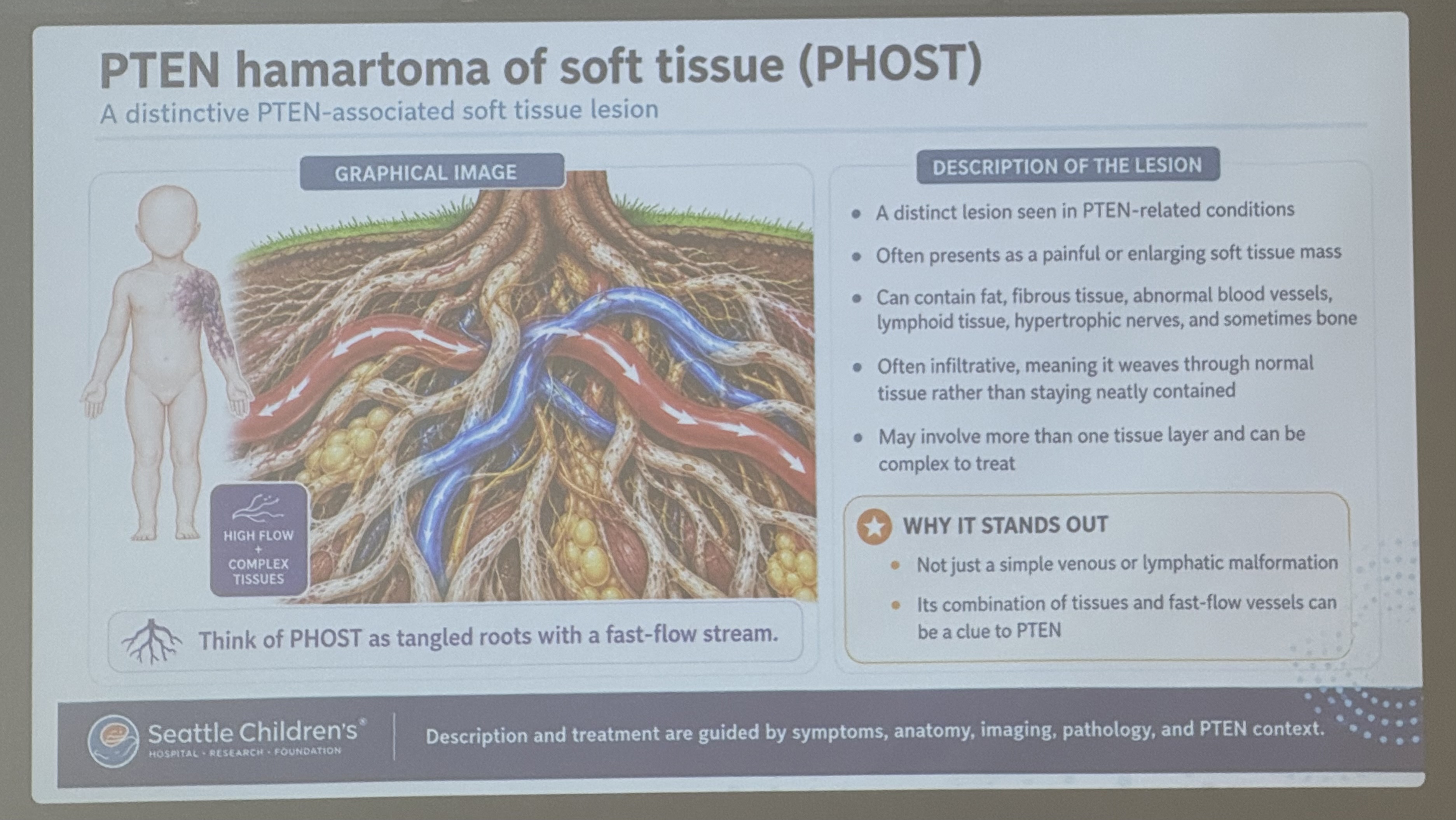
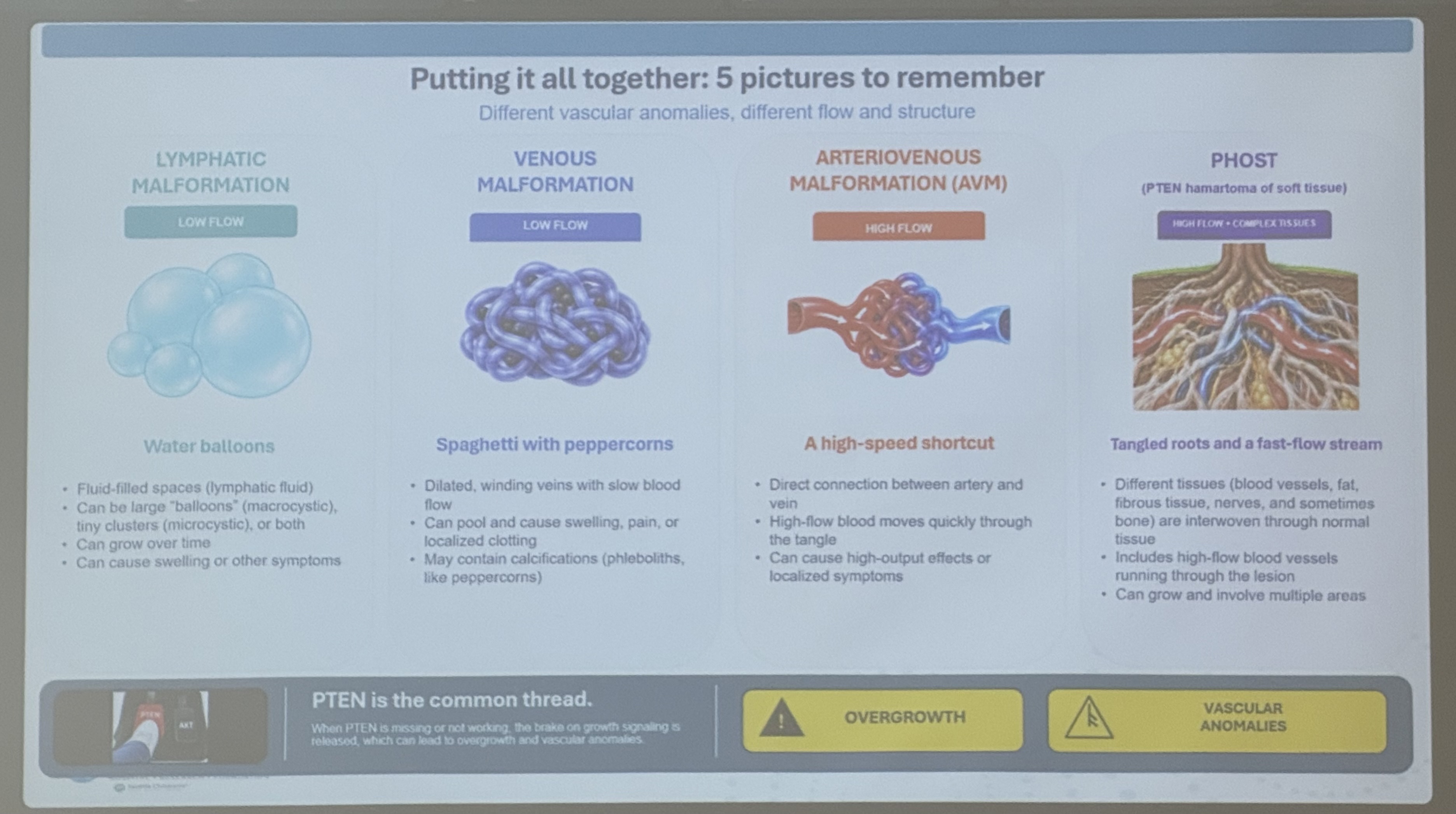
Dr. Eng had my attention from the start for a few reasons. Meghan and I have a heavily vascular presentation of PHTS, and in Meghan’s world, 12 of her surgeries have been on her right leg, due to vascular anomalies.

Also, the teacher in me thought the slides were super engaging and I loved the analogies she used.

I connected a few things in my own life through her presentation as well!
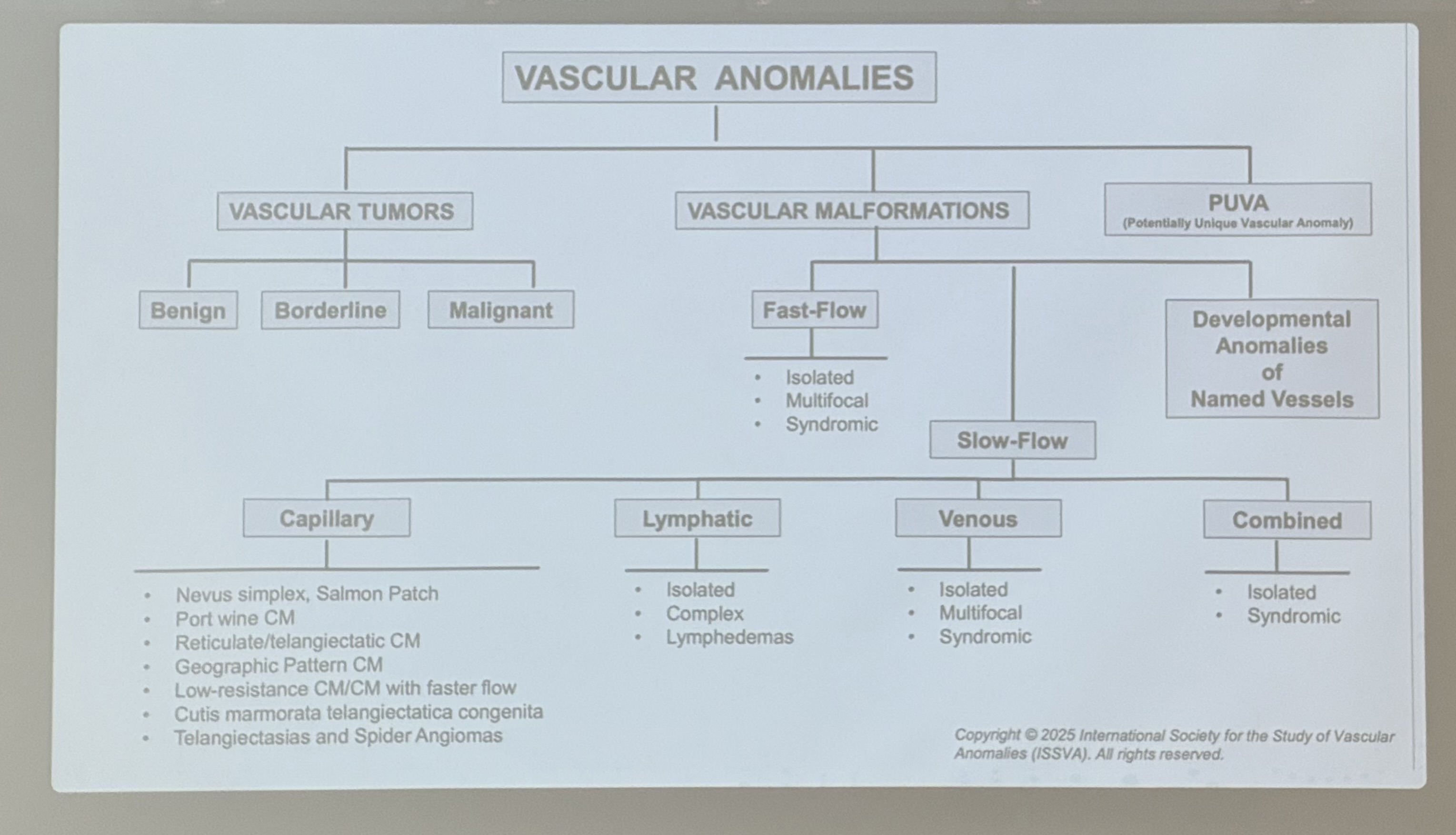
Before the presentation, I only knew of Meghan’s AVM in her knee and the beast of a PHOST tumor that tortured her for years. During the presentation, I came to realize the ‘varicose veins’ I have been battling since my 20s are more than likely connected to my PHTS.

Where that leads remains to be seen, but it was helpful to know it wasn’t that I had DONE something wrong per se. I have simply been seeing doctors who cannot/ or choose not to connect the web of symptoms I have.

I was also unaware that the tumors on my spleen, first discovered during my intake screening in 2012, and frequently classed as “lymphangiomas” by radiology, are, in fact vascular anomalies as well.

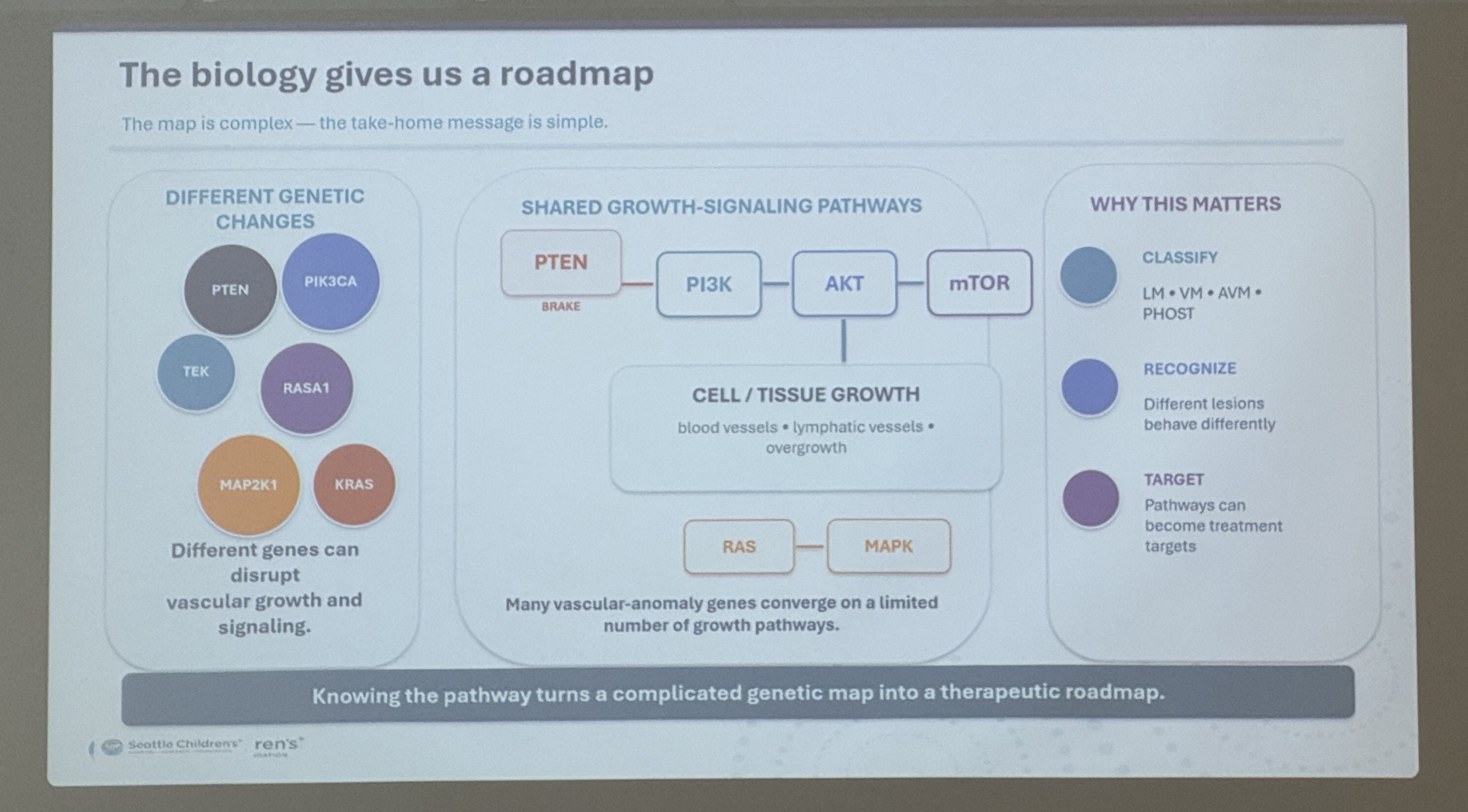
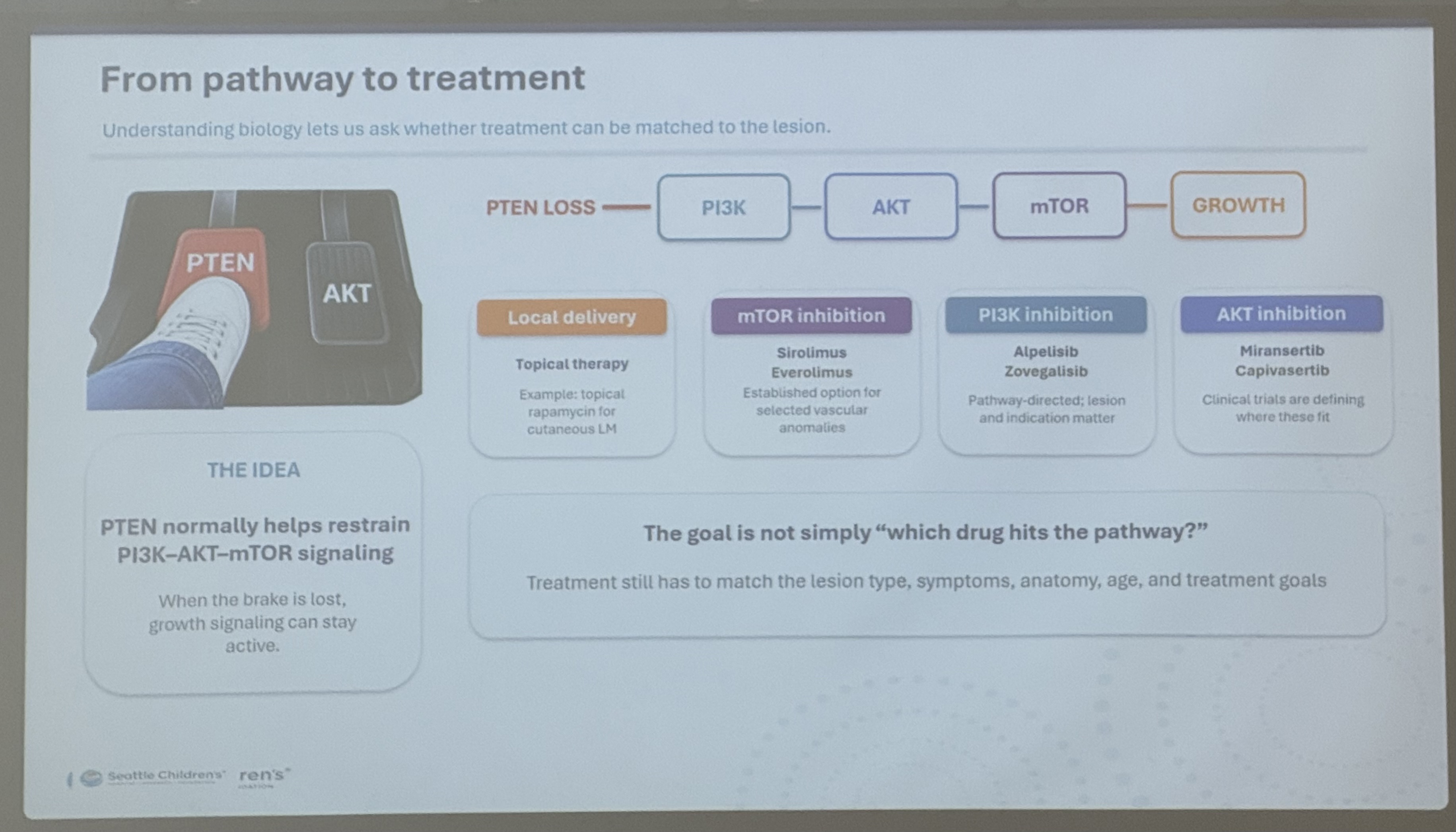
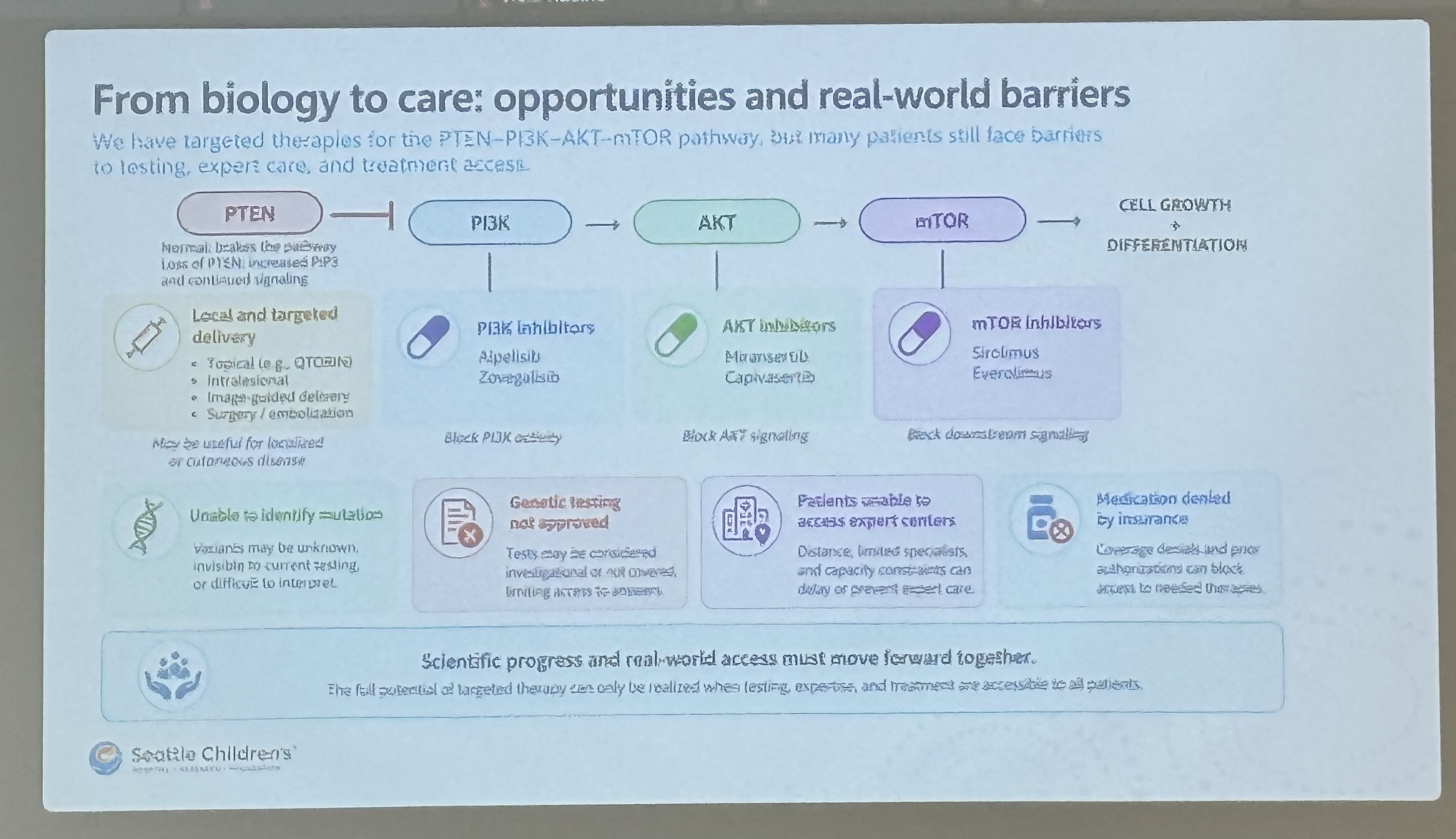
The biology of it takes a lot of work for me to understand, but with persistence and patience I am learning.

Our vascular journeys are far from over – but the knowledge gained is priceless.
1:30 Ying Ni, PhD Cleveland Clinic

Prevalence and Spectrum of PTEN Germline Variants

If I’m being honest, I was a bit checked out of this one. My brain was spinning after listening to Dr. Eng. 

I also think she was so super smart that a lot of the content was above me!

I did write in my notes that we are seeing younger average age of first cancer diagnosis in PHTS patients. It is now 46 down from 59.

I also noted that she said PTEN mutations may be a bit more common than we think/ know.

2:00 Ms. Jana Heady MS, CGC- UT Southwestern 

UT Southwestern PTEN Program

I did not do much better with this presentation. I think it is harder for me to drill down into the genetic part of PHTS now that we are 15 years post diagnoses.

I did learn something about germline mosaicism that I never fully understood. But, it will only play into unproven theories of our disease origin in my own family. 

2:30 Dr. Denise Adams- CHOP

PTEN Vascular Anomalies Research

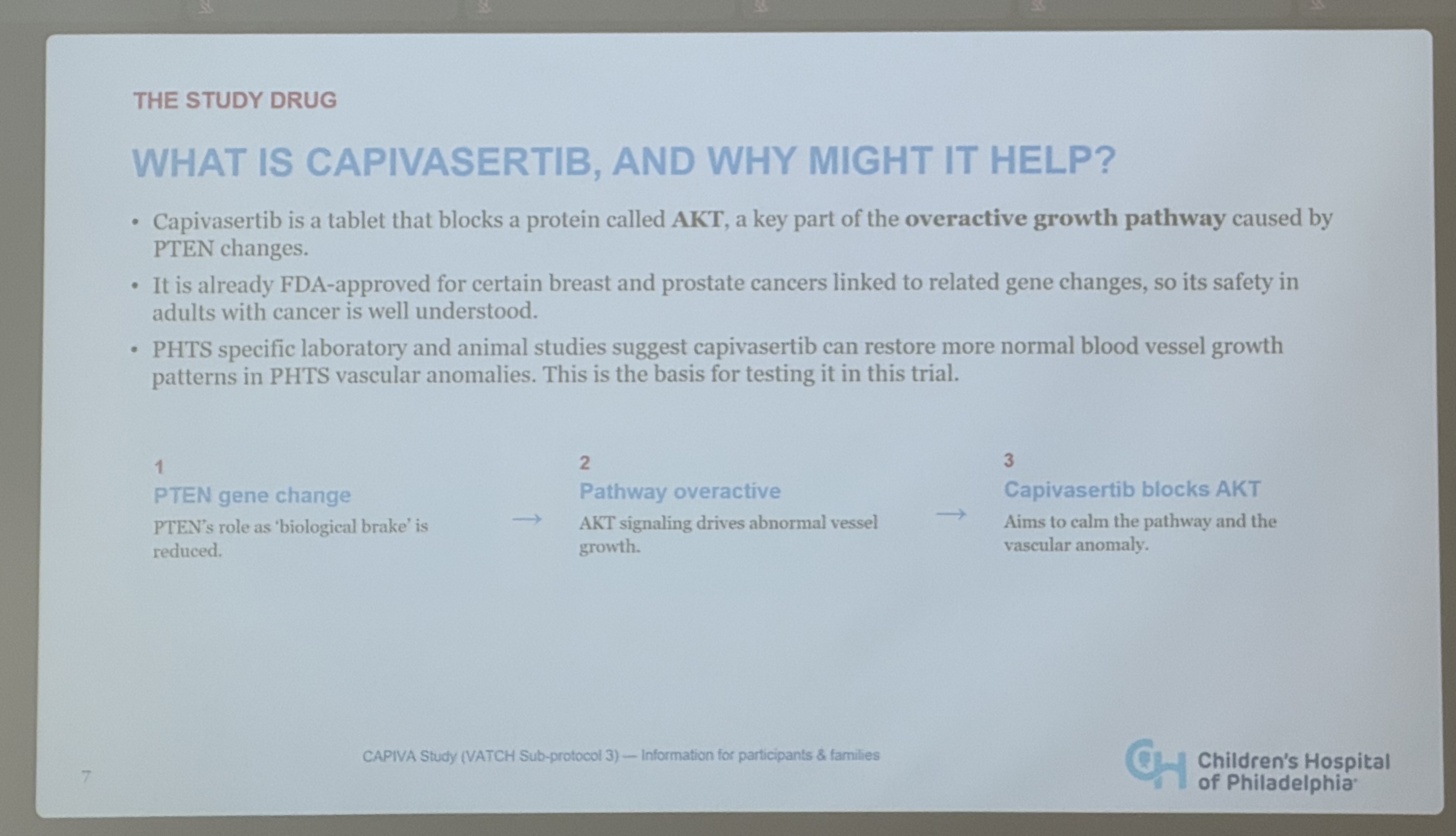
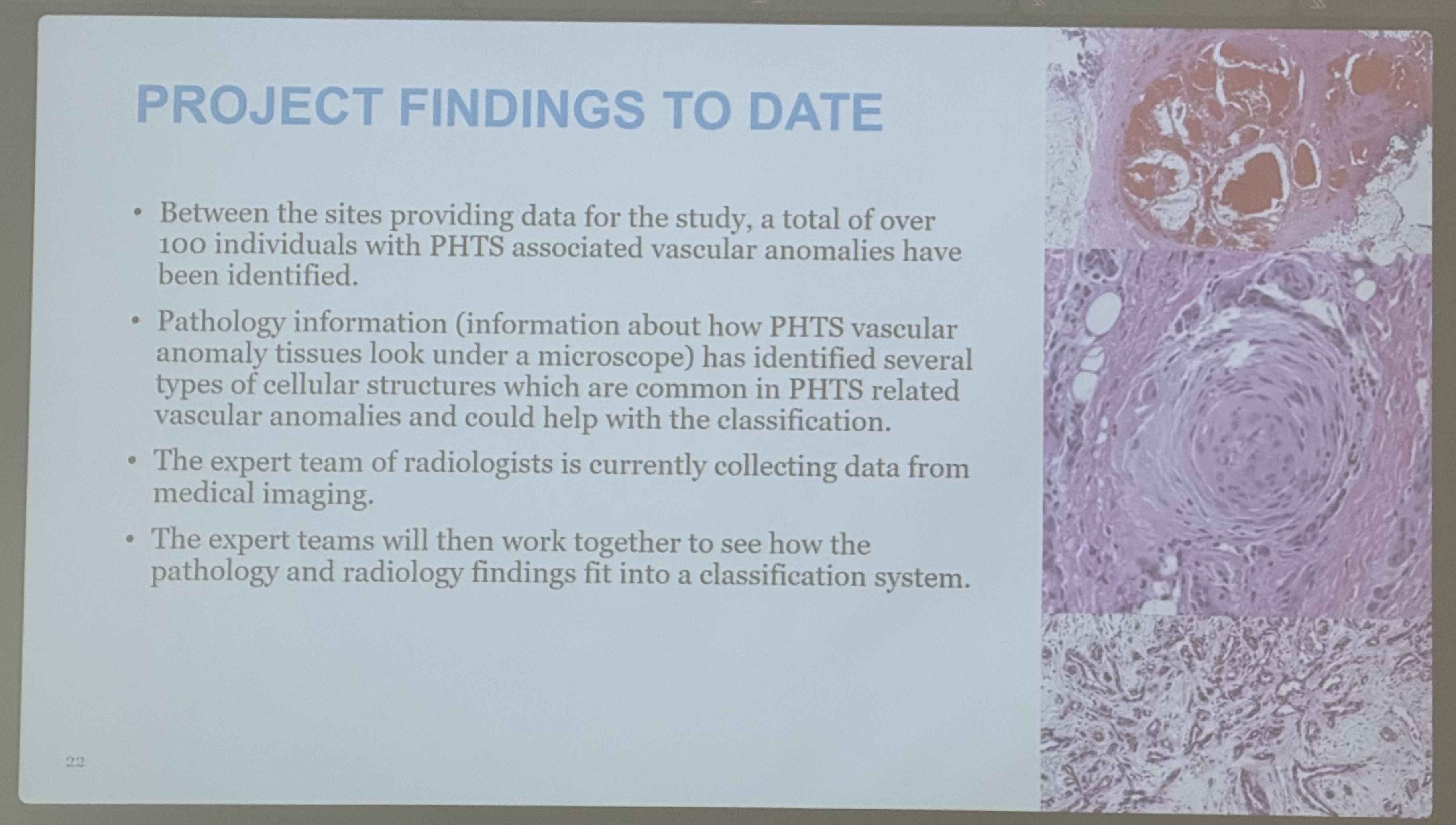
Again, because vascular anomalies are so personal to Meghan and I, I was more dialed in here. I have enough slides to share the gist of the presentation.
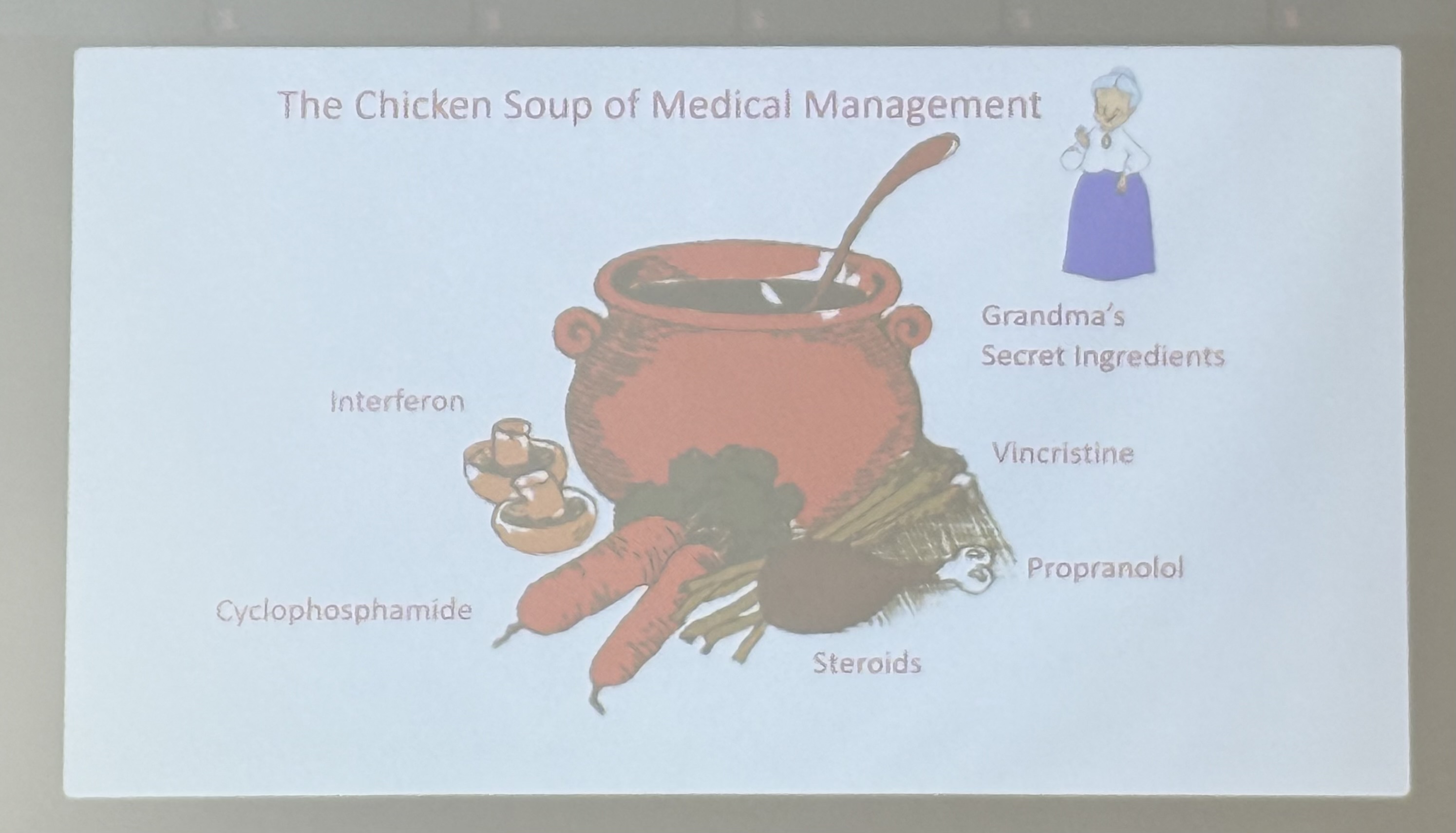
This slide got my attention because I recognized a few drugs, including propranolol, recently prescribed to me to potentially assist in my migraine management.
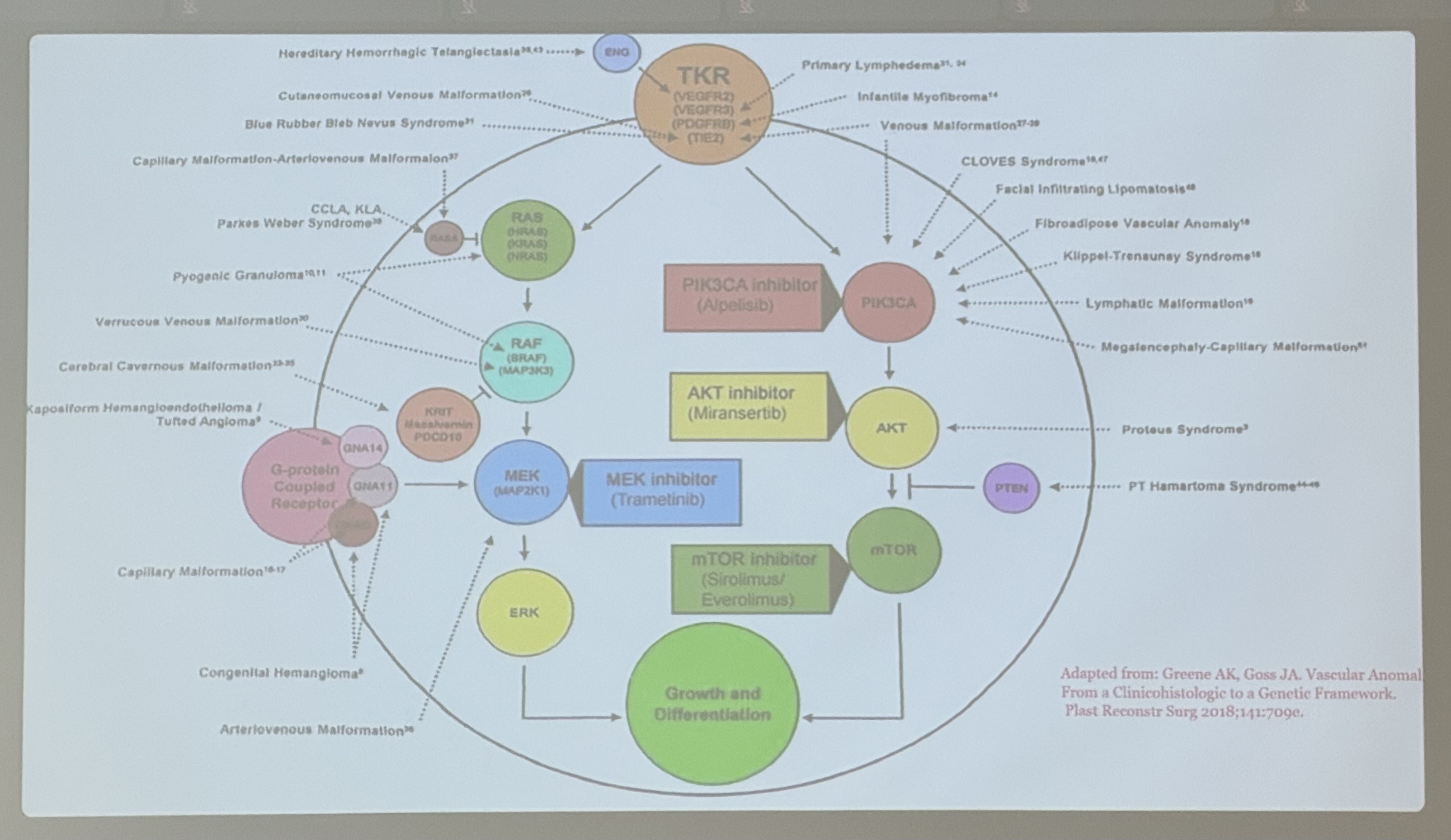
That slide makes my head hurt but I kept it because some of your understanding far surpasses my own. I was excited I knew SOME if the terms!

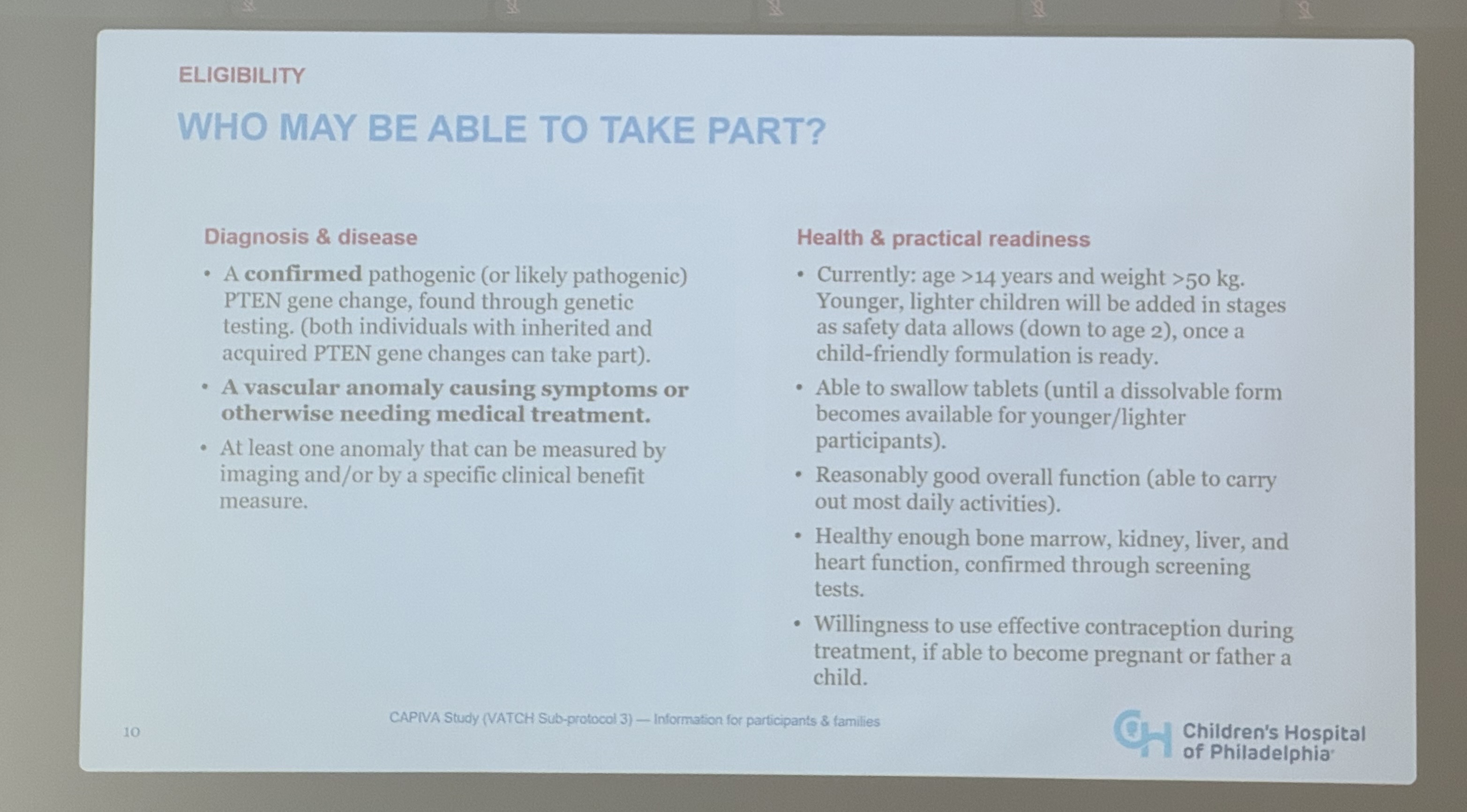
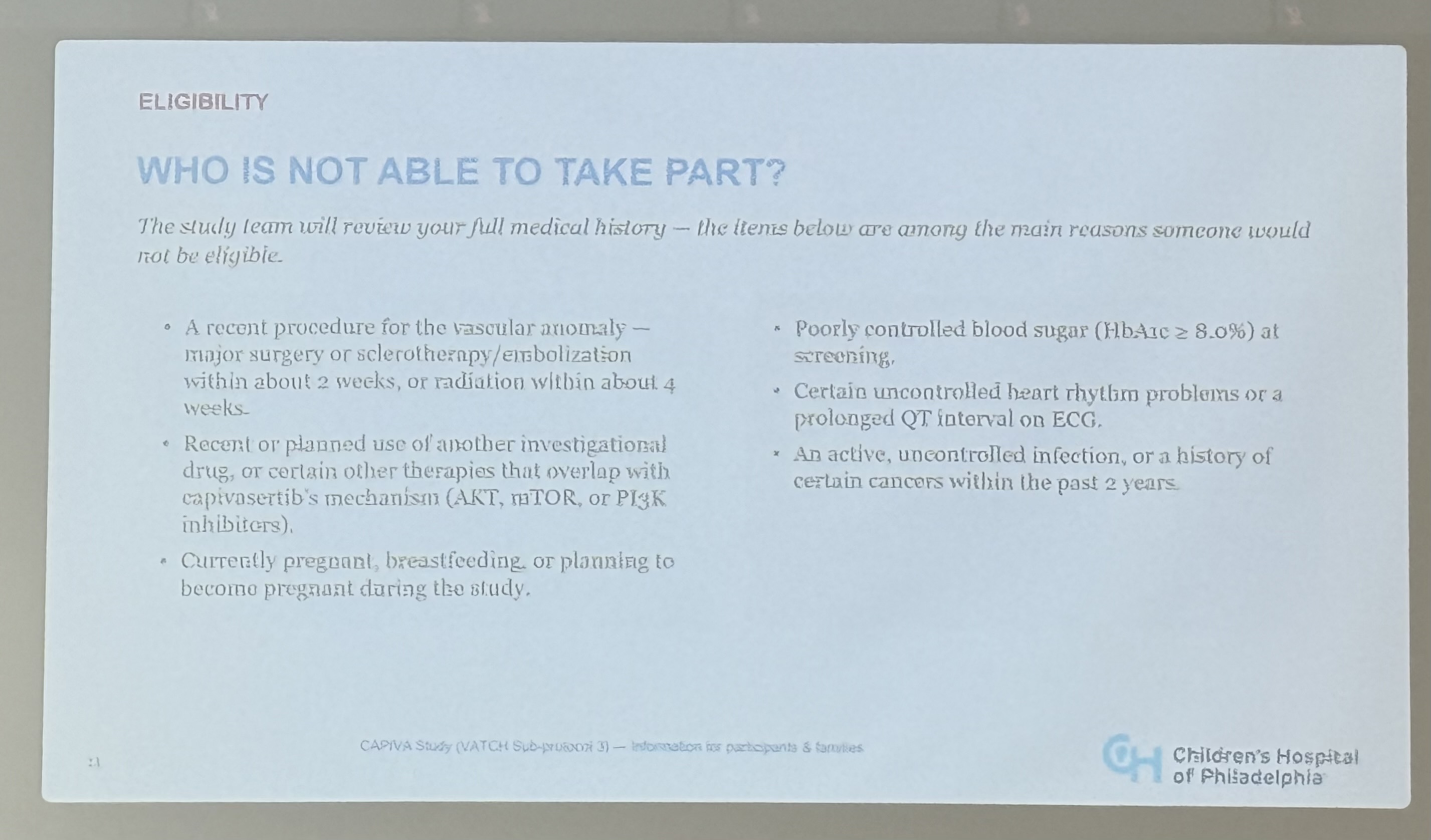
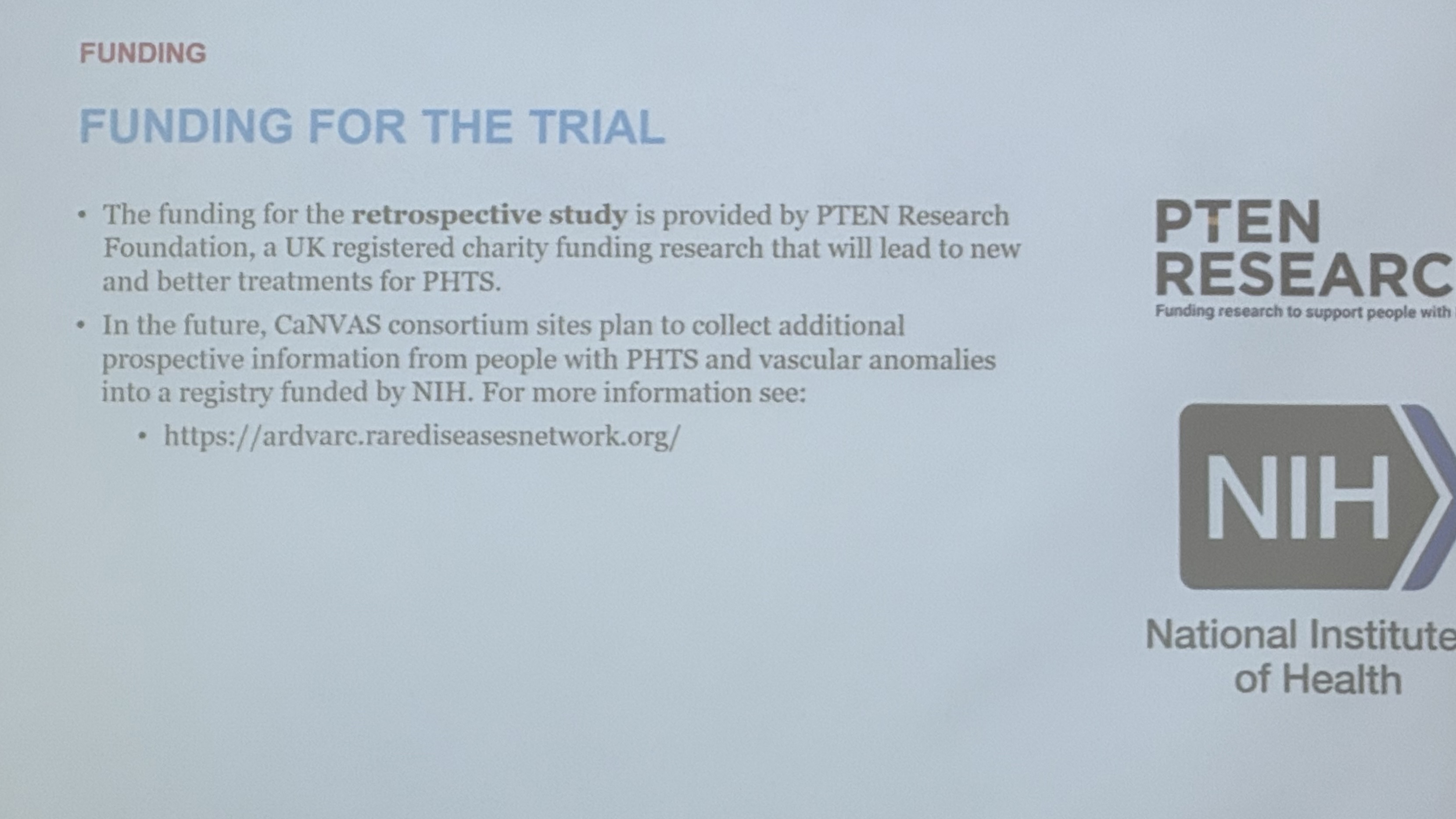
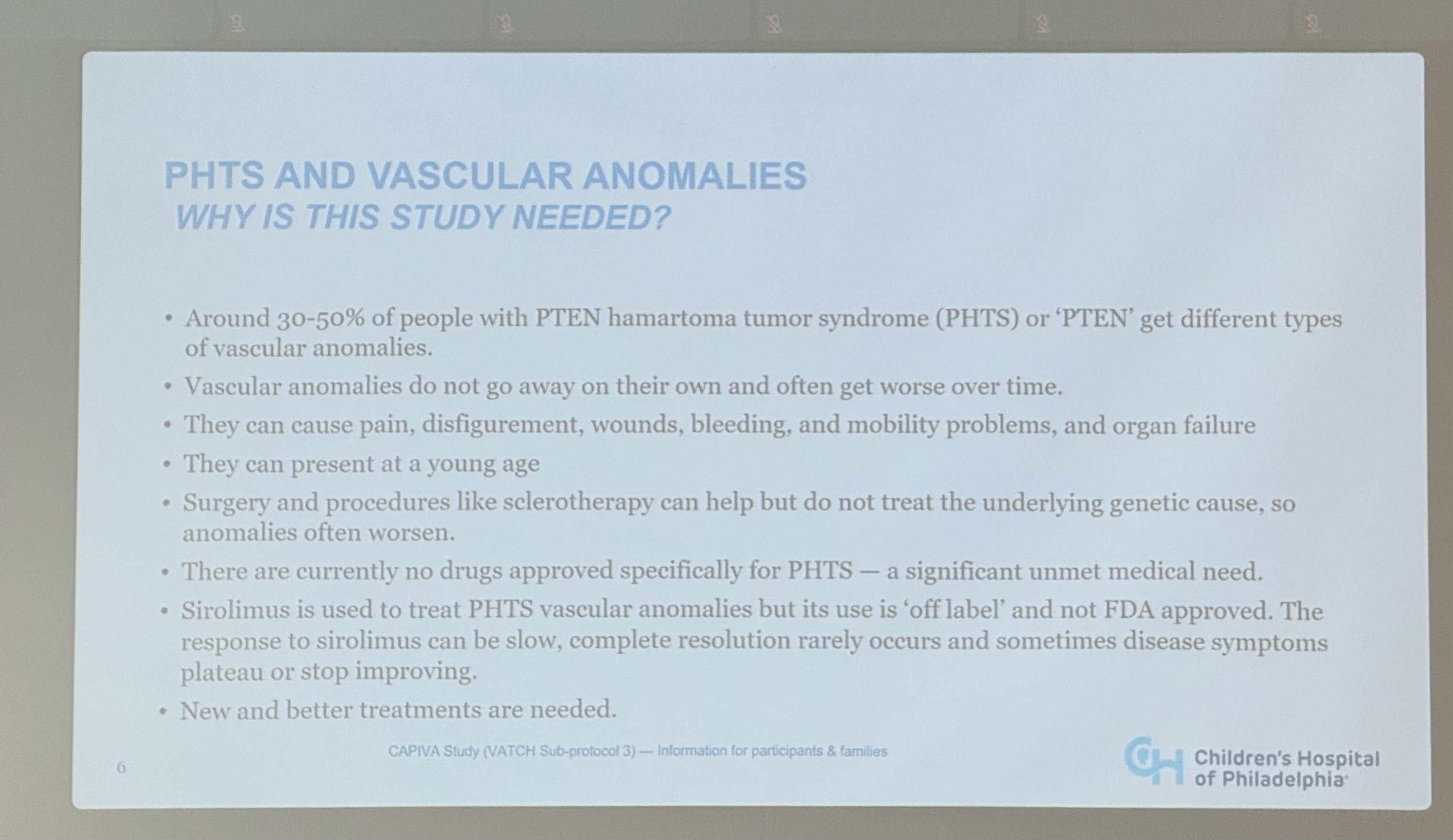
Dr. Adams was speaking of two studies, but proceed with caution because I do not have a full set of slides on either one.

I believe these are for the ‘CAPIVA’ study.


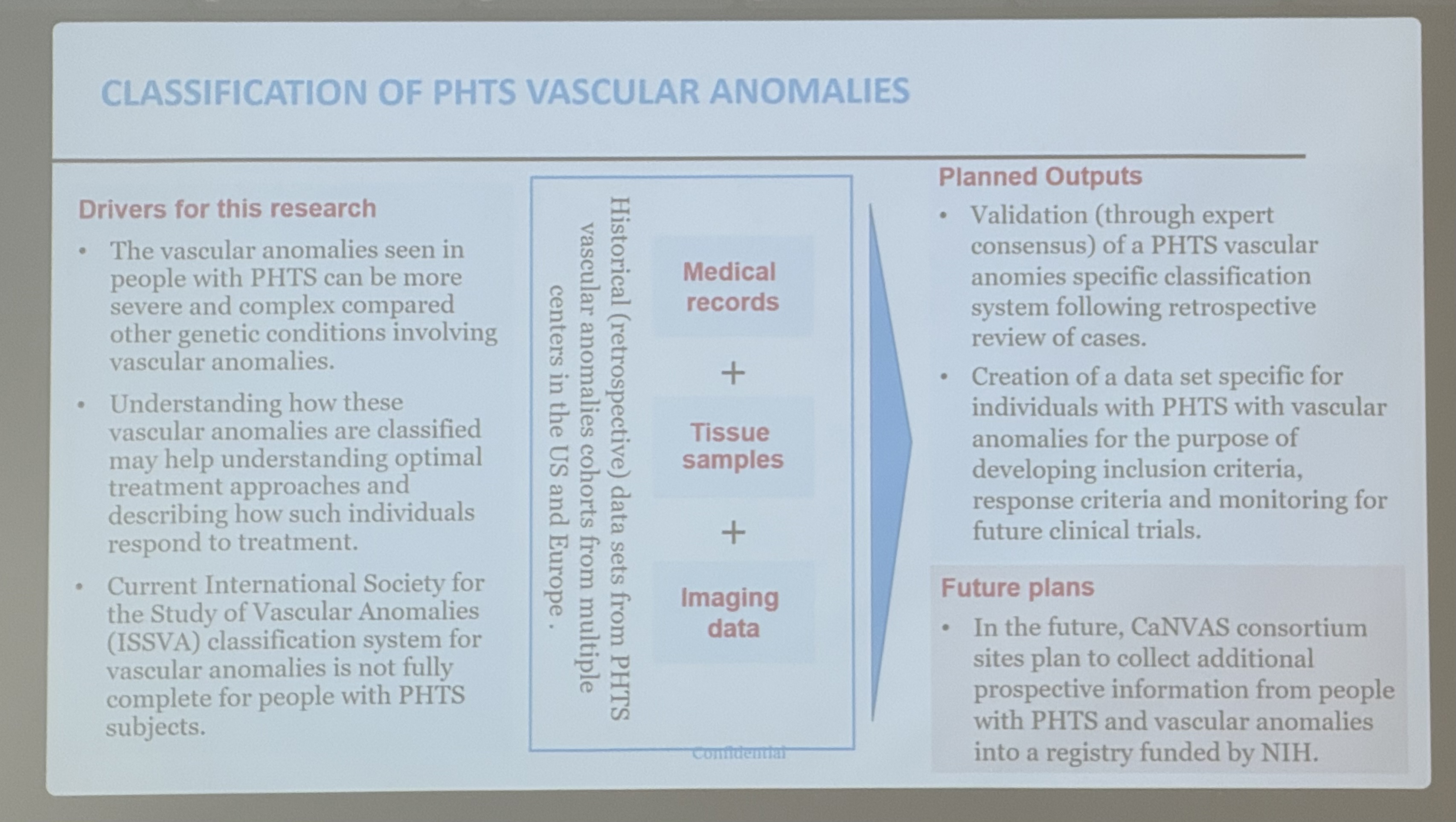
The other one is a research base retrospective of 100 PHTS patients with vascular anomalies.

This girl is the BEST!

Every year prior to this one, I wished I had been at the in person Symposium. I always wished I could have seen and heard the presentations. I hope this helped some of you who were unable to attend.

I wholeheartedly recommend attending in person when you are able and I am grateful that this year I was able to.

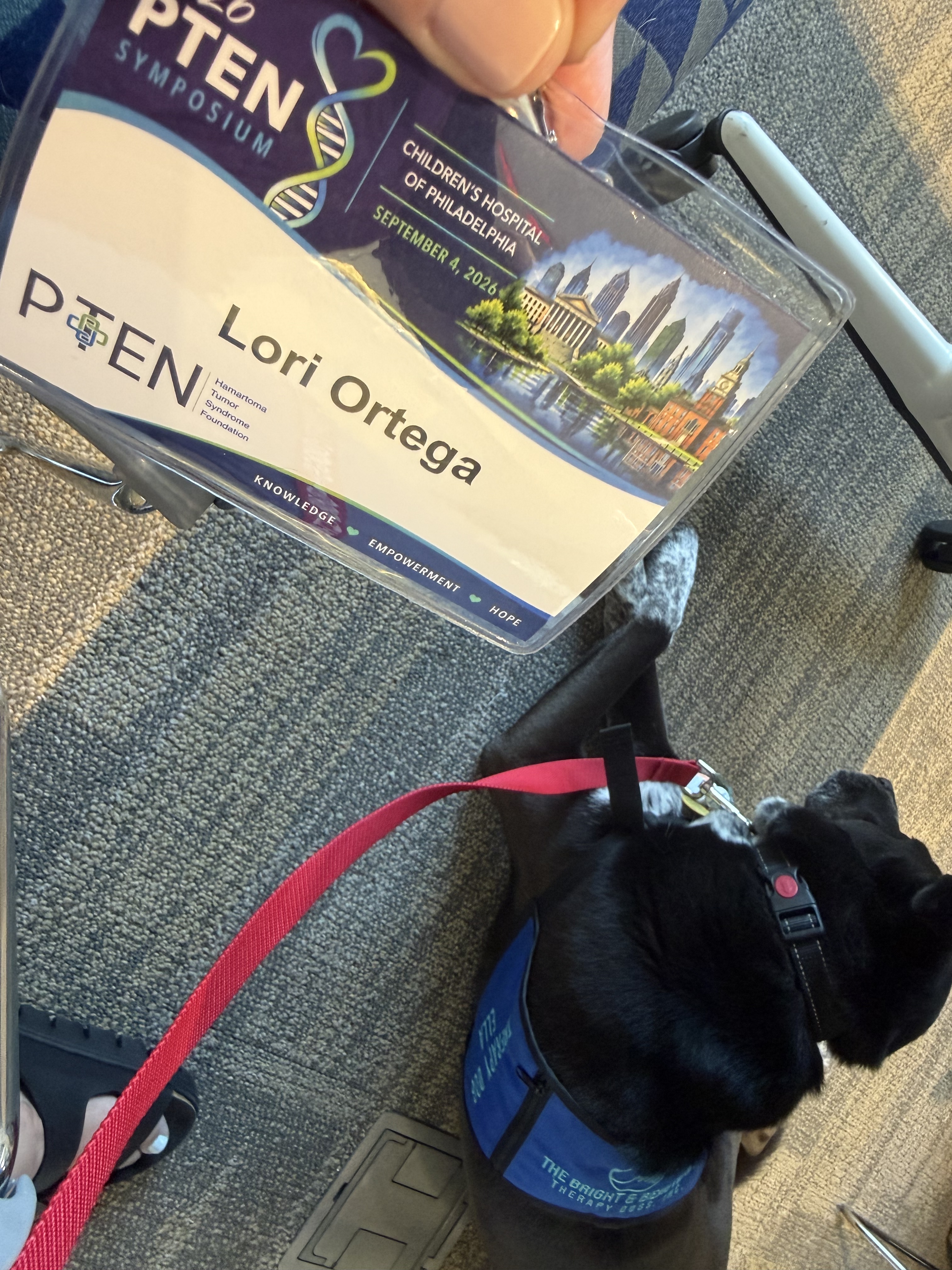
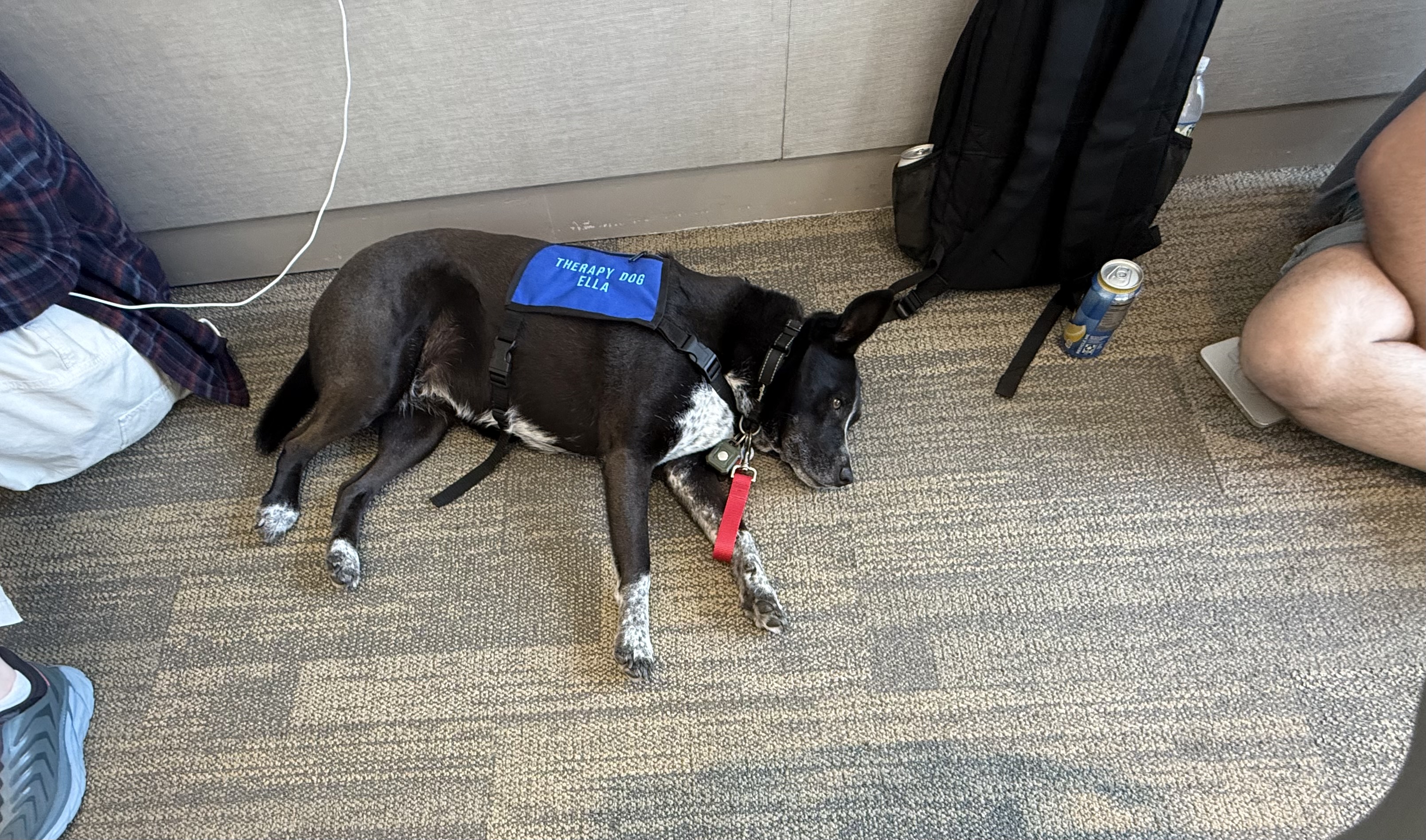
And now, I feel like Ella! So goodnight all.

I am grateful to be

alongside all of you!
Second Chances

We rescued our first dog in November of 2005. Meghan was a toddler. A sick toddler. I was functioning with little sleep and trying to balance being a full time mom of a beautiful, yet painfully unhealthy kiddo, with being a full time elementary school teacher.

We were years away from having the Cowden Syndrome diagnosis on a day when everything changed. Her dad and I had her at another grueling appointment where she was being held down by unsympathetic practitioners and screaming with all she had in her soul. Her dad, desperate to make it stop, said, “What do you want? I’ll get you whatever you want.”

“A happy… yellow… puppy… I want a HAPPY… YELLOW… PUPPY.”

To which her dad said, “OK, you’ll get one,” and I cringed in my soul. I could barely manage the life we had. I had never even owned a dog. But, a promise was a promise, and we started the process of finding a puppy.

I knew nothing about rescues, and in hindsight we definitely took a puppy from a puppy mill, through the guise of a “Petfinder” website.

“Santa” brought Lucky in late November of 2025. In a frenzy we threw the tree up the night before and raced around the night before Thanksgiving (with all of its crazy traffic) to let “Santa” drop Lucky into our living room that November night.

All the joy and chaos of a puppy filled our house and our poor babysitter had her tasks easily double with the terrible twos now multiplied under her care. She was not yellow, but all was forgiven. She was happy, and full of mischief, and Meghan and Lucky bonded forever.

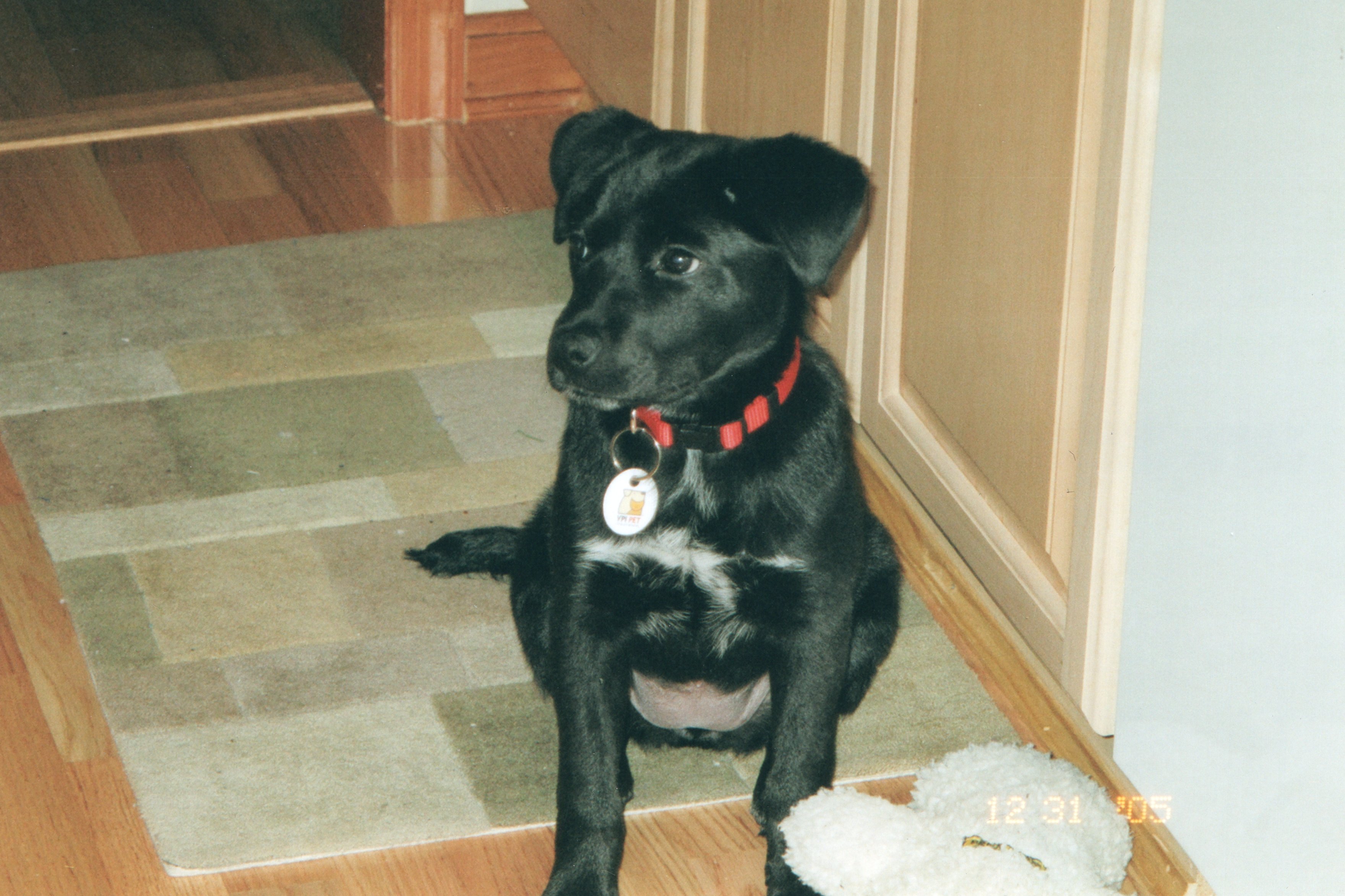
Lucky- December 2005
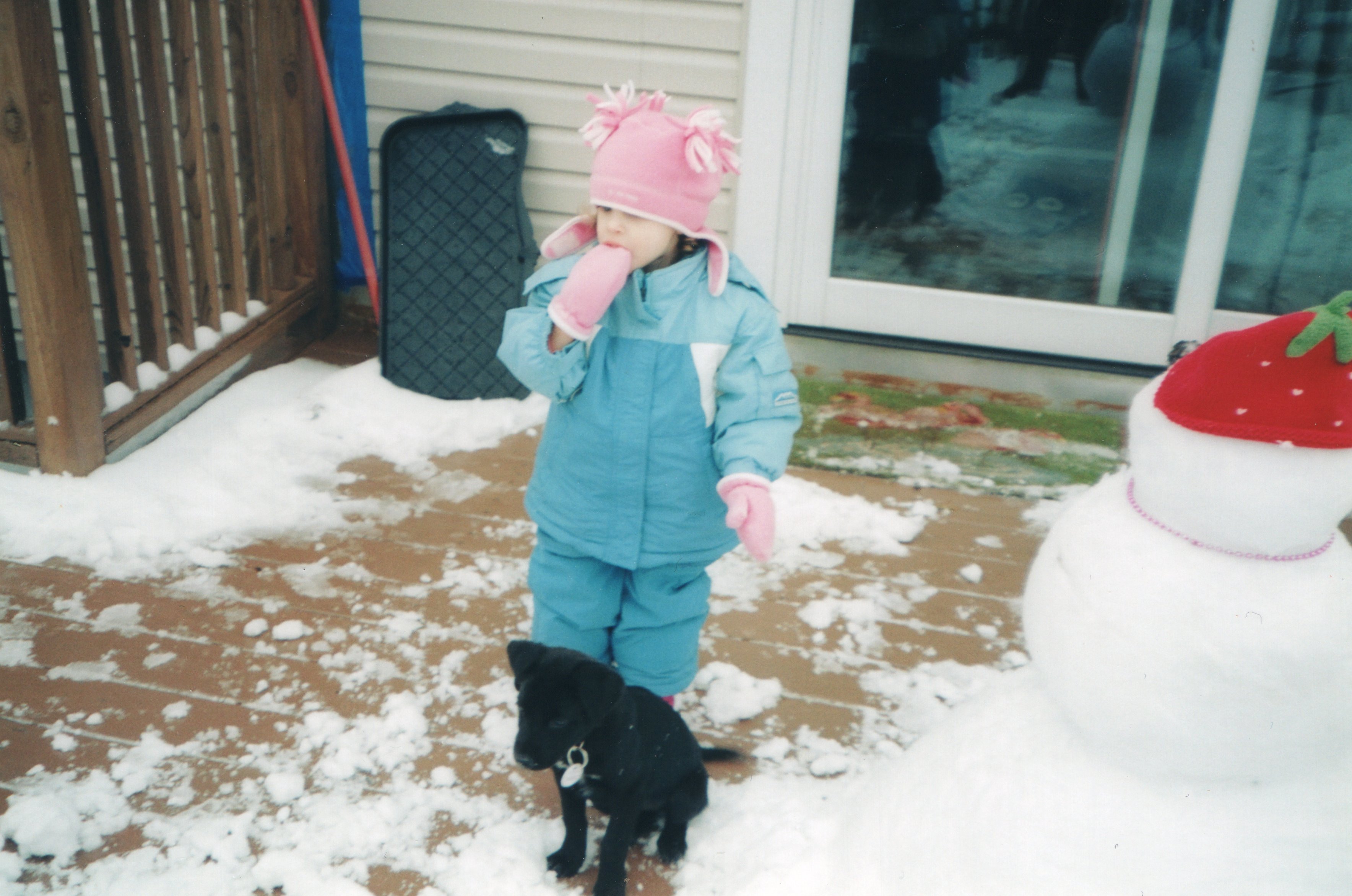
A girl and her first bestie- December 2005

And so from that moment on, there was always a dog, or two, or three in our house. We held onto the stability that despite all the medical chaos in our lives, we loved each other and we loved our dogs. We held it together, three humans and a canine or two or three. We stayed in the same home, and relied heavily on each other.

Decades passed and Allie and April, who never met each other entered our lives from different rescues. We loved them hard. They loved us back.

Top left white dog (clockwise), Angel April, Angel Allie, Angel Lucky, Ella, Buddy and Jax

Life continued and Meghan kept her head up through more medical and emotional trauma than a room full of adults could have endured. The effects became evident only to those who loved her closest through the years, and that is a very tiny list. The abandonment, the need to lessen her own suffering to make those around her feel better, took its toll on her. The anxiety became utterly oppressive. Medical conditions continued to surface. POTS affected her heart rate regularly, the daunting fatigue and nausea were sometimes insurmountable, and the ADHD that would remain undiagnosed until college was starting to surface.

So, it was no surprise in the early part of 2018 that she began to talk about a service dog. I left her to do her own research, uncertain of exactly what having a service dog would entail, but certain it would be complicated and expensive.

After years of rescue dogs, Meghan locked in on Medical Mutts, a rescue to train facility in Indiana. She decided that she did not need a pure breed. She wanted a mutt who had been given a second chance at life, and a renewed purpose, to be the dog that helped her in her darkest hours. I let her take the lead and she interviewed with the facility. She was placed on their list and told the wait time was typically 12-18 months. We were given the cost, and while about half of the charge of a breed-to-train program, the number was a gut punch. Through grace and guidance we applied for grants and were accepted by ECHO, the Emergency Children’s Help Organization local to us. They agreed to fund the dog and our travel to and from Indianapolis.

Now all we had to do was wait.

But, because nothing is without additional agony for Meghan the 18 months became almost 3 years, and it was in the middle of the Covid era, in January of 2021 that we were set to spend 8 days bonding with her new bestie, and preparing them for full public access.

I was teaching remotely at the time, a full class of 4th graders. And while they were eagerly supportive of the trip, planning for a substitute to enter my google classroom was also an adventure. Nothing worth it is easy. So our goals and our journey were so worth it!

Meghan and I set out on the 12 hour drive to Indianapolis, where we met this beautiful, crazy girl. (Our blog from January 2021 has every step in great detail.)

Ella – in the hotel with us. January 2021

Our lives were literally never the same. Ella passed her public access test and proved to be a champion car passenger as we drove the 12 hours back in a snowstorm together!

Ella went on to spend some time in Meghan’s public High School, whenever it was open that crazy spring, with the solid help of the team at Borough Hall and the awesome administration at Curtis HS.

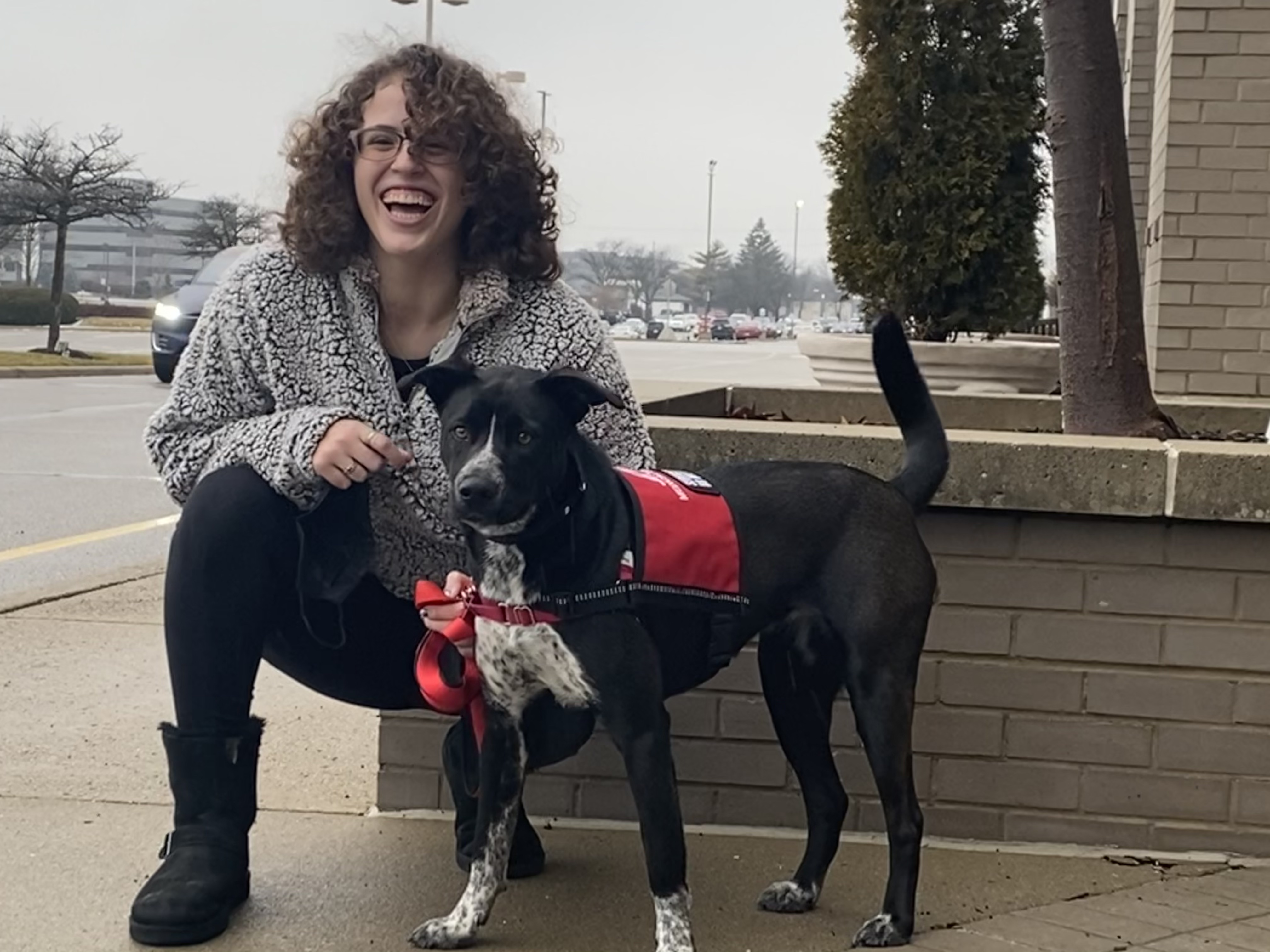
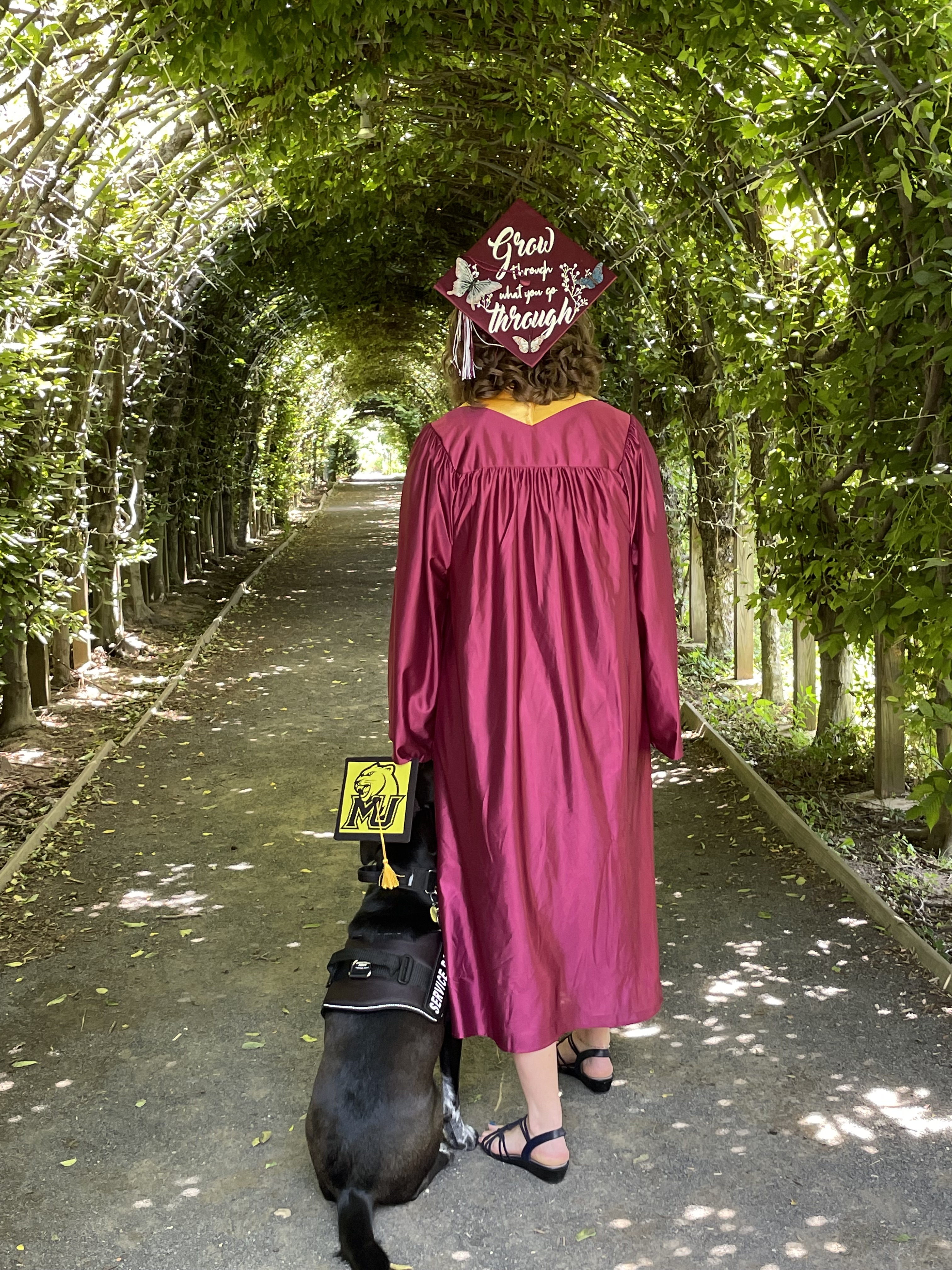
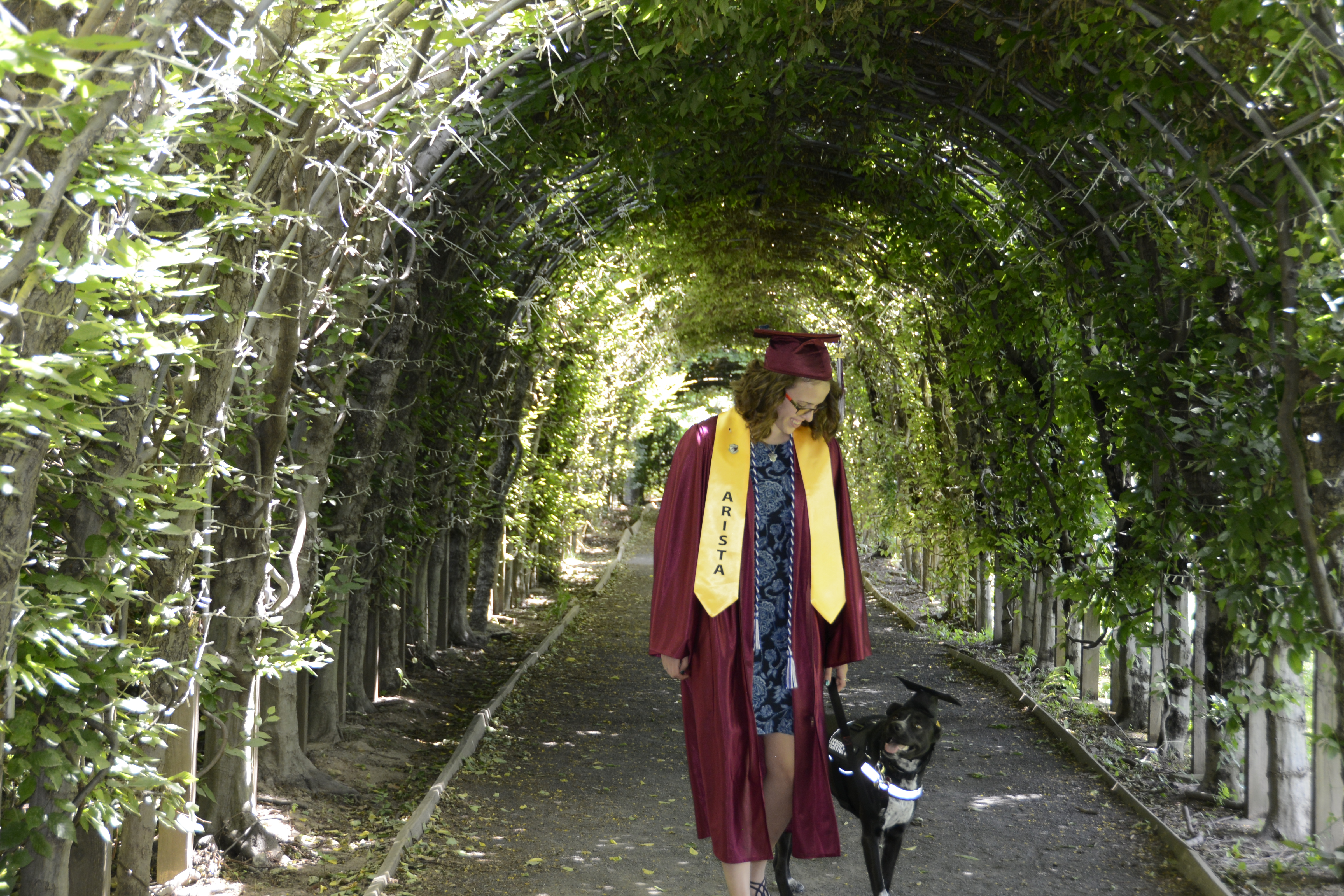
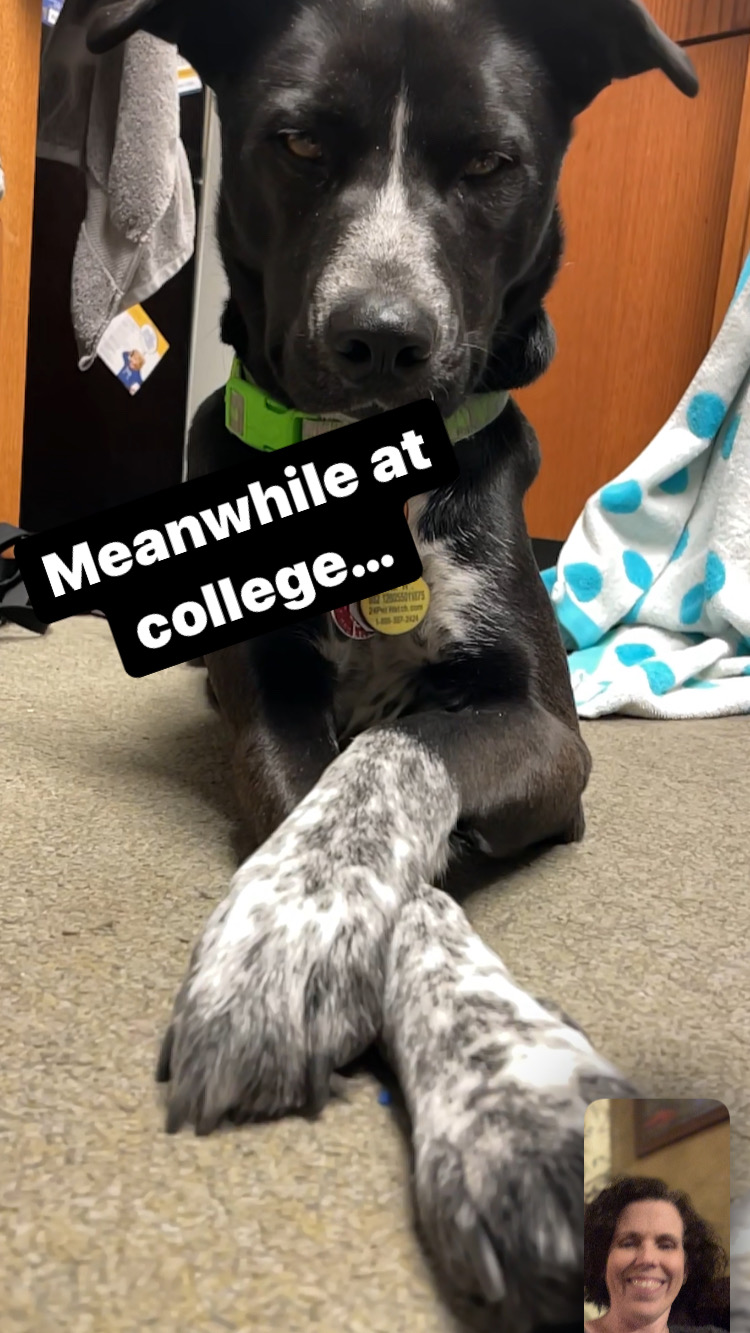
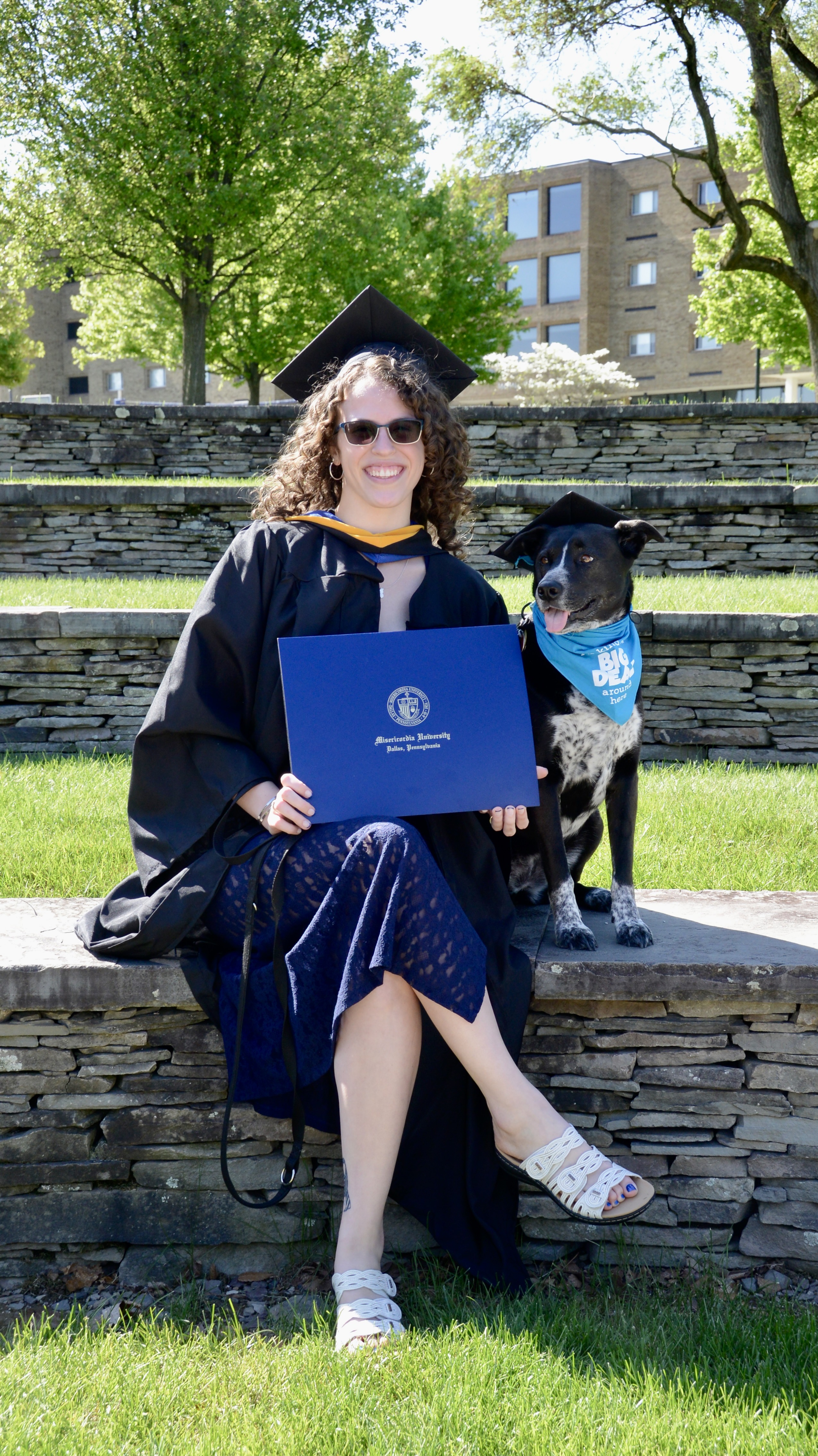
She headed off with her to Misericordia University where they were on the swim team for two years, although Meghan covered the swimming end of that deal. Ella lived with Meghan in the dorms for a few years, and in off campus housing for one, until they finally settled into their own place in the summer of 2024.

College Facetime

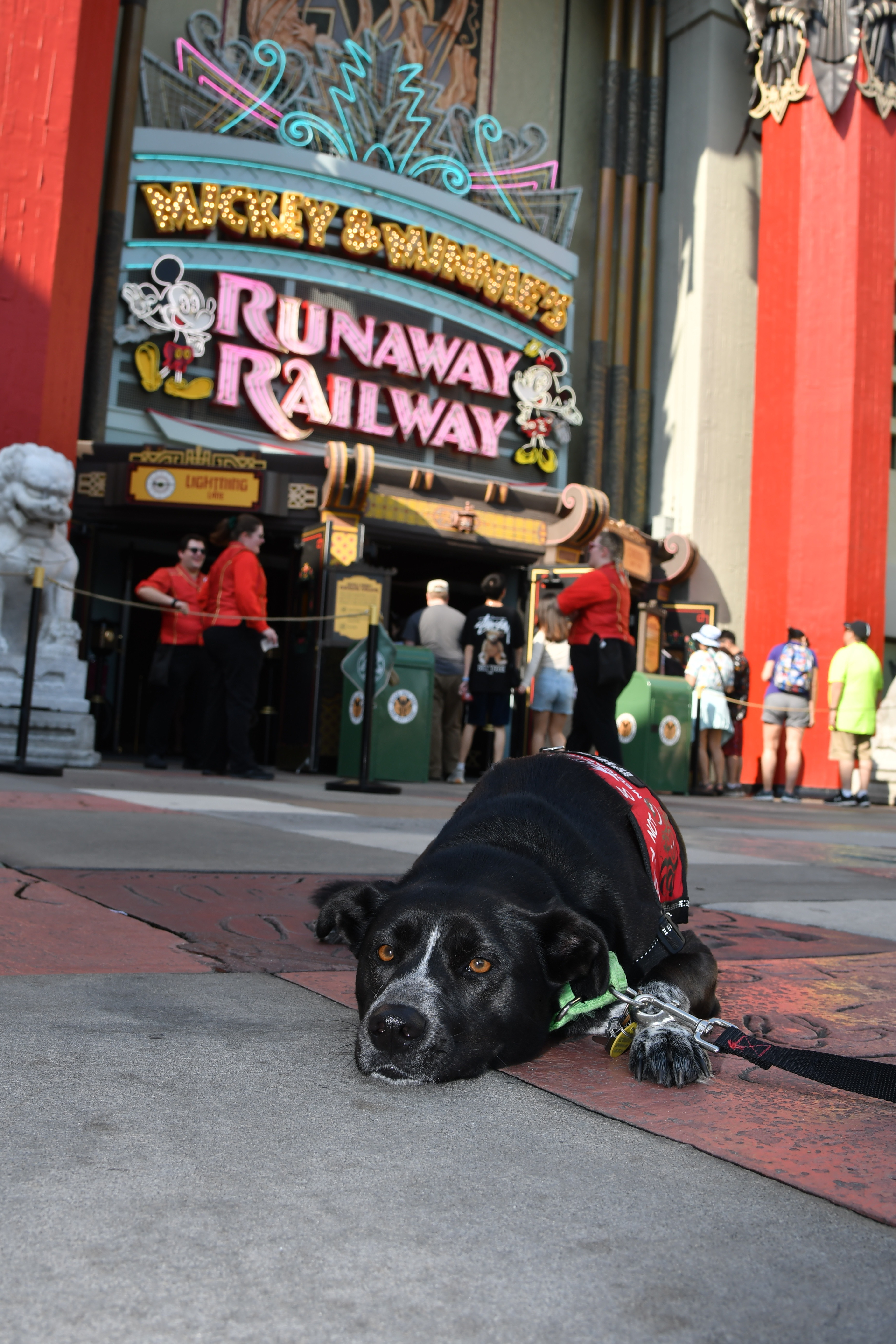
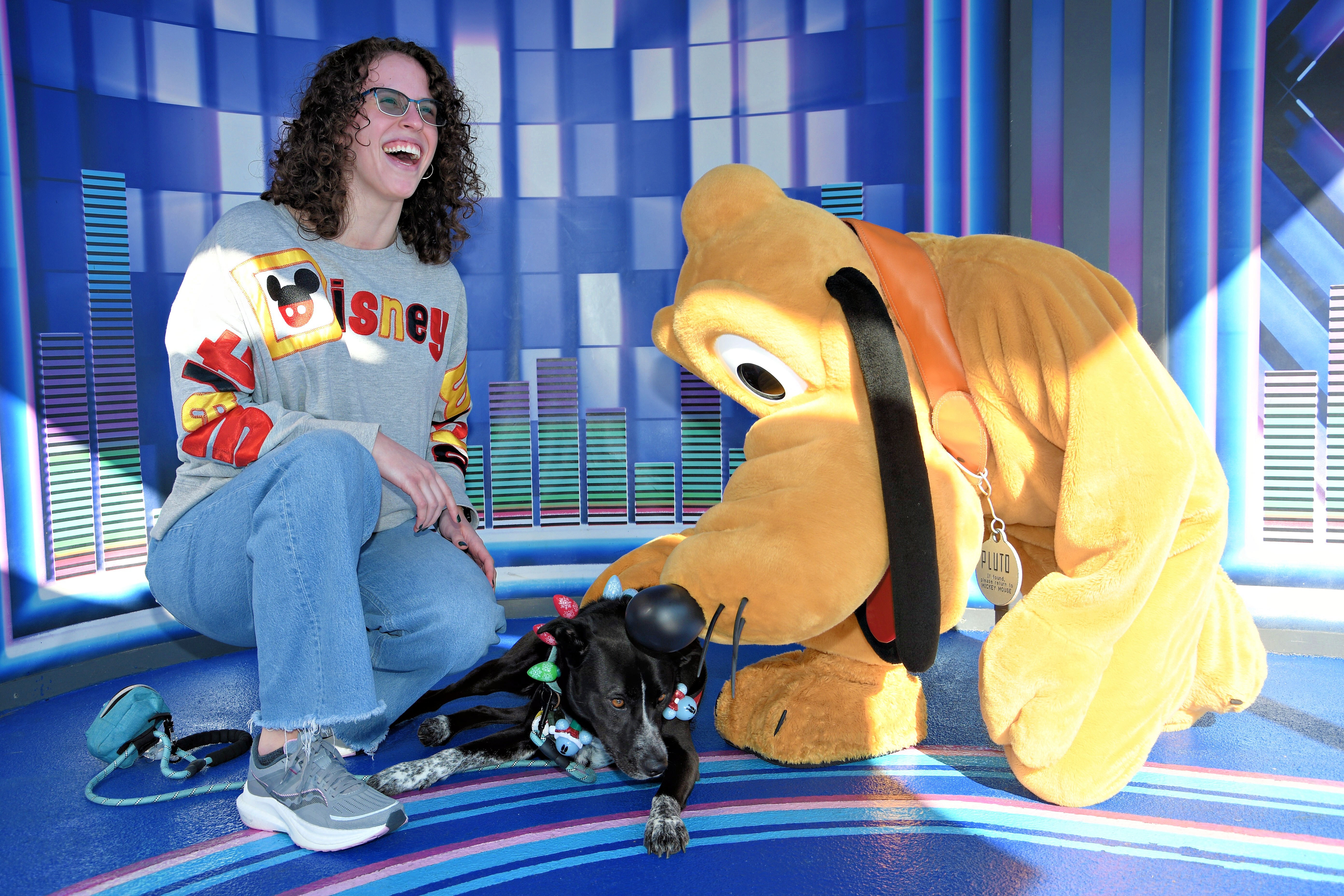
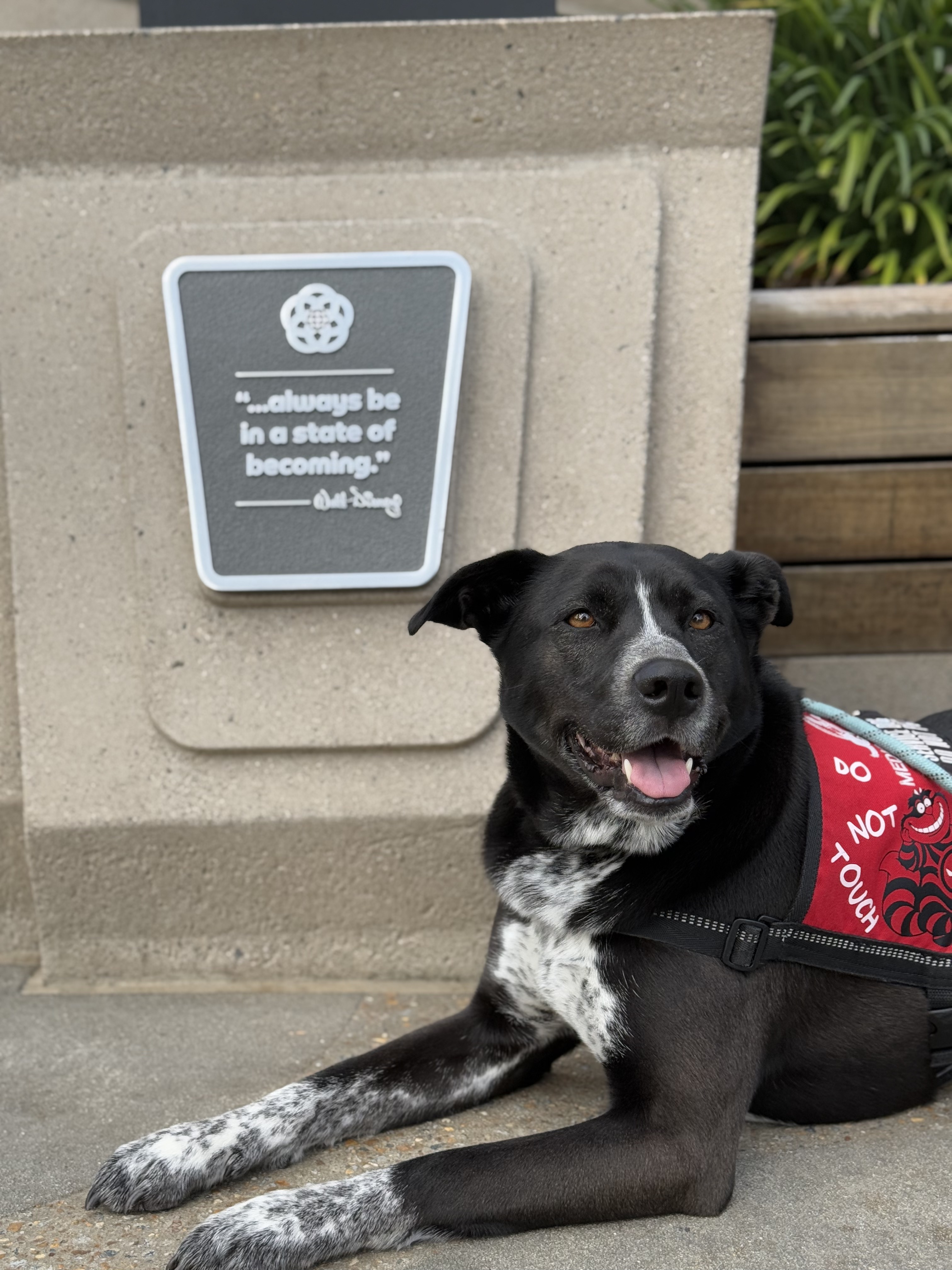
She made a few trips to Disney with us.

Ella became an extension of Meghan. Those college years that were supposed to be so carefree, held challenges we could not have seen coming and left her father and I so thankful for Ella. The vascular tumor that had been festering just up the leg from the AVM in her knee that had repeatedly assaulted her childhood, was making a valiant go at her. It grew up against her sciatic nerve and left her in unspeakable pain.

Medication didn’t help. Sclerotherapy didn’t help. Cryoablation took some of the bulk away for a bit- but it didn’t hold.

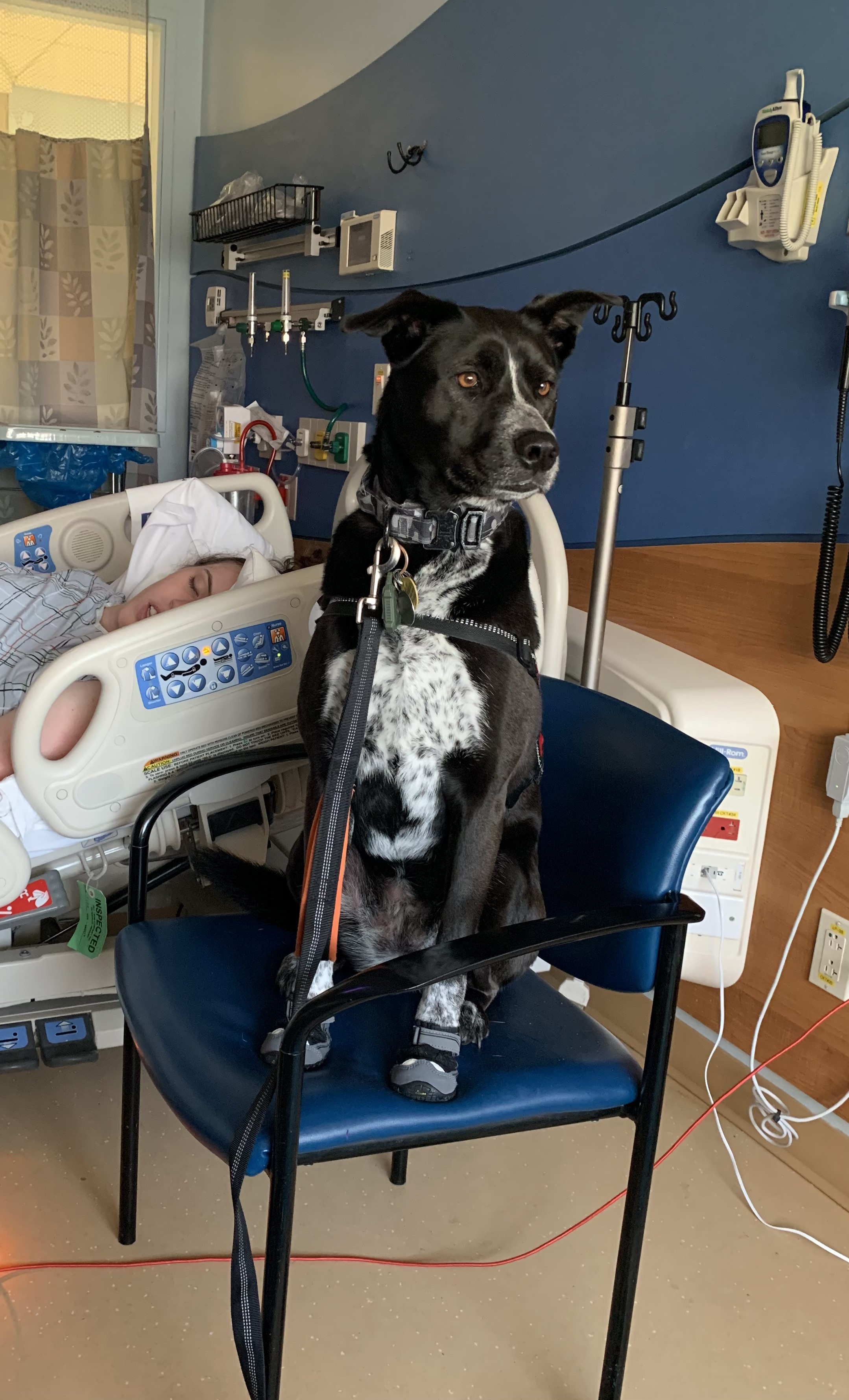
Ella held her together. Ella gave her a reason to get out of bed.

Ella sat by her side in the summer of 2024 when she had the most traumatizing surgery I could have ever imagined to remove 2 square inches of muscle, and that tumor, from her thigh.

Ella never left her side a mere 7 months later when a series of faulty scans forced her into facing her 91% lifetime breast cancer risk with a double mastectomy at the age of 21.

And Ella was by her side a few months later when she graduated with a 3.8 GPA right on time.

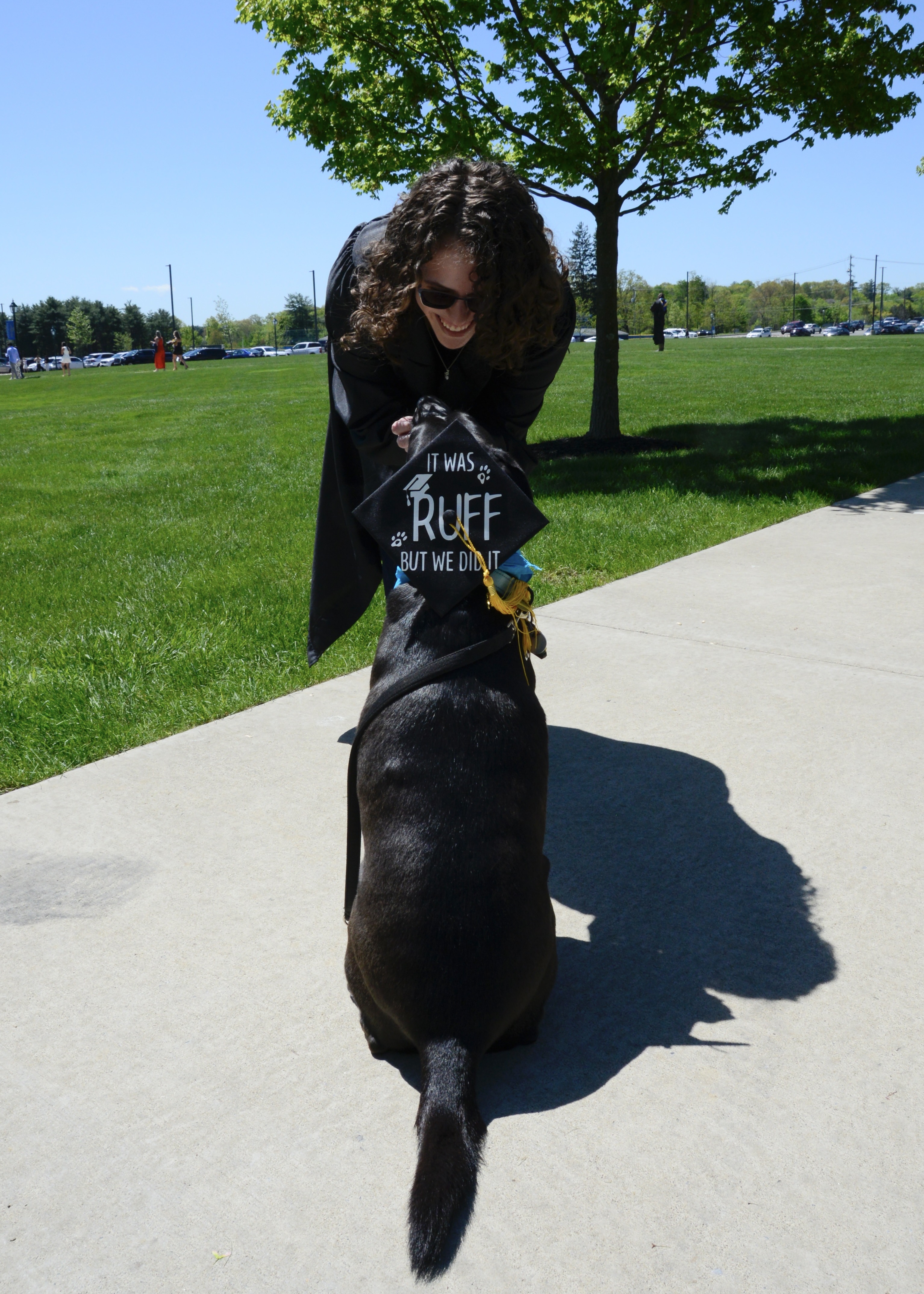
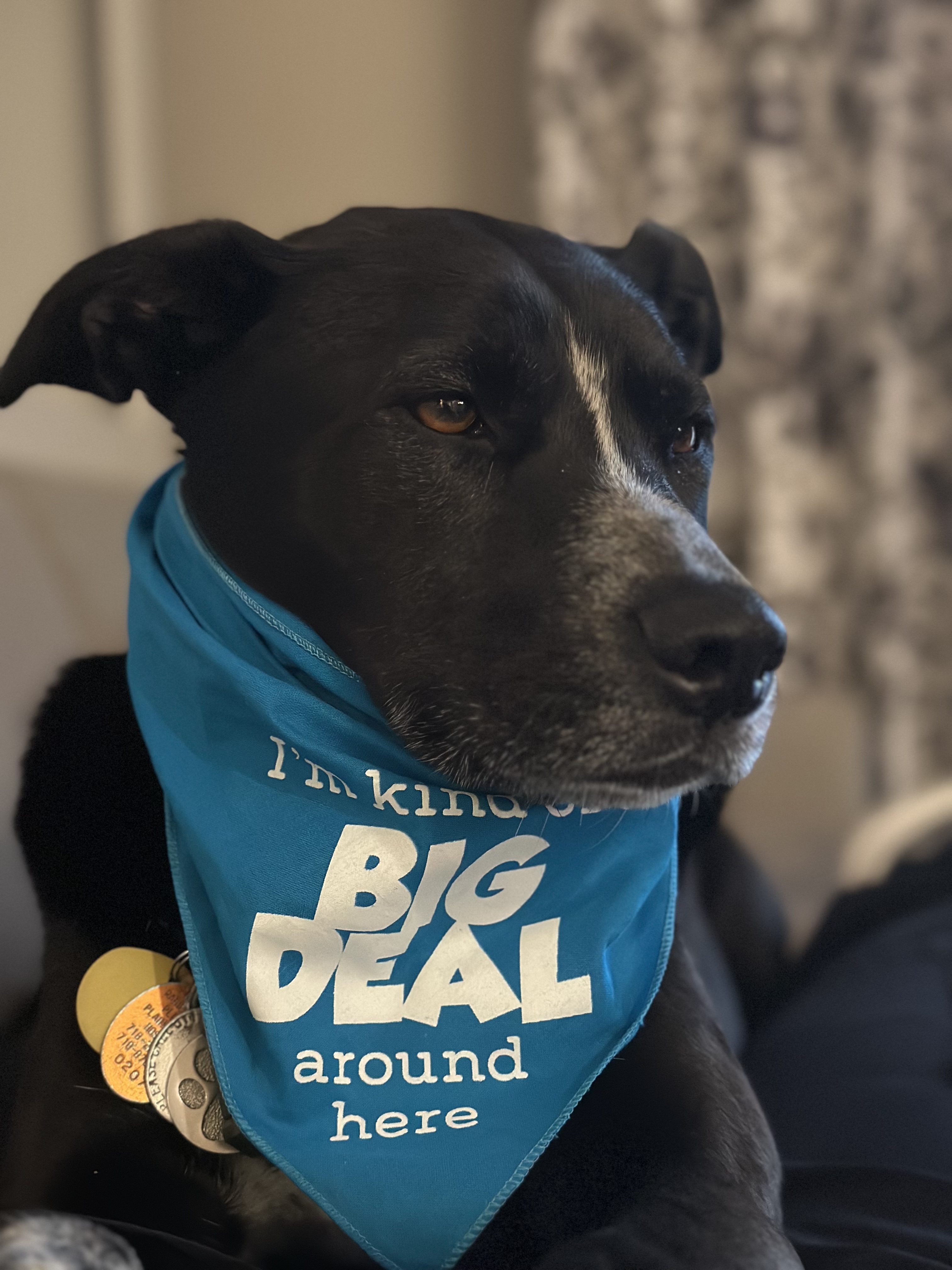
And despite being a little more gray in the whiskers than when she started, Ella remained kind of a “Big Deal.”

The advice that she should likely retire from service work came after an emergency vet visit in April of 2025. She was suffering with some back pain and 10 hour days were getting to be too much. It was not easy at all for Meghan or Ella, yet we spent some time making the transition as fun as we could this summer.

I took Ella to some classes this summer, and met up with Janet, a most remarkable trainer. Ella and I figured out how to work together, and we have been brainstorming ways to keep this brilliant girl busy.

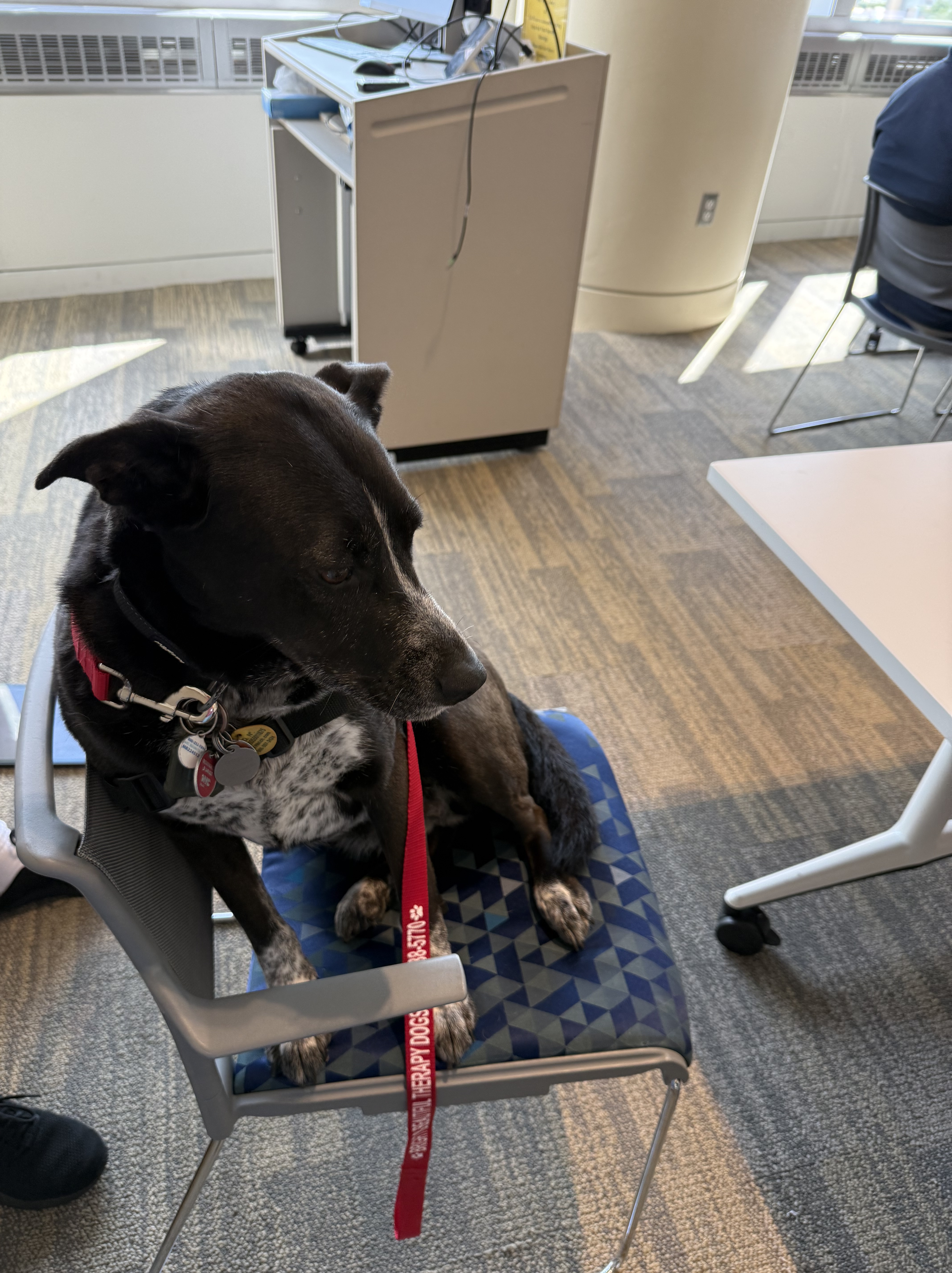
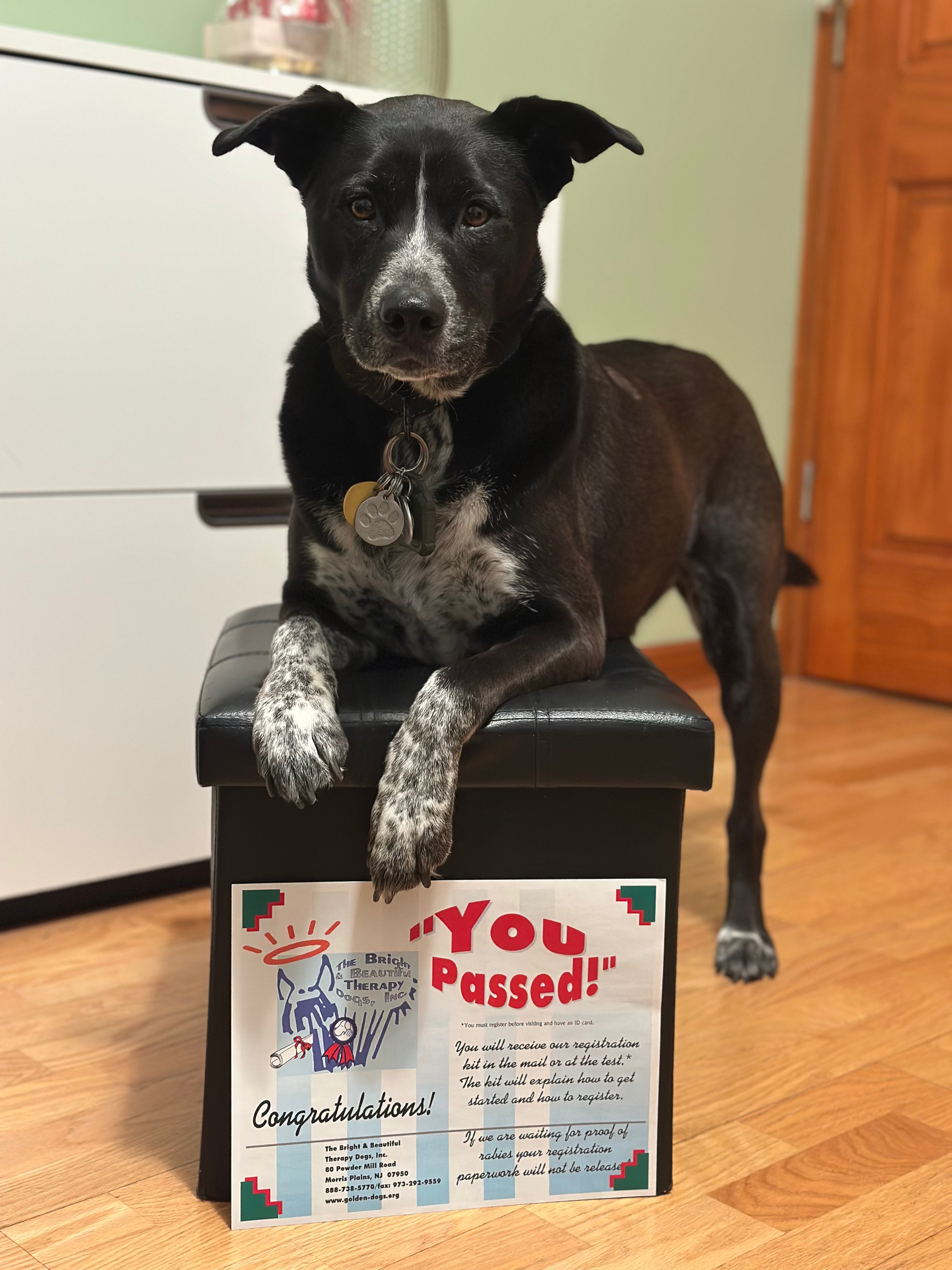
In addition to quality time with her brothers, Ella has become a certified therapy dog, and will begin working this month. We will figure out a slow and steady schedule that suits us both. Her vest will look a little different, and her tasks will have changed, but the goal is still the same. Ella will be making humans lives better, one pet, snuggle, and goofy trick at a time.

This is a story of second chances. This is a story about a shelter dog who became a Service Dog that graduated High School and College, and went on to become a Therapy Dog. This is a story about what happens when we give second chances and look at what someone has to offer instead of judging or dismissing them as “less than.” This is a story of humanity and what we can do for each other when we SEE each other, past the labels that have been slapped on us.

I shudder to wonder what would have been if someone didn’t pluck Ella out of the shelter and believe in her.

It’s why our family is so connected to shelter animals. Our hearts need second chances too.

Maybe that’s the lesson we all need.

Difficult to talk to…

That was the assessment of my sister-in-law, some time in 2004. She told me I was difficult to talk to, and I had no idea how to speak to children. There was a longer story than that, obviously, but her words were in my head today. It’s funny how certain things can stick around for decades. I’m not sure we’ve had a conversation of any length since then.

But, in fairness I don’t speak to too many people. Not because I don’t want to. In fact most of the time I would love to share a (caffeinated) beverage with any number of people. But, I don’t talk too much anymore.

I’ve kind of run out of things to say.

Pop music? Sports? Movies? Actors/ Actresses? Fashion? Influencers? I’ve got nothing. All out. I have NO IDEA.

Politics? I’ve got things that most people don’t want to hear. So that’s out too because I lack the energy to debate morality. And, well, as a chronically ill woman, who has held down a career, and not stunk at it for 29 years, and the mom of a chronically ill woman, who is well on her way to a career in healthcare, I lack the patience or desire to hold my tongue on certain things.

I’ve noticed there are people in life primed for a crisis. They love to help and jump all in until something is fixed. Those are amazing people. We knew a lot of them. We sometimes ARE them. They come in full force in a difficult situation, and then they wait for the issue to resolve so they can move on. They are wired for acute situations. Chronic medical drama requires a set of wiring most people don’t have.

What happens when the crisis rolls into another? What of the tests that have more tests to follow, and scanxiety that leads to procedures and surgeries where we then wait for biopsy results? What happens when multiple body systems get involved at the same time and prevention and survival crash into each other?

Unfixable situations make people uncomfortable. They want to lob well meaning suggestions about “not worrying so much,” or “is all that really necessary?” They want to pretend it’s not happening. They avoid basic questions because the answers make them uncomfortable. They avoid learning more about our rare disease because it is pretty intense.

My 50s have brought me to a place where I have tired of making reality softer to make other people feel better.

We’re not head in the sand people. We are face it head on, be healthy and strong for as long as God fills our lungs with air and of people. And that has meant some chronic string of medical insanity.

PTEN can’t be fixed. It’s a broken gene. It permeates every cell in the body. It is with us forever, with all of its tests, and scans, and tumors, and surgeries, and all the subsequent PTSD from too many hospital stays; and too many incompetent, insensitive, and often uneducated medical professionals.

They decorate the hospitals. For the seasons. I guess it makes sense. But, it always seems kind of odd while we’re there. The decorations help mark time on the calendar and keep us aware of what’s happening in the rest of the world.

I will stand by the fact that I wish they would provide my greatest need – caffeine in a bottle for the coffee averse among us. I cannot commit to a can. If you’ve been in a recovery room, you felt that on some level. I just want a bottle that I can close back up and return to as needed while pretending I care about my Facebook feed or the random game of solitaire I play.

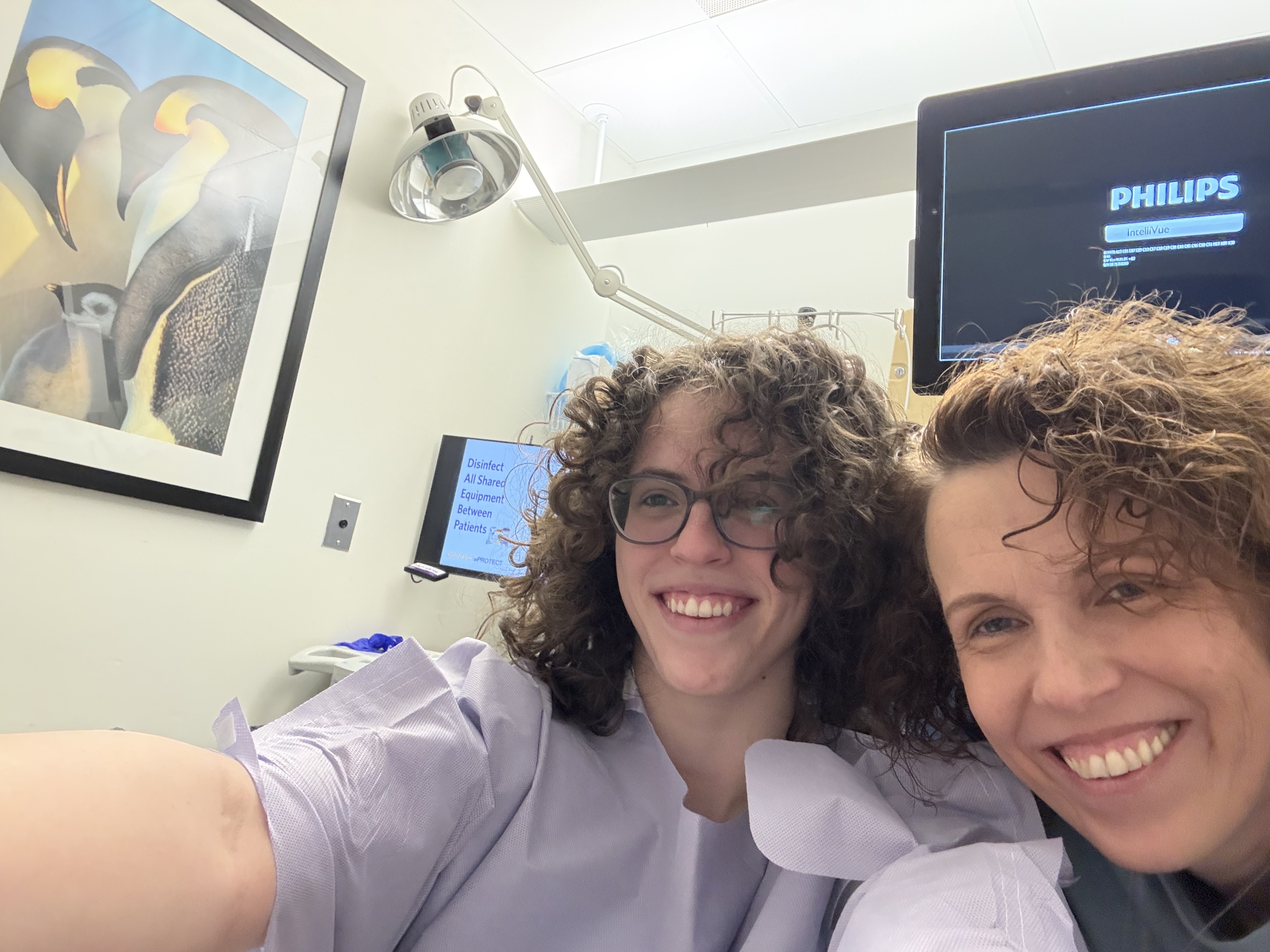
We tend to mark time in pre surgical selfies and waiting room photos. To each their own I guess.

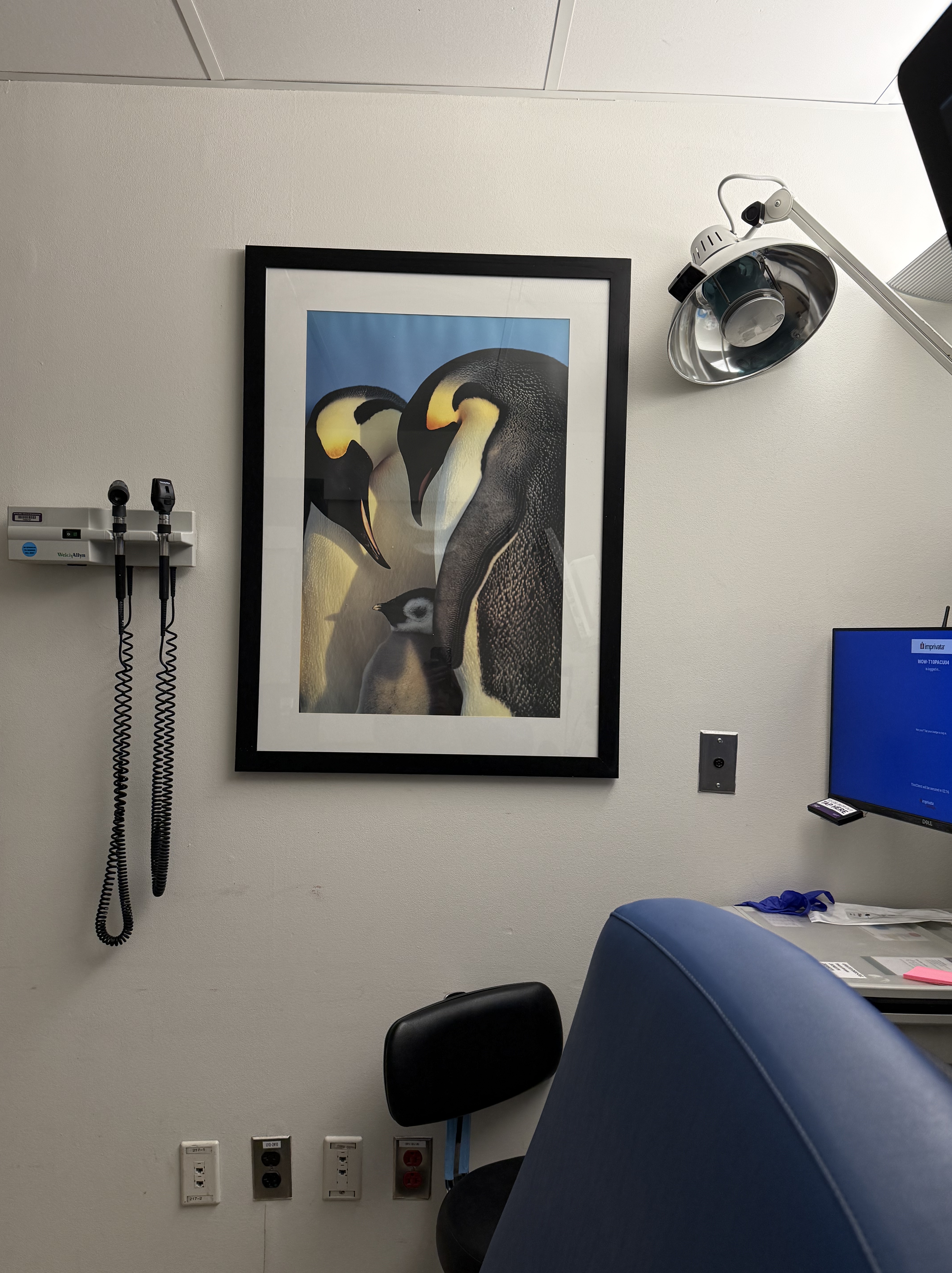
On December 16th we were in a “pre-surgical” room where I recognized the photo on the wall from a stay in 2017. It was 3 penguins. I distinctly remember because it reminded me of our family. That’s a whole new level of weird. And it’s not exactly table conversation.

Every time I think we will get a breath, it gets more intense not less. and I retreat. Into a shell. In my house. Where the act of going outside and pretending I understand a culture that I have not been part of for well over 2 decades is simply too much.

I got invited to dinner yesterday. It was a sincere invitation to a celebration. I couldn’t get out of my own way. The anxiety swallowed me whole.

I promise I’m not wickedly self-absorbed. I actually am a pretty good listener. I am decent at looking involved at tables where I have nothing to contribute.

I’ve become more empathetic as I age.

I know people around me suffer challenges and crises all the time. I sometimes feel guilty taking my own time to deal with the things heavy on my heart. My Grandma was quick to remind me “it could be worse.” She wasn’t wrong.

But, just because it could be worse, doesn’t mean that something doesn’t suck. And just because it sucks doesn’t mean that you get to lie around and freak out. Or hide in your bed and whine for too long.

Because we only get one go round on this earth. And the only way out – is through.

Wishing you health in 2026. Because little matters more.

We remain…

#beatingcowdens

Finding Strength in Struggles: A Mother-Daughter Story #beatingcowdens

They never go away. Your experiences, that is. Our lives are literally made of them. And in all of our lives, some are happy, some are sad, others are joyful, or sometimes traumatic. We can’t change them. The glue that holds us together is how we deal with them.

After I crested 50 I became more introspective. I guess the decades between 2003 and 2023 saw most of my existence in survival mode. I would look at my friends with multiple children and think, “that must be so hard.” And I am sure it was. In a moment I can be full of empathy for anyone in any situation. What I never realized, or thought about, or spent too much time on was that our life was a daily challenge to survive as well.

Comparison is a devil’s tool in my opinion. So, I try my best to leave it alone. And in reality it doesn’t matter how you see someone else’s life or how they see yours. Social media is an illusion, and even this blog is often carefully worded to step over the darkest parts.

I only know my own life. And as my girl has grown, I have more time to reflect, and make changes as I need to. I am learning to give myself grace, to focus on my strengths and to set limits. I get tired. And allowing myself to feel that sometimes is a big step.

However, life is about balance. And negative speak drives me wild. I’m not one who likes to say things that are untrue, but I push to find the best in anything. Sometimes I fail. Mostly I succeed. Always, I try.

I spent decades holding myself together with superglue. And it gave me perspective and gratitude that allow me to be alone with myself a great deal, and still have peace.

We only get one go round on this earth, we might as well make the best of it. This earth is far from all I have, and I live with joyful anticipation of heaven, whenever God sees fit to take me from here. But, while I am here…

I am full of gratitude for my husband of 25 years. He is often the unspoken hero in our Cowden Syndrome tale. He has done more behind the scenes work to keep us afloat than anyone besides me knows, and he prefers it that way. The fact that we not only love each other after this many years, but we also still LIKE each other, well, that is everything. We share goals and hopes and dreams. And we share our love and respect for our feisty young woman.

I am grateful for survival. I am not sure why I was fortunate enough that my breast cancer was caught so early that I required no treatment beyond my surgery. But, in this pink washed month I am reminded of those who were not so fortunate. I am reminded of the wonders of modern medicine. I never forget the doctor who diagnosed our PTEN mutation, and the urgency with which he spoke to me, telling me of the cancer risks that “peak right around 40.” I am thankful that my daughter’s breast changes were found at such an early age, and that her screenings began when they did. I am amazed at her strength as she chose to get in front of her virtually inevitable breast cancer risk.

I have a hard time fitting in in groups. It’s not because I don’t like people. It is because a lifetime of a complex medical history, a daughter with a complex medical history and a rare disease diagnosis left little time for hobbies. I cannot relate to people too easily. My girl’s youth was definitely not “typical” of today’s world, and truthfully I don’t fully understand a lot of this world. It’s not necessarily a better/ worse situation as much as it is a very different existence.

Medical trauma is real. That I know for sure. I am exhausted. I am forever changed. But, I’m not mad about it. It just is. Like I said before, you get one go round on this earth. You get one body to work with. You do the best you can with the one you have. If you know you know, but if you don’t that’s actually better for you. It makes me happy, albeit confused, when I have to remember that there are people my own age that have never had, a single surgery, an MRI, a CT scan, etc. It doesn’t mean their life was easy. But, it does mean perhaps that we use a different brand of superglue to keep ourselves together.

Meghan calls me from her Physician Associate program in PA often. We talk several times a day and text throughout. Maybe that’s a mother/ daughter thing, but I don’t think so. I think it’s a friendship that has been forged by a similar life philosophy and work ethic. I think it is a product of our shared experiences, and the desire to make the best out of the lives we have. I know she makes me better. A better mom, a better teacher, and a generally better human. I think I do the same for her.

For a while I wondered if it wasn’t good for her to be this close to me. Now I know that’s nonsense. I think we all seek people who “get” us, and situations where we can be real. It’s not a place where any of us can live 24/7. We have to survive in the real world, meeting people from a vast variety of experiences where they are. But, I like being her landing spot, a place she always knows is ready for her, and a place where she is secure enough to be herself.

I am unapologetically proud of my daughter. My heart bursts when she explains how she works to do better, and to be better. She fully understands that we all are a work in progress, and she actively focuses on understanding her own strengths and weaknesses. She is a realist. She is honest. She is driven. She is tenacious. She never quits. She tucks and rolls through adversity like it is her job. (And, well, maybe it has been.) She is compassionate in a way that blows my mind.

She is so compassionate that at one of the most vulnerable junctures in her life, she parted with her own superglue, her service dog Ella, so that Ella could have a better life. Ella and she grew up together in college. Ella sat through classes, and exams, and up and down moments in Meghan’s day to day life. And, when things weren’t quite right with Ella and her overall well-being, my girl put HER girl first. Ella is retired now, living comfortably with us and her two furry brothers. Meghan soldiers on without her bestie by her side. She is forming her own superglue from within the cells of her rare and spectacular self.

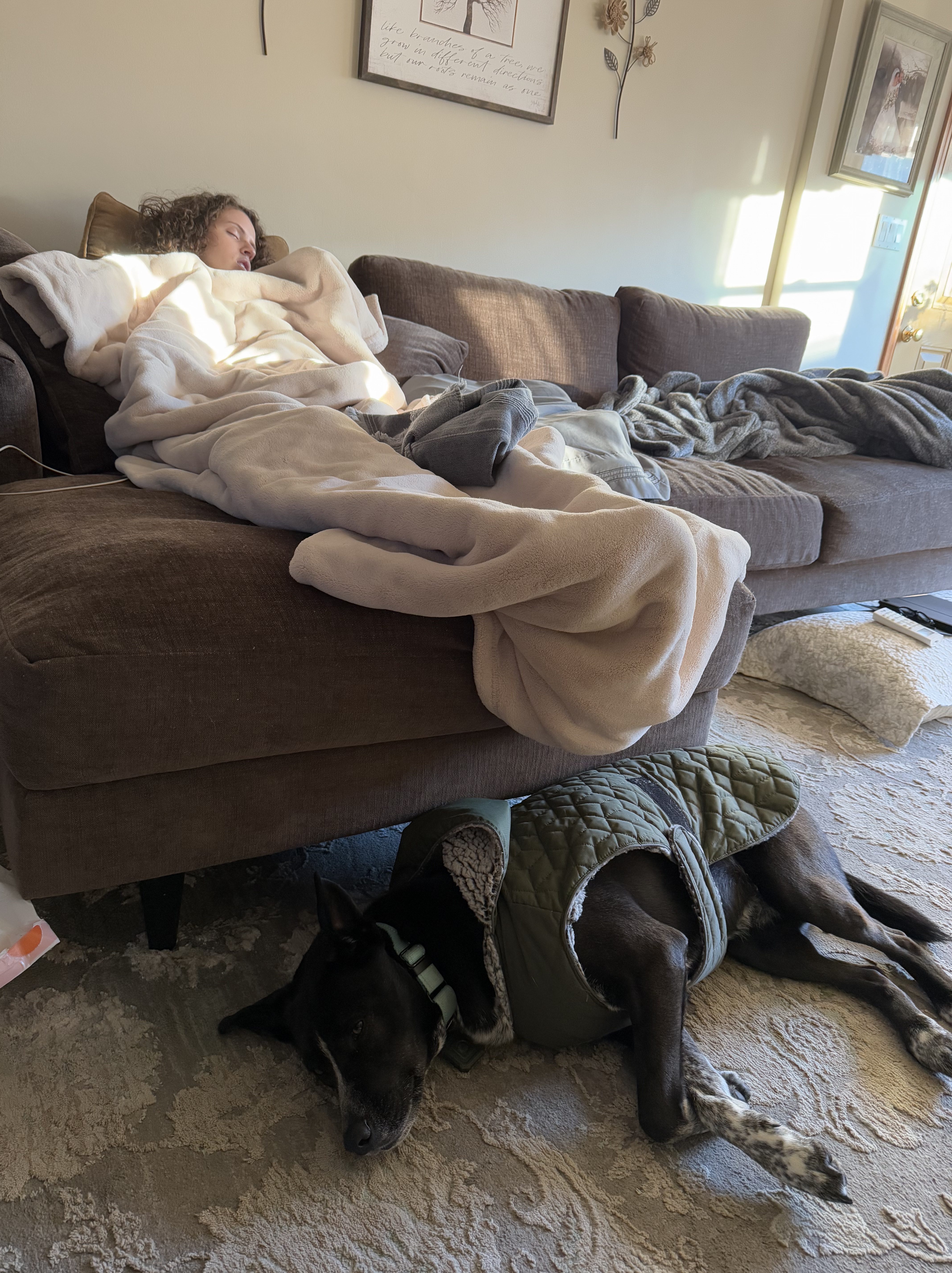
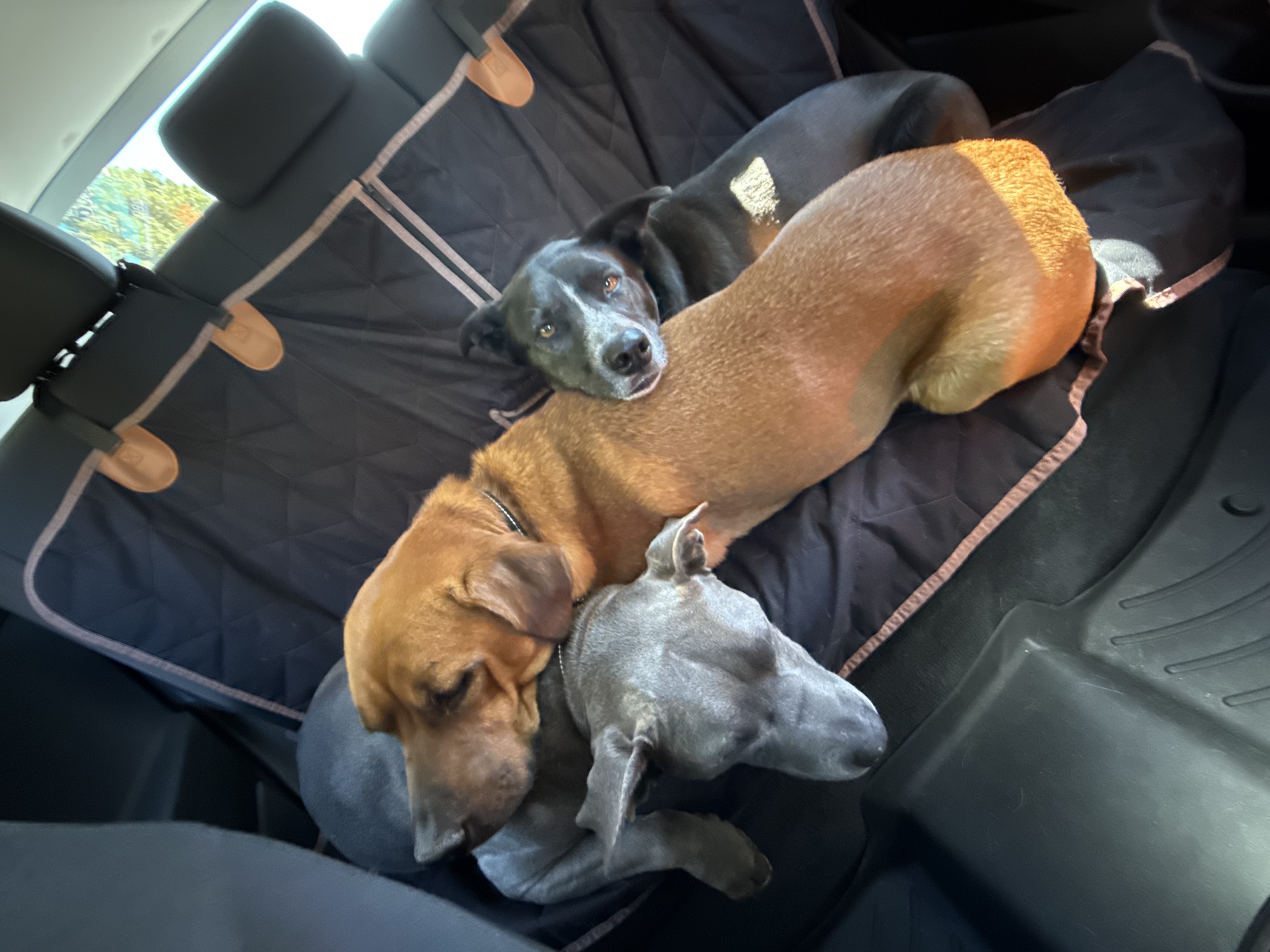
The three furry siblings on the way home from visiting Meghan.

Recently we took Ella for a “Retirement” photo shoot. Natalie https://natalielicinicreative.com captured the love these two have for each other in a most magical way.

Photo Credit https://www.facebook.com/NatalieLiciniCreative

If you’ve read this far, thank you. I started this blog over 10 years ago to chronicle our journey. And I have not reread a single post. I have worked so hard pressing forward, and sharing our story in the event it could help someone else, that there has been no time to look back. In truth, there’s not point. We’re not going that way anyway. So from wherever the 285K plus hits on this blog have come, thank you.

In fact, as I reflect, blogging has kept me sane. Putting my thoughts together helps cleanse my crowded head and focus myself on the important things. And I think, being able to focus on what matters, is in fact my own superglue.

Just Let Me Know if I Can Do Anything….

Spoiler alert…

If they are messed up enough from something, a loss, a trauma, or literally ANYTHING that prompts you to ask that question, they are likely INCAPABLE of figuring out what they need, let alone asking you to do it.

My advice to you – SHOW UP.

My further advice is if you are not prepared to listen, sometimes to heavy things, or if you are not prepared to leave your judgment behind, and support them, KEEP GOING. When you offer to do ANYTHING, many times it will not be a THING. Many times it will be letting them talk out their pain, anger, grief, recovery, fear, difficult decision…etc.

But if you truly want to show up, and are prepared that they may actually reply in a way that requires you to do so, then I offer these examples of showing up in increasing levels of challenging in case you like to start small:

*When you are checking on someone, whenever possible, check DIRECTLY on them. Use their own cell phone. Text them. Call them. Checking on someone by proxy may be easier for you, but it’s not helpful to the person suffering.

  • Text. Even If you don’t know what to say. Text anyway. There a million cute emojis that can signal to a human that they are on your mind. Don’t assume they know. Again, if you were prompted to make the statement above, they are in a whirlwind of pain. They literally can’t tell you what they need. Except knowing you’re thinking of them helps. And they can’t know without you reaching out because they are not psychic. One. Single. Emoji. Counts.
  • Text words. Even if you don’t know what to say, but you are more daring than the emoji only suggestion above, use words. Simple words. I’m thinking of you. I hope you see a pretty flower today. You are loved. Or any variation of the above.
  • Text invitations for them. This gets a little trickier because you may have to try a few times. But, “Hey, I’m free for a few, do you want to vent?” Or “Feel like chatting? I can call.” Or, if you live close, “I’d love to pick you up and take you for an ice cream, cup of coffee, loud scream in the park, swing on the swings….” etc. are all good suggestions. These invitations make someone feel valuable, and not pressured. They make them feel like they are on your mind and worth your time. They are currently doubting this while feeling like they are “too much” for human contact and worried that they will drag you down into their abyss.
  • Call them. Now to some this is terrifying, but here is a spoiler alert. Cell phones make it easy to bypass calls that come at difficult times. So if you call them, and they can’t talk, leave them a voicemail telling them they are on your mind, and invite them to call or text you. Hearing your voice may be just what they need.
  • Offer to meet them. Doing something they like. On terms that are good for both of you. Maybe a walk in the park. (Someone did that for me last week and it was so amazingly helpful. 🙂 )Anything that no one feels cornered by works
  • Stop by. Yep, it might seem freaky in this age of minimal contact, but try it. Showing up in person to just sit with someone in their pain is amazingly therapeutic, and might make you feel good too. And when you stop by, be content to sit in a messy, chaotic space and need only a glass of water.

They likely do not want an opinion or a suggestion, or a platitude. If you feel compelled to give those… you may want to refer to paragraph 4 above the picture.

They may never choose to offload their burden, or they may do it repeatedly. I have found once you allow the “elephant” to sit in the room with you, and you acknowledge it is there it becomes an understood, albeit unwanted guest. But only once you have offered that “elephant” a spot in the room, and acknowledged that you see it, can things move forward. At that point, topics change for a time, and sometimes people even laugh. It’s incredible. And when the person needs you again it is so much easier, because they know the “elephant” a bit. They know it is there. No one needs to start from zero again.

If you have truly decided to show up, then whatever way you decide to show up. Do it. Don’t make yourself feel better by saying “I didn’t want to bother them.” They’re bothered. Their life is in turmoil. Your caring will not make them feel worse. I can almost guarantee it.

The older I get the less I understand social dynamics, and the more of a recluse I become.

I am pretty in touch with real life. I am totally aware that other people have epic chaos in their lives. As a matter of fact I would dare to say, when given the chance, I am a pretty good listener. To be honest, I enjoy the opportunity to listen because it means someone cares enough to share their life with me. But chronic illnesses are, well, CHRONIC. Genetic disorders are FOREVER. And I am finding that people, the same ones who can be so supportive in the moment, experience fatigue over the CHRONIC nature of Cowden’s Syndrome. I mean, there’s a pretty good chance every time you speak to Meghan or I there is a new chapter in the life of medical drama.

Sometimes we want to talk about it. Sometimes we want to ignore it. Sometimes we want to sit under a table in a dark room and cry. Sometimes we want to scream. Sometimes we are sad. Sometimes we are scared. Sometimes it’s an ugly combination of all of the above.

Most of the time we feel lonely and isolated.

Yet, we dust off and keep moving forward. Not in a quest for a medal or accolades, but with the fervent desire to do what we can to live the life we’ve been given to the best of our ability in these often faulty bodies.

A screening scan in August that was less than stellar tipped off a lengthy week in October that will bridge to another surgery for Meghan in January.

One day soon we will share more about it.

But for today I will leave this here…

Whether you are reading this because you know us, or this found its way into your path because you have someone in your life to whom you have said “Just let me know if I can do anything…,” please show up for them. In some way, shape, or form, show up.

I hate a lot of things about cell phones. I love the ease with which we can show up for each other.

Never in the history of text messaging have I seen or heard of someone who felt angry or sad that someone checked in on them.

In this age of disconnectedness… SHOW UP….